
Hidden Step Fall Claims at Florida Restaurants and Bars
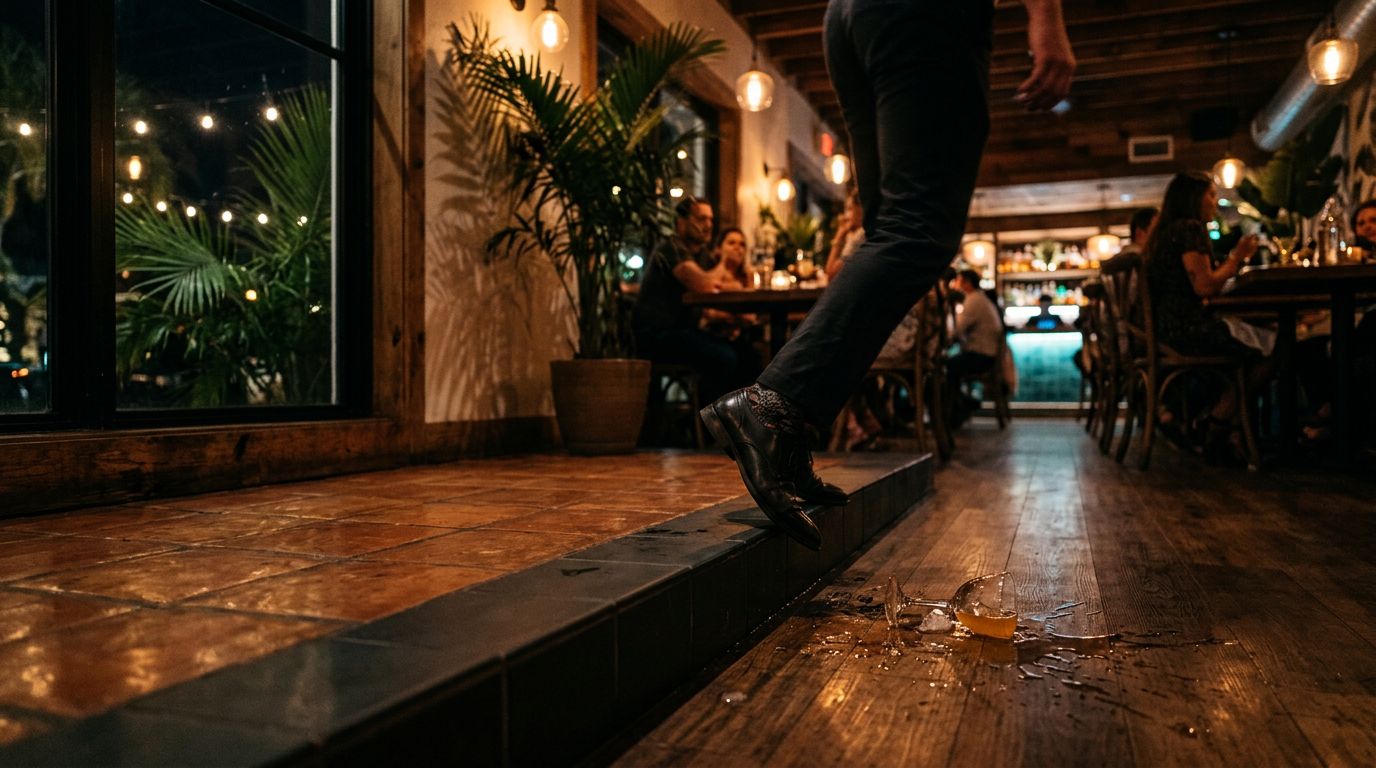
A hidden step can turn a normal night out into a painful injury in seconds. In Florida restaurants and bars, these falls often happen because a drop-off blends into the floor, sits in poor light, or lacks any warning at all.
The hard part is that the fall itself is only the start. To make a hidden step fall claim work, you need proof that the step was unsafe, that the business should have addressed it, and that the fall caused real harm.
Why hidden steps are so dangerous in restaurants and bars
Restaurants and bars use levels, ramps, booth platforms, patios, and narrow entrances all the time. Those design choices are common, but they can become dangerous when guests cannot tell where one surface ends and another begins.
A step is easy to miss when it blends with the floor. Dark tile, busy patterns, low lighting, and crowded seating can hide the change in height. In a noisy room, people also move faster and pay less attention to the floor.
Common problem spots include:
- step-downs into dining areas
- sunken booths or lounge sections
- entrance steps near glass doors
- patio thresholds and curb-like changes
- ramps or transitions that are not marked well
A small height change can cause a major fall. The result is often a wrist fracture, knee injury, back strain, or a head injury. Even a short drop can send someone forward without enough time to brace.
That is why these cases are not about the size of the step. They are about whether a customer had a fair chance to see it before the fall happened.
What Florida law looks at in a hidden step case
Florida business owners must keep their property reasonably safe for guests. That duty includes warning people about hazards they are unlikely to notice. A hidden step is a classic example when the danger is not clear to an ordinary customer.
For a business fall claim, Florida law often turns on actual or constructive knowledge. In plain terms, that means the restaurant or bar knew about the condition, or should have known about it because it existed long enough or happened often enough.
You can read more about that duty in our Florida premises liability duty of care guide.
A step that blends into the floor may look harmless to staff, but it can be a trap for a guest who has never been there before.
The key issue is notice. If the business placed the step where customers would not expect it, then the owner should have used signs, lighting, contrast paint, or another clear warning. If the step was already known to be a problem, the business had an even stronger reason to fix it.
Florida courts also look at the facts around the fall. Was the area crowded? Was the lighting dim? Did the floor color match the step? Was the step in a place where people naturally walked while looking ahead, not down? Those details matter because they show how easy the hazard was to miss.
Warning signs that a step was not marked properly
A claim gets stronger when the dangerous change in level was hard to see. Restaurants and bars often try to defend these cases by saying the step was visible or the guest should have been careful. That defense gets weaker when the property itself gives people little chance to avoid the fall.
Watch for these warning failures:
- no paint, tape, or bright edge marking
- no sign telling guests about the step
- poor lighting near the change in floor level
- flooring that matches the step and hides the edge
- furniture or decor that blocks the view
- a layout that makes the step look like a flat surface
One clue often stands out. If you can miss the step while walking normally, the business may have created an unsafe condition. A guest should not need to study the floor like a road map before reaching a table or restroom.
The same is true at bars with dim lighting. A mood-lit room can look fine from across the bar, but that atmosphere can hide an abrupt drop. If the owner wants a dark setting, the owner still has to protect patrons from a floor change that blends into the shadows.
The evidence that matters most after a fall
Evidence fades fast after a restaurant or bar fall. Staff may clean the area, move furniture, or fill out a report that leaves out key details. Because of that, the first version of the story often matters a lot.
Our evidence checklist for restaurant injuries can help you focus on what usually matters most. The goal is simple, preserve the scene and preserve the proof.
A short incident report can also help, especially if it records the exact location and the staff member who responded. If the business has its own report form, ask for it right away. You can also review our guide on requesting a Florida slip and fall incident report.
Here is a quick look at the most useful evidence:
| Evidence | Why it helps |
|---|---|
| Photos of the step and lighting | Shows how visible, or invisible, the hazard was |
| Witness names and contact info | Confirms how the fall happened |
| Incident report | Records the business’s first response |
| Shoes and clothing | May help explain traction and impact |
| Medical records | Tie the fall to the injury |
The best evidence is often simple. A phone photo of the step from a guest’s eye level can say more than a long argument later. If possible, take pictures from several angles and include the surrounding area.
What to do in the first hours after the fall
The first hours matter because the scene can change quickly. Even if you feel embarrassed, report the fall and get help right away. Pain often shows up later, so do not brush off an injury just because you can still walk.
A smart response usually includes these steps:
- Get medical care as soon as you can.
- Tell a manager what happened and ask for a written report.
- Take photos of the step, the lighting, and the surrounding floor.
- Get names and numbers for witnesses.
- Keep the shoes and clothes you wore.
- Save all bills, discharge papers, and follow-up notes.
Do not rely on memory alone. Small details matter, such as whether the step had tape, whether a server warned you, or whether the area looked dim. If you wait too long, those details can blur.
Also, be careful with quick explanations. A brief apology or a casual comment at the scene can be twisted later. Stick to the facts. Say where you fell, how you were hurt, and that you want the incident documented.
How these claims are valued and defended
Hidden step fall claims are usually built around real losses. Medical bills are the starting point, but they are not the whole picture. A serious fall can also mean missed work, physical therapy, pain, and limits on daily tasks.
The value of a claim depends on the injury and the proof. A sprained ankle is one thing. A broken hip, herniated disc, or head injury is another. Future treatment matters too, especially when a doctor expects months of care.
Businesses often raise a few defenses. They may argue the step was obvious, the lighting was good, or the customer was not paying attention. They may also claim the guest wore bad shoes or stepped off without looking.
Those arguments can fail when the facts point the other way. A hidden step that lacks markings, sits in poor light, and blends into the floor is hard to excuse. If staff knew about it, or should have known about it, the business may face liability.
The best claims show three things clearly. The hazard existed. The business did not address it. The fall caused measurable harm.
Conclusion
A hidden step is easy to overlook and hard to forget after a serious fall. In Florida restaurants and bars, these cases turn on visibility, warning signs, notice, and proof.
If a step was poorly marked, poorly lit, or hidden by the layout, the facts may support a claim. The sooner you document the scene and your injuries, the better your chances of showing what really happened.