
VA COPD Ratings in 2026: PFTs and Oxygen Use
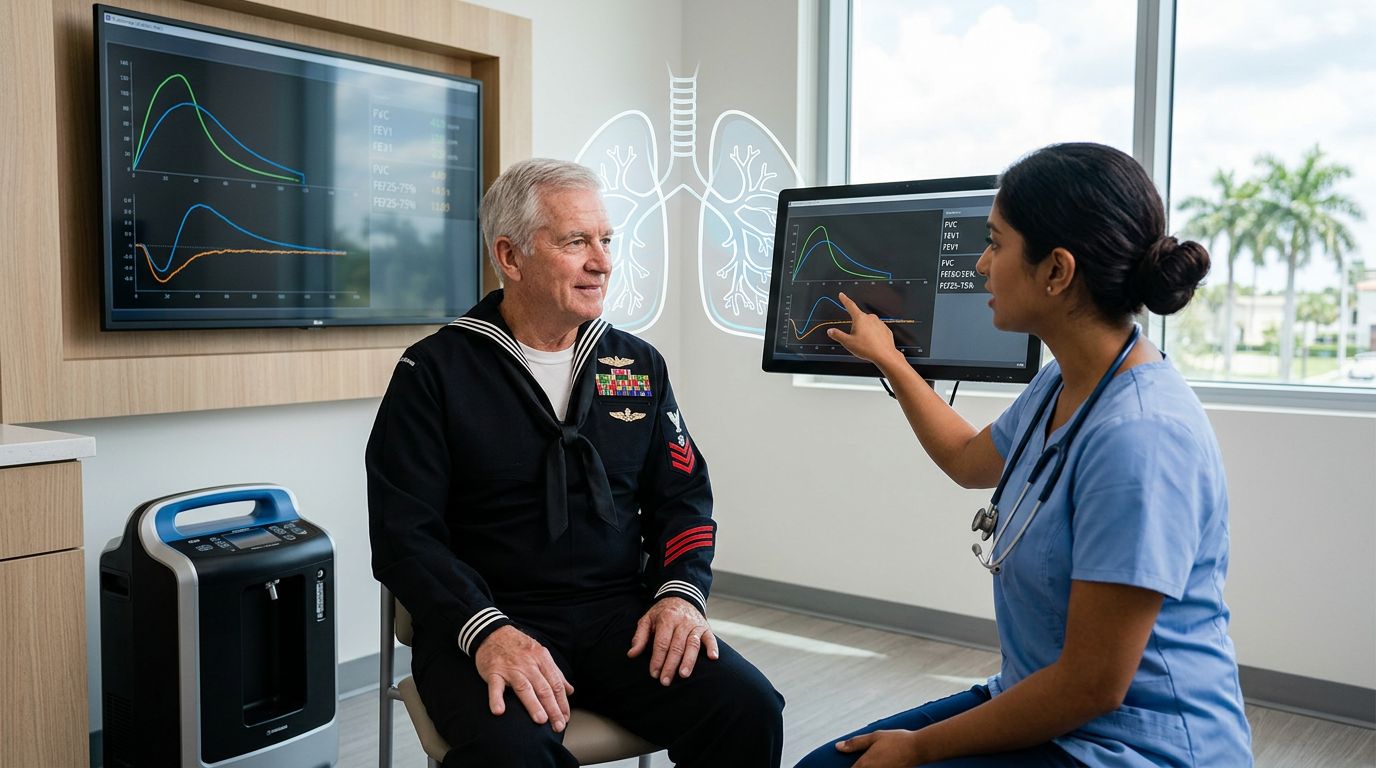
A COPD claim can turn on a few numbers on a breathing test. A small change in those numbers can move a veteran from 30% to 60%, or from 60% to 100%.
That’s why VA COPD ratings are often more about evidence than symptoms alone. Shortness of breath matters, but the VA still wants the right test results, oxygen records, and medical proof. If you’re filing in Florida or reviewing an old denial, the details matter more than the diagnosis label.
How the VA rates COPD in 2026
The VA usually rates COPD under Diagnostic Code 6604. In most cases, it looks at pulmonary function test results first. If the testing supports a higher evaluation, that number drives the rating.
The VA generally uses the test result that gives the veteran the highest qualifying rating. That means one good number doesn’t cancel out a worse one. The strongest qualifying result usually controls.
| VA Rating | PFT Results That Can Qualify | Other Ways the Rating Can Be Met |
|---|---|---|
| 10% | FEV-1 of 71% to 80%, FEV-1/FVC of 71% to 80%, or DLCO (SB) of 66% to 80% | Usually based on relatively mild test loss |
| 30% | FEV-1 of 56% to 70%, FEV-1/FVC of 56% to 70%, or DLCO (SB) of 56% to 65% | Often tied to noticeable breathing limits |
| 60% | FEV-1 of 40% to 55%, FEV-1/FVC of 40% to 55%, or DLCO (SB) of 40% to 55% | Max oxygen use of 15 to 20 ml/kg/min with breathing or heart limits |
| 100% | FEV-1 below 40%, FEV-1/FVC below 40%, or DLCO (SB) below 40% | Max oxygen use below 15 ml/kg/min with breathing or heart limits, cor pulmonale, right ventricular hypertrophy, pulmonary hypertension, acute respiratory failure episodes, or outpatient oxygen therapy |
The VA does not rate COPD by symptoms alone. It rates the test results and the evidence behind them.
That table is the heart of the claim. If your PFT numbers fall in more than one range, the VA should use the result that supports the higher rating. If your oxygen use is documented, that can matter just as much as the spirometry.
What your PFT numbers actually mean
Pulmonary function tests can sound technical, but the key numbers are straightforward. They show how much air you move, how fast you move it, and how well your lungs transfer oxygen.
FEV-1
FEV-1 is the amount of air you can force out in one second. Lower numbers mean more airway obstruction. For COPD claims, this number often gets the most attention because it can show how hard it is to breathe under strain.
A result in the 40% to 55% range can support a 60% rating. A result below 40% can support 100%.
FEV-1/FVC
This ratio compares how much air you can blow out in the first second to your full forced breath. It helps the VA see whether air is trapped in the lungs.
When this ratio drops into the 40% to 55% range, the claim may support 60%. If it falls below 40%, the claim may support 100%.
DLCO (SB)
DLCO measures how well oxygen passes from the lungs into the blood. That matters when breathing feels harder than the spirometry alone suggests.
A DLCO result between 40% and 55% can support 60%. A result below 40% can support 100%.
These numbers matter because COPD does not always look the same on paper as it does in daily life. A veteran may feel exhausted after a short walk, yet one test result may still leave room for a lower rating. That is why the quality of the exam matters so much.
Why oxygen use can push a claim higher
Oxygen therapy is a major marker in VA COPD claims. If you need oxygen at home or use it on a regular basis, that can support a 100% rating. The VA looks for clear proof that the treatment is prescribed and medically necessary.
That proof can include:
- A prescription for oxygen therapy
- Pulmonology notes that explain why oxygen is needed
- Durable medical equipment records
- Test results showing severe exercise limits
- Hospital records tied to respiratory failure or worsening COPD
The VA also considers other severe complications. Pulmonary hypertension, cor pulmonale, right ventricular hypertrophy, and repeated acute respiratory failure episodes can all support a 100% evaluation.
What matters most is documentation. A veteran may use oxygen every day, yet still struggle if the records are thin. On the other hand, a clean paper trail can make the difference between a partial award and full compensation.
If your condition has worsened since your last exam, do not assume the VA will catch it on its own. Claims often stay frozen at an old rating until someone submits newer evidence.
How COPD becomes service-connected
A rating only matters after the VA accepts that COPD is connected to service. That part can be simple for some veterans and hard for others.
Burn pit smoke, diesel fumes, chemical exposure, and heavy dust can all be part of the story. If your COPD may be tied to deployment exposure, VA burn pit presumptive conditions can help you understand what the VA may recognize without as much fight over the cause.
Some veterans also need to check whether their service location fits the PACT Act rules. PACT Act deployment locations can matter when you are trying to show that exposure happened in the first place.
COPD claims often rise or fall on the nexus. That is the link between the condition and service. If the VA agrees that the disease started, or worsened, because of military exposure, the rating analysis becomes much easier. If the nexus is missing, even strong PFT results may not lead to benefits.
For Florida veterans, this is where strong records help most. Service treatment records, deployment history, civilian pulmonary notes, and a clear medical opinion can all support the claim. Without them, the VA may treat the condition like any other non-service-related illness.
Common mistakes that slow COPD claims
Many COPD claims fail for simple reasons. The problem is often not the disease. It’s the paper trail.
- Relying on old PFTs can hide how bad the condition is now.
- Missing oxygen records can keep a veteran from reaching a 100% rating.
- Ignoring the lowest qualifying result can leave money on the table.
- Skipping service evidence can make the VA deny the claim before it reaches the rating stage.
Another common issue is failing to explain day-to-day limits. The VA wants medical proof, but it also needs context. If a veteran cannot climb stairs, mow the yard, or walk a short block without stopping, those facts should match the medical records.
A claim also gets weaker when the testing is incomplete. If the VA or a private doctor runs only one part of the exam, the file may miss the result that helps most. That is why full PFTs matter.
Conclusion
A COPD rating in 2026 still comes down to the same core facts, how the lungs test, how oxygen is used, and how well the records show the condition’s impact. The VA looks closely at PFT numbers, but oxygen therapy and serious complications can move a claim higher.
For veterans, the biggest mistake is assuming symptoms alone will do the job. A strong claim matches the diagnosis, the test results, and the service connection evidence in one clear file. When those pieces line up, the rating process makes a lot more sense, and the result is usually stronger.