
Florida Workers Comp TTD vs TPD After a Job Injury
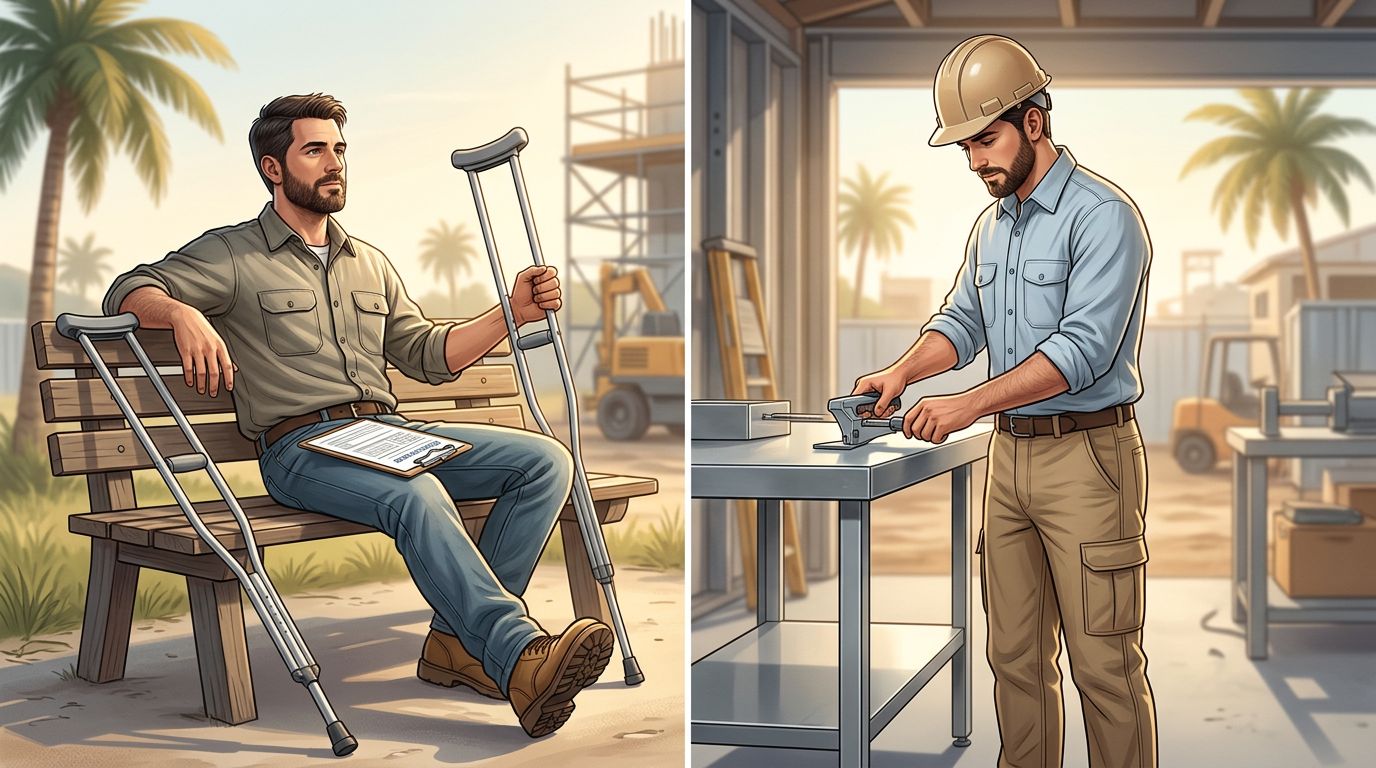
A job injury can change your income almost overnight. One day you’re working full shifts, the next you’re trying to figure out whether your checks should be TTD or TPD.
That difference matters in a big way. It affects how much money you get, when benefits start, and whether the insurance carrier says you can work at all.
If the paperwork feels confusing, you’re not alone. The labels sound similar, but Florida treats them differently, and the wrong label can leave you with less money than you should receive.
TTD and TPD mean different things in Florida
Temporary total disability, or TTD, applies when your injury keeps you out of work completely. Your doctor says you cannot do any job right now, or you cannot do one that the employer has available.
Temporary partial disability, or TPD, applies when you can work, but not at full strength. You may be on light duty, shorter hours, or a lower-paying assignment because of medical limits.
The simplest way to separate them is this: TTD means no work, while TPD means some work with lost wages. That difference sounds small, but it changes how the carrier measures your claim.
Here’s a quick comparison.
| Benefit | When it usually applies | What it replaces | Common example |
|---|---|---|---|
| TTD | You cannot work at all because of the injury | Part of the wages you lose while fully out | A warehouse worker is told to stay home during recovery |
| TPD | You can work, but only with restrictions | Part of the pay you lose because you earn less | A nurse returns on reduced hours after surgery |
The label matters because it changes how the carrier reads your wage loss. If the records show work is possible, the check can shrink fast.
TTD and TPD are both temporary benefits. They do not last forever. They exist while you’re healing and before you reach a stable medical point.
How Florida decides which benefit fits your claim
Florida does not pick TTD or TPD based on what hurts most. It depends on medical restrictions, your actual work status, and whether the employer has suitable work for you.
The doctor’s note carries real weight. If the note takes you fully off work, that supports TTD. If the note allows limited duty, that points toward TPD.
The employer’s job offer matters too. For example, if your employer offers a light-duty role that fits your restrictions, the carrier may argue that TTD no longer applies. If the job is outside your limits, that position should not count as a true return to work.
The paperwork also has to match the facts. If your hours drop, your pay falls, or your doctor changes your restrictions, the carrier should get that update. A missing note can turn a valid claim into a payment fight.
Florida also uses time limits. Temporary disability benefits usually stop when you reach maximum medical improvement, hit the 104-week cap, return to work at the same pay, or lose the medical support for missed time.
If you are still waiting on the first check, timing can be part of the problem too. This expected timeline for Florida workers comp benefits gives a better sense of when checks often start and why delays happen.
In plain terms, the carrier is asking one basic question: can you work, and if so, how much can you earn?
How the checks are usually measured
Florida workers’ comp wage benefits are built around lost income. That means the amount depends on what you earned before the injury and what you can earn after it.
TTD usually pays when your injury keeps you completely off the clock. TPD comes in when you return with limits and your pay drops because of them. So if you work fewer hours, or your modified job pays less, the benefit is meant to close part of that gap.
A simple example helps. Suppose you earned steady full-time wages before the injury. After a doctor clears you for limited duty, your employer only gives you half the hours. Your pay falls, so TPD may help cover part of the loss.
The first payment also depends on the waiting period. Florida generally has a 7-day waiting period before disability wage benefits begin, and that waiting week may become payable if the disability lasts long enough.
Small paperwork issues can slow the check. Missing wage records, unclear restrictions, or a late work-status form can all cause delays. That is why early documentation matters.
If you want a broader look at how wage loss gets handled, this Florida workers compensation lost wages guide explains the common benefit issues in plain language.
Common reasons the carrier pays the wrong benefit
A lot of disputes start with a simple mismatch. The doctor says one thing, the employer says another, and the carrier follows the version that helps it pay less.
One common problem is an outdated work note. If your doctor first took you off work, then later allowed light duty, the carrier may keep paying TTD too long or cut it off too soon if it misses the update.
Another issue is job availability. An employer may say it has light duty, but the job may still be too heavy, too far from your restrictions, or too different from your medical limits. In that case, the carrier may treat you as able to work when you really are not.
Wage records can also create confusion. If overtime, second jobs, or recent pay changes are missing from the file, the carrier may understate your loss. That can reduce a TPD check or make it look like you have no wage loss at all.
Sometimes the doctor’s language creates the problem. A note that says “may return as tolerated” is not the same as a clear restriction. The carrier may use that vague wording to deny or reduce benefits.
The best response is to read every form carefully. If the work status note does not match your condition, get it corrected fast.
What to do if checks stop or never start
When checks stop, the worst thing you can do is wait and hope the carrier notices. Florida workers’ comp runs on records, dates, and medical notes.
Start with the most recent work status form. If the form changed, find out exactly what the doctor wrote. If it did not change, ask whether the carrier received it.
Next, compare your wage records with your actual hours. If you returned on light duty and still lost money, that loss should be documented. Sometimes a small payroll error causes a big benefit problem.
Then, talk to the employer in writing if your schedule, pay, or job duties changed. Keep copies of emails, texts, and pay stubs. Those details often matter more than a phone call.
If the carrier still will not pay the right benefit, legal action may be needed. A Florida petition for benefits is the step that asks the system to order the carrier to provide benefits that are due.
A few signs point to a deeper dispute:
- Your doctor says you cannot work, but the carrier says you can.
- Your pay dropped after a return to light duty, yet TPD never started.
- Checks stopped after a status change, and nobody explained why.
- The insurer keeps asking for the same records without making a decision.
These problems do not fix themselves. The longer they continue, the harder it can be to sort out the back pay.
When legal help makes the difference
TTD and TPD claims can look straightforward at first. Then one missing form, one bad work offer, or one vague doctor note changes everything.
That is where a Florida workers’ compensation attorney can help. A lawyer can review the medical records, compare them with the wage history, and push back when the carrier uses the wrong benefit label. In many cases, the issue is not whether you were hurt. It is whether the file proves the right level of disability.
Legal help also matters when a claim turns into a timing fight. If benefits stop early, or the insurer says you no longer qualify, the clock starts working against you. Getting the claim organized early can keep a small problem from growing into a long payment gap.
For injured workers, the key is simple. Match the doctor’s restrictions, the job offer, and the wage records. When those three pieces line up, the benefit choice becomes clearer.
Conclusion
The difference between TTD and TPD comes down to one question, can you work and still earn your full pay? If the answer is no work, TTD may fit. If the answer is limited work and lower wages, TPD may apply.
That is why paperwork matters so much after a job injury. Your check depends on what the doctor writes, what the employer offers, and what the carrier puts in the file.
If your benefit type looks wrong, or your checks stop without a clear reason, the records need a close look. In workers’ comp, the right label can mean the difference between a steady check and a frustrating delay.