
Florida Roundabout Crash Claims and the Yield Proof That Matters
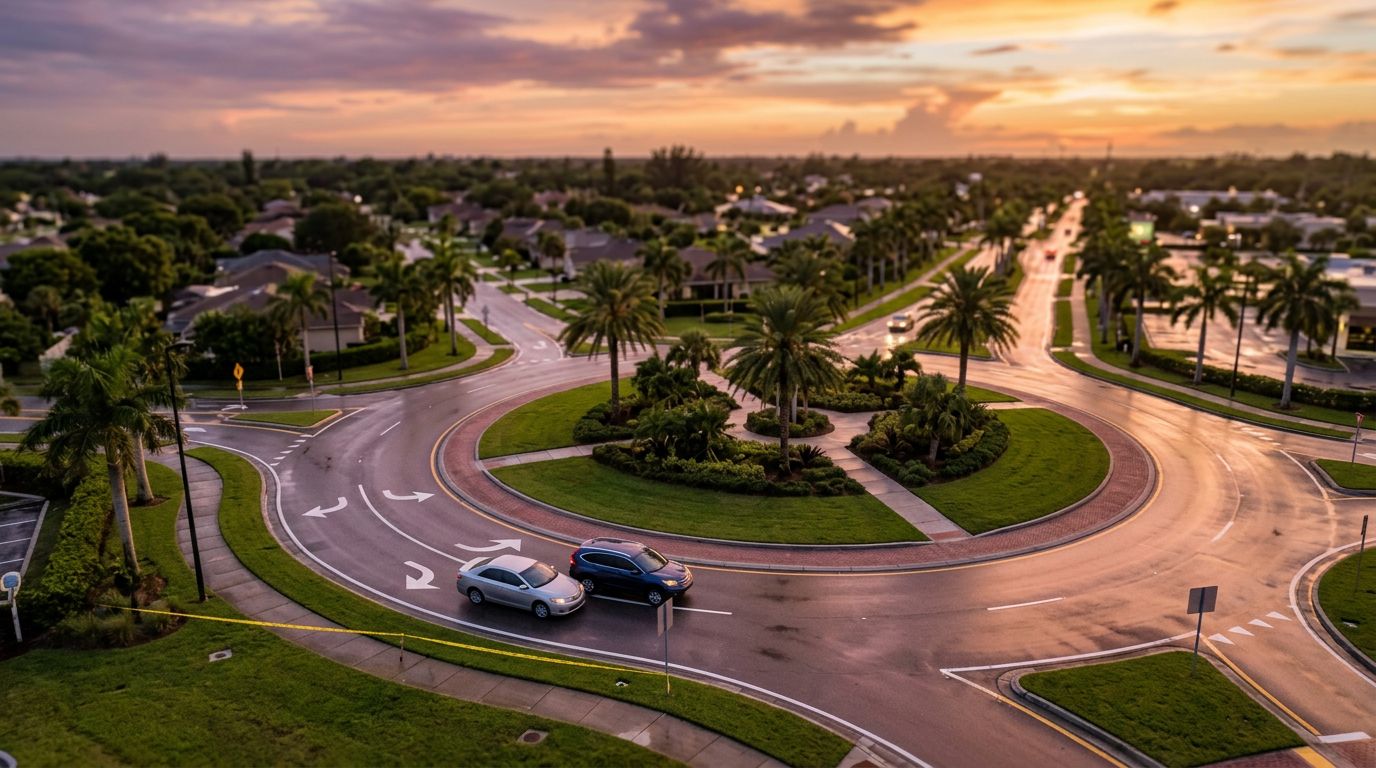
Roundabouts are built to keep traffic moving, but one bad entry can turn them into a mess. In a Florida roundabout crash claim, fault often comes down to a few seconds, a painted sign, and who can prove what happened.
That is where yield proof matters. If you were hit in a roundabout, the insurer will look hard at gap choice, lane position, and impact points. The better the evidence, the harder it is for the other side to shift blame.
Why roundabout crashes get blamed so quickly
Roundabouts look simple from far away. Up close, they can get confusing fast.
Drivers enter from different angles, speeds change in a hurry, and sight lines can be short. One car may already be in the circle while another is rolling in from the right. That split second decides a lot.
Florida crash claims often turn on a basic question, who had to yield? If the entering driver failed to wait for a safe opening, that driver may carry most of the blame. If the circulating driver changed lanes, sped up, or cut across an entry, the fault picture can shift.
Insurance adjusters know this. They often start with the assumption that the driver who entered did it wrong. Still, assumptions are not proof. The scene, the damage, and the statements can tell a different story.
A roundabout crash claim often turns on one narrow fact, who had the right to enter, and can you prove it?
What yield proof means in a Florida crash claim
Yield proof is any evidence that shows which driver should have waited. In a roundabout, that usually means proof of who was already in the circle, who had a clear path, and who moved without enough space.
It can also show lane choice. Some roundabouts have multiple lanes, and lane changes inside the circle can create side-swipe crashes. In those cases, the question is not only who entered first. It is also who moved into another driver’s path.
Timing matters, too. If one vehicle entered from a stop while another was already circulating, that timing can matter more than either driver’s memory. People often remember the crash, not the gap they saw or missed.
The strongest yield proof is specific. It should show where each car was, how fast it moved, and what the road looked like at the moment of impact.
Evidence that can make or break the claim
The right evidence often decides whether a claim grows into a fair payout or gets stuck in a blame fight. A quick photo can say more than a long argument.
| Evidence | What it can show | Why it helps |
|---|---|---|
| Dashcam or traffic video | Who entered first, speed, lane position | It gives a time-stamped view of the crash |
| Photos of the scene | Signs, lane markings, debris, vehicle angles | It shows how the roundabout looked right after impact |
| Witness statements | Who yielded, who accelerated, who cut across | It supports one driver’s version of events |
| Police report | Initial scene notes and driver statements | It gives an early record, even if it is not final |
| Vehicle damage and data | Point of impact, braking, sudden force | It helps match the story to the collision |
A police report can help, but it does not end the case. Officers arrive after the crash, and they do not see every move that led to it. Photos and video often fill those gaps.
Small details can matter more than people expect. Tire marks, broken glass, fresh gouges, and lane arrows can show the path each car took. Even weather and lighting can help explain why a driver missed a yield sign.
A witness near the roundabout can be powerful. So can a nearby store camera or a dashcam from another car. These records fade fast, which is why early collection matters so much.
Common fault disputes after a roundabout wreck
Roundabout claims often turn into he said, she said fights. The drivers may agree that there was a crash, but disagree on almost everything else.
Here are some of the most common disputes:
- The entering driver says there was enough space.
- The circulating driver says the other car pulled out too early.
- One driver claims the other changed lanes inside the circle.
- Another says a third vehicle blocked the view.
- Someone says the other car was speeding and could not stop in time.
These disputes matter because Florida fault rules can reduce compensation when blame is shared. If the insurer can pin part of the crash on you, it may lower the payout. That is why clear proof is so important.
Roundabouts also create impact patterns that confuse people. A side-swipe at the entry may look different from a rear-end crash inside the circle. A hard hit on the passenger side may suggest one car entered from the wrong angle. A rear impact may point to tailgating or a sudden stop.
The damage pattern should fit the story. If it does not, the claim gets harder to defend.
What to do in the first 24 hours
The first day after a roundabout crash is about facts, not guesses. Move carefully and keep the record clean.
- Get medical care right away. Some injuries do not show up at the scene.
- Call law enforcement and ask for a report.
- Take photos of the signs, lane lines, vehicle damage, skid marks, and road layout.
- Get names, phone numbers, and insurance details from every driver and witness.
- Ask nearby businesses if their cameras may have caught the crash.
- Save your torn clothes, medical records, and repair estimates.
- Give the insurer only basic facts until you know what happened.
Do not guess about speed, distance, or fault. A fast answer can hurt a claim later. Stick to what you saw and what you felt.
If you were taken to a hospital, keep every bill and discharge note. Keep track of missed work, follow-up visits, and changes in your pain level. Those records connect the crash to the harm.
When legal help matters most
A roundabout crash claim can look simple at first. Then the other driver changes their story, and the insurer starts asking for proof you may not have.
That is where legal help can change the pace of the case. A lawyer can move fast on video requests, scene photos, and witness contact information before those records disappear. If the crash involved serious injury or a denied claim, Florida car accident attorneys can help pull the facts together and deal with the insurer.
Some cases also need broader injury work, especially when treatment lasts for weeks or months. In those situations, attorneys for injury and accident claims can help connect the crash evidence to medical losses, wage loss, and future care.
The key is simple. The more the other side argues about yield, the more important it becomes to lock down the scene, the timing, and the damage pattern.
Conclusion
Roundabout crashes often look minor from the outside, but the claim can turn serious fast. The driver who had to yield, and the proof that shows it, often shape the whole case.
Photos, video, witnesses, and early medical records can tell a clean story when memories do not. If your crash is tied to disputed fault, the best move is to protect the evidence before it disappears.
A strong yield proof record gives a Florida roundabout crash claim its best chance at fair treatment.