
Florida Wide Right Turn Truck Crashes and Camera Proof
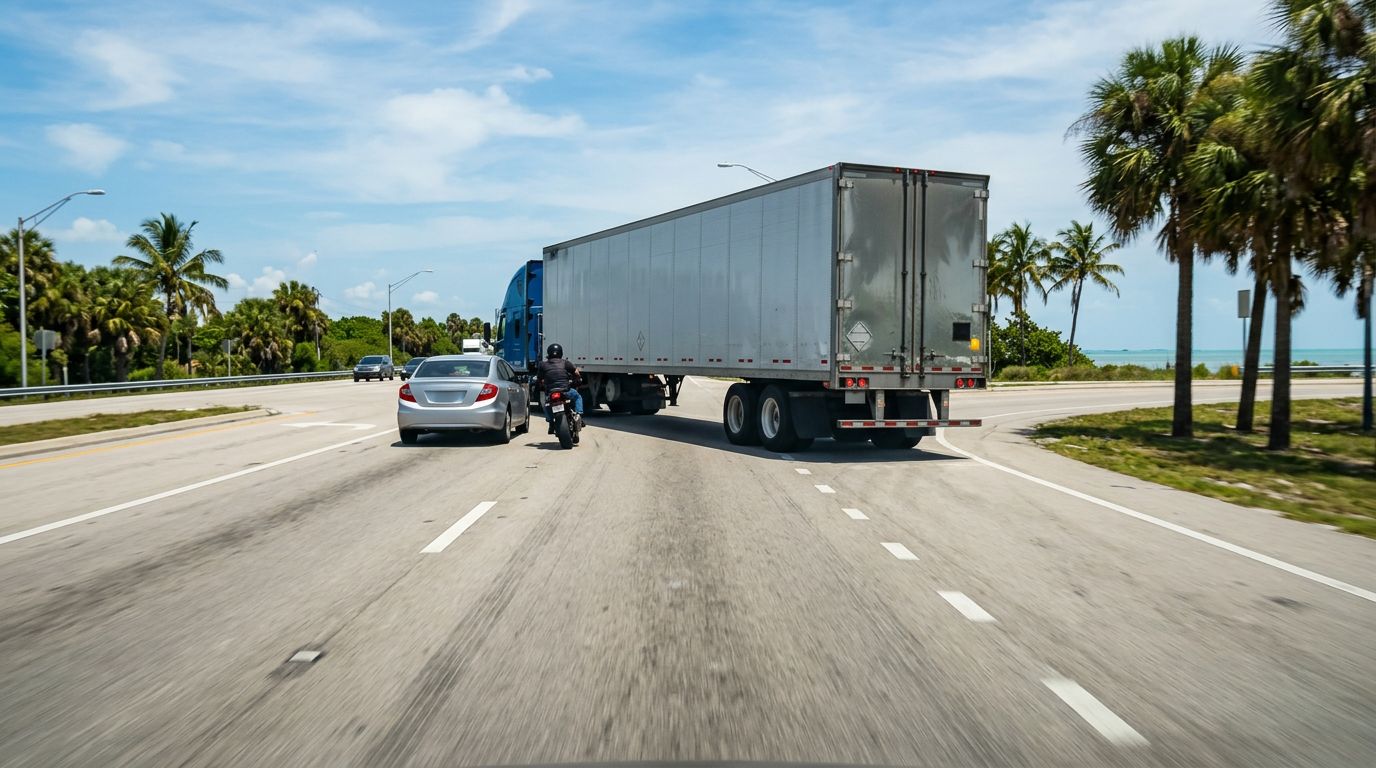
A semi that swings wide can trap nearby traffic in seconds. In a Florida truck turn accident, the first fight is often over fault, and the second is over proof. Camera footage can settle both, but only if it gets saved before it disappears. That makes the first hours after the crash far more important than most people expect.
Why wide right turns cause serious truck crashes
Truck drivers need extra room to make a right turn. The trailer cuts a tighter path than the cab, so the driver may swing left first, then cut back right. To someone in the next lane, that move can look like a sudden lane change or a blocked escape route.
That is where the danger grows. A car, motorcycle, or bicycle beside the truck may have nowhere to go once the trailer starts moving across the lane line. The side of the trailer can clip a vehicle, push it toward a curb, or pin it between the truck and another object.
Blind spots make the problem worse. A driver can miss a smaller vehicle that sits low and close to the trailer. In busy parts of Florida, especially near intersections, gas stations, and delivery lots, there is often little room for error.
A wide right-turn crash also creates a messy scene. People may remember the truck pulling left before the turn. They may also disagree about signal use, speed, or whether the truck stayed in its lane. Those details matter because they shape the whole claim.
When the turn is poorly timed, the damage can be severe even at low speed. A heavy trailer does not need much force to cause crushed doors, broken glass, shoulder injuries, or head trauma. The size of the truck turns a small mistake into a large case.
What camera proof can show in a Florida truck turn accident
Video often tells the story faster than witness memory. It can show lane position, signal use, speed, braking, and the exact path of both vehicles. It may also show whether the truck drifted left before turning right, which is a key detail in many claims.
A few common video sources matter most:
| Video source | What it may capture | Why it matters |
|---|---|---|
| Truck dash cam | Driver view, mirrors, lane position | Shows what the driver could see |
| Store or gas station camera | Side view of the turn and impact | Shows the truck’s full movement |
| Traffic or intersection camera | Signal use, lane changes, timing | Helps build a clear sequence |
| Nearby business camera | Before and after crash scene | Can show speed, traffic, and debris |
The best footage often comes from more than one angle. One camera may miss the signal, while another catches the full turn. Put together, those clips can make a weak defense story much harder to defend.
Video is strongest when it shows the turn from start to finish, not just the impact.
That matters because a single freeze frame can mislead people. A truck may look centered in one image and out of position in the next. The full clip shows whether the driver had room, whether the trailer swept across a lane, and whether the other vehicle had a fair chance to avoid the crash.
Where the footage comes from, and why speed matters
Do not wait for the insurance company to ask for video. Some systems overwrite footage fast. Store cameras can loop within days, and private security systems may delete old files unless someone asks in time.
Start with the trucking company, nearby businesses, loading docks, fuel stations, and any agency that controls an intersection camera. Witnesses may also have phone video, which can fill gaps between fixed cameras. A lawyer with Florida truck accident attorneys can send preservation letters before the key files disappear.
That step matters because missing footage changes the whole tone of the case. Once a recording is gone, the claim often turns into a battle of memories. That is a bad place to be, especially when a trucking insurer has more records and more staff.
Look for video from before the impact, not just the crash itself. The lead-up often shows the truck edging left, crossing a line, or blocking the lane. Those seconds can answer questions that the collision scene alone cannot.
Photos, police reports, and witness statements still matter. Video just gives them shape. When the footage matches the rest of the evidence, it becomes much harder for the other side to claim the crash came out of nowhere.
What your claim has to prove after the crash
A strong claim needs more than bad-looking video. It has to connect the turn to the injury and show what the crash cost you. That usually means proving how the collision happened, who caused it, and how badly you were hurt.
This is where the proof starts to line up:
| Claim issue | What helps prove it |
|---|---|
| Fault | Video, photos, witness statements, police report |
| Cause of injury | Medical records, crash timing, impact point |
| Losses | Bills, wage records, repair estimates, pain notes |
The video may be the anchor, but it works best with the rest of the file. Medical care shows the physical harm. Repair records show the property damage. Wage records show time lost from work. Together, those records turn a crash scene into a real claim.
If the insurer argues that you were speeding or in the wrong lane, the footage can answer that argument frame by frame. It can also show whether the truck used enough space, gave proper warning, or crossed into another lane too early. Those points often shape settlement talks.
A claim built on clear video has less room for blame shifting. That matters because trucking insurers often look for any opening to reduce what they pay. Good proof narrows those openings.
How a lawyer uses footage to push back on blame shifting
Insurers rarely accept a truck turn claim at face value. They may say the other driver was in a blind spot, that traffic moved too fast, or that the crash happened because someone stayed too close. Video can test each of those claims against the real scene.
Lawyers and investigators can enlarge frames, compare road markings, and match the time stamp to the police report. They can also compare the footage with vehicle damage, skid marks, and medical timelines. That kind of review turns a short clip into usable evidence.
The work does not stop with the obvious cameras. If a business or city fails to keep what it should have saved, that loss may matter. A trucking company that ignores a preservation request may face harder questions later. The sooner the request goes out, the better the chance that the truth stays on record.
A clean case file often changes the tone of the dispute. Instead of arguing in circles about who moved first, the parties can look at the same footage. That is when weak blame stories start to fall apart.
The best claims are not built on outrage. They are built on a timeline that matches the scene, the injuries, and the video. When those pieces fit, the crash becomes much easier to prove.
Conclusion
A wide right turn crash can look confusing in the moment, but video often strips away that confusion. When camera proof shows lane position, signal use, and the truck’s path, a Florida truck turn accident becomes much easier to explain and much harder to deny.
Fast action matters because recordings disappear. The sooner the footage is found and preserved, the stronger the claim usually is.