
Florida Pool Deck Fall Claims and Slip Resistance Testing
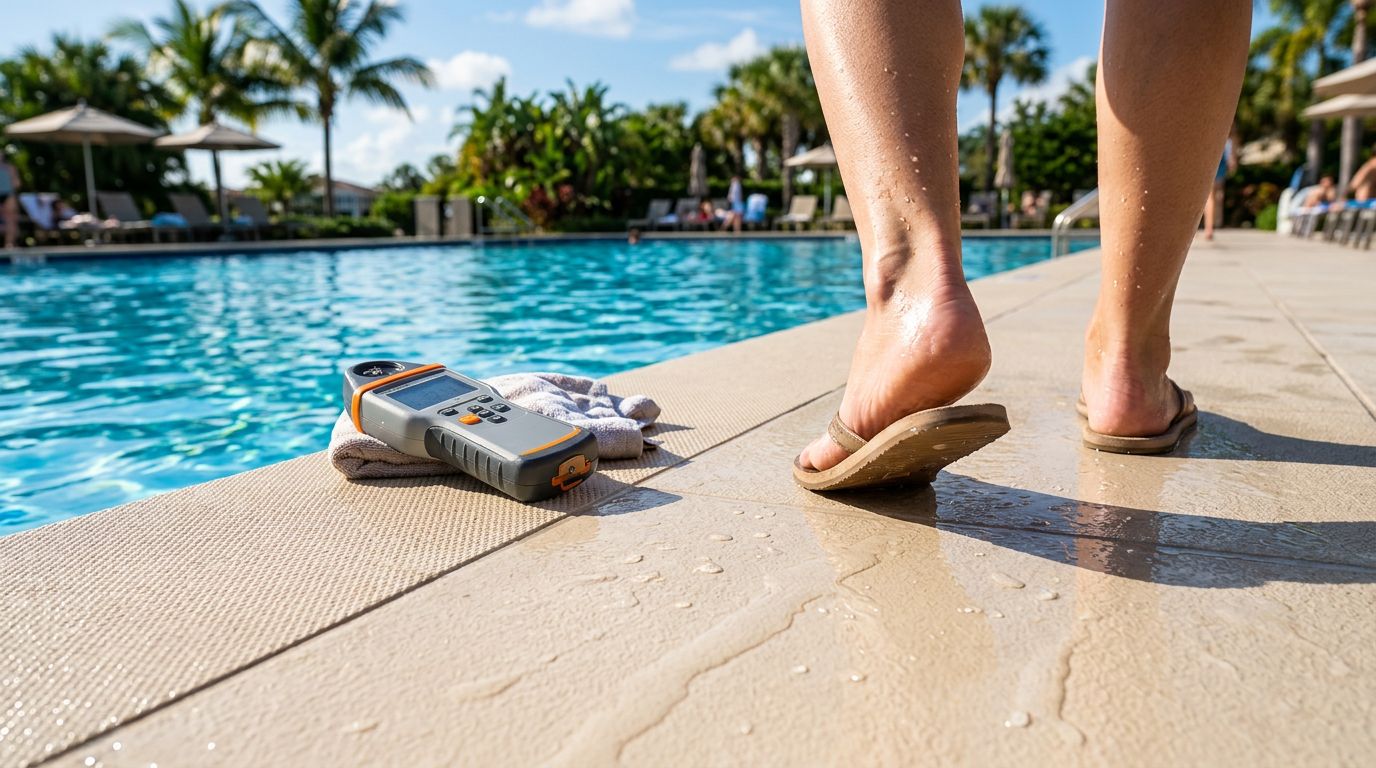
A pool deck can look clean and still fail when it gets wet. Standing water, worn coatings, algae, and poor drainage can turn a normal step into a hard fall, and the case often turns on what the surface was made of, how it was maintained, and whether anyone tested it.
Florida pool deck falls happen in condos, apartments, hotels, and resorts, where more than one party may control the area. That makes the paper trail important early, before cleanup, repairs, or resurfacing change the scene.
The first question is whether the deck met Florida’s safety rules in the first place.
Key Takeaways
- Florida building rules require wet deck areas to use nonabsorbent, slip-resistant surfaces, and wooden decks are not allowed on wet deck areas.
- Modern traction analysis usually centers on ANSI A326.3 wet DCOF testing, not the withdrawn ANSI/NFSI B101.1 standard.
- Pool decks often need stronger traction than ordinary walking surfaces because water, bare feet, and constant cleaning change the floor fast.
- Strong claims rely on photos, maintenance records, prior complaints, and medical records tied closely to the fall.
- Most negligence claims in Florida now have a two-year deadline from the date of the fall.
Why Florida Pool Deck Falls Become Legal Claims
When someone falls on a pool deck, the legal issue is usually simple. Was the surface reasonably safe for the way people actually used it? Florida Building Code Chapter 4, Section 424.1.3.1.1, requires wet deck areas to be made of concrete or other nonabsorbent materials with a smooth slip-resistant finish. It also prohibits wooden decks and walkways on wet deck areas.
That rule matters because a deck can pass a quick visual check and still fail when it gets wet. Algae, sunscreen, pool chemicals, worn sealers, loose pavers, and poor drainage all affect traction. In a condo, apartment complex, hotel, or resort, the owner, manager, or association may face scrutiny if inspections were weak or repairs were delayed.
A claim still needs proof. The injured person has to show a dangerous condition, notice or constructive notice, and actual damages. If you need a practical starting point, the Florida pool deck slip and fall evidence checklist shows the kinds of proof that usually matter first.
A clean-looking deck can still be unsafe if the surface loses grip when it gets wet.
What Slip Resistance Testing Means on a Pool Deck
Slip resistance testing asks a different question. It measures how much grip the deck provides under wet conditions. For hard surfaces, the current benchmark is ANSI A326.3-2021, which measures wet dynamic coefficient of friction, or DCOF. The older ANSI/NFSI B101.1 standard was withdrawn in 2021, so reports that still rely on it can look outdated.
That distinction matters in Florida pool deck claims. The Florida code requires a slip-resistant surface, but it does not name one single test for every situation. In practice, owners, testers, and lawyers often look to A326.3 because it is the current national standard for wet hard-surface testing. OSHA and the ADA do not publish one universal minimum for every wet surface, so the test method and the context matter a great deal.
A few common measures help frame the conversation:
| Measure or standard | What it means | Why it matters |
|---|---|---|
| ANSI A326.3-2021 | Current wet DCOF test method for hard surfaces | Common reference for modern slip testing |
| DCOF 0.42 | Baseline wet traction level for level walking surfaces | May be too low to tell the full story on a pool deck |
| ANSI/NFSI B101.3-2022 | Current NFSI wet DCOF guidance for wet, light-footwear areas | Often discussed for pool decks, showers, and similar spaces |
| BOT-3000E | ANSI-recognized tribometer used for A326.3 testing | Common tool for measuring wet traction |
The takeaway is plain. The number matters, but so do the test method, the device, the date, and the condition of the deck that day. A pool surface that passed months earlier may not pass after wear, cleaning, weather, or resurfacing.
How Lawyers Build a Claim Around the Surface Conditions
The strongest Florida pool deck fall claims start with the surface as it existed on the day of the fall. Photos, video, and maintenance records can show whether the deck was wet, dirty, cracked, or coated with a finish that had worn smooth. That evidence matters because pool areas change fast.
A strong file often includes:
- photos of standing water, algae, cracked pavers, or missing warning signs
- inspection logs and cleaning schedules
- pool service, repair, and resurfacing records
- prior complaints about the same deck or walkway
- surveillance footage and incident reports
- medical records from the first visit after the fall
If the fall happened at a condominium, liability for falls on condo property often turns on who controlled the deck and who knew about the hazard. A management company may handle cleaning, while the association handles repairs. That split matters because control and notice usually drive the case.
A later test can help, but it cannot replace a record of what the deck looked like before cleanup.
Sometimes the best proof is what was done after the fall. A repair invoice can show the owner knew the coating was failing. A resurfacing job can show the surface changed before a meaningful test could be done. Even a simple work order may help fill in the timeline.
Injuries, Deadlines, and the Insurance Questions That Follow
Florida pool deck falls often cause wrist fractures, torn knees, back injuries, and concussions. The injury may not feel dramatic at first, because adrenaline can hide pain for hours. That is one reason same-day medical care helps. It protects your health, and it ties the injury to the fall before the story gets blurry.
Insurers usually look for gaps. They ask whether anyone took photos, whether an incident report was made, whether the owner had prior notice, and whether the slip test was done before or after repairs. If the only traction number comes from an old certificate, that may not tell the full story.
Florida also gives most negligence claims a two-year deadline now. That clock starts on the date of the fall. Once it runs out, a strong claim can lose value fast, even when the surface hazard is real.
The deadline matters for another reason. Pool decks are often cleaned, resurfaced, or repaired quickly after an accident. Once the original condition is gone, the case becomes harder to prove. That is why early investigation and testing are so important.
Conclusion
Pool decks invite water, and water changes traction fast. That is why Florida pool deck falls often turn on evidence that disappears in hours, not years.
The best claims do not rely on one photo or one number. They show what the surface was doing, who controlled it, and whether the property kept up with maintenance and testing. In cases like that, timing can matter as much as the injury itself.