
Florida Tire Blowout Claims and Tread Separation Evidence
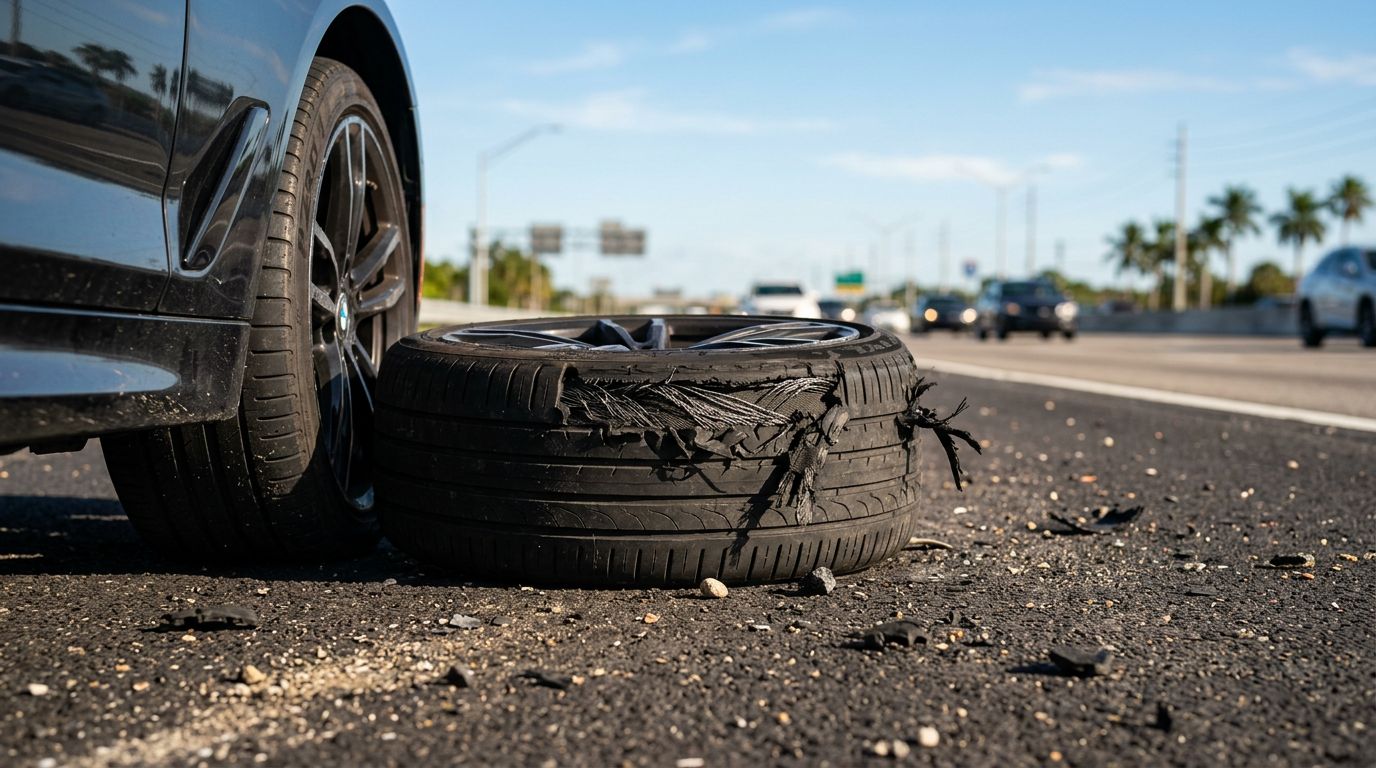
A tire failure can turn a normal drive into a violent crash in seconds. For Florida tire blowout crash claims, the hardest part is often proving why the tire failed and who had the duty to prevent it.
That proof usually starts with the tire itself, then moves to maintenance records, recall history, and expert analysis. When tread separation or a blowout causes serious injuries, the facts matter fast because the wrong theory can send the claim in the wrong direction.
Key Takeaways
- A tire failure claim in Florida can involve negligence, product liability, or both.
- Tread separation and a sudden blowout are not the same thing, and experts look for different proof.
- The failed tire, its DOT number, and photos from the scene can shape the whole case.
- Insurers often blame underinflation, road hazards, or driver error, so early evidence matters.
- Florida’s fault rules can reduce recovery, which makes careful documentation important.
How Florida law treats a tire failure on the road
A tire failure does not automatically mean someone else is liable. In Florida, the claim usually depends on whether a person, company, or manufacturer acted carelessly, or whether the tire was defective when it left the factory.
That means several parties may be involved. A driver may be at fault for skipping inspections. A trucking company may be at fault for poor maintenance or pressure to keep rolling on unsafe tires. A mechanic may be responsible for faulty repair work. A tire maker or distributor may face product liability if a design flaw or manufacturing defect caused the failure.
Florida also has a minimum tread depth standard. Tires at 2/32 of an inch or less need replacement. A driver who keeps using tires below that point can face a negligence argument, especially if the worn tread contributed to the crash.
Commercial crashes can be even more complicated. Trucking companies must keep proper inspection and maintenance records, and drivers must do pre-trip checks. If a commercial vehicle had worn or damaged tires, those records become important quickly.
Florida’s fault rules matter too. If a driver or company blames the injured person for part of the crash, compensation can shrink. Florida modified comparative negligence rules can affect how much a claim is worth, so fault should be pinned down with evidence, not guesswork.
If injuries are serious, speaking with Florida car accident lawyers early can help keep the claim focused on the right evidence.
Why tread separation is not the same as a blowout
People often use “blowout” as a catchall phrase, but that can hide the real cause of the crash. A blowout is usually a sudden rupture. Tread separation is different. In that situation, the tread peels away from the belt package, often because of a bonding problem, heat, age, or damage that weakened the tire over time.
That difference matters because the proof changes. A blowout caused by hitting road debris may point to a one-time event. Tread separation may point to a defect in design or manufacturing. An expert can look at rupture patterns, bead damage, sidewall tears, belt separation, and delamination to tell the story more clearly.
The label on the crash report is not enough. The tire has to tell the same story as the photos, the maintenance records, and the damage pattern.
Tread separation claims often turn on whether the tire was defective when it left the factory. If that is true, strict liability may apply, which means the injured person does not have to prove the manufacturer was careless. On the other hand, if the tire was worn out, underinflated, or overloaded, the defense will try to shift blame to the driver or vehicle owner.
The National Highway Traffic Safety Administration also keeps a public recall database. A recall does not prove the whole case by itself, but it can show notice, defect patterns, and similar failures in the same tire line.
Evidence that can make or break the claim
The most important evidence is often the one item people want to throw away: the failed tire. Once it is discarded, the chance to inspect it for tread separation, zipper failure, bead damage, or manufacturing clues may be gone. That can weaken the case fast.
The tire should be preserved in the condition it was found. It should be photographed before it moves, then stored so experts can examine it later. The same goes for wheel and rim damage, skid marks, roadway debris, and vehicle position.
A few other pieces of proof matter just as much:
- The DOT number on the sidewall identifies the tire’s plant, size, and batch information.
- Maintenance and service records show whether the tire was inspected, rotated, repaired, or replaced on time.
- Driver logs and fleet records can show ignored warning signs or rushed schedules.
- Scene photos can capture tire debris, damage patterns, weather, and road conditions.
- A police crash report gives the first official account of what happened.
- Tread depth measurements help prove whether the tire was legally worn out.
The DOT number is especially useful because it gives lawyers a way to track recall history and similar failures from the same production run. That can open the door to subpoenaing manufacturer records and speaking with experts who know how the tire should have behaved.
A tread depth gauge matters too. It gives a measurement in 32nds of an inch, which is more reliable than a quick glance. The penny test can help a driver spot worn tread, but a claim needs stronger proof than that.
Preservation letters go out quickly in serious cases because evidence can disappear. A tire left in a tow yard, shop, or junk pile may never be the same again.
Common defenses after a tire failure
Insurers and manufacturers rarely admit a tire defect without a fight. They often look for other explanations that move blame away from the tire.
| Defense | What they may claim | Evidence that helps the claim |
|---|---|---|
| Underinflation | The tire was run too low on air for too long | Pressure records, maintenance logs, photos of other tires |
| Road hazard | A nail, curb, or debris caused the failure | Scene photos, damage pattern, reconstruction analysis |
| Driver error | The driver ignored visible wear or skipped inspections | Inspection logs, dashcam video, witness statements |
| Overloading | The vehicle carried more than the tire could handle | Load records, cargo logs, manufacturer limits |
| Old or mismatched tires | Age or mixed tire types caused instability | Tire age codes, vehicle service history, expert review |
These defenses are common because they can reduce or eliminate liability. They also matter under Florida fault rules, since an insurer may argue the injured person shares responsibility for the crash.
That is why the timeline matters. If the tires were rotated regularly, pressure checks were documented, and the failed tire shows a likely bonding defect, the defense has less room to shift the story.
How a Florida lawyer builds the case
A strong tire failure claim usually starts with preservation, then moves into expert review. The attorney sends letters to keep the tire, the vehicle, and the records from being lost or altered. After that, engineers and reconstruction experts examine the failure pattern.
The legal team may also compare the tire to recall data, production records, and prior complaints. If the tire came from a known batch with similar failures, that can become powerful evidence. If a trucking company ignored maintenance rules, those records matter just as much.
Sometimes the claim turns on what the company knew. A fleet that cut corners on inspections or pressure checks leaves a paper trail. Service invoices, internal emails, and driver instructions can show whether the company put speed ahead of safety.
If the tire failure involved a commercial vehicle, the case may also require federal safety records. If it involved a passenger vehicle, the focus may stay on the vehicle owner, shop, or tire manufacturer. Either way, the claim should match the facts, not the first story an insurer tells.
Florida gives most product liability claims a four-year deadline. That sounds like plenty of time, but tire evidence can disappear in days. Waiting only helps the other side.
Conclusion
A tire failure looks simple at first, but the real case usually lives in the details. The difference between a blowout and tread separation can decide who is responsible, how strong the claim is, and what evidence matters most.
The tire, the DOT number, the maintenance history, and the scene photos can tell a consistent story if they are preserved early. When a crash leaves injuries behind, that evidence is often the line between a weak claim and a solid one.