
Florida Workers’ Comp for Remote Workers Hurt at Home
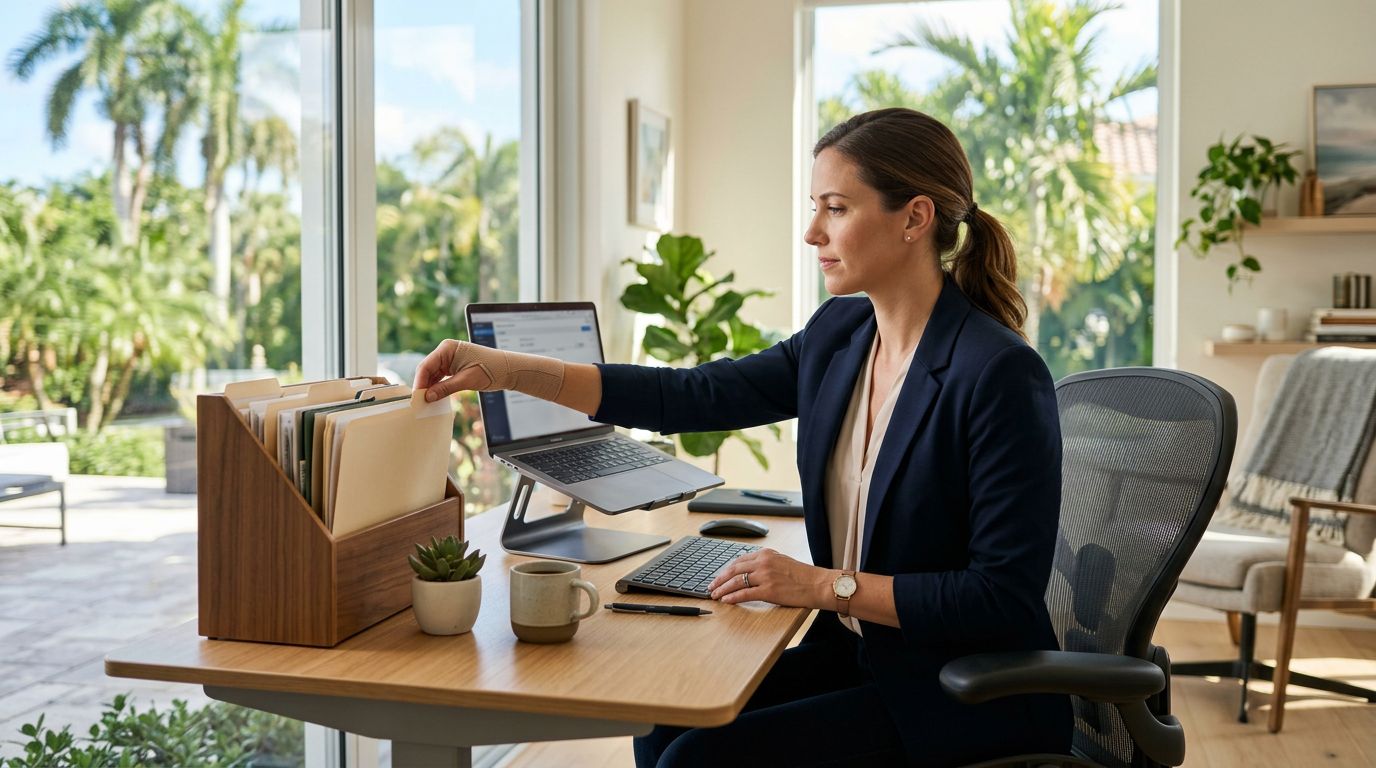
Florida workers’ comp for remote workers does not disappear when you log in from home. If you get hurt while doing your job, the claim can still fit under Florida law, even if the accident happens at a kitchen table or in a spare bedroom.
The problem is proof. A fall while carrying work files is different from a slip while doing laundry, and insurers know the difference matters.
Florida law focuses on whether the injury happened in the course and scope of employment. That is where many home-based claims turn, so the details around the injury matter from the start.
Key Takeaways
- Remote employees can qualify for Florida workers’ compensation if the injury happened while performing work duties.
- The job connection matters more than the location. A home office injury still has to tie back to the workday.
- Quick reporting, photos, medical records, and work logs often make or break the claim.
- Wage replacement depends on the kind of disability, your average weekly wage, and Florida’s current benefit caps.
- If the carrier denies the claim, deadlines still run, and a Florida workers’ compensation lawyer can step in early.
When a home injury can qualify in Florida
Florida uses the same basic test for remote workers as it does for office employees. Under section 440.09, Florida Statutes, the injury must arise out of and in the course of employment. In plain terms, you need a real link between the injury and the work you were hired to do.
That link gets stronger when you were on the clock, doing assigned tasks, or handling equipment for your employer. It gets weaker when the injury comes from an ordinary household activity that has nothing to do with the job. Most Florida employers with four or more employees must carry workers’ compensation coverage, and construction employers must carry it with just one employee.
A home office injury still has to connect to your job. The address changes, but the legal test stays the same.
The law also recognizes a narrow set of personal comfort moments. A short trip to the restroom or a quick coffee break can still fall within the workday if the injury happens during that normal pause. The problem starts when the activity becomes personal instead of work-related.
Here is a simple way to think about the line:
| Situation | Usually covered? | Why it matters |
|---|---|---|
| Typing at your desk and developing wrist pain | Often yes | The injury ties directly to repeated work tasks |
| Tripping over a charging cord while walking to a work printer | Often yes | The hazard is part of the work setup |
| Walking to the kitchen for coffee during work hours | Sometimes | A short comfort break may still be work-related |
| Folding laundry during lunch and slipping on a wet floor | Usually no | The activity is personal, not job-related |
The closer the activity is to your assigned work, the stronger the claim usually is. That is why remote-work injuries often turn on small facts, like the time of day, the task in progress, and whether your employer asked you to use a specific setup.
How to document a remote-work injury
The first hours after the injury matter a lot. A weak record gives the insurer room to argue that the accident happened during a personal errand or a household chore. A clear record makes that argument harder.
A good starting point is the Florida workers’ comp first 24 hours checklist, because early details often decide whether the carrier accepts the injury as work-related.
Start by reporting the injury to your employer as soon as possible, and do it in writing if you can. Florida gives injured workers 30 days to report, but waiting makes the case harder. The report should say what task you were doing, where you were, and what happened next. “I hurt my back at work” is vague. “I lifted a monitor from my home office desk at 10:15 a.m. while on my scheduled shift” gives the insurer something concrete to evaluate.
Then save every piece of proof you can find. That includes emails, chat logs, calendar invites, and screenshots of your schedule. If a cord, chair, desk, or other item caused the injury, take photos right away. If a supervisor saw the hazard on video or heard your report during a call, write that down. Even small details can matter later.
Medical care also needs attention. Florida workers’ compensation usually expects treatment through an authorized provider chosen by the employer or the insurance carrier. If the injury is an emergency, get emergency care first. After that, follow the workers’ comp process so the insurer cannot say you used the wrong doctor.
The best records usually answer four questions:
- What were you doing when you got hurt?
- Was it part of your job?
- When did it happen?
- Who can confirm the details?
If those answers stay clear, the claim has a better chance of surviving the carrier’s first review.
What Florida workers’ comp can pay
A valid claim can cover more than a single doctor visit. It can also pay for wage replacement if the injury keeps you out of work or limits your hours. For a deeper breakdown of wage replacement, see Florida workers’ comp wage benefits.
Florida workers’ comp can pay for medical treatment, including doctor visits, tests, physical therapy, prescriptions, and other authorized care tied to the injury. It can also pay temporary total disability, often called TTD, if the doctor takes you completely off work. If you can work but only in a reduced role or for fewer hours, temporary partial disability, or TPD, may apply.
In some cases, the claim can also lead to impairment income benefits after you reach maximum medical improvement. Those checks usually depend on an impairment rating and the type of injury. Vocational services can also come into play when you cannot return to the same job.
For injuries on or after January 1, 2026, Florida’s maximum weekly workers’ compensation rate is $1,358. The current Florida workers’ comp rates page explains how that cap affects real payments. Your actual benefit still depends on your average weekly wage, the medical restrictions in your file, and the benefit type the carrier owes.
Pain and suffering is not part of Florida workers’ compensation. That surprises many people. The system pays for medical care and wage loss, not the personal discomfort that comes with the injury.
That is why two remote workers can have different outcomes even when their injuries sound similar. One may qualify for TTD after a doctor takes them off work. Another may get light-duty pay because the doctor clears limited tasks. The medical notes decide a lot.
What happens when the insurer pushes back
Insurers often deny home-based claims by saying the injury happened during a personal activity, the report came too late, or the medical records do not connect the injury to work. Pre-existing conditions also come up often, especially with back, neck, shoulder, and wrist claims.
When that happens, the record matters more than the argument. A clean timeline, a clear work task, and a prompt report can answer many of the carrier’s objections. If the insurer still refuses to accept the claim, it may help to send additional records and ask for a formal review of the denial.
If that does not fix the problem, the next step can be a Petition for Benefits with the Florida Office of Judges of Compensation Claims. The deadline is important, because Florida generally gives injured workers two years to file for benefits after the injury or the last authorized treatment, depending on the facts of the case.
That is where legal help often changes the pace of the case. A lawyer can line up witness statements, work records, medical notes, and the reporting history so the claim looks like a claim, not a guess. That matters even more when the employer is out of state but the remote worker lives and works in Florida, because Florida law still controls the injury.
Remote workers should also keep in mind that a denial does not always mean the case is over. It often means the insurer wants more proof, or wants the proof framed in a way that favors a denial. The faster the response, the better the chance of fixing the record before the dispute hardens.
Conclusion
A home office changes the setting, but it does not erase a work injury. Florida still asks the same question it asks for any other employee, was you hurt while doing your job?
That is why the best remote-work claims depend on details. The task, the timing, the medical visit, and the reporting trail all matter. If those pieces line up, Florida workers’ comp for remote workers can cover injuries that happen well outside a traditional office.
If your claim has already been denied, or if you are unsure how to describe what happened at home, getting legal advice early can keep a small paperwork problem from turning into a missed deadline.