
Florida Airbag Failure Claims: Using Recall Evidence
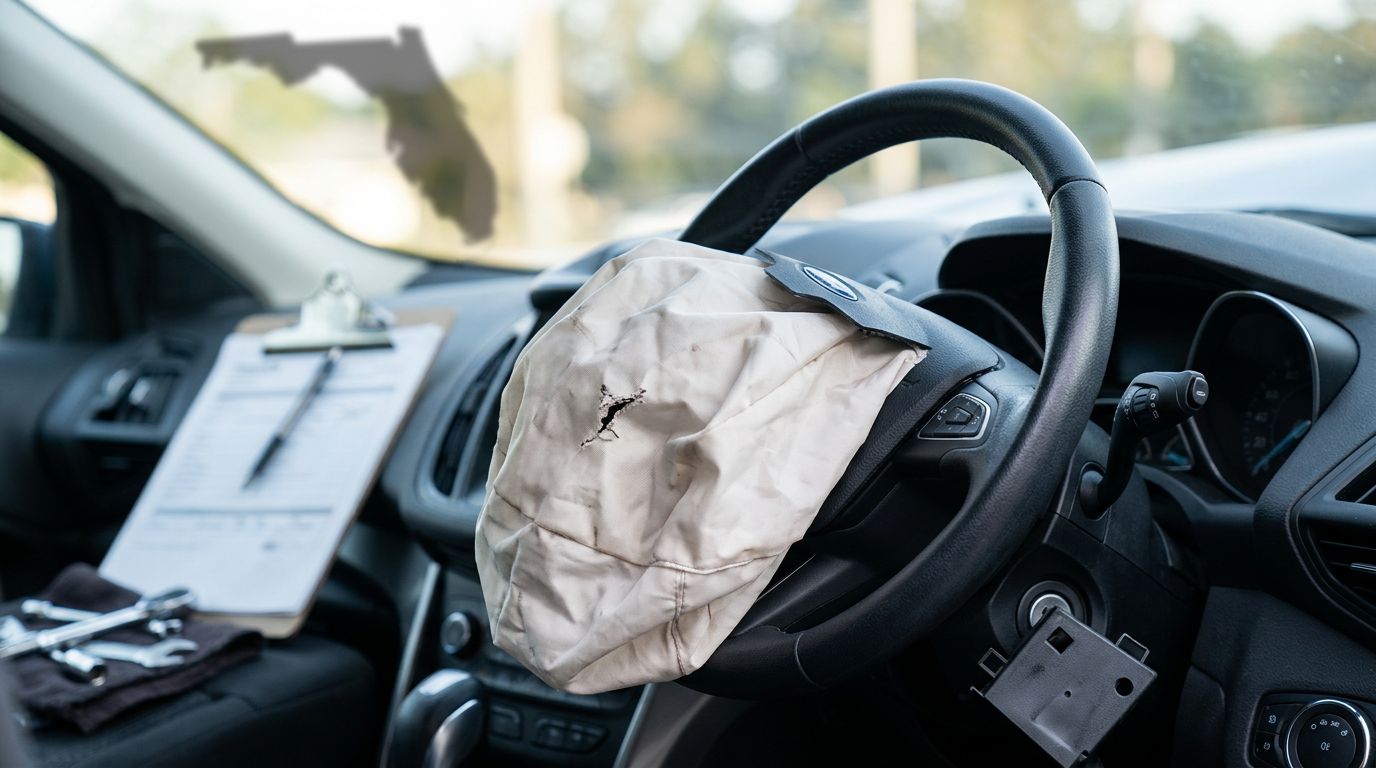
An airbag should reduce the force of a crash, but a defective system can create a second injury inside the vehicle. If the bag fails to deploy, deploys without reason, or ruptures during impact, the resulting claim may involve the driver, vehicle manufacturer, airbag supplier, dealership, or another responsible party.
Florida airbag failure claims often depend on evidence that disappears quickly. The vehicle may be repaired, sold, salvaged, or stripped for parts. Photos can be lost, electronic data can be overwritten, and crucial component records may remain with a manufacturer or insurer. Knowing what to preserve can affect whether the defect can be proven.
Key Takeaways
- Airbag injuries can support a product liability claim when a defect, warning problem, or manufacturing error caused additional harm.
- A vehicle recall can support notice and defect arguments, but a recall alone doesn’t prove legal responsibility.
- The VIN, recall status, repair history, event data, crash photos, and removed airbag components may all matter.
- Florida law imposes deadlines, and the applicable period depends on the legal claims and date of the incident.
- A lawyer may need to preserve the vehicle and inspect the airbag control module before repairs or disposal occur.
When an Airbag Failure Becomes a Legal Claim
An airbag failure isn’t limited to a bag that stays inside the steering wheel. The system includes sensors, an electronic control module, wiring, inflators, deployment algorithms, and, in some vehicles, occupant-classification equipment. A problem with one part can affect the entire safety system.
Several failure patterns may support an investigation:
- Nondeployment: The airbag doesn’t open during a crash that should trigger deployment.
- Late deployment: The bag inflates after the occupant has already moved into a dangerous position.
- Unexpected deployment: The airbag opens during ordinary driving or a minor impact.
- Inflator rupture: The inflator breaks apart and sends metal fragments into the cabin.
- Partial deployment: The bag opens with insufficient pressure or fails to inflate fully.
- Warning system failure: The dashboard light doesn’t alert the driver to a malfunction.
The central legal question is usually whether the airbag system was defective and whether that defect caused additional injury. A collision alone doesn’t prove an airbag defect. Airbags don’t deploy in every crash, and the decision depends on factors such as impact direction, crash severity, seat position, belt use, vehicle design, and sensor data.
A successful case must separate the injuries caused by the original collision from injuries caused or worsened by the airbag problem. Medical records, photographs, biomechanical analysis, and vehicle inspection can help establish that difference.
Florida product liability law may recognize claims based on a manufacturing defect, design defect, inadequate warning, or another failure involving the product’s safety. The facts determine which theory fits. A defective component supplied by another company can also raise questions about the vehicle maker’s responsibility and the supplier’s role.
How Recall Evidence Can Support Your Case
A recall is a formal safety action involving a known or suspected safety defect. The National Highway Traffic Safety Administration maintains a searchable vehicle recall database where owners can check open recalls by vehicle identification number.
Recall records may contain useful information about the alleged problem, affected vehicles, production dates, repair procedures, warning language, and manufacturer communications. They can also show when the manufacturer knew about a defect and what action it took.
However, a recall doesn’t automatically establish that the recalled defect caused your injury. The vehicle must match the recall’s make, model, model year, production range, and affected component. The incident must also involve the problem described in the recall.
For example, a recall involving a passenger-side inflator may not explain a driver’s injuries from a nondeploying steering-wheel airbag. A recall concerning a wiring connector may matter only if the evidence shows that the connector failed in the crash vehicle.
A recall can support several parts of a claim:
- Notice: The manufacturer may have received reports or identified a recurring condition before your crash.
- Causation: The recall description may match the failure observed in your vehicle.
- Defect evidence: The repair procedure may show how the original component differed from the safer replacement.
- Industry records: Complaints, technical reports, and defect investigations may reveal similar failures.
- Damages: The repair history may help explain why the vehicle wasn’t safe to operate after a warning.
A recall that occurred after the crash can still deserve review. Its timing may raise an important question about when the manufacturer learned of the defect. Yet courts may restrict later repairs or safety changes when offered to prove negligence or a prior defect. The admissibility depends on the evidence, the legal theory, and the purpose for which the evidence is offered.
Takata Inflators and Other Recall Patterns
The Takata airbag recall is one of the clearest examples of why recall records matter. Certain Takata inflators used ammonium nitrate propellant that could deteriorate after extended exposure to heat and humidity. When the inflator activated, excessive pressure could cause the metal housing to rupture.
A ruptured inflator can turn the airbag assembly into a source of metal fragments. The injuries may include deep lacerations, eye trauma, damage to the neck or chest, and fatal wounds. NHTSA maintains information about the Takata airbag recall, including affected manufacturers and replacement requirements.
Florida’s heat and humidity can make airbag recall compliance especially important, but weather alone doesn’t prove that a particular inflator failed. The vehicle’s age, location, maintenance history, inflator type, recall status, and physical damage all require review.
Other airbag recalls have involved electronic control modules, faulty sensors, wiring problems, passenger detection systems, and software errors. Some defects can prevent deployment. Others can cause deployment when no serious collision occurred.
A recall search should include more than the vehicle’s current status. Evidence may show that:
- The recall was open when the crash occurred.
- The owner received a notice but couldn’t obtain a timely repair.
- The owner brought the vehicle to a dealer, but the dealer failed to complete the repair.
- The manufacturer marked the repair complete without replacing the affected part.
- A prior owner ignored or never received the notice.
- The vehicle changed ownership before the recall repair occurred.
The recall status on the day of the crash may differ from the status shown today. Save copies of the search results and notices, and keep any letters, emails, text messages, or dealer paperwork.
Evidence That Can Prove an Airbag Defect
The damaged vehicle is often the most important physical evidence. A lawyer may send a preservation demand to the owner, insurer, repair facility, salvage yard, towing company, manufacturer, or dealership. The demand should identify the vehicle and request that no person alter, dismantle, repair, transfer, or dispose of it without notice.
Useful evidence includes:
| Evidence | What it may show |
|---|---|
| Vehicle photographs | Damage, seating position, airbag condition, and cabin debris |
| Airbag module | Whether the bag deployed, tore, burned, or remained intact |
| Inflator and sensor parts | Potential rupture, corrosion, impact damage, or component failure |
| Event data recorder | Speed, braking, seat belt use, and crash-related data |
| Airbag control module | Diagnostic codes and deployment commands |
| Repair estimates | Parts removed, damage noted, and proposed work |
| Dealer records | Recall notices, service visits, and repair history |
| Medical records | Injury pattern and timing after the crash |
| Witness statements | Deployment sounds, warning lights, and occupant movement |
Photographs should show the whole vehicle, the interior, the steering wheel, the dashboard, the seats, the airbags, and any loose material. Close-up images can help document tears, burns, powder, broken plastic, and metal fragments. Take photographs before cleaning the vehicle or removing personal property.
The airbag control module may contain diagnostic information, but the data isn’t self-explanatory. A qualified investigator may need to download it using appropriate equipment and document the process. Removing or testing a module without preserving its condition can create disputes about the evidence.
The event data recorder may provide information about the seconds before impact. It doesn’t answer every question, and access can depend on the vehicle and the crash circumstances. Still, it may help establish impact severity, speed, belt use, and whether the vehicle recorded a deployment command.
Medical evidence must connect the product failure to the injury. A fractured hand, facial injury, eye trauma, chest injury, or neck wound may be consistent with certain airbag failures, but an attorney and medical professionals must compare the injury pattern with the crash dynamics. Records should identify symptoms that appeared immediately, treatment received, and any change in the diagnosis after imaging or surgery.
Proving the Crash and the Defect Together
Product cases require more than showing that an airbag malfunctioned. The evidence must connect the malfunction to the harm. That usually requires analysis of the crash, the vehicle, the occupant’s position, and the airbag system.
A crash reconstruction professional may examine vehicle deformation, crush measurements, roadway evidence, photographs, event data, and statements. The analysis can help determine the direction and severity of the impact. It may also show whether the impact should have produced a deployment under the manufacturer’s design.
An engineer or other qualified specialist may inspect the airbag assembly and related components. The inspection may identify a torn cushion, failed inflator, damaged wiring, corrosion, altered module, missing parts, or evidence of prior repair. The specialist may compare the component with recall documents, technical specifications, and exemplar parts.
The defense may argue that the airbag worked as designed. It may contend that the impact was below the deployment threshold, that the occupant was out of position, that the seat belt changed the movement, or that the injuries came from the collision itself. Those arguments make early evidence preservation important.
The vehicle’s repair history also matters. Prior body work may have affected sensors, wiring, or the airbag control module. A prior collision can create a separate causation issue. Service records may show whether a replacement part was installed, whether a warning light remained on, or whether a technician documented a diagnostic code.
An airbag warning light deserves attention. If the light appeared before the crash, the defense may argue that the driver knew the system had a problem. The evidence may instead show that the warning appeared only after the collision. Dashboard photographs, inspection records, text messages, and witness statements can help establish the timing.
Who May Be Responsible for an Airbag Injury?
The correct defendant depends on the evidence and the product’s history. Potential parties can include the vehicle manufacturer, airbag supplier, dealership, repair facility, used-car seller, or another driver whose conduct caused the crash.
A vehicle manufacturer may face a claim involving the design, assembly, warnings, software, or failure to address a known defect. An airbag supplier may be responsible for an inflator or other component. A dealership may face separate issues if it performed an improper repair or failed to complete a known recall service.
A repair shop can create a new problem by installing the wrong component, failing to reconnect a sensor, or returning a vehicle with an airbag warning light. The shop’s records, invoices, photographs, and technician notes can help identify what happened.
The crash may also involve another driver’s negligence. In that situation, the injured person may have claims against the at-fault driver and a product claim involving the vehicle. Florida’s comparative negligence rules can affect recovery when multiple causes contributed to an injury. Insurance coverage, fault allocation, and the date of the claim all require separate analysis.
Manufacturers and insurers often have access to technical teams early in the process. They may inspect the vehicle before the injured person hires a lawyer. An owner should avoid authorizing destructive testing or signing a release that covers product claims without understanding what rights the document affects.
A recall doesn’t decide which party pays. The legal analysis must address the defect, notice, causation, responsibility for the component, and the damages caused by the failure.
What to Do After an Airbag Failure Crash
If you were hurt in a crash involving an airbag problem, seek medical care first. Tell the medical provider that the airbag failed to deploy, deployed unexpectedly, or caused a specific injury. The first treatment records may contain details that later become important.
Next, preserve the vehicle and evidence. Don’t send it to a salvage yard, authorize repairs, or allow the insurer to dispose of it until an attorney has reviewed the situation. If the vehicle must be moved, record its condition before towing and identify the storage location.
Gather documents that may show the vehicle’s history:
- The vehicle identification number
- Purchase, lease, and registration documents
- Insurance information
- Recall notices and dealer communications
- Service invoices and inspection records
- Crash reports and photographs
- Medical bills and treatment records
- Employer records showing missed work
- Names of witnesses and responding officers
Avoid posting detailed statements or photographs about the crash on social media. Don’t guess about speed, fault, or the airbag system in recorded statements. Provide necessary information to your insurer, but obtain legal advice before discussing a potential product claim with a manufacturer or its representatives.
You can check recall information through NHTSA, but an online result isn’t a substitute for preserving the physical component. Save the result as a PDF or screenshot with the date, VIN search, recall number, and repair status.
Florida’s statute of limitations for civil actions can restrict the time available to file suit. Different claims may involve different rules, and exceptions can apply. Because investigation and expert review take time, waiting until the deadline approaches can weaken the case.
How an Attorney Evaluates Florida Airbag Failure Claims
A product liability attorney usually starts by identifying the vehicle, the airbag system, the crash date, and the injury pattern. The attorney then looks for recall records, prior complaints, service documents, photographs, and available electronic data.
The next step may involve sending preservation letters and arranging a vehicle inspection. The attorney may retain a crash reconstruction professional, automotive engineer, medical expert, or other specialist. The necessary experts depend on the disputed issues. A case involving a ruptured inflator may require a different investigation than one involving a nondeploying airbag.
The attorney also reviews insurance coverage and possible defendants. Product cases may involve manufacturers located outside Florida, multiple insurers, contractual indemnity issues, or federal safety records. Those details can affect where and how a lawsuit proceeds.
Damages may include emergency care, surgery, rehabilitation, medication, future medical treatment, lost income, reduced earning ability, pain, disability, scarring, and other losses recognized under Florida law. The claim should focus on the harm tied to the defect, not assume every injury came from the airbag.
Early legal review can also prevent evidence problems. Once a vehicle is destroyed or altered, later experts may have to rely on photographs and records instead of examining the original component. That limitation can affect opinions about deployment, timing, and causation.
A free case evaluation can help determine whether the facts support further investigation. Bring the VIN, photographs, recall information, crash report, medical records, and repair documents if available.
Conclusion
An airbag failure can change the legal analysis of a crash because the vehicle’s safety system may have added to the harm. Recall records can help show a pattern, notice, or possible defect, but they must be matched to the vehicle, component, crash, and injury.
Preserve the vehicle, save every recall and service record, document the injuries, and act before evidence disappears or a filing deadline expires. In Florida airbag failure claims, the strongest cases usually begin with careful protection of the physical evidence.