
Florida Surgical Stapler Claims: Preserve the Device
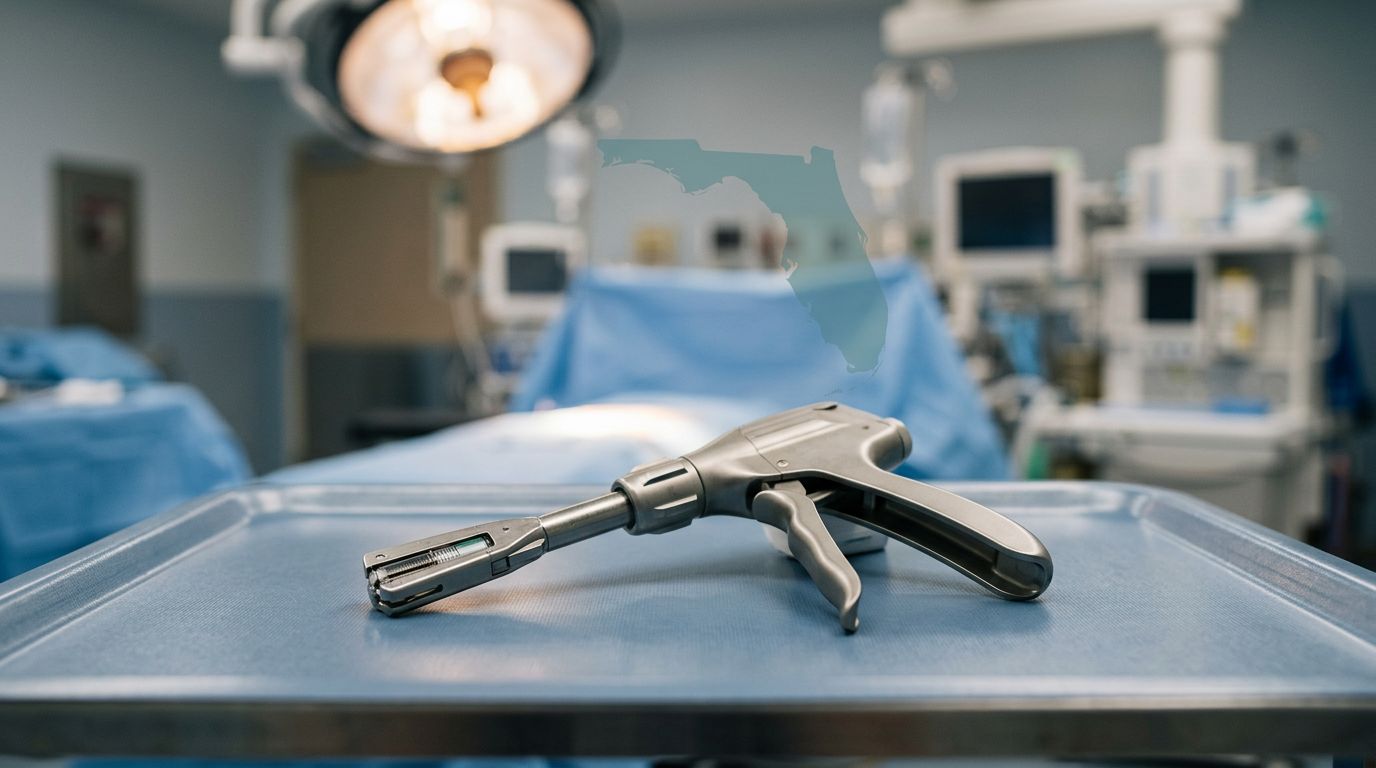
A surgical stapler can turn a routine operation into a medical emergency when it misfires, forms an incomplete staple line, or gets used on tissue it cannot safely hold. The resulting injuries may include internal bleeding, leaks, infections, organ damage, emergency surgery, and death.
If you or a family member suffered harm, preserving the stapler and related evidence can affect the entire claim. Hospitals may discard disposable devices, manufacturers may request the device for testing, and important records can become harder to obtain with time. Florida law also imposes deadlines that vary by the legal claims involved.
Key Takeaways
- A surgical stapler injury claim may involve medical negligence, product liability, or both.
- Preserve the stapler, reloads, packaging, lot information, photographs, records, and removed tissue when available.
- Ask the hospital and surgeon in writing to retain the device, operating-room records, incident reports, and electronic data.
- Florida medical negligence and product liability deadlines differ, and presuit requirements may apply.
- Do not return the device to a manufacturer or sign a release before a lawyer reviews the request.
How surgical stapler injuries happen
Surgeons use staplers to close tissue, connect sections of the digestive tract, remove tissue, or control blood vessels. These devices can save time and reduce the number of hand-placed sutures. They also require the correct cartridge, tissue thickness, compression, angle, and firing technique.
A problem can occur when staples fail to form correctly or fail to hold the tissue together. The stapler may jam, fire only partially, misalign with the intended tissue, or produce a staple line that leaks. Sometimes the device works as designed, but the wrong reload or an unsuitable technique causes injury. The medical records and physical evidence must show what happened.
The FDA reported more than 41,000 medical device reports involving surgical staplers and staples between January 1, 2011, and March 31, 2018. Those reports included deaths, serious injuries, and device malfunctions. The reports do not prove that every injury resulted from a defective product, but they show why these cases require careful investigation. The FDA’s surgical stapler safety information describes the agency’s concerns and recommendations.
Common complications include:
- Internal bleeding or hemorrhage
- Leakage at a bowel or stomach connection
- Peritonitis and other serious infections
- Sepsis
- Damage to the intestine, stomach, liver, blood vessels, or nearby organs
- Tissue tearing or failure to heal
- Emergency surgery or extended hospitalization
- Permanent disability or death
A complication alone doesn’t establish negligence or a defective device. Surgical procedures carry known risks, and some patients experience complications despite appropriate care. A viable claim requires evidence connecting the device, the medical care, or both to the injury.
That distinction matters because Florida surgical stapler claims often involve several parties. The surgeon or facility may be responsible for negligent selection, placement, firing, or follow-up care. A manufacturer may face a product liability claim if the stapler had a design defect, manufacturing defect, or inadequate warning. Each theory requires different proof.
Why preserving the stapler matters
The physical device may answer questions that medical records cannot. A lawyer or engineer may need to examine whether the stapler fired, whether the staples formed properly, whether the cartridge matched the device, and whether a mechanical failure occurred.
Once a hospital discards the stapler, independent examination may become impossible. A written operative report may say that the device “fired normally,” but the report may not reveal whether one staple was malformed or whether the device jammed during the procedure. The actual stapler, reload, or cartridge can provide evidence that a later summary cannot replace.
Preservation also protects against disputes about what happened. A manufacturer might claim that the surgeon used the product incorrectly. The surgeon might say the device malfunctioned. Without the device and the operating-room records, the parties may rely on incomplete recollections.
Evidence can also disappear through routine hospital practices. Facilities may discard disposable equipment as regulated medical waste. Staff members may complete incident reports that never become part of the patient’s ordinary chart. Electronic records can contain time stamps, barcode scans, supply logs, and notes that change after the initial procedure.
A surgical stapler may be small, but its evidentiary value can be substantial. Treat it as potential evidence from the moment a serious complication occurs.
Preservation doesn’t mean you should remove equipment from a hospital or interfere with patient care. If the device remains at the facility, ask the hospital’s risk-management department, patient-safety office, or medical-records department to preserve it. If the facility gives you physical possession, keep it in its existing condition and ask counsel how to store and transfer it.
Do not clean, disassemble, test, bend, or attempt to fire the stapler. Avoid handling it more than necessary. Place related packaging and reloads in separate clean containers if they are already in your possession, and record where each item came from.
What to preserve after a stapler injury
Start with the device itself, but don’t stop there. The surrounding evidence can show which product the surgical team used, how it was handled, and when the complication developed.
Preserve these materials whenever you can obtain them lawfully:
- The stapler and reloads
Keep the stapler, cartridges, staple lines, and any related disposable components. A cartridge can identify the size, configuration, and lot number. - Packaging and labels
Save boxes, sterile packaging, barcodes, implant stickers, UDI information, lot numbers, and serial numbers. Photograph each label before handling it. - Medical records
Request the operative report, anesthesia record, nursing notes, medication administration record, discharge summary, imaging, pathology, laboratory results, and records from every corrective procedure. - Operating-room materials
Ask for the device log, supply record, barcode scans, preference card, implant or equipment record, nursing count sheet, and any record identifying the surgeon, assistants, and staff present. - Photographs and video
Keep photographs of incisions, drains, wounds, bruising, swelling, infection, and visible medical equipment. Preserve the original files and their metadata when possible. - Follow-up evidence
Maintain records of additional surgeries, hospitalizations, rehabilitation, prescriptions, home-health services, work restrictions, and continuing symptoms. - Communications
Save emails, text messages, patient-portal messages, letters, and notes from conversations with the hospital, surgeon, device company, or insurer.
A simple evidence log can help. Record the item, the date you obtained it, who had it before you, where you stored it, and every person who later received it. This chain of custody helps show that the item is the same device used during the procedure.
| Evidence | Questions it may help answer |
|---|---|
| Stapler and cartridge | Did the device fire, jam, or contain a visible defect? |
| Lot and serial information | Which product and production batch did the hospital use? |
| Operative report | What procedure, technique, and complication did the surgeon document? |
| Device and supply logs | Which reload was opened and when? |
| Imaging and pathology | What injury occurred, and what tissue required repair or removal? |
| Corrective surgery records | When did the complication appear, and what did the next surgeon find? |
If the stapler remains with the hospital, your attorney can request its preservation and arrange a controlled inspection. That process should identify who possesses the device, how it is stored, and whether anyone has altered or tested it.
How to request preservation from a Florida hospital
A phone call may alert the facility, but a written request creates a clearer record. Send the request to the hospital’s risk-management department and medical-records department. Include the patient’s name, date of birth, procedure date, surgeon, facility, and a short description of the complication.
Ask the hospital to preserve:
- The surgical stapler, cartridge, reloads, and packaging
- All device, lot, serial, barcode, and inventory information
- The operative report and anesthesia records
- Nursing notes and operating-room records
- Patient-safety reports and internal incident reports
- Photographs, videos, imaging, pathology, and specimen records
- Electronic audit trails and amended medical records
- Communications with the manufacturer or distributor
- Policies, training materials, and instructions applicable to the device
Use clear language. State that the materials relate to a potential claim and must not be discarded, altered, returned, tested, or transferred without notice. Keep a copy of the request and proof of delivery.
Hospitals may respond that an incident report is privileged, confidential, or not part of the medical chart. That response doesn’t end the inquiry. Other records may contain the same facts, including device logs, nursing notes, emails, purchase records, and communications with the manufacturer. A lawyer can determine which materials can be requested through formal discovery.
Manufacturers sometimes contact patients after a reported complication. The company may offer to inspect the stapler or ask for its return. Do not assume that a free inspection protects your interests. Before releasing the device, ask for a written description of the proposed testing, photographs, sample retention, chain-of-custody procedures, and a complete copy of all test results.
A release may also waive claims or allow the company to use the device without preserving evidence. Let a Florida attorney review any proposed form before you sign it.
Florida legal theories and filing deadlines
Florida surgical stapler claims commonly fall into two broad categories. The first involves the healthcare providers or facility. The second involves the manufacturer, distributor, or seller.
A medical negligence claim may arise if a healthcare provider failed to meet the applicable standard of care. Examples might include choosing an unsuitable stapler, using the wrong reload, applying excessive force, failing to recognize a misfire, or delaying treatment after signs of bleeding or leakage appeared. Expert medical testimony often plays a central role.
Florida generally requires a claimant to complete a presuit investigation before filing a medical negligence lawsuit. Under Florida’s medical negligence statute, a claimant must have a reasonable basis for the claim and follow notice procedures that give the prospective defendant an opportunity to respond. The Florida medical negligence presuit statute contains important procedural requirements.
A product liability claim focuses on the device rather than only on the provider’s conduct. Potential theories include:
- Design defect, when the product’s design creates an unreasonable danger even when manufactured correctly
- Manufacturing defect, when a particular unit differs from its intended design
- Failure to warn, when instructions or warnings don’t adequately explain known risks or safe use
- Negligent marketing or distribution, depending on the facts and the parties involved
- Breach of warranty, when express or implied promises about the product were not met
A product claim still requires proof of causation. The claimant must connect the product condition or warning problem to the injury. The manufacturer may argue that the product was used improperly, that the injury resulted from an unavoidable medical risk, or that another condition caused the complication.
Time limits create another concern. Florida generally applies a four-year limitations period to many negligence and product liability claims. Medical negligence claims often involve a two-year period tied to when the patient knew, or should have known, of the injury and its possible medical cause, along with a four-year statute of repose. Wrongful death claims generally have a two-year deadline. The exact calculation can change because of the claim type, discovery facts, concealment, age, incapacity, and other circumstances.
The Florida statute of limitations provisions should be read with the presuit rules and the facts of the case. A preservation letter doesn’t extend a filing deadline. Contacting an insurer or filing an FDA report doesn’t preserve a civil claim either.
An attorney can analyze claims against each party, calculate the deadlines, arrange the medical review, and handle required notices. A firm such as Avard Law Offices can evaluate whether the facts support a Florida medical malpractice or personal injury case.
How lawyers investigate stapler injury claims
The investigation usually begins with the medical timeline. Counsel will compare the preoperative condition, procedure, first symptoms, diagnosis, corrective treatment, and current limitations. The timing can help show whether the injury began during the stapling procedure or developed from another cause.
Medical experts may review the operative technique, tissue condition, device selection, staple formation, and response to the complication. A biomedical engineer or other product expert may examine the device, cartridge, technical specifications, warnings, recall history, and prior complaint data.
The FDA’s MAUDE adverse-event database contains reports involving medical device injuries and malfunctions. A search can identify reports involving a product family, manufacturer, or model. MAUDE reports are not a final finding that a device caused an injury. They are one source of information for an attorney and expert.
Counsel may also seek:
- The manufacturer’s design and testing records
- Complaint files and prior adverse-event reports
- Recall and corrective-action information
- Instructions for use and training materials
- Sales, distribution, and lot-traceability records
- Hospital contracts and purchasing records
- Communications between the facility and manufacturer
The injury’s financial effects require separate documentation. Keep wage records, tax documents, employment restrictions, medical bills, insurance statements, travel expenses, and receipts for necessary care. Damages may include past and future medical expenses, lost income, reduced earning capacity, physical pain, emotional distress, disfigurement, and loss of normal activities. Wrongful death cases may involve funeral costs, lost support, and the losses allowed under Florida’s wrongful death law.
Do not estimate future losses from memory alone. Medical and economic experts may need to calculate the cost of lifelong treatment, additional surgeries, or reduced work capacity.
What to do after a surgical stapler complication
Get emergency care first. Severe abdominal pain, fainting, rapid heartbeat, fever, swelling, vomiting, black or bloody stool, drainage, or worsening weakness may require immediate attention. Follow the treating physician’s instructions and tell every provider that a surgical stapler was used.
Request your complete medical records as soon as practical. Ask the facility how it identifies device information and whether the stapler or cartridge remains available. Keep a written timeline with dates, symptoms, calls, diagnoses, procedures, and time missed from work.
Don’t post detailed allegations or photographs on social media. Avoid recorded statements to a device manufacturer, hospital insurer, or liability carrier before receiving legal advice. You can report a suspected device problem through the FDA’s MedWatch reporting system, but that report doesn’t create a claim for compensation and doesn’t replace the preservation steps above.
A lawyer may need to act quickly because the hospital could discard the device, staff memories can fade, and relevant electronic records can change. Early advice also helps prevent an accidental release of the physical evidence or an incomplete account of the medical history.
Conclusion
A serious complication after surgical stapling doesn’t automatically prove malpractice or a defective product. It does create a reason to preserve evidence before the device, packaging, records, and operating-room data disappear.
Keep the stapler and related materials in their existing condition, request written preservation from the hospital, protect your medical records, and watch the Florida deadlines. The strength of Florida surgical stapler claims often depends on what investigators can examine and prove, not only on what the final medical record says.