
Florida Guardrail Failure Claims After Cross-Median Crashes
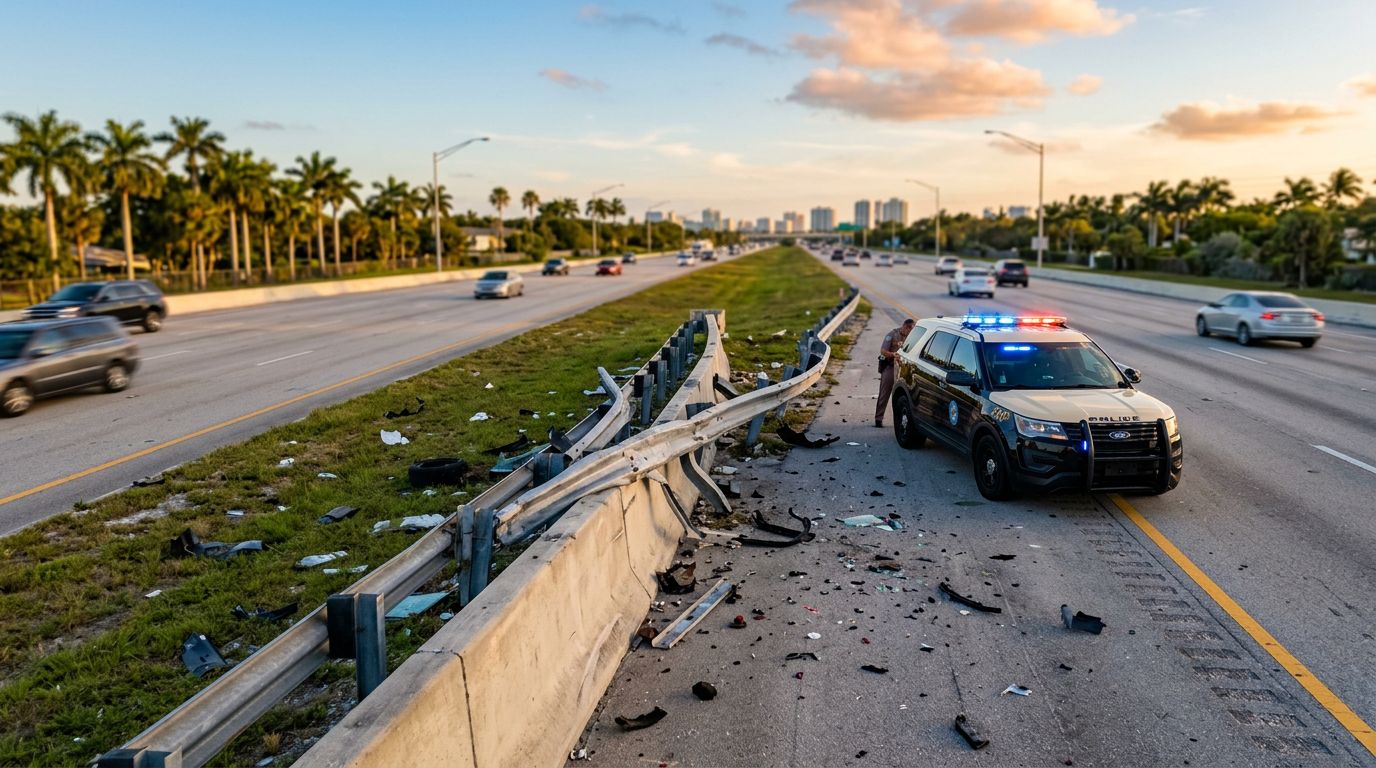
A guardrail can be the last barrier between a driver and oncoming traffic. When it fails during a cross-median crash, the resulting injuries may involve more than the driver who caused the initial impact.
Florida guardrail failure claims require proof about the roadway, the barrier’s condition, the crash forces, and the actions of agencies or contractors responsible for the road. The evidence can disappear quickly after a collision, so early investigation matters.
Key Takeaways
- A failed guardrail may involve poor design, improper installation, missing parts, delayed repairs, or a damaged barrier that remained in service.
- Photos alone rarely prove liability. Crash reconstruction, roadway records, maintenance files, and component testing may all matter.
- Potential defendants can include a government agency, maintenance contractor, road designer, guardrail manufacturer, or another driver.
- Florida’s filing deadlines, comparative negligence rules, insurance requirements, and public-entity procedures can affect the value and timing of a claim.
- Injured drivers should preserve medical records, insurance information, photographs, vehicle evidence, and all available crash documentation.
Why a Cross-Median Crash Can Point to Guardrail Liability
A cross-median crash occurs when a vehicle leaves its travel lane, crosses a median, and enters opposing traffic. The first vehicle may lose control after speeding, distraction, impairment, a tire failure, or another collision. Yet the injuries to people in oncoming vehicles may depend on whether the median barrier contained or redirected that vehicle.
Roadside barriers have defined purposes. A cable barrier, concrete median, steel guardrail, or transition system is designed for particular road conditions and impact forces. Each system also has limits. A barrier isn’t automatically defective because a vehicle went through it.
The central question is whether the barrier performed as required under the circumstances. An investigation may examine the vehicle’s speed, angle, size, weight, point of impact, and direction of travel. It may also examine the barrier’s height, length, end treatment, posts, connections, anchors, soil support, and distance from the travel lanes.
A guardrail can fail in several ways. It may tear loose from its posts, fold around a vehicle, allow a vehicle to vault over it, or direct the vehicle into traffic instead of away from it. A blunt or exposed end can create a separate hazard. A damaged section may also fail because workers repaired it with the wrong parts or left it without adequate protection.
The fact that a barrier failed doesn’t prove negligence by itself. The injured driver must connect the failure to a legal duty and to the harm suffered. That connection often depends on evidence that isn’t visible in the final crash scene.
What Counts as Guardrail Failure Evidence?
Evidence in these cases has two jobs. First, it must show what happened to the barrier. Second, it must help establish why that condition existed and whether it caused or worsened the injuries.
Physical evidence from the crash scene
Photographs and video can show the barrier’s condition before repairs or removal. Useful images may capture the full median, damaged posts, broken bolts, cable tension, guardrail height, terminal ends, tire marks, debris, and the path taken by each vehicle.
The location of damaged parts matters. Investigators may map where posts came out of the ground, where rail sections separated, and where vehicles crossed the median. Measurements can help determine whether the barrier had enough length and support to contain the vehicle.
The guardrail itself should be preserved when possible. So should broken bolts, posts, brackets, cables, terminal components, and pieces found inside or near the vehicle. Those parts may later be inspected, measured, photographed, or tested.
A vehicle also contains evidence. Damage patterns can show the impact angle and sequence. The event data recorder, often called an EDR, may contain information about speed, braking, seat belt use, throttle position, and other conditions immediately before a crash. The National Highway Traffic Safety Administration’s EDR information describes how these devices record crash-related data.
Roadway design and maintenance records
A road agency may hold plans, specifications, inspection reports, work orders, repair invoices, and contracts for the median barrier. Those records can reveal whether the barrier matched the approved design and whether workers identified earlier damage.
Important records may include:
- Original roadway plans and as-built drawings
- Guardrail or cable-barrier installation specifications
- Inspection and maintenance logs
- Reports of prior crashes at the same location
- Work orders for damaged posts, cables, terminals, or rail
- Contractor agreements and repair standards
- Complaints from drivers or nearby residents
- Photographs taken during roadway inspections
- Records showing when the agency learned about a hazard
Public records can take time to obtain. A lawyer may send a preservation request and seek records through Florida’s public-records process. Delay can matter because electronic files, vehicle data, surveillance video, and repair records may be overwritten or discarded.
Expert analysis
A qualified crash-reconstruction expert can calculate vehicle paths, impact angles, speeds, and the sequence of impacts. A highway-safety or barrier expert can evaluate whether the system was appropriate for the median and whether it was installed or maintained correctly.
The expert may compare the actual barrier with the applicable version of the Florida Department of Transportation Design Standards. The relevant standard depends on the road, project date, barrier type, installation date, and later modifications.
Experts don’t replace the underlying evidence. Their opinions are stronger when they can inspect physical components, review reliable measurements, and explain the connection between the barrier condition and the injuries.
Common Causes of Guardrail Failure in Florida
Guardrail failure claims can involve one error or several conditions acting together. The following issues often deserve investigation.
Improper installation
A guardrail may fail when posts are set at the wrong spacing or depth. Soil conditions can also affect how well posts hold during impact. Missing washers, incorrect bolts, loose connections, and incompatible components can weaken the system.
Installation records may show whether the contractor followed the approved specifications. Photographs from the construction period can be useful if they show post placement, terminal assembly, or the condition of the median before the road opened.
Poorly selected or placed barrier
A barrier must fit the roadway and the hazard it is meant to protect. A system may be unsuitable for a narrow median, steep slope, drainage feature, bridge approach, or high-speed road. The barrier also needs enough length to protect the hazard and enough room to redirect a vehicle safely.
The terminal and transition areas need separate review. A guardrail that ends before the hazard, connects poorly to a bridge rail, or presents an exposed end may create a serious risk.
Delayed repair after an earlier crash
A previous collision can bend rail, pull posts from the ground, break cables, or damage anchors. If the agency or contractor knew about the damage but failed to repair it within a reasonable time, that history may support a negligence claim.
The timing matters. A barrier damaged moments before the later crash may present a different legal issue than one left unrepaired for weeks. Work orders, dispatch records, inspection logs, and photographs can help establish what the responsible party knew.
Incorrect repair or replacement
Repairs must match the system. Mixing components from different manufacturers or using a substitute part can affect how the barrier absorbs and redirects impact. A repair that looks complete may still lack the strength or geometry required by the design.
The investigation should identify who performed the repair, what parts were used, when the work occurred, and whether anyone inspected it afterward.
Product or manufacturing defects
A component may break because of a manufacturing defect, a design problem, corrosion, or a material issue. Product liability claims require a different analysis than negligence claims against a roadway agency.
The injured driver’s lawyer may need to preserve the failed part and identify its manufacturer, model, lot, installation history, and maintenance records. Altering or discarding the component can make later testing difficult.
Who May Be Responsible for a Failed Median Barrier?
Responsibility depends on ownership, control, notice, and the specific failure. Several parties may share legal responsibility.
A state agency, county, municipality, or transportation authority may have duties involving roadway design, inspection, maintenance, and repair. The agency may not be responsible for every roadway defect, but records can show whether it had notice of a dangerous condition and had a reasonable opportunity to address it.
A private contractor may have installed the barrier, performed maintenance, or handled repairs under a government contract. Contract documents can identify the required work and the contractor’s responsibility for inspection or correction.
A design firm may face a claim if it selected or designed a system that failed to meet applicable requirements. A manufacturer may be involved when a component contained a design or production defect.
The driver who crossed the median can also be liable. That does not automatically eliminate a claim against another responsible party. Florida generally reduces damages according to each party’s percentage of fault, subject to the state’s modified comparative negligence rule. Under Florida’s comparative negligence statute, a claimant found more than 50 percent at fault for the harm can’t recover damages in a negligence action.
Insurance may come from more than one source. The at-fault driver’s bodily injury coverage, the injured person’s uninsured or underinsured motorist coverage, and applicable commercial or governmental policies may all require review. Personal injury protection benefits may also pay certain initial medical expenses, regardless of fault.
Florida Deadlines and Public-Entity Rules
Time limits can control whether an otherwise valid claim moves forward. Florida’s general personal injury deadline changed for many claims arising after March 24, 2023. The Florida statute of limitations for civil actions contains the current periods and exceptions.
The date of the crash isn’t the only issue. Wrongful-death claims, claims involving minors, delayed discovery, and other legal circumstances can affect the deadline. A lawyer should review the accident date and the nature of each claim rather than relying on a general rule.
Claims against a public agency require added care. Florida’s sovereign-immunity statute contains rules about notice, claim presentation, litigation timing, and damage limits. The Florida sovereign-immunity statute should be reviewed with the facts of the case because public-entity procedures differ from an ordinary claim against a private driver.
A notice requirement can arise before a lawsuit. The correct agency, department, or entity must receive the claim through the required process. Sending information to the wrong office or waiting until the deadline passes can create a serious problem.
Fault also affects damages. A defense may argue that the injured driver was speeding, distracted, failed to wear a seat belt, or could have avoided the impact. The defense must support those arguments with evidence. A cross-median crash reconstruction can show whether the driver’s conduct had any connection to the injuries caused by the failed barrier.
How Lawyers Investigate a Florida Guardrail Claim
A careful investigation usually begins with preservation. Counsel may send letters to the agency, contractor, insurer, vehicle owner, and manufacturer demanding that relevant evidence be retained. The request can cover the barrier, vehicles, EDR data, photographs, video, inspection records, digital communications, and repair materials.
The crash report is an important starting point, but it is not the complete investigation. The Florida Highway Safety and Motor Vehicles crash-report page explains how reports may be requested. The report may identify the roadway, vehicles, witnesses, citations, and initial observations, but it may not answer why the barrier failed.
A lawyer may then obtain:
- Scene photographs and measurements
- 911 calls and dispatch records
- Traffic-camera or business surveillance video
- Vehicle inspection and EDR downloads
- Medical records and bills
- Insurance policies and claim communications
- Roadway plans and maintenance histories
- Prior crash and complaint records
- Contractor and manufacturer documents
The legal team may inspect the roadway before repairs alter it. Experts can photograph the median, survey the barrier line, examine soil and slope conditions, and compare the installed system with the applicable plans.
Medical evidence must connect the crash to the injuries. Emergency records, imaging studies, surgical reports, rehabilitation notes, and physician opinions can show the extent of physical harm. Lost wages, reduced earning capacity, household limitations, and future care may also affect damages.
The investigation should also separate injuries caused by the initial vehicle impact from injuries caused or worsened by the barrier. That distinction can affect how fault is assigned. A person can suffer one injury when another vehicle strikes the car and a second injury when the car is forced through a defective barrier.
What Injured Drivers Should Do After the Crash
Your first priority is medical care and immediate safety. Once you can do so, preserve information before the roadway is cleaned or repaired.
Keep copies of the crash report, citations, tow records, insurance correspondence, medical bills, and work-loss documents. Save photographs in their original form and record when and where each image was taken. Ask witnesses for contact information if you can do so safely.
Don’t authorize destruction, salvage, or repairs that could remove evidence from your vehicle before the insurer and a lawyer can inspect it. If the vehicle must be repaired, ask for photographs and a written record of every replaced component.
Avoid giving a recorded statement about guardrail responsibility before you understand the facts. Tell the truth about what you remember, but don’t guess about speed, distance, or the barrier’s condition. Memories can change after a traumatic collision, while physical evidence may provide more reliable answers.
Keep a short recovery journal. Note pain levels, medical restrictions, missed work, medication effects, and tasks you can’t perform. This record won’t replace medical documentation, but it can help show how the injuries affect ordinary life.
Finally, speak with a Florida personal injury attorney promptly. The lawyer can identify possible defendants, preserve evidence, review insurance coverage, and determine whether public-entity deadlines apply. A delay can make it harder to inspect the barrier and obtain records before they disappear.
Compensation in a Guardrail Failure Case
A successful claim may seek payment for medical treatment, rehabilitation, prescription costs, lost income, reduced future earning ability, property damage, and pain and suffering. The available damages depend on the injuries, proof of fault, insurance coverage, and the parties involved.
Serious injuries can require long-term care. Spinal cord injuries, traumatic brain injuries, fractures, internal injuries, and permanent scarring may affect work and daily activities for years. Medical opinions can help estimate future treatment and functional limitations.
Wrongful-death claims follow different rules. Surviving family members may pursue damages allowed by Florida law, including certain medical and funeral expenses, lost support, and losses related to the deceased person’s companionship. The proper claimant and deadline require individual review.
A settlement offer should be measured against the evidence, not only the current medical bills. Early offers may arrive before doctors know whether surgery, additional therapy, or permanent restrictions will be necessary. A lawyer can assess liability and damages together before advising on settlement.
No recovery is guaranteed. A claim may face disputes about the driver’s conduct, the barrier’s design, the timing of notice, expert opinions, or governmental protections. Strong documentation gives the case a fair basis for negotiation or litigation.
Conclusion
A cross-median crash can begin with one driver’s mistake, yet a failed barrier may increase the injuries suffered by people in the opposite lanes. Guardrail failure evidence must show the barrier’s condition, the responsible party’s duty, and the connection between the failure and the harm.
Preserve the vehicle and barrier evidence, obtain the crash records, document medical treatment, and address Florida deadlines early. When the roadway itself may have contributed to the collision, a prompt investigation can reveal facts that a standard crash report never captures.