
Florida Playground Injury Claims: Why Inspection Records Matter
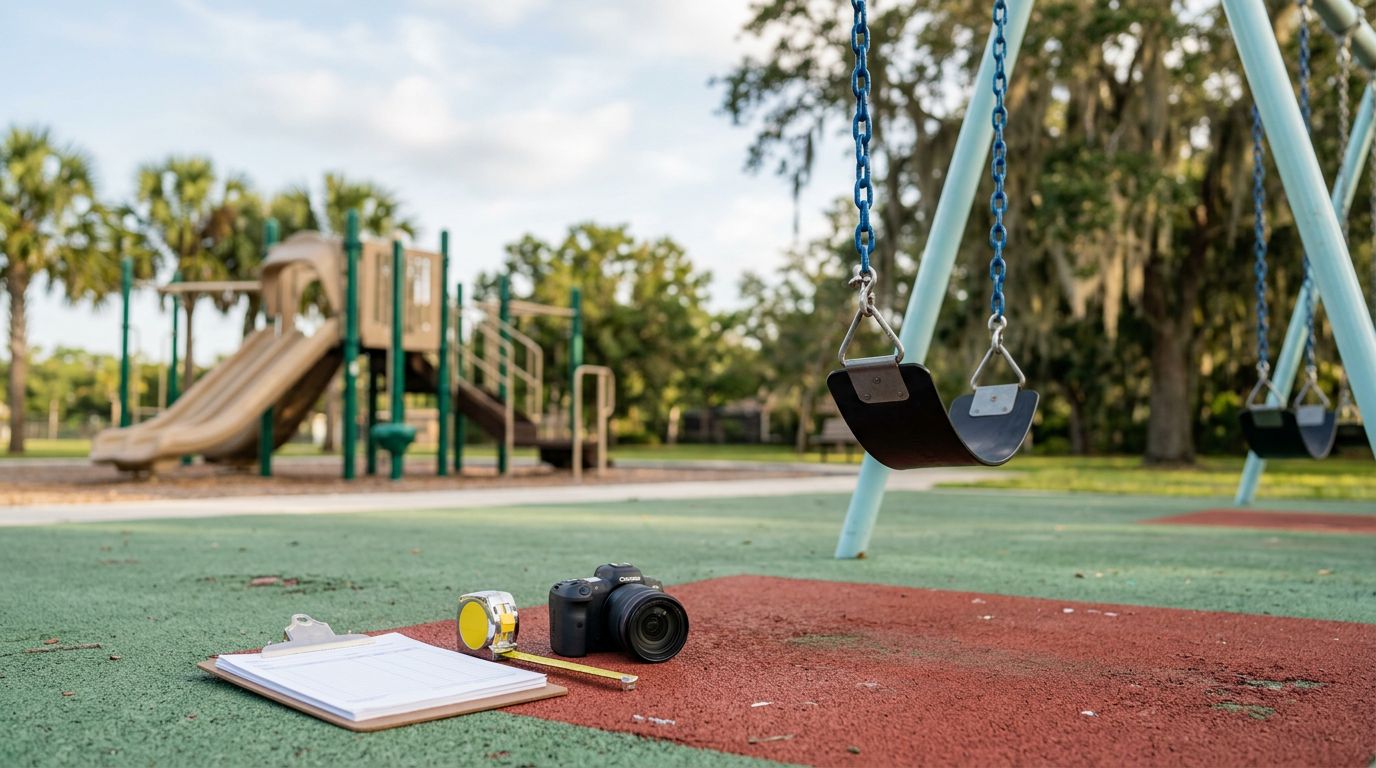
A playground injury can happen in seconds, but proving who caused it may take careful investigation. A broken fastener, worn-out safety surface, or ignored complaint can turn ordinary play equipment into a serious hazard.
Florida playground injury claims often depend on records that show what the owner knew, when inspections occurred, and whether anyone corrected the problem. Those records can help connect the unsafe condition to your child’s injury and resulting losses.
Key Takeaways
- Playground owners must use reasonable care to maintain equipment and address known hazards.
- Inspection records can show prior notice, delayed repairs, repeated defects, or weak safety practices.
- Florida applies different rules to public parks, schools, daycares, HOAs, apartment complexes, and private businesses.
- Parents should report the injury, photograph the area, preserve documents, and request records quickly.
- Claims involving public entities may have special notice rules, deadlines, and damage limits.
Who May Be Responsible for a Florida Playground Injury?
The responsible party depends on who controlled the playground and what caused the injury. Ownership matters, but control and maintenance duties matter just as much.
A city or county may face a claim after an injury at a public park. A school district may be responsible for unsafe equipment or poor supervision at a school playground. A daycare, apartment complex, church, restaurant, or private club may also have a duty to keep its play area reasonably safe.
Florida negligence claims generally require proof of four facts:
- The defendant owed the child a duty of care.
- The defendant failed to act reasonably.
- That failure caused the accident.
- The child suffered actual harm and losses.
For example, a playground owner might know that a swing chain has a damaged link but leave it in service. A child then falls when the chain breaks. A maintenance request, inspection entry, or employee email about the chain could help prove notice and breach.
The hazard must also relate to the way the child used the equipment. Playground owners aren’t insurers against every accident. Children can fall during safe, ordinary play. A claim becomes stronger when the injury resulted from a condition such as exposed hardware, broken boards, defective restraints, dangerous gaps, unstable structures, or inadequate impact-absorbing surfacing.
Florida’s public-playground standards require qualifying new equipment to follow ASTM standards and the U.S. Consumer Product Safety Commission’s Public Playground Safety Handbook. The Florida Senate’s public-playground standards bill text identifies standards including ASTM F1292 and F1487. Older public playgrounds also faced retrofit requirements.
Those standards can provide useful evidence, but a violation doesn’t automatically decide the case. The claim still requires proof that the unsafe condition caused the injury and produced damages.
Public Schools and Government Parks
Public schools and government parks involve additional legal rules. Florida’s sovereign immunity statute limits when and how a person can sue a state or local government. It doesn’t eliminate every negligence claim, but it may require pre-suit notice and imposes statutory limits on damages.
The State Requirements for Educational Facilities also affect school playground design and safety. The Florida Department of Education’s educational facilities guidance provides information relevant to school facilities and playground requirements.
A claim against a public school, city, or county should receive prompt legal review. The deadline and notice process may differ from a claim against a private property owner. Waiting until the ordinary personal injury deadline can cause a government claim to fail before the underlying evidence is considered.
What Playground Inspection Records Can Reveal
Inspection records can provide a timeline of the playground’s condition. They may show that the owner found a problem, received a complaint, postponed a repair, or claimed that equipment was safe shortly before the accident.
For public playgrounds open to the public, Florida requires inspections by a Certified Playground Safety Inspector, commonly called a CPSI, at least every five years under the applicable standards. That periodic inspection doesn’t replace daily monitoring or routine maintenance. A playground can become dangerous between formal inspections.
A complete record request may include:
- CPSI inspection reports and follow-up reports
- Daily or weekly opening inspections
- Monthly and quarterly maintenance checklists
- Work orders, invoices, and repair completion records
- Complaints from parents, staff, tenants, or visitors
- Emails, text messages, and internal reports about equipment problems
- Vendor contracts and maintenance agreements
- Records identifying the equipment manufacturer and model
- Surfacing depth tests and fall-zone measurements
- Photos, video, and surveillance footage
- Incident reports from earlier injuries
The timing of each document matters. An inspection from two years before the injury may have limited value if the defect developed later. On the other hand, several complaints about the same swing or climbing structure can show that the owner had repeated warnings.
Records can also expose gaps in the owner’s safety system. Missing inspection forms, unexplained periods without maintenance entries, or work orders marked “completed” without supporting details may raise questions. Still, a missing record alone doesn’t prove negligence. The evidence must fit together with photographs, witness accounts, medical records, and testimony.
What Inspection Standards May Address
A CPSI or maintenance worker may examine the equipment’s structural integrity, fasteners, sharp edges, protruding parts, entrapment openings, moving components, protective barriers, and fall zones. The inspection may also address whether the surface under the equipment provides adequate impact protection.
Surfacing is especially important because a fall from safe equipment can still cause a serious head injury when the ground is hard or the protective material has worn away. Sand, engineered wood fiber, rubber tiles, and poured-in-place surfaces each require proper installation and maintenance.
The report may identify a condition as an immediate hazard, a repair item, or a condition that needs monitoring. A property owner who receives an immediate-hazard finding should remove access or complete the repair without delay.
How Parents Should Preserve Evidence After an Accident
Report the injury to the person or agency that controls the playground. At a public park, contact the parks department. At a school, notify the principal or district. At a daycare, apartment complex, or private business, ask for the manager or owner.
Request a copy of the incident report. If the property representative refuses, write down who refused and when. Keep the report, but don’t assume it will contain every important fact. Employees may describe the incident without recording the defect that caused it.
Photograph the equipment and surrounding area as soon as possible. Capture the defect from several angles, along with the ground surface, warning signs, lighting, barriers, and nearby landmarks. Include a person or familiar object in some photographs to show scale. If the equipment is repaired or removed later, the original photos may be the clearest evidence of its condition.
Preserve the child’s clothing, shoes, helmet, or other items involved in the accident. Don’t wash or alter them until a lawyer advises you. Save medical bills, discharge papers, prescriptions, school absence records, therapy notes, and receipts for travel or medical equipment.
Witness information can disappear quickly. Record names, phone numbers, and what each person observed. Ask whether anyone took photos or video. Many businesses and apartment communities overwrite surveillance footage after a limited period, so a written preservation request may be necessary.
Parents should also avoid posting accident photos or detailed statements on social media. Insurance representatives may request a recorded statement or broad medical authorization. Before signing documents or giving a detailed account, discuss the request with a Florida personal injury attorney.
Avard Law’s Florida playground injury claims guide provides additional information about preserving proof, documenting losses, and establishing the elements of a claim.
Requesting Records From Schools, HOAs, and Private Owners
A written records request should identify the playground, the accident date, and the equipment involved. Ask the owner to preserve all inspection, maintenance, complaint, repair, incident, and video records for a reasonable period before and after the accident.
Schools may have separate district procedures for requesting student records, incident reports, and facility documents. A school may also maintain records through a facilities department rather than at the individual campus.
HOAs and condominium associations often keep maintenance records as part of their official records. Depending on the community and governing law, those records may include routine inspections, vendor reports, repair invoices, board communications, and complaints. Florida association record-retention rules can make older documents important, particularly when the same defect appeared before the injury.
Private owners may not voluntarily provide internal documents. A lawyer can send a preservation letter and pursue records through the legal process when necessary. The request may seek documents from both the property owner and the company hired to inspect or maintain the equipment.
Equipment manufacturers may also hold relevant information. If a defect involves the design, materials, assembly, or warnings, the claim may include product liability issues. The manufacturer, distributor, installer, or maintenance contractor may have separate records about recalls, prior failures, installation instructions, or repair recommendations.
Damages and Deadlines in Playground Injury Claims
A child’s losses may include emergency care, hospitalization, surgery, medication, physical therapy, follow-up treatment, and future medical needs. The claim may also involve pain, scarring, emotional distress, disability, and the effect of the injury on school and daily activities.
Serious injuries sometimes require a long-term medical opinion. A child’s condition can change as the child grows, especially after a head, spinal, orthopedic, or nerve injury. Settlement decisions should account for the treatment already provided and the care doctors expect in the future.
Florida law applies different deadlines depending on the defendant, the injury, the child’s age, and the type of claim. Public entity claims may require pre-suit notice before a lawsuit can proceed. Product liability claims and claims involving schools, daycares, or associations may raise additional issues.
A parent or legal guardian generally takes action for an injured child, but settlement procedures can involve court approval. Because waiting can result in lost video, repaired equipment, and missed notice deadlines, early legal advice is important.
A lawyer can examine the inspection history, identify every party that controlled the playground, calculate damages, and communicate with insurers. The goal is to build the claim around evidence rather than relying on a property owner’s description of what happened.
Conclusion
A playground injury claim may turn on a record created before anyone knew your child would be hurt. Inspection logs, complaints, repair orders, and photographs can show whether the owner identified a hazard and failed to correct it.
Report the accident, preserve the scene, obtain medical care, and request records before evidence disappears. When a public agency, school, HOA, daycare, business, or equipment manufacturer may be involved, a timely review can protect your child’s right to seek compensation.