
Florida Workers’ Comp for Misclassified 1099 Workers
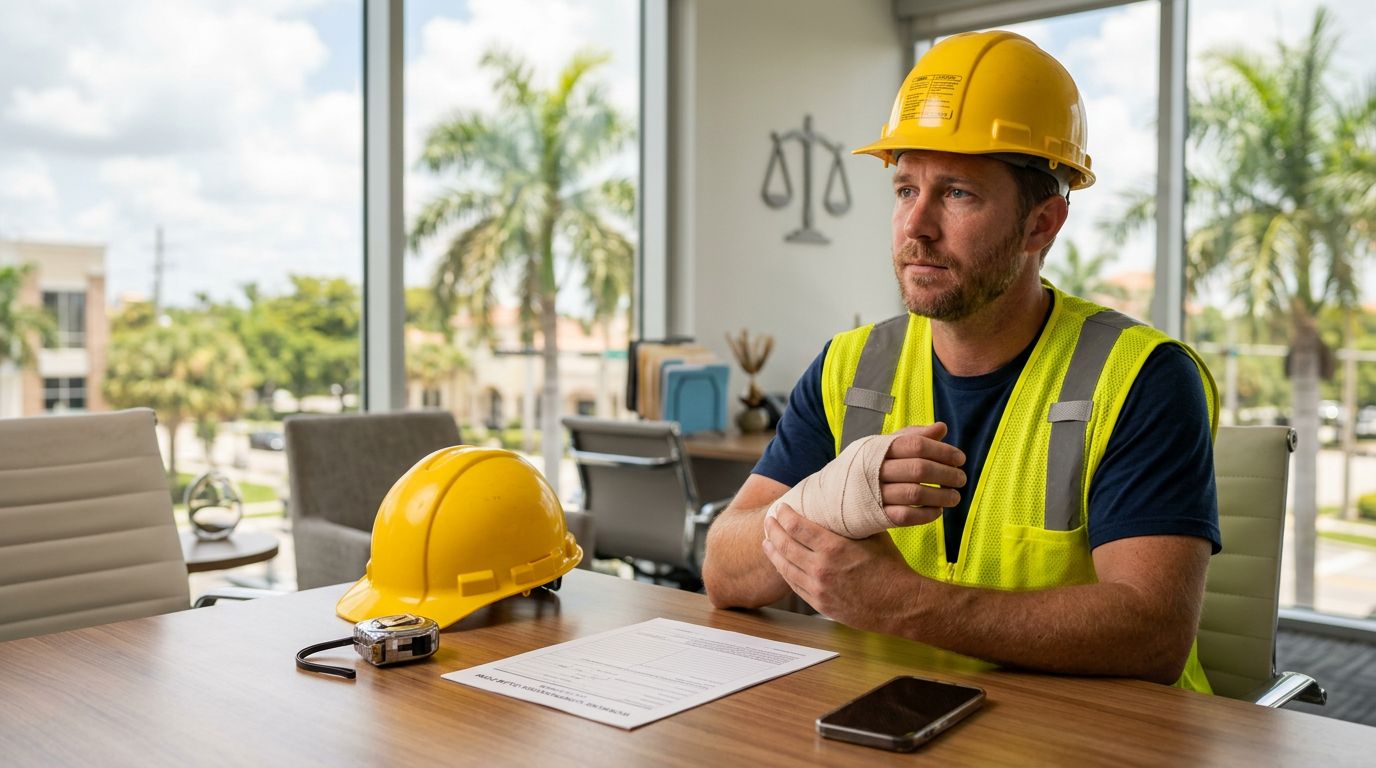
A 1099 form doesn’t decide whether you qualify for Florida workers’ compensation. If a company controlled your work like an employer, calling you an independent contractor may not remove your rights.
After an injury, the company or insurer may deny responsibility before anyone examines how you actually worked. Report the injury quickly, preserve evidence, and get advice before signing documents or accepting a status determination. Florida’s classification rules are the starting point.
Key Takeaways
- A contract or 1099 form doesn’t automatically make you an independent contractor.
- Control, payment, tools, scheduling, business operations, and the nature of the work can affect your status.
- Construction workers face stricter classification rules under Florida workers’ compensation law.
- If you establish employee status, you may qualify for medical care and wage-loss benefits.
- Report the injury within 30 days and watch the two-year deadline for filing a claim.
Why a 1099 Label May Not End Your Florida Workers’ Comp Claim
Companies often classify workers as independent contractors to avoid payroll taxes, benefits, and workers’ compensation costs. However, Florida law looks beyond the label. A written agreement matters, but the parties’ actual relationship matters more.
For example, a company may call a delivery driver an independent contractor while assigning routes, setting work hours, requiring branded clothing, monitoring performance, and disciplining missed shifts. Those facts can support an argument that the driver functioned as an employee.
The same issue can arise with warehouse workers, cleaners, caregivers, landscapers, installers, drivers, and other people paid through invoices or direct deposits. Calling yourself a contractor, forming an LLC, or receiving a Form 1099 doesn’t automatically settle the question.
Florida classification rules examine whether you operated a genuinely separate business. Relevant facts can include:
- Who controlled the manner, time, and location of the work
- Whether you could accept jobs from other companies
- Who supplied tools, equipment, materials, and training
- Whether you earned a set wage or faced a real risk of profit or loss
- Whether you advertised services and maintained a separate business
- Whether the relationship continued indefinitely or covered one defined project
- Whether your work was part of the company’s regular business
No single fact always decides the case. A contract stating “independent contractor” may conflict with daily instructions, required schedules, or company supervision. Those contradictions can provide important evidence in a workers’ compensation dispute.
Florida’s employee classification guidance also distinguishes employment from independent contracting for reemployment tax purposes. That analysis is separate from every workers’ compensation and wage-law question, but it shows why the parties’ real working relationship matters.
How Florida Classifies Independent Contractors
Florida workers’ compensation law uses its own statutory standards. Federal wage law, tax rules, and workers’ compensation law can overlap, but they don’t always ask identical questions. A person could face different classification results under different laws.
Generally, a true independent contractor runs an independent business and controls how the work gets done. The contractor may set prices, serve multiple customers, provide equipment, hire help, and accept the risk of losing money on a project.
An employee usually depends on one business for work and follows that company’s direction. The business may set the schedule, provide the tools, control the process, require personal service, and evaluate performance.
Construction work receives special treatment. Florida imposes stricter requirements on construction workers who claim independent contractor status. A construction worker may need to satisfy specific statutory conditions involving business operations, licensing, equipment, and independence. A 1099 form alone doesn’t remove workers’ compensation protection.
A certificate of exemption or business entity can also create confusion. Those documents may support the company’s position, but they don’t automatically erase evidence that the worker functioned as an employee. The details surrounding the certificate, who obtained it, and how the person performed the work can all matter.
The classification question often becomes important after an injury because the company has a financial reason to defend its original decision. That makes records from before the accident especially valuable. Text messages about schedules, instructions, pay, and discipline may reveal more than the written contract.
A worker’s title is only one piece of evidence. The day-to-day relationship often tells the fuller story.
Workers’ Compensation Benefits After Misclassification
If you establish that the company treated you as an employee, you may become eligible for benefits under Chapter 440 of the Florida Statutes. Benefits can apply even when the employer initially denied that you were covered.
Workers’ compensation generally pays for reasonable, necessary, and authorized medical care related to the workplace injury. Depending on the injury and your doctor’s work restrictions, you may also qualify for wage-loss benefits.
Temporary total disability benefits may apply when an authorized doctor takes you completely off work. Temporary partial disability benefits may apply when you can work with restrictions but earn less than before the injury. After your condition reaches maximum medical improvement, permanent impairment or permanent total disability benefits may become relevant.
Florida workers’ compensation can also provide vocational rehabilitation in appropriate cases. If a workplace injury causes a death, surviving dependents may have a claim for death benefits.
Your weekly payment depends on your average weekly wage, work status, medical restrictions, and the statutory limits in effect when the injury occurred. For injuries occurring in 2026, Florida’s maximum weekly workers’ compensation rate is $1,358. The calculation can differ based on whether you receive temporary total, temporary partial, or impairment benefits. A Florida workers’ comp wage benefits guide explains how those categories operate.
If the employer should have carried insurance but didn’t, the dispute can become more difficult. Florida law may impose direct responsibility on the responsible employer or statutory employer for covered benefits. The Florida Division of Workers’ Compensation can also pursue enforcement against businesses that fail to maintain required coverage.
Workers’ compensation usually doesn’t pay pain and suffering. However, a separate claim may exist against a negligent third party, such as a careless driver, property owner, equipment manufacturer, or subcontractor. That claim can involve damages workers’ compensation doesn’t cover, including pain, emotional distress, and some future losses.
What to Do After a Workplace Injury
Misclassified independent contractors in Florida should act as though the injury will become disputed. Early steps can protect both a workers’ compensation claim and possible third-party claims.
- Report the injury promptly. Tell the supervisor, company owner, or designated contact as soon as possible. Florida generally requires notice within 30 days after the injury, or within 30 days after you knew, or should have known, that the condition was work-related. Occupational diseases have different rules.
- Request medical care. Ask the company to report the injury to its workers’ compensation carrier. If the company refuses, seek legal help and explain that you were treated as an employee despite the 1099 label. Emergency treatment should not wait for an insurance decision.
- Describe the accident accurately. Tell medical providers when, where, and how the injury occurred. Mention repetitive work, lifting, falls, vehicle crashes, and symptoms that developed over time. Inconsistent descriptions can give an insurer a reason to challenge the claim.
- Preserve work records. Save the contract, 1099 forms, invoices, pay records, schedules, text messages, emails, training materials, job-site rules, photographs, and names of witnesses. Keep copies outside any company account you may lose access to.
- Track restrictions and missed income. Follow authorized treatment and attend appointments. Keep records of canceled shifts, reduced assignments, modified work, and out-of-pocket expenses.
The first 24 hours can affect medical care and the evidence available later. Use this Florida workers’ comp injury checklist for immediate reporting and documentation steps.
Florida generally requires a workers’ compensation claim to be filed within two years after the date of injury. A separate one-year rule can apply after the employer or insurer last provided benefits. Classification disputes can consume time, so waiting for the company to “fix” the paperwork may put your claim at risk.
When the Insurance Company Denies Your Claim
A carrier may deny the claim by stating that you were an independent contractor, the accident didn’t arise from work, you reported it too late, or the medical condition isn’t related to the job. A denial letter doesn’t necessarily end the case.
Ask for the denial in writing and keep the envelope, email, and attachments. Don’t assume that accepting a small payment or signing a release will preserve your rights. Have the agreement reviewed before signing it.
You may need to file a Petition for Benefits with Florida’s Office of the Judges of Compensation Claims. The petition can address medical treatment, temporary disability payments, compensability, and employee status. Your attorney may gather testimony from supervisors, coworkers, customers, and medical providers.
If you cannot prove employee status, other options may remain. A negligent property owner, driver, equipment maker, or another responsible party may be liable through a personal injury claim. General liability, health, disability, or uninsured motorist insurance may also matter, depending on the accident.
Those claims have different deadlines and proof requirements. A personal injury case requires evidence of another party’s legal fault, while workers’ compensation generally focuses on whether the injury arose out of work, regardless of employer negligence.
Evidence That Can Support Misclassification
The strongest cases connect the paperwork to the way the company actually operated. Gather documents that show control and dependence over time, not only records from the accident date.
Helpful evidence may include messages ordering you to report at a certain time, schedules created by the company, required uniforms, company-issued equipment, employee handbooks, performance reviews, and proof that you couldn’t send another person to perform the work.
Payment records can also help. Hourly pay, recurring deposits, tax withholding discussions, unpaid training, and deductions for company expenses may contradict the claim that you operated an independent business. Evidence of other customers, advertising, separate tools, business insurance, and the ability to set prices may support the company’s position instead.
A Florida workers’ compensation attorney can assess the classification facts, preserve evidence, communicate with the carrier, and pursue benefits before deadlines expire. Bring every version of the contract and every relevant message to the consultation. Small details often show who truly controlled the work.
Conclusion
A 1099 form doesn’t decide whether an injured Florida worker qualifies for workers’ compensation. The company’s control, the worker’s independence, the type of work, and the actual conditions on the job all matter.
Report the injury within the required time, document the working relationship, and challenge a denial promptly. For a person hurt while performing employee-like work, proving misclassification may open the door to medical treatment and wage benefits that the company initially refused to provide.