
Florida Government Claims: Notice Rules After a Property Injury
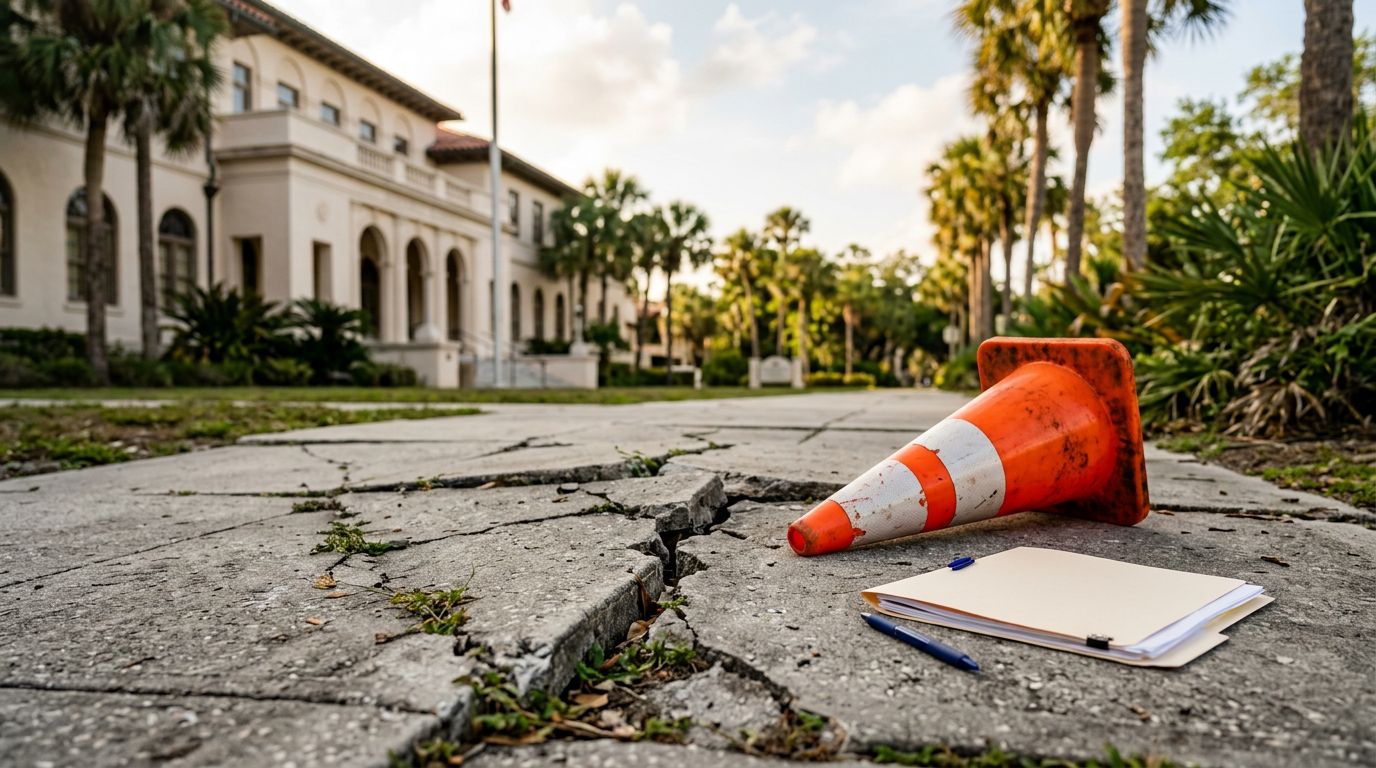
A fall on a broken sidewalk, a dangerous condition in a county building, or an injury at a public park can create more than a medical problem. Florida government claims follow special notice rules that can affect whether you may recover compensation.
Government entities have limited protection from lawsuits, and the law gives them time to investigate before you file in court. Missing the correct agency, sending notice to the wrong address, or waiting too long can put an otherwise valid injury claim at risk. Start by identifying who controlled the property and which deadline applies.
Why Florida government claims follow separate rules
Florida treats government property injury claims differently because of sovereign immunity. This legal protection limits when the state and its agencies or subdivisions can be sued.
Florida’s limited waiver of sovereign immunity
Section 768.28 of the Florida Statutes waives sovereign immunity for certain negligence claims. The waiver applies only within the conditions and monetary limits set by the statute.
A government entity may face liability when an employee acts within the scope of employment and causes injury through negligence. For example, a claim may involve poor sidewalk maintenance, an unrepaired hazard at a public building, or unsafe conditions at a government-operated facility.
The law generally applies to the state, state agencies, counties, cities, school boards, special districts, and other government subdivisions. However, the entity must have a legal duty to maintain or control the property. Government ownership alone doesn’t prove negligence.
The current text of Florida Statute 768.28 explains the waiver, notice rules, recovery limits, and conditions that apply before suit.
Identify the property owner and the property controller
The deed owner isn’t always the party responsible for a dangerous condition. A city may own a facility while a private company handles maintenance. A county may lease space to a business, or a public agency may contract with a company to repair roads and walkways.
These details can affect who receives notice and who may owe compensation. A claim may involve a government entity, a private contractor, or both. The lease, maintenance contract, inspection records, and actual control of the property can matter.
When the injury occurred at a public location, gather the exact name of the facility and the entity operating it. A sign, receipt, incident report, or property website may help identify the correct defendant.
Florida government claims notice deadlines
The notice deadline is separate from the deadline for filing a lawsuit. Both clocks matter, and the shorter deadline can control the case.
The general three-year presentation deadline
For most tort claims under Section 768.28, the claimant must present the written claim within three years after the claim accrues. Presenting a claim means giving written notice to the appropriate government agency and, in most cases, the Florida Department of Financial Services.
Accrual usually relates to when the injury occurs and the claimant knows, or should know, that an injury resulted from the event. The facts can become less clear when an injury develops gradually or when a dangerous condition isn’t discovered immediately.
The deadline applies to the notice itself. It isn’t permission to wait three years before collecting evidence. Surveillance video may be overwritten, witnesses may move, and the government may repair the condition after the incident.
Wrongful death and contribution claims have different periods
Wrongful death claims have a shorter notice deadline. The claim must be presented to the Department of Financial Services within two years after the claim accrues. Treat that as a deadline for all required notices, not only the notice sent to DFS.
Contribution claims have another rule. A party seeking contribution from another tortfeasor generally has six months after the relevant judgment becomes final or after payment or an agreement to discharge common liability, depending on the circumstances. This deadline usually concerns the parties responsible for paying a judgment, not the injured person’s initial claim.
Notice and lawsuit deadlines are separate
Florida’s current limitations law provides a separate deadline for filing many negligence lawsuits. For causes of action accruing on or after March 24, 2023, many negligence actions generally must be filed within two years, subject to statutory exceptions. Review the Florida limitations statute for the applicable period.
A three-year notice deadline doesn’t give you three years to file a lawsuit. In some cases, the lawsuit deadline can arrive before the notice period ends. A late notice can also prevent the claim from moving forward even when the lawsuit deadline appears open.
A timely notice doesn’t automatically make a lawsuit timely. Calculate the notice deadline and the court-filing deadline separately.
Where to send notice after a government property injury
The recipient depends on the government entity involved. Sending a letter to the facility manager or an employee may not satisfy the statutory requirement.
Send notice to the appropriate agency
The appropriate agency is the government entity responsible for the property or conduct that caused the injury. Depending on the case, that may be a state department, city, county, school board, public hospital district, water management district, or another subdivision.
Use the entity’s official legal, risk management, or claims address only after confirming it. Address the claim to the entity itself, not just an individual employee. Keep a complete copy of everything you send.
A claim involving a county-owned courthouse may require notice to the county. An injury at a state park may require notice to the state agency that operates the park. A fall at a city sidewalk may require notice to the city department or claims office designated to receive legal claims.
Send notice to the Florida Department of Financial Services when required
For most claims against the state or a state agency, written notice must also go to the Florida Department of Financial Services. DFS handles state liability claims through its Division of Risk Management.
DFS identifies the mailing address for tort claims as:
Florida Department of Financial Services
Division of Risk Management
200 E. Gaines Street
Tallahassee, Florida 32399-0338
Before mailing a claim, review the agency’s current instructions and the DFS state liability claims process. The delivery method and proof of receipt can become important if the government later argues that it never received notice.
Municipalities and counties have a statutory exception
Section 768.28 excludes claims against a municipality, county, or the Florida Space Authority from the separate DFS notice requirement. Those claims still require written notice to the appropriate government agency.
This exception doesn’t eliminate the notice deadline or the need for a properly directed claim. It only changes whether DFS must receive a separate copy under the statute. If you aren’t certain whether the defendant is a county, city, authority, district, or state agency, obtain legal advice before relying on the exception.
What a valid notice should include
A strong notice gives the government enough information to identify the event, investigate the condition, and evaluate the injury. It should be clear, factual, and complete.
Describe the incident and the dangerous condition
Include your full name, mailing address, phone number, and other contact information. Identify the government entity and the location where the injury occurred.
State the date and approximate time of the incident. Describe the specific condition that caused the injury, such as a raised sidewalk slab, broken handrail, wet floor, missing warning sign, poor lighting, or damaged stair.
Explain how the event happened without overstating facts you can’t prove. If you know that an employee reported the hazard or that the same condition existed earlier, include that information. List witnesses and provide their contact information when available.
A vague statement that you “fell on government property” may create avoidable problems. The notice should identify the location precisely enough for an investigator to find the condition.
Describe your injuries and losses
List the injuries diagnosed so far, medical providers, emergency treatment, follow-up care, medications, therapy, and any recommended treatment. Include lost work, reduced earning ability, out-of-pocket costs, and other financial losses when supported by records.
If treatment continues, state that the damages are ongoing. Don’t guess at a final medical prognosis. Medical records and physician opinions can provide stronger support than an unsupported estimate.
Attach useful photographs, incident reports, bills, wage records, and witness statements when appropriate. Keep the originals. Also request that the government preserve surveillance video, inspection logs, maintenance records, work orders, and electronic reports.
Use a delivery method that creates proof
Send the notice in a way that documents when the agency received it. Certified mail with return documentation can help, although an attorney may recommend another method based on the entity’s instructions.
Keep the mailing receipt, tracking history, signed delivery record, letter, attachments, and any response. If you send notice electronically, save the complete transmission record and confirmation.
A notice that never reaches the correct recipient is not protected by the fact that you mailed something somewhere. Proof of receipt helps establish compliance.
What happens after notice is sent
Presenting notice doesn’t mean the government has accepted responsibility. It begins a review process before a lawsuit can proceed.
The government investigates the claim
The state or agency generally has six months after presentment to review the claim and make a final disposition. This period is often described as 180 days, although six calendar months and 180 days aren’t always identical.
During the investigation, the government may request medical records, photographs, wage information, witness details, or permission to inspect the location. An adjuster or risk manager may contact you for a statement.
Respond carefully. A casual statement about how the incident happened, your prior injuries, or your recovery can later appear in the claim file. Provide accurate information, but avoid guessing or minimizing your injuries.
A written denial or deemed denial affects suit timing
Under Section 768.28, a lawsuit generally can’t be instituted until the claim is denied in writing or the statutory review period expires without a final disposition. After six months without a final decision, the claim may be treated as denied for purposes of the statute.
A denial doesn’t decide the merits of the case. It may state that the agency disputes negligence, causation, notice of the condition, damages, or the amount claimed. The denial also doesn’t extend the separate deadline for filing suit.
The complaint must identify the proper defendant and state the facts supporting liability. Service of process must follow Florida’s rules for government entities. Filing against the wrong agency can cause additional delay.
Failure to follow the procedure can lead to dismissal
Pre-suit notice is a condition that must be satisfied before many Florida government claims can proceed. If the claimant fails to provide required notice, uses the wrong recipient, or misses the deadline, the government may ask the court to dismiss the case.
A late notice may be especially difficult when the statutory period has expired. Re-sending a corrected letter doesn’t always fix the problem. A lawyer should review the notice before the deadline whenever possible.
Proving negligence on government property
The injury alone doesn’t establish government liability. You must connect the dangerous condition to a legal duty, a failure to use reasonable care, and the harm that followed.
Show that the government knew or should have known
Evidence often must show that the government had actual or constructive notice of the condition. Actual notice may include a complaint, inspection report, employee observation, or prior incident.
Constructive notice may involve evidence that the condition existed long enough for a reasonable inspection to discover it. Maintenance schedules, repair requests, work orders, photographs, and prior complaints can help establish that timeline.
If an employee created the hazard, different facts may support the claim. For example, a government worker who leaves equipment across a walkway may have created the condition directly.
For a broader explanation of the duty and breach issues, see this guide to Florida premises liability duty of care.
Connect the condition to the injury
The government may argue that the defect didn’t cause the fall or that another medical condition caused the symptoms. Clear evidence can answer those arguments.
Photograph the condition from several angles. Include a wider view showing the surrounding location and a closer view showing the defect’s size and depth. Note lighting, weather, surface changes, warning signs, handrails, and anything that affected visibility.
Medical records should connect the event to the diagnosis and treatment. Tell medical providers how the injury happened and identify symptoms accurately. Gaps in treatment can give the defense an argument about the severity or cause of the injury.
Expect arguments about your own conduct
The government may argue that you failed to watch where you were walking, ignored a warning, used the property in an unsafe way, or contributed to the accident. Florida’s comparative fault rules can reduce an award based on the claimant’s share of responsibility.
That doesn’t mean a visible hazard automatically ends a claim. The location, lighting, purpose of the area, warning signs, need for a repair, and reason you were using the property all matter.
Preserve footwear, clothing, mobility aids, and other items involved in the incident. Don’t alter or discard them before the claim is evaluated.
How damages caps affect Florida government claims
The value of an injury claim and the amount recoverable from a government entity may be different.
The statutory caps
Section 768.28 generally limits government liability to:
- $200,000 for one person’s claim
- $300,000 for all claims arising from one incident
The incident cap applies to the total claims connected to the occurrence. If multiple people are injured, the available amount may not equal $200,000 for each person.
The statute also bars punitive damages against the state and its agencies or subdivisions under this waiver. It doesn’t allow prejudgment interest for the period before judgment. A separate claims bill approved by the Florida Legislature may provide payment above the statutory limits, but that process isn’t automatic.
Other parties may affect the recovery analysis
A private contractor, property manager, or maintenance company may have separate liability. The government cap doesn’t automatically limit a claim against a private defendant.
The contract may identify who controlled inspections, repairs, warnings, or cleaning. It may also contain indemnity provisions or insurance requirements. Those terms require review, but a contract doesn’t decide liability by itself.
Damages can include emergency care, future medical treatment, lost wages, diminished earning capacity, pain, disability, and other losses supported by evidence. The cap may limit what the government pays even when the total injury value is higher.
Federal property is handled under different rules
A Florida government claim under Section 768.28 concerns Florida’s state and local governments. It doesn’t cover every public building in the state.
Federal facilities may involve the FTCA
Injuries at a VA hospital, federal courthouse, post office, military facility, or other federal property may involve the Federal Tort Claims Act. The claim goes through the responsible federal agency, not the Florida Department of Financial Services.
The U.S. Department of Justice identifies Standard Form 95 for FTCA claims. Federal administrative deadlines and procedures differ from Florida’s notice requirements. A letter sent under Section 768.28 may not preserve a federal claim.
The agency, employee status, location, and conduct must be confirmed before selecting the procedure. When federal and Florida entities are both involved, separate claims may be necessary.
Public property may involve a private contractor
A city sidewalk or county building may have private maintenance workers. A contractor’s negligence can create a separate path to compensation, but the case still requires proof about the contractor’s duty, control, notice, and conduct.
Send any required government notice while investigating private liability. Waiting to determine every responsible party can cause the government deadline to expire. A lawyer can review contracts, public records, photographs, and incident reports together.
For sidewalk incidents, this sidewalk fall proof checklist covers photographs, maintenance evidence, notice issues, and common defenses.
Steps to take after an injury on public property
The first days after the incident often determine how much evidence remains available. Take these steps as soon as your health allows:
- Get medical treatment and tell each provider that the injury occurred on government property.
- Photograph the hazard, nearby signs, lighting, weather conditions, and your clothing or footwear.
- Report the incident to the facility or agency and request a copy of the report.
- Write down witness names, exact locations, conversations, and what happened before your memory changes.
- Identify the government entity, property operator, and any private maintenance company.
- Preserve bills, medical records, wage information, photographs, video, and correspondence.
- Ask for preservation of surveillance footage and maintenance records.
- Have a Florida injury attorney calculate every applicable deadline before signing a release or accepting payment.
Avoid quick settlements before the injury is understood
An early payment may cover an emergency bill but fail to account for surgery, therapy, permanent limitations, or lost earning capacity. Government claims can also involve statutory caps and multiple responsible parties that affect settlement decisions.
Don’t give a recorded statement or sign a broad release without understanding what rights it ends. A release may affect claims against private contractors or other defendants, depending on its language.
A legal review can determine whether the location was government-controlled, whether notice went to the right recipients, and whether the evidence supports negligence. Avard Law Offices provides Florida personal injury representation and case evaluations for people hurt in accidents.
Protect your Florida government claim early
A dangerous condition on public property can create a valid injury claim, but Florida law requires more than proving that a fall or accident occurred. You must identify the right entity, present written notice on time, preserve evidence, and track the separate deadline for filing suit.
The general notice period is three years, while wrongful death claims require faster action. Government liability is also subject to statutory caps, and federal property follows a different administrative process.
When the condition has been repaired or the agency disputes responsibility, early legal advice can protect the evidence and clarify your options. A timely, properly directed notice gives your Florida government claims the best chance to receive a fair review.