
VA Vision Loss Claims: Field Testing and Limits
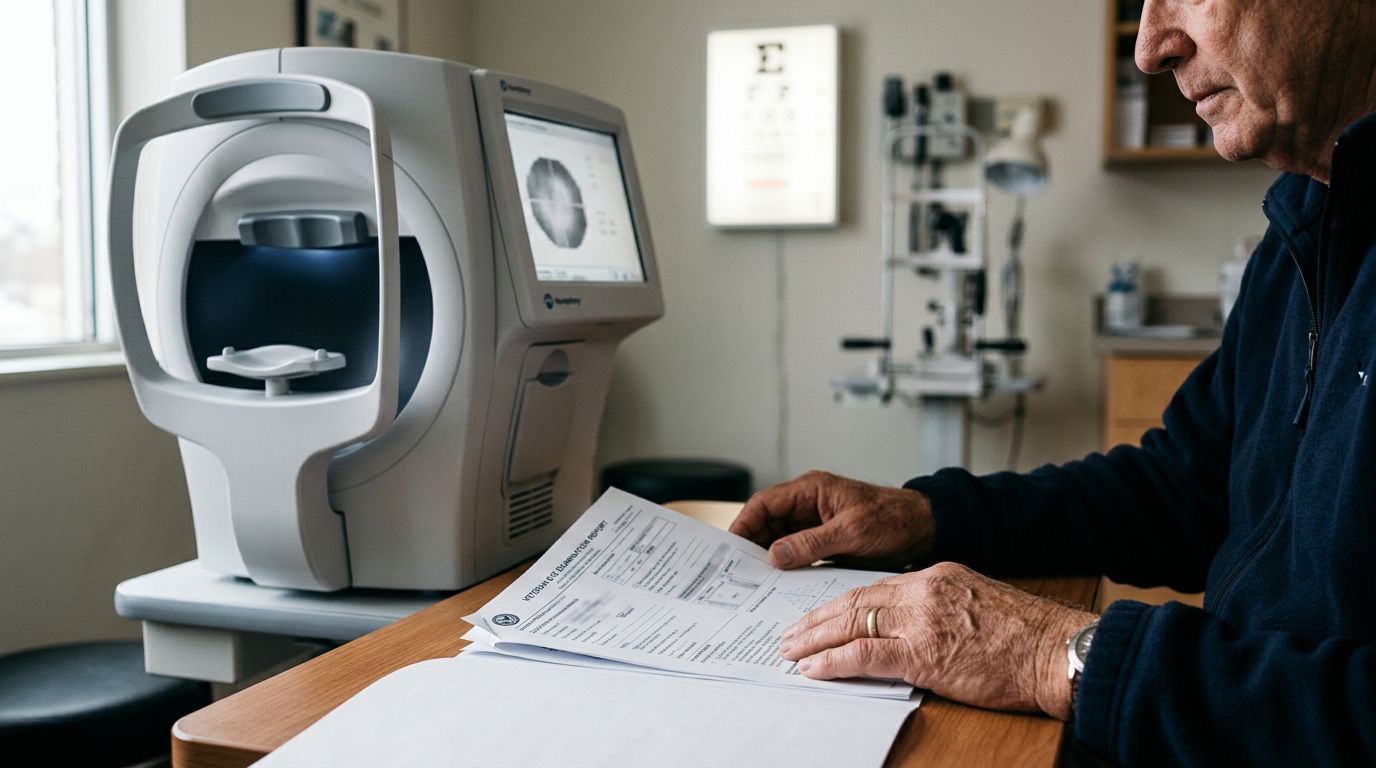
A normal score on a wall eye chart can hide the vision problem that keeps a veteran from driving, reading, or working safely. That distinction matters in VA vision loss claims, because the rating schedule looks at measurable central acuity, visual field loss, muscle function, and anatomical loss.
In 2026, a claim can turn on examination details, including whether vision was tested with correction and whether the field test produced the data VA needs. Florida veterans also must connect those measurements to service and describe the limits they face each day. Start with the measures that control the rating.
What VA vision loss claims measure
Central visual acuity is only one part of the rating
The current 38 CFR eye-rating provisions evaluate visual impairment through central visual acuity, visual field, and muscle function. The schedule also addresses anatomical loss and other serious eye conditions.
Central visual acuity generally uses corrected distance vision with central fixation. A proper examination should record uncorrected and corrected vision for distance and near. When the eyes require prescriptions that differ by more than three diopters, a special rule may affect how VA evaluates the poorer eye.
A diagnosis alone doesn’t establish the percentage. The medical record must show how the condition affects vision through measurable findings. Developmental refractive errors also don’t qualify as service-connected eye disabilities by themselves.
Peripheral field loss can produce a higher evaluation
A veteran may read letters on an eye chart yet struggle to notice objects approaching from the side. Constricted peripheral vision can affect walking through unfamiliar spaces, detecting hazards, using stairs, or operating a vehicle.
VA decisions have recognized that visual field loss can support a higher evaluation than central acuity alone. In one VA Board decision involving visual field loss, the field measurement produced a more favorable rating than the veteran’s best central acuity.
For that reason, a claim should not focus only on the 20/20 or 20/40 result. The complete record should address both what the veteran can see directly and what disappears outside the center of vision.
Field testing rules that matter in 2026
The quality of a visual field examination can affect whether VA has enough evidence to apply the rating schedule. The current schedule for eye disabilities should be reviewed with the actual examination report.
VA accepts defined perimetry methods
For rating purposes, visual field testing must use Goldmann kinetic perimetry or an accepted automated method. The regulation identifies Humphrey Model 750, Octopus Model 101, and later versions with simulated kinetic Goldmann testing capability.
The test also must use the appropriate target. For many phakic veterans, and for pseudophakic or aphakic veterans who have adapted to their lens correction, the applicable target is Goldmann equivalent III/4e. Different conditions may require IV/4e.
A routine office screening may help an eye doctor manage treatment, but it may not contain the measurements needed for a VA rating. The report should make clear which device and method the examiner used.
The report must contain usable field data
VA rules call for field results across at least 16 meridians, spaced 22.5 degrees apart, for each eye. The examiner should identify the Goldmann equivalent and document enough information to evaluate the field accurately.
The rating calculation for average concentric contraction uses eight principal meridians. VA measures the remaining field at those points, adds the measurements, and divides the total by eight. The 16-meridian report and eight-meridian rating calculation serve related but different purposes.
A field chart without the device, stimulus, and meridian data may leave the rating specialist unable to calculate the loss.
The record should also identify the test object, color, distance, and other conditions that could affect reliability. If the C&P report includes only a vague statement such as “field restricted,” the veteran may have grounds to challenge the examination’s adequacy.
Functional limits need concrete evidence
A rating should reflect measurable impairment, but daily limitations help show how the impairment affects the veteran’s life. The strongest evidence connects medical findings to specific activities and safety concerns.
Describe what happens during ordinary activities
A veteran’s statement should explain the limitation in direct terms. “My peripheral vision is poor” carries less weight than a dated, detailed description of missing objects on one side, bumping into doorframes, or needing another person to guide navigation in unfamiliar places.
Useful evidence can include:
- An ophthalmologist’s explanation of how field contraction, diplopia, glare, or depth-perception problems affect function.
- Statements from family members, coworkers, or supervisors who have observed collisions, missed hazards, or navigation problems.
- Workplace records showing changes in duties, inability to use equipment, or increased safety restrictions.
- Treatment notes describing falls, headaches, light sensitivity, visual fatigue, or problems reading and focusing.
The description should identify the affected eye, the frequency of the problem, the conditions that trigger it, and the task the veteran cannot perform safely. Specific facts give the medical findings practical meaning.
Functional statements don’t replace compliant testing
Lay evidence can establish what a veteran experiences and what others observe. It generally cannot replace a required visual field measurement or establish a specialized medical diagnosis without competent medical support.
That distinction matters when an eye chart appears acceptable but the veteran reports serious peripheral restrictions. The statements support the claim, while a compliant Goldmann or qualifying automated field test supplies the measurement VA uses.
A private evaluation can help when it follows VA’s required method and explains the results. It should include the raw or charted field data, the device used, the target equivalent, corrected acuity, diagnosis, and an opinion about the condition’s relationship to service.
If vision prevents substantially gainful employment, functional evidence may also affect a separate total disability rating based on individual unemployability claim. The eye percentage and employability question remain different issues.
How VA evaluates severe vision loss
The percentage depends on the combination of findings in both eyes, not on a single number viewed in isolation. The VA rating schedule for eye conditions contains detailed tables for central acuity, field impairment, diplopia, and other conditions.
One-eye limits can affect the outcome
Under the current rules, evaluation of visual impairment in one eye generally cannot exceed 30 percent unless the eye has anatomical loss. This limit makes the condition of the other eye important in many unilateral claims.
A veteran with reduced vision in one eye may still have a serious functional problem. However, the rating analysis depends on the service-connected status of each eye, the better eye’s acuity, field loss, and whether the affected eye is anatomically absent or has only minimal perception.
The record should therefore identify whether the condition affects one eye or both. It should also distinguish decreased vision from anatomical loss, because the schedule treats those situations differently.
Bilateral impairment can produce higher ratings
When both eyes have service-connected impairment, VA combines the findings under the applicable table. Severe corrected acuity loss in both eyes, extensive field contraction, or blindness involving both eyes can support high evaluations.
The rating schedule includes examples in which combinations such as corrected vision of 20/50 in both eyes qualify for a compensable evaluation. At the extreme end, blindness or anatomical loss combined with severe impairment in the other eye can support a 100 percent evaluation.
These examples don’t predict every claim. A rating specialist must apply the correct diagnostic code and consider whether acuity, field, muscle function, or another eye criterion provides the better evaluation.
Building stronger VA vision loss claims
A successful claim must address two separate questions: whether the condition is connected to service and how severely it limits vision now.
Prove the service connection theory
Begin with service treatment records, separation examinations, deployment records, injury reports, and post-service treatment. The evidence should identify the in-service injury, disease, exposure, or event and show a current diagnosed eye condition.
A medical nexus opinion may be needed when the connection isn’t obvious from the service records. The opinion should discuss the veteran’s history, current diagnosis, treatment records, and reasons for linking the condition to service.
Some veterans may claim an eye condition as secondary to an already service-connected disability or treatment. In that situation, the evidence must address causation or aggravation under the theory being claimed.
A strong file also shows the condition over time. Preserve older ophthalmology reports, prescription changes, visual field charts, surgery records, and records of worsening symptoms. A single examination may not show the full course of progressive vision loss.
Check the C&P examination for errors
Read the C&P report against the regulation and the veteran’s actual symptoms. Look for missing corrected and uncorrected measurements, an unidentified testing device, absent meridian results, or a field test that used a method the schedule doesn’t recognize.
Compare the report with private testing. A large unexplained difference doesn’t automatically prove error, but it creates a reason to ask whether the examinations measured the same condition under comparable conditions.
The examiner also should address all diagnosed eye problems that affect function. A report focused on central acuity may overlook field contraction, diplopia, muscle dysfunction, or anatomical changes.
Keep the decision notice and examination report together. A review of VA disability ratings and compensation can help identify whether the dispute involves service connection, the percentage, or the effective date.
What to do after a denial or low rating
The VA’s stated reason controls the next step. If the decision says the condition isn’t connected to service, the case needs evidence addressing the nexus. If VA granted service connection but used an inadequate field test, the appeal should focus on the correct rating evidence and examination error.
A Supplemental Claim can fit when new and relevant medical evidence is available. Higher-Level Review may fit when the existing record already contains the proof and the adjudicator made an error. A Board Appeal may be appropriate when the issue requires review by a Veterans Law Judge or a hearing.
Read the VA denial letter and appeal options promptly. In many cases, the veteran has one year from the decision notice to preserve review rights and potentially protect the effective date. The exact deadline depends on the decision and procedural history.
Florida veterans who need to compare a Supplemental Claim, Higher-Level Review, and Board Appeal can review the available VA appeal lane options. The best choice depends on the missing evidence and the error identified in the decision.
Conclusion
VA vision loss claims require more than an eye-chart number. The evidence should show the service connection, use an accepted field-testing method, record the measurements VA needs, and describe how the impairment affects ordinary activities.
A veteran whose central acuity looks acceptable may still have significant field loss. Careful review of the examination can reveal whether the rating reflects the full disability, including the functional limits that the chart alone doesn’t show.