
Florida Alligator Attack Claims and Warning Sign Evidence
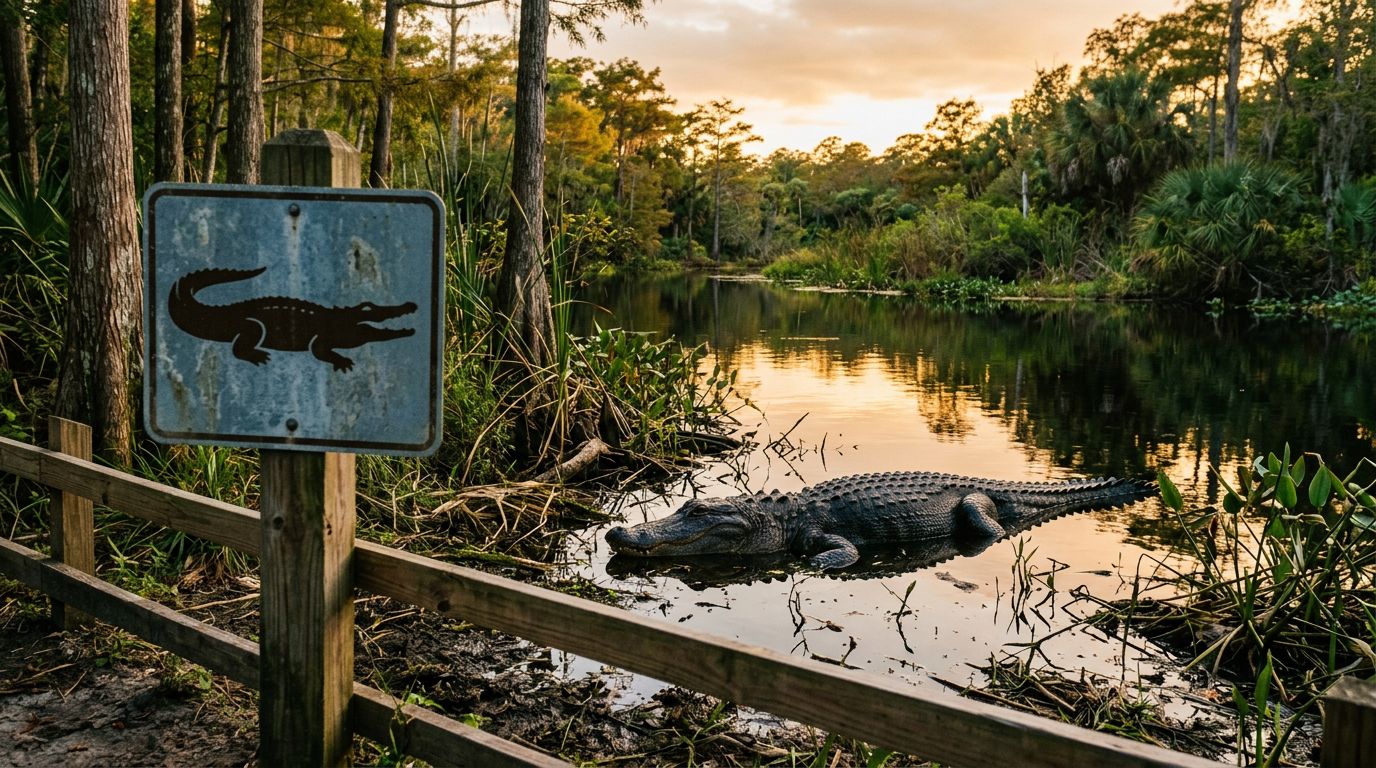
An alligator attack can leave you facing emergency treatment, surgery, lost income, and permanent physical or emotional injuries. After the immediate danger passes, the next question is often who should have warned you or protected the area.
Florida alligator attack claims usually turn on notice, property control, warning signs, and the steps taken to address a known danger. The facts surrounding the pond, canal, lake, or recreational area may determine whether a negligence or premises liability case is possible.
How alligator attack claims are proven in Florida
Florida doesn’t have a separate civil lawsuit category called an “alligator attack case.” Most claims rely on negligence or premises liability law. The injured person generally must show that another party had a legal duty, failed to act reasonably, and caused the injury.
The property owner’s duty depends on the location
A landowner, business, resort, apartment complex, golf course, or recreational facility may owe duties to people who enter the property lawfully. The exact duty depends on why the person was there and who controlled the area.
For example, a resort that invites guests to use a lakefront walkway may have different responsibilities than a private landowner whose property borders a canal. A business that advertises fishing, swimming, or waterfront activities may also face questions about whether it gave adequate warnings and controlled access.
The property owner doesn’t automatically become responsible every time an alligator appears. The case usually depends on whether the danger was foreseeable and whether reasonable precautions were available. A detailed explanation of these issues appears in this guide to Florida premises liability duty of care.
Breach requires more than proof of an attack
An attack proves that a serious injury occurred. It doesn’t, by itself, prove that a property owner was negligent.
Evidence of a possible breach may include:
- Repeated alligator sightings near a swimming or walking area.
- Prior complaints from guests, residents, employees, or visitors.
- A known pond, canal, or lake used by people despite an absence of warnings.
- Missing, damaged, hidden, or poorly placed signs.
- Open access to water where the owner knew alligators were present.
- A failure to respond after receiving reports or nuisance-alligator complaints.
The central question is whether the defendant knew, or should have known, about the risk and failed to take a reasonable step to reduce it.
Why warning signs matter in Florida cases
Warning signs can affect both liability and the strength of the injured person’s case. However, the existence of a sign doesn’t automatically protect a property owner. The sign must provide a meaningful warning that people can see and understand before entering the danger area.
The Florida Fish and Wildlife Conservation Commission provides information about alligator safety and directs people to report nuisance alligators through its hotline at 866-FWC-GATOR, or 866-392-4286. The agency’s alligator safety guidance also explains how people should respond to alligator concerns.
Visibility and placement can decide the issue
A property owner may argue that a sign warned the injured person about alligators. The investigation should then examine the sign’s actual condition and location.
Important details include:
- Whether the sign stood at the entrance or somewhere away from the access point.
- Whether trees, shrubs, parked vehicles, or structures blocked it.
- Whether lighting made it readable at night.
- Whether the words were large enough to read.
- Whether the sign warned about alligator presence, prohibited swimming, or both.
- Whether the sign remained in place before and after the attack.
- Whether the property used signs in every area where people could reach the water.
FWC sign guidance calls for signs in prominent locations that are easily visible to people on foot and people using assisted mobility devices. The agency’s Alligator Management Program also promotes signs that create awareness about alligators near ponds and canals.
A warning sign carries less weight when a person had to leave the marked path, walk around an obstruction, or enter a poorly lit area before seeing it.
A sign doesn’t erase other safety duties
Even a visible sign may not resolve the case. A warning can be inadequate if employees continued directing guests toward the water, the business advertised the area for swimming, or the property ignored reports of an aggressive alligator.
The wording also matters. “Wildlife may be present” may communicate a different level of danger than “Alligators present, do not enter the water.” A property owner may need more than a general sign when the area has a known history of alligator activity.
A photograph showing that a sign existed after an incident doesn’t prove that it was visible, readable, or properly placed before the attack. Earlier photographs, surveillance footage, maintenance records, and witness accounts may provide a more accurate picture.
Evidence that supports alligator attack claims
Evidence can disappear quickly after an attack. Signs may be moved, vegetation may be cut, cameras may overwrite recordings, and employees may change the area before anyone documents it.
The strongest investigations usually begin with the scene and then examine what the property owner knew.
Document the scene and injury
After receiving emergency care, preserve information about what happened while the details remain fresh. Don’t return to an unsafe area or approach the alligator to collect evidence.
Useful evidence may include photographs or video of:
- The water’s edge and the path used before the attack.
- Warning signs, barriers, gates, lighting, and access points.
- Obstructions that prevented a person from seeing a sign.
- Clothing, footwear, equipment, or personal items involved in the incident.
- Visible injuries, surgical wounds, scarring, and mobility limitations.
Medical records should describe the injuries in detail. Keep bills, prescription records, travel expenses, wage-loss documents, rehabilitation records, and information about future treatment. A serious alligator injury may involve infection, nerve damage, fractures, amputation, scarring, or post-traumatic stress.
Witnesses can provide important details about the sign, the property conditions, staff statements, prior sightings, and the moments before the attack. Obtain contact information when possible, but avoid asking witnesses to change or embellish their accounts.
Look for proof of prior notice
Notice is often the most disputed issue in an alligator case. A property owner may deny knowing that an alligator was present. Records can show otherwise.
Potential sources include maintenance logs, incident reports, emails, text messages, guest complaints, HOA records, employee statements, security footage, and animal-removal records. A call to the FWC nuisance alligator hotline may also help identify whether a report was made before the incident. FWC explains how to report a wildlife interaction or emergency.
Prior notice doesn’t guarantee a successful claim. Still, it can help establish that the danger was foreseeable and that the owner had time to post a warning, restrict access, contact the proper agency, or take another reasonable measure.
Who may be responsible for an alligator attack?
The responsible party isn’t always the person who owns the land. Liability may depend on control over the water, access route, signs, maintenance, and safety policies.
Private property owners and business operators
A hotel, resort, apartment complex, HOA, campground, golf course, or private recreation facility may face a claim if it controlled the area and failed to address a known danger. The owner and operator may be separate entities, so contracts and management records can matter.
Short-term rentals create additional questions. The host may have information about prior reports, while a property manager may control signs, landscaping, or access to the water. A third-party maintenance company may also have responsibilities under its contract, although a contract alone doesn’t establish liability.
The claim should identify who controlled the property when the attack occurred. Ownership, possession, management, and actual control can involve different parties.
Public land and sovereign immunity
Attacks at a city park, county recreation area, state property, water management district, or public trail require a separate review of governmental liability. Florida Statute 768.28 addresses the state’s waiver of sovereign immunity and includes limits on recovery. Read the official text of Florida Statute 768.28 before assuming a public claim follows the same rules as a private case.
The statute generally limits recovery to $200,000 per person and $300,000 per incident unless a claims bill provides otherwise. It also bars punitive damages against the state and its subdivisions under the statute.
Public-property cases require prompt identification of the correct governmental entity. Notice requirements, defenses, claim limits, and control of the waterway may all affect the case.
Defenses and deadlines that can affect your case
A defendant may argue that the injured person ignored a warning, entered a restricted area, used the property after hours, fed an alligator, or trespassed. Those facts can affect liability or the amount of compensation, but the defense must match the evidence.
Trespassing and comparative fault arguments
Florida has a statute addressing immunity for injuries to trespassers on real property. The Florida trespasser statute may become relevant when a property owner claims the victim entered without permission.
The case may turn on whether the person had permission, whether the area was clearly restricted, and whether the owner knew people regularly entered there. A broken fence, an open gate, or a commonly used path may support a different factual argument than a clearly marked restricted area.
A defendant may also claim that the injured person failed to follow an obvious warning. This issue requires a close review of the sign’s location, wording, visibility, and the victim’s route.
The negligence deadline is generally two years
As of August 2026, Florida Statute 95.11 generally requires an action founded on negligence to be filed within two years. The official statutory text lists negligence claims under the two-year limitations period in Florida’s Chapter 95 limitations law.
The deadline can involve exceptions and may not apply the same way to every possible claim. Government defendants may involve additional requirements. Medical negligence related to treatment after the attack follows separate rules.
If the attack caused a death, the personal representative may bring a wrongful death action for eligible survivors and losses. Families can review Florida wrongful death claim requirements while gathering records and identifying the property owner.
Steps to take after an alligator attack
Medical treatment comes first. Once you’re safe, these steps can protect important evidence:
- Report the incident to emergency services and the property manager. Ask for the incident report and keep copies of all communications.
- Write down the time, location, route, weather, lighting, warnings, witnesses, and statements made by employees.
- Request that the property preserve surveillance video, maintenance records, incident reports, complaints, and electronic communications.
- Save photographs, medical records, bills, wage information, and records of follow-up care.
- Avoid giving a recorded statement to an insurance company before understanding what the claim involves.
- Contact a Florida personal injury attorney before the two-year deadline creates a problem.
The FWC hotline is intended for nuisance-alligator reports, not as a substitute for emergency medical assistance. Don’t approach, feed, or attempt to capture an alligator.
Conclusion
Florida alligator attack claims depend on more than the fact that an alligator was present. Notice, property control, warning-sign visibility, access conditions, and the owner’s response can determine whether negligence is provable.
Preserve the scene, document the warnings, identify prior complaints, and act quickly. In these cases, warning sign evidence can either support the property owner’s defense or show why the warning failed to protect the person who was injured.