
Florida Ambulance Crash Claims and Immunity Rules
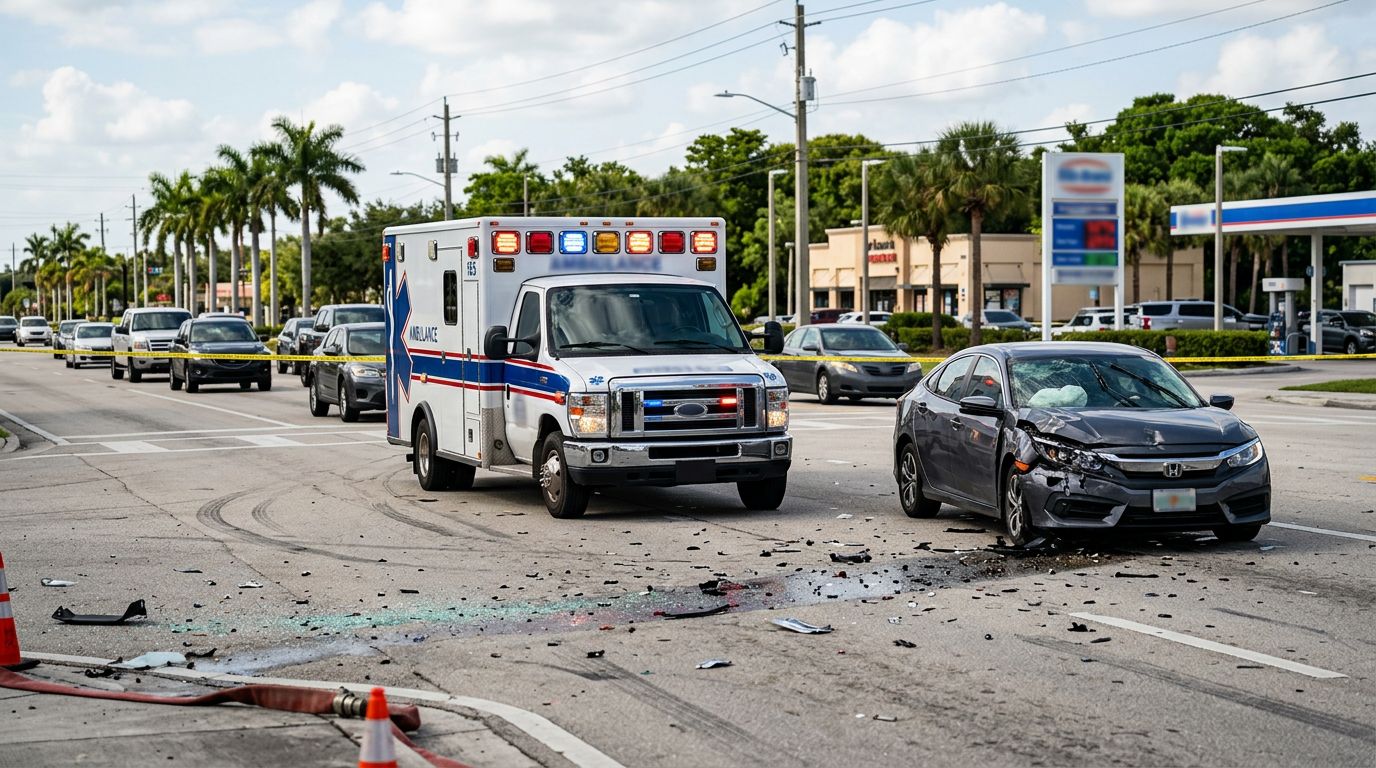
An ambulance can have the right of way and still cause a legally compensable crash. When emergency lights, sirens, speed, and urgent patient care enter the picture, fault becomes more complicated than a standard car accident.
Florida ambulance crash claims depend on who operated the vehicle, whether the ambulance was responding to an emergency, and whether the driver stayed within Florida’s emergency-vehicle rules. Public ambulance services also face sovereign-immunity limits that can affect notice, deadlines, and compensation.
The first step is identifying the rules that apply to the ambulance and the organization behind it.
What Florida Ambulance Crash Claims Usually Involve
An ambulance crash may injure someone in another vehicle, a pedestrian, a cyclist, an emergency responder, or the patient being transported. Each situation requires a different liability analysis.
The central question is whether the driver used emergency privileges lawfully and safely. Florida law gives authorized emergency vehicles special traffic privileges during emergency responses. Those privileges do not automatically excuse careless driving.
Emergency privileges are not blanket immunity
Florida Statutes section 316.072 addresses how traffic laws apply to authorized emergency vehicles. The statute allows certain drivers responding to emergency calls to take actions that ordinary motorists cannot, such as proceeding through a red light after slowing as necessary, exceeding the posted speed limit under specific conditions, and disregarding certain rules governing direction or turns.
The Florida emergency vehicle traffic rules still require compliance with statutory conditions. The driver must use due regard for the safety of others.
An ambulance’s emergency status changes some traffic rules. It does not erase the driver’s responsibility for reckless disregard of public safety.
The ambulance’s ownership changes the claim
A county ambulance, a city-operated emergency service, and a private ambulance company may face different legal procedures. A private company generally falls under ordinary negligence law. A public ambulance provider may qualify as a state agency or political subdivision under Florida’s sovereign-immunity statute.
A contract with a county doesn’t automatically make a private ambulance company a government entity. The vehicle’s owner, employer, operator, and governing agency must be confirmed before evaluating the claim.
How Emergency Vehicle Privileges Affect Fault
Emergency lights and sirens can help establish that the ambulance was responding to an emergency. They don’t settle every issue in the case.
Investigators review the entire sequence, including the ambulance’s speed, location, lane position, intersection approach, visibility, traffic conditions, and communication with other drivers.
Lights and sirens don’t decide the case
A driver approaching an intersection may have permission to proceed against a traffic signal after slowing enough to operate safely. The question is whether the driver actually slowed, checked for traffic, and entered when the movement was reasonably safe.
Likewise, exceeding the speed limit may fall within an emergency privilege. That privilege becomes harder to defend when speed prevents the driver from seeing cross traffic, stopping for a foreseeable hazard, or controlling the vehicle.
A siren may also be difficult for another motorist to hear because of closed windows, heavy traffic, construction, weather, or surrounding noise. Those facts can affect comparative fault without automatically clearing either driver.
Reckless disregard remains outside the protection
Section 316.072 does not protect an emergency driver from the consequences of reckless disregard for the safety of others. A claimant may therefore examine conduct such as entering a crowded intersection at high speed, passing without adequate visibility, driving while distracted, or continuing a dangerous maneuver after recognizing a serious risk.
The defense may argue that the ambulance acted within its statutory privilege. The injured person must then connect the evidence to the exact maneuver. A traffic violation alone may not prove liability if the statute allowed the maneuver, but conduct outside the privilege can support a negligence claim.
Florida ambulance crash claims often turn on this distinction. The issue is rarely whether the driver was responding to an emergency. It is whether the emergency response justified the specific driving decision that caused the impact.
Public Ambulance or Private Provider?
Before sending a claim or filing suit, determine whether the ambulance service is public or private. The answer affects the defendant, notice process, recoverable damages, and litigation deadline.
| Ambulance provider | Main legal framework | Important issue |
|---|---|---|
| County, city, or public hospital district | Florida sovereign-immunity law | Notice, waiting period, and damage caps |
| Private ambulance company | Ordinary negligence law | Company liability and insurance coverage |
| Individual driver | Personal negligence rules | Employment status and scope of work |
| Mixed public-private service | Depends on the legal entity involved | Contract and ownership records |
Claims involving public ambulance services
Florida Statutes section 768.28 waives sovereign immunity for certain tort claims against the state and its agencies or subdivisions. The waiver allows liability when a government employee causes injury through a negligent or wrongful act within the scope of employment, and a private person would be liable under similar circumstances.
That waiver has strict limits. It doesn’t place a public ambulance service in exactly the same position as a private business. The government entity may assert statutory defenses, and the claim must follow the required pre-suit process.
The identity of the ambulance provider matters more than the vehicle’s markings. A public hospital may operate its own ambulance service, while another hospital may contract with a private emergency medical provider.
Claims against private ambulance companies
A private ambulance company usually faces the same basic negligence analysis as another private transportation or medical-service business. The company may be responsible for its employee’s conduct when the driver acted within the scope of employment.
Additional theories may involve negligent hiring, inadequate training, unsafe scheduling, poor supervision, or defective maintenance. Each theory requires evidence. A crash alone doesn’t prove that the company negligently trained or supervised its driver.
The driver’s personal conduct also matters. A private driver may be individually liable for speeding, failing to yield, distracted driving, unsafe lane changes, or another breach of the duty of reasonable care.
Florida Sovereign Immunity, Notice, and Damage Caps
Public-entity cases require early attention because the claim process begins before a lawsuit. Sending a demand to an insurer may not satisfy Florida’s statutory notice requirement.
Under Florida Statute section 768.28, a claimant generally must present written notice to the proper agency or subdivision and to Florida’s Department of Financial Services when required. The notice should identify the incident, the government entity, the injuries, and the legal basis for the claim.
Notice and the six-month investigation period
For many public-entity injury claims, written notice must be presented within three years after the claim accrues. Wrongful-death claims have a shorter notice period. The agency then receives a statutory period to investigate, and a lawsuit generally cannot begin until six months have passed unless the claim is denied earlier.
These rules create multiple deadlines. A person can preserve evidence and communicate with an insurer while the statutory claim process continues, but those steps don’t replace formal notice.
The deadlines for Florida government vehicle claims should be reviewed as soon as the ambulance’s public or private status becomes clear. A mistake in naming the agency or delivering notice can create a serious problem even when the underlying driving conduct appears clear.
Compensation limits against government entities
Section 768.28 generally limits government liability to $200,000 per person and $300,000 per incident for claims arising from the same occurrence. These limits can affect multiple injured people when one ambulance crash produces several claims.
The statute also bars punitive damages and prejudgment interest against the state and its agencies or subdivisions. Recovery above the statutory limit generally requires a legislative claims bill.
The cap applies to the government entity under the statute. It doesn’t automatically determine every possible source of recovery. Other liable parties, applicable insurance policies, and separate defendants may require analysis.
Deadlines for Florida Ambulance Crash Claims
A strong claim can fail if the lawsuit or required notice arrives too late. The correct deadline depends on the defendant and the type of harm.
Private injury and wrongful-death deadlines
Florida’s current statute of limitations generally gives two years for many negligence actions involving private defendants. The 2026 Florida negligence limitations statute also addresses wrongful-death claims, which generally must be filed within two years after the person’s death.
The date of death may differ from the date of the ambulance crash. That distinction matters when a person survives for a period before passing away.
Public-entity claims involve additional rules under section 768.28. Ordinary claims under that statute may have a four-year filing period, but the written-notice requirement and six-month investigation period apply first. Wrongful-death and medical-malpractice claims can follow different limitation rules.
Because exceptions can alter these periods, don’t use a general car-accident deadline as the only guide.
Damages after an ambulance collision
A personal-injury claim may seek compensation for medical treatment, rehabilitation, lost wages, reduced earning capacity, property damage, and pain and suffering when supported by the evidence.
If the ambulance transported an already injured or ill patient, medical causation requires careful review. The claim may involve a new injury, an aggravation of an existing condition, or a delay in necessary treatment. EMS records and treating-doctor opinions can help separate the original medical problem from harm caused by the crash.
A wrongful-death claim may allow survivors to seek damages authorized by Florida law, including lost support and services and certain losses connected to the death. The Florida wrongful-death damages statute identifies the categories that may apply.
Insurance payments, health coverage, and personal injury protection benefits may help with immediate bills. They don’t decide whether the ambulance driver or provider caused the collision.
Evidence That Can Prove What Happened
Ambulance crashes often produce evidence that disappears quickly. Traffic-camera footage may be overwritten, vehicle data may be retained for a limited time, and witnesses may forget the sound or timing of a siren.
A lawyer may send preservation requests to the ambulance company, public agency, nearby businesses, transportation authorities, and other custodians of relevant records.
Records that deserve prompt preservation
Important evidence may include:
- 911 recordings, dispatch notes, computer-aided dispatch records, and radio communications.
- GPS data, vehicle telematics, event data recorder information, and speed records.
- Dash-camera, body-camera, traffic-camera, and nearby surveillance footage.
- Ambulance inspection, repair, maintenance, and tire records.
- Driver training files, schedules, work-hour records, and employment information.
- EMS patient-care reports, transport records, and records of equipment securement.
- Scene photographs, vehicle damage, roadway conditions, witness statements, and crash reports.
The emergency call itself may explain why the ambulance was traveling. It doesn’t prove that every driving decision was safe. Dispatch records, GPS data, and video can show whether the vehicle used lights and sirens, when it slowed, and how it entered the crash area.
Medical proof matters
Seek medical care promptly and describe every symptom accurately. Gaps in treatment can give an insurer an argument that the injury was minor or unrelated, even when the symptoms are genuine.
Keep records of appointments, medication, therapy, mileage, wage loss, and out-of-pocket expenses. If the crash affected your ability to work, obtain documentation from your employer and medical providers.
Patients injured during transport should also preserve records from the facility that requested transport and the EMS provider that supplied it. The treatment timeline can show what changed after the collision.
Who May Be Liable for an Ambulance Crash?
The ambulance driver is only one possible defendant. Liability may involve several parties, especially when another motorist contributed to the impact.
The employer may face vicarious liability for an employee’s negligence. A public employer may receive the protections and limits of section 768.28. A private employer generally does not receive sovereign immunity merely because it provides emergency medical transportation.
A maintenance contractor, vehicle owner, or equipment provider may also face liability if a mechanical failure or inadequate repair contributed to the crash. Those claims require proof that the maintenance or equipment defect caused the collision.
Another driver may be responsible for failing to yield, blocking an emergency vehicle, following too closely, or violating Florida’s Move Over Law. The Florida Move Over Law and emergency vehicle rules can matter when a stopped ambulance or emergency vehicle creates a secondary crash scene.
Fault can be divided among multiple parties. The available insurance and the defendant’s legal status should be evaluated before a settlement is accepted.
What to Do After an Ambulance Crash
Take practical steps early, even if the ambulance crew or police officers say the collision was unavoidable.
- Obtain medical evaluation and follow the treatment plan. Tell providers that the symptoms began or worsened after the crash.
- Photograph the vehicles, intersection, road surface, traffic signals, lighting, visible emergency equipment, and your injuries if you can do so safely.
- Collect the ambulance company’s name, vehicle number, agency name, driver’s information, witness contacts, and the incident report number.
- Avoid guessing about speed, the siren, the traffic signal, or your injuries when speaking with an insurer. Request time to review the facts before giving a recorded statement.
- Consult a Florida personal-injury attorney promptly when a public ambulance, serious injury, death, or disputed fault is involved.
Early legal review is especially important for public ambulance cases. Counsel can identify the proper government agency, send statutory notice, preserve electronic evidence, and investigate other sources of compensation.
Conclusion
Florida ambulance crash claims require two separate analyses: whether the driver acted within Florida’s emergency-vehicle privileges and whether the provider is public or private. Emergency status can permit certain traffic maneuvers, but it doesn’t protect reckless disregard for safety.
Public ambulance claims also involve written notice, investigation periods, statutory damage caps, and special deadlines. Private ambulance claims usually follow ordinary negligence rules. Identifying the provider and preserving dispatch, vehicle, video, and medical records can protect the claim before those facts disappear.