
Florida Sidewalk Obstruction Fall Claims: Proving Fault
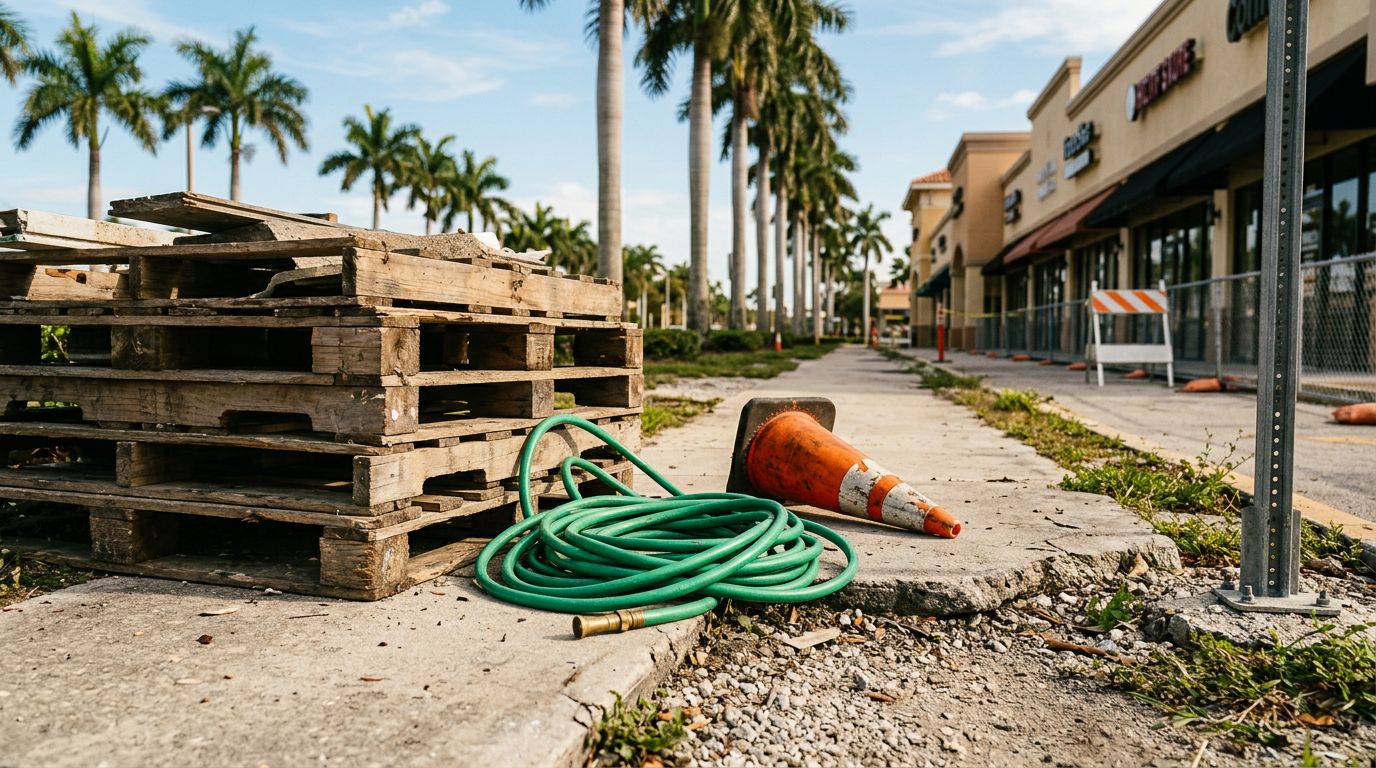
A sidewalk can look harmless until a misplaced pallet, hose, sign, or construction barrier sends someone to the ground. A Florida sidewalk obstruction claim may provide a path to compensation, but the seriousness of the injury alone won’t establish liability.
Property lines, maintenance agreements, and notice records often matter more than the deed. When a business, landlord, association, or contractor controlled the walking route and ignored a known danger, it may owe damages.
The first task is to identify the obstruction, preserve its condition, and determine who had a duty to address it.
A Florida sidewalk obstruction claim begins with duty and control
A property owner is not automatically responsible for every fall near its building. A successful claim must show that a person or entity had a duty to maintain the area safely, failed to use reasonable care, and caused measurable harm.
For visitors allowed on commercial or residential property, Florida premises liability law usually focuses on control, notice, and the reasonableness of the response.
The responsible party may not be the deed holder
Legal ownership does not always decide liability. A retail tenant may control the entrance walkway. An apartment manager may direct maintenance crews. A landscaping company may leave equipment in a pedestrian path. A condominium association may maintain common walkways.
Leases, maintenance contracts, work orders, and property-management records can reveal who had the actual responsibility to inspect and correct hazards. This is why Florida premises liability duty of care often depends on control rather than a name on a property record.
The obstruction must have caused the fall
The claim needs a direct connection between the condition and the injury. A person who trips over a delivery box, temporary sign base, exposed cord, loose paver, or construction debris should be able to identify what caught their foot and where it sat.
Photographs, witness accounts, incident reports, and medical records help establish that connection. Florida’s standard premises-liability instruction for invitee claims also reflects the core question: did the party responsible for the premises fail to use reasonable care?
Determine whether the sidewalk is private or public
A walkway next to a store, apartment complex, or home may appear private while actually sitting in a city or county right-of-way. That distinction can change the defendant, the proof required, and the deadlines that apply.
Start by identifying the precise fall location. An address alone may not answer the question.
Obstructions on private property
A sidewalk inside a shopping center, apartment complex, condominium community, or business entrance area is often subject to private maintenance. The owner, tenant, property manager, or maintenance contractor may share responsibility.
For example, a restaurant may be responsible for an outdoor dining area that narrows the pedestrian path. A property manager may be responsible for recurring garbage bins left across a walkway. A contractor may be responsible if it created the obstruction and failed to remove it.
Public sidewalks next to private land
A private owner usually does not become liable merely because a public sidewalk borders its land. However, liability may arise when that owner created the danger, altered the sidewalk, placed an object in the right-of-way, or accepted maintenance responsibility.
Local ordinances can matter, but an ordinance does not automatically create a private injury claim. A city, county, utility, homeowners association, Florida Department of Transportation, and private contractor may each have a role. Determining sidewalk ownership after an accident should happen early, before repairs or jurisdictional questions blur the evidence.
Notice often decides property owner liability
A property owner must usually know, or reasonably should have known, about the dangerous condition before liability attaches. This requirement prevents a claim from turning every sudden accident into automatic fault.
The evidence must show more than a fall. It must show why the responsible party had a fair opportunity to correct or warn about the danger.
Actual and constructive notice tell different stories
Actual notice means someone told the owner or manager about the hazard, an employee saw it, or the business itself created it. A maintenance request, customer complaint, incident report, text message, or employee testimony can support actual notice.
Constructive notice relies on circumstances. An obstruction left in the same spot for hours, a deteriorated walkway hazard, recurring blocked access, or repeated complaints can show that reasonable inspections should have uncovered the condition.
Florida Statute section 768.0755 requires proof of actual or constructive knowledge when a business fall involves a transitory foreign substance. A physical obstruction such as a box or sign may call for ordinary premises-liability proof, yet notice remains central.
A warning may not resolve the danger
A cone, small sign, or verbal warning does not automatically excuse an unsafe condition. The warning must be visible, understandable, and placed where pedestrians can see it before reaching the hazard.
Warning signs also matter less when an obstruction blocks the only practical path, blends into poor lighting, or remains in place for an unreasonable time. The property controller may need to remove the object, reroute pedestrians, or fix the underlying condition.
Evidence disappears fast after a sidewalk fall
Property owners often repair or remove the obstruction soon after an incident. That may make the path safer, but it can also erase the clearest evidence of its size, placement, and visibility.
A Florida sidewalk obstruction case is stronger when the available proof captures the walkway as it existed at the time of the fall.
Photograph the location from more than one angle
If your condition allows, take photographs and video before leaving. Include wide images that show the walking route, close images of the obstruction, nearby doors or storefronts, lighting, and any warning signs.
Useful evidence can include:
- A photograph that shows the object’s height, width, and position in the walking path.
- Video that captures lighting, shadows, crowding, and available alternate routes.
- Photos of footwear, torn clothing, bruising, and visible injuries.
- Names and contact details for witnesses who saw the fall or knew about the obstruction.
- A copy of the incident report, even if the property manager refuses to admit fault.
- Screenshots of prior complaints or messages about the hazard.
A repair made after a fall may remove the hazard, but it does not prove that the responsible party lacked notice before the injury.
For a more detailed record of what to collect, review this sidewalk accident evidence checklist.
Seek medical care and preserve records
Prompt medical care protects health and documents causation. Tell medical providers how the fall occurred and describe each area of pain, even if some symptoms seem minor at first.
Keep discharge papers, bills, prescriptions, therapy records, work restrictions, and documentation of missed work. If the injury aggravated an older condition, medical records can distinguish the new harm from the prior condition.
An attorney can also request surveillance footage before a business overwrites it. Many systems record over video within days or weeks.
Visible hazards and shared fault can reduce recovery
Property owners and insurers often argue that the hazard was obvious or that the injured person should have watched where they were going. Those arguments require facts, not assumptions.
The lighting, the route, the distraction created by the property, and the condition’s placement all matter.
An obvious condition may still support a claim
An open and obvious obstruction can affect a failure-to-warn theory. Still, it does not always erase the duty to maintain a walking area in reasonably safe condition.
For example, an oversized planter may be visible in daylight but become hard to see near an unlit exit. A stack of materials may be apparent only after a customer turns a blind corner. Florida courts recognize that obviousness can affect the duty to warn without always ending a negligent-maintenance claim, as shown in this Florida appellate discussion of obvious conditions.
Comparative fault affects the amount recovered
Florida’s comparative fault statute can reduce damages by the injured person’s percentage of fault. In most negligence actions, a person found more than 50 percent responsible for their own harm cannot recover damages.
Defendants may point to cellphone use, prior knowledge of the condition, footwear, weather, or an available alternate path. A clear record of lighting, congestion, and the obstruction’s location gives those claims proper context.
Filing deadlines and public claims follow different rules
Time limits can end an otherwise strong case. The deadline depends on when the fall occurred and whether a private party or government entity controlled the sidewalk.
Early investigation also helps identify every potentially responsible defendant before a deadline passes.
Private property claims usually have a two-year deadline
For ordinary negligence claims accruing on or after March 24, 2023, Florida generally allows two years to file suit. The current Florida negligence limitations statute contains that deadline.
Waiting for a full recovery before investigating can create problems. Footage disappears, employees leave, memories fade, and property conditions change even when the filing deadline has not expired.
Claims against cities or state agencies require notice
A public sidewalk claim may involve sovereign-immunity rules. Under Florida Statute section 768.28, a claimant generally must provide written notice to the appropriate government entity within three years of accrual.
For claims against the state and many state agencies, notice also goes to the Florida Department of Financial Services. Counties and municipalities have different notice-recipient rules. The statute generally requires a 180-day investigation period before suit, and it has separate filing provisions for government defendants.
A strong claim connects the hazard to the loss
A fall claim needs proof of harm as well as proof of fault. Medical bills alone may not show the full effect of a fractured wrist, knee injury, back injury, traumatic brain injury, or loss of mobility.
Medical evidence should connect the condition to the fall and the fall to the treatment, work limits, and lasting symptoms.
Damages must be supported by records
Recoverable damages may include reasonable medical expenses, rehabilitation costs, lost income, diminished earning capacity, pain and suffering, and future medical care. The evidence must support each category.
Insurers often scrutinize gaps in treatment and pre-existing conditions. An existing injury does not automatically defeat a claim, but medical records should clearly show how the sidewalk fall worsened or changed the person’s condition.
Conclusion: Act before the sidewalk changes
A sidewalk fall becomes a viable claim when the evidence shows control, an unsafe obstruction, notice, causation, and real losses. The strongest cases preserve the scene before repairs, identify the responsible party, and document treatment without delay.
A Florida sidewalk obstruction injury deserves a careful review because a private business, property manager, contractor, or public entity may have had a duty to keep the walking route safe.