
Florida Stop Sign Crash Claims When Foliage Blocks the View
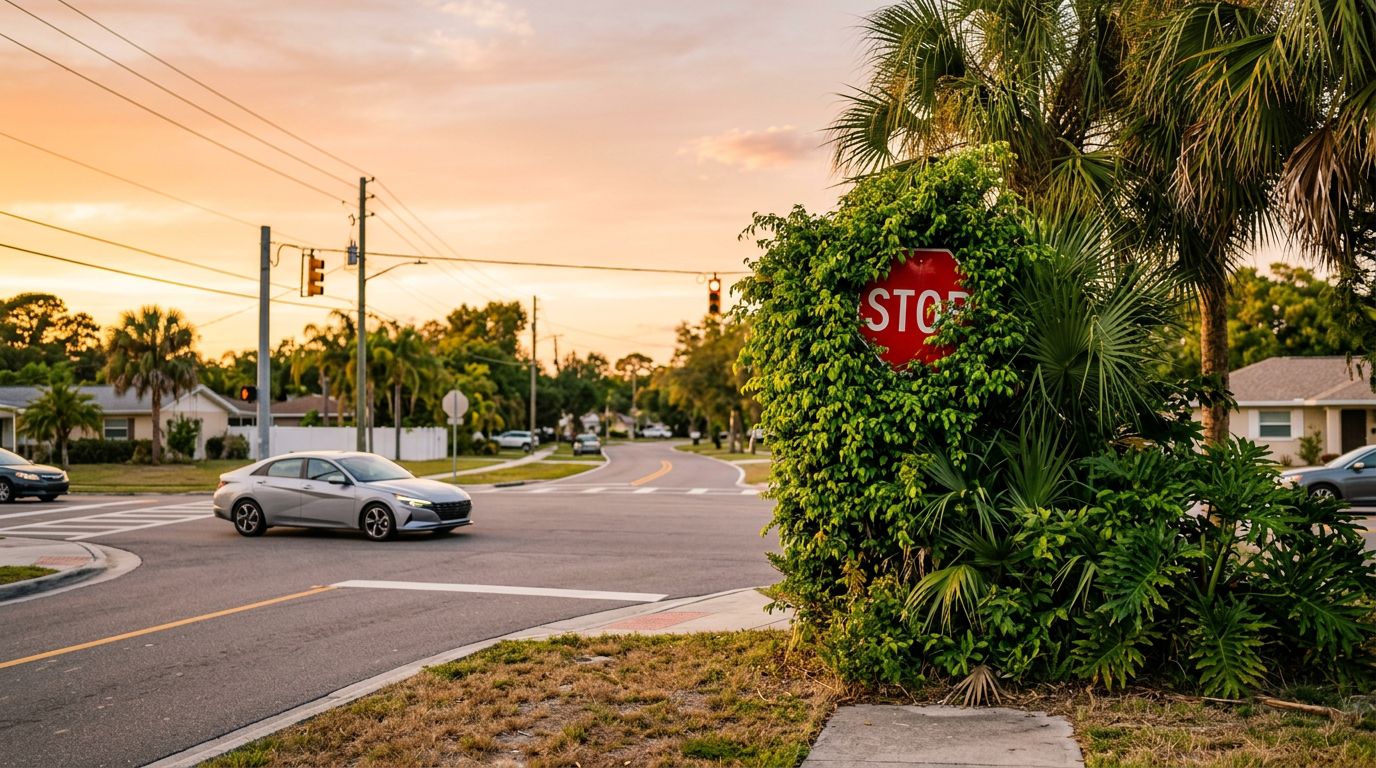
An overgrown hedge can turn a routine intersection into a blind corner in seconds. In Florida, that matters because sight line proof often decides stop sign crash claims.
A blocked sign does not erase a driver’s duty to stop and yield. It can, however, point to a dangerous intersection, a missed maintenance duty, or both.
The proof starts with the scene, the timing, and the condition of the foliage. If you’re sorting through fault and insurance pressure, Florida car accident attorneys can help lock down the facts before the scene changes.
Why overgrown foliage changes a Florida intersection
A stop sign only works when a driver can see it soon enough to react. When bushes, palm fronds, tree limbs, or tall ornamental plants crowd the corner, the sign may appear too late.
That delay matters in a split second. A driver who spots a sign at the last moment has less time to brake, look both ways, and avoid cross traffic. In a busy neighborhood, that short gap can decide whether the cars miss each other or collide.
Sight lines matter even more at odd-shaped intersections. A sign can be visible from one approach and hidden from another. It can also disappear behind a curve, a parked vehicle, a slope, or a corner lot with thick landscaping.
Weather and light can make the problem worse. A sign that seems obvious at noon can be nearly invisible at dusk or in the rain.
The key question is simple. Could the driver see the sign in time to stop safely? If the answer is no, the foliage may be part of the crash story.
What Florida law says about a blocked stop sign
Florida law still expects a driver to stop at a stop sign. Under Florida Statute 316.123, the driver must stop at the stop line, the crosswalk, or the nearest point with a clear view of traffic. A partly hidden sign does not give anyone permission to roll through the intersection.
That said, a blocked sign can still matter in a claim. Florida law can place responsibility on a property owner when vegetation on or extending from the property creates a road hazard. A city or county may also face liability if it knew, or should have known, about the danger and did not fix it in time.
A hidden stop sign does not end the case. It shifts the fight to visibility, notice, and causation.
The most important issue is causation. In other words, did the overgrown foliage help cause the crash? If the answer is yes, the obstruction becomes much more than a landscaping problem.
Shared fault can still matter too. A driver who speeds, looks away, or ignores the intersection can still face blame. The claim becomes stronger when the sign was hidden and the driver still acted reasonably.
How to prove a sight line was blocked
Strong cases show what the driver could see, not just what a person sees while standing beside the sign. That means the angle, distance, and timing all matter.
The best proof often starts at the scene. Photos taken from the driver’s lane, at eye level, can show how much of the sign was visible. Measurements can show how far the sign sat from the stop point. If the foliage was trimmed after the crash, early photos can still capture the earlier condition.
A few forms of proof often carry the most weight.
| Evidence | What it can show | Why it matters |
|---|---|---|
| Photos from the driver’s approach | How visible the sign was from the lane | A view from the curb can hide the real problem |
| Distance measurements | How close the foliage sat to the sign and stop line | It helps show whether the sign was blocked early or late |
| Witness statements | What other drivers saw before the crash | Other views can confirm the obstruction |
| Dashcam or security video | The actual approach to the intersection | Video can settle disputes about speed and visibility |
| Repair logs or complaints | Whether anyone knew about the blockage | Notice often matters as much as the hazard |
The strongest file usually combines several of these items. One photo can help. A full record can prove the scene was unsafe.
Who may be responsible after the crash
Responsibility depends on control and notice. A homeowner may be responsible when bushes or tree limbs on the property hide a stop sign. A business can face the same issue when landscaping blocks the view near its frontage. A city or county may be responsible when the hazard sits in the public right-of-way and officials had time to act.
Sometimes the evidence points to more than one party. The driver who caused the collision may share fault, while the property owner or public agency may also bear blame for the hidden sign. That is why these claims need careful review. The wrong target wastes time, and the right one can change the result.
Maintenance history matters here. If a sign had been blocked for weeks, complaints, work orders, or prior crash reports may help show notice. If the obstruction grew after a storm, that detail can matter too. The timeline often tells the story.
A lawyer who handles personal injury attorneys in Florida can sort out the property line, maintenance records, and insurance issues tied to the crash.
Evidence that strengthens stop sign crash claims
Quick action helps because proof fades fast. Foliage gets trimmed. Memories blur. Security footage gets deleted on a schedule.
The best files focus on both the obstruction and the impact it had on the driver. That means collecting the scene details before anyone changes them.
- Photos of the stop sign from the driver’s approach lane.
- Pictures taken at the stop bar, not just from the sidewalk.
- Names and phone numbers for witnesses who saw the intersection before the crash.
- The police crash report and any diagram of the scene.
- 311 complaints, email records, or maintenance requests about the overgrowth.
- Dashcam, nearby business video, or doorbell footage from the area.
If the crash happened at night, photos in low light can matter even more. A sign that barely showed up in daylight may disappear after dark.
The scene can also change after the wreck. If a crew trims the bushes the next morning, that does not erase what happened. It does make early documentation more important.
Conclusion
Florida stop sign crash claims often come down to one question, could the driver see the sign in time to react? When foliage blocks the view, the answer depends on hard proof, not guesses.
A hidden sign does not automatically create liability. It does, however, open the door to a claim when the obstruction helped cause the wreck and someone had a chance to fix it.
The strongest cases are built early, while the scene, the vegetation, and the paperwork still match what happened on the road.