
Florida Falling Tree Branch Injury Claims and Prior Notice
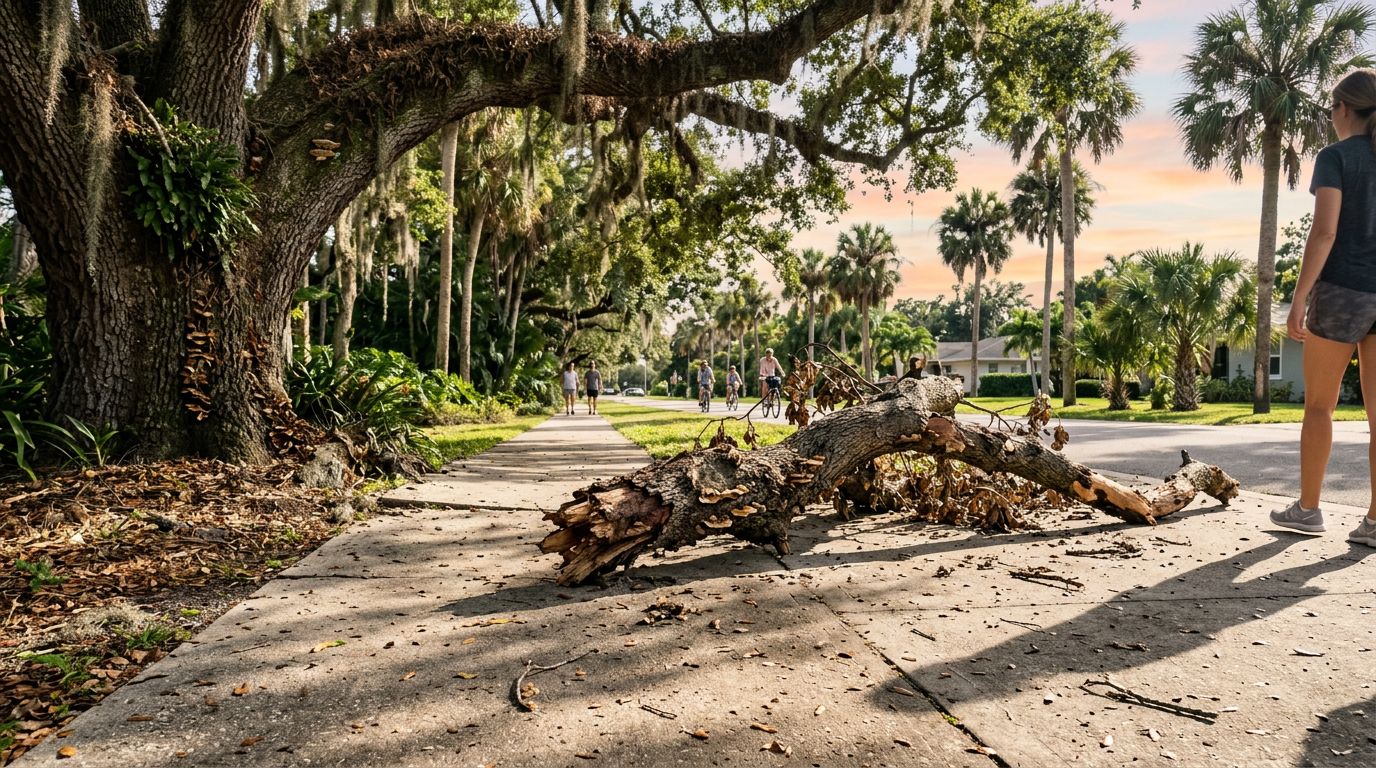
A falling tree branch can do serious harm in seconds. It can break bones, cause a head injury, or leave you out of work for weeks.
In Florida, the hard part is often not proving that you were hurt. It is showing that the property owner knew, or should have known, the tree was dangerous before the branch fell.
That difference matters. If the branch came from a parking lot tree, a rental property, or a sidewalk next to a business, the facts around prior notice can shape the whole case.
When a falling branch becomes a Florida injury claim
Not every branch injury leads to a valid claim. Trees drop limbs during storms, and Florida weather can be harsh. Still, a property owner has a duty to keep the area reasonably safe.
That duty becomes important when there were warning signs before the injury. Dead limbs, visible decay, fungus, leaning limbs over a walkway, or repeated breakage can all point to a known hazard. If an owner ignores those signs, the branch may be more than bad luck.
Claims often arise in places people use every day. Think about apartment walkways, storefront entrances, hotel parking lots, school grounds, and sidewalks near private buildings. In those settings, the owner or manager usually has time to inspect, trim, and act.
A case can also involve more than the branch itself. Sometimes the branch falls because pruning was done poorly. Sometimes the tree had been flagged for removal months earlier. Sometimes the danger was obvious from the ground.
A claim gets stronger when the danger was visible before the branch fell.
That is why these cases are so fact-heavy. The branch may be gone, but the condition of the tree, the maintenance history, and the owner’s response can still tell the story.
What prior notice means in a falling tree branch case
Prior notice means the property owner knew about the danger, or the danger existed long enough that the owner should have found it. In Florida injury cases, that detail often decides whether negligence is hard to prove or fairly clear.
Here is a simple way to look at it:
| Type of notice | What it means | Example in a tree branch case |
|---|---|---|
| Actual notice | The owner knew about the danger | A tenant reported a dead limb, or a manager saw it during an inspection |
| Constructive notice | The hazard was there long enough that the owner should have found it | A hanging limb, rot, or split trunk stayed visible for weeks |
| No notice shown | There is no proof the owner knew or should have known | A healthy limb broke in a sudden, severe storm with no warning signs |
The table shows why these claims can be tough. A branch that falls after an unexpected storm may not create liability by itself. But a branch that breaks after repeated complaints, visible decay, or missed inspections can support a claim.
The same proof themes that support how to prove a property owner is at fault in other premises cases also apply here. The key question is whether the owner had a fair chance to fix the danger before someone got hurt.
Proof that can show the owner knew, or should have known
These cases often rise or fall on records. Photos help, but they are only part of the picture. A strong claim usually ties together the condition of the tree, the owner’s knowledge, and the injury itself.
Useful proof often includes:
- Photos and video of the tree before the fall: Images of decay, broken limbs, fungus, or a leaning trunk can show the hazard was visible.
- Prior complaints or work orders: Emails, texts, tenant reports, or maintenance requests can show the owner was warned.
- Tree service records: Pruning logs, inspection notes, and removal quotes may show the owner knew the tree needed attention.
- Witness statements: Neighbors, tenants, workers, or customers may have seen the branch hanging low or noticed it had been damaged.
- Surveillance footage: Video can show how the branch fell and whether the area had been neglected.
- An arborist or other tree professional’s opinion: A qualified review can help explain why the limb failed and whether the problem was visible before the fall.
The best evidence is often simple and ordinary. A complaint email can matter more than a dramatic story. A maintenance log can matter more than a guess.
For that reason, it helps to preserve everything quickly. Take photos from different angles. Write down names of witnesses. Save medical records and incident reports. If a business or landlord controls the area, ask for the footage before it disappears.
Storms, HOAs, rentals, and public property can change the claim
Florida weather changes these cases, but it does not erase them. A storm defense can work when a healthy branch breaks during a sudden wind event. It is weaker when the owner ignored obvious danger before the storm arrived.
That difference matters on private property, too. In an apartment complex, condo community, or HOA area, the group that controls the trees may have inspection and maintenance duties. A landlord may also be responsible for common areas, parking lots, or paths used by tenants and visitors.
Public property adds another layer. If a branch falls from a tree on city, county, or state property, the claim rules can be different. Deadlines can be shorter, notice requirements can be stricter, and the paperwork matters more than many people expect.
A tree near a roadway or sidewalk can also create a mixed question. If the limb fell into traffic, the facts may involve both property safety and road hazard issues. In those situations, the location of the tree, the control of the land, and the way the area was maintained all matter.
A fast storm does not automatically defeat a claim. It only changes the proof. If inspections were skipped, if a dead limb had been ignored, or if warnings had been documented before the weather turned, prior notice may still exist.
Medical bills, lost wages, and what to protect after the fall
A branch injury can cost far more than the first ER visit. You may need imaging, follow-up care, physical therapy, prescriptions, or surgery. Some people also miss work or lose the ability to do their job for a while.
Those losses matter in a claim. So does pain, scarring, and a longer recovery time. If the injury affects your neck, back, shoulder, or head, the effects can last well beyond the day of the accident.
If you want a closer look at recovery in a fall case, understanding Florida slip and fall compensation gives a helpful sense of the types of losses that may count. The same basic idea applies here, even though the hazard is a tree branch instead of a wet floor.
After the injury, keep your focus on proof. Get medical care right away. Report the incident. Save the clothes and shoes you wore. If the branch is still at the scene, take photos before it gets cut up or hauled away.
The claim gets stronger when the evidence is fresh. Once the property is cleaned up, the history of the tree may become harder to prove.
Conclusion
A falling branch can look random, but many claims turn on something less dramatic, prior notice. If the owner saw warning signs, received complaints, or ignored a visible hazard, the facts may support an injury claim.
The best cases are built early, while the tree, the scene, and the records still tell the same story. When a branch falls in seconds, the proof often starts with what happened in the days before it broke.