
Florida Four-Way Stop Crash Claims and Right-of-Way Proof
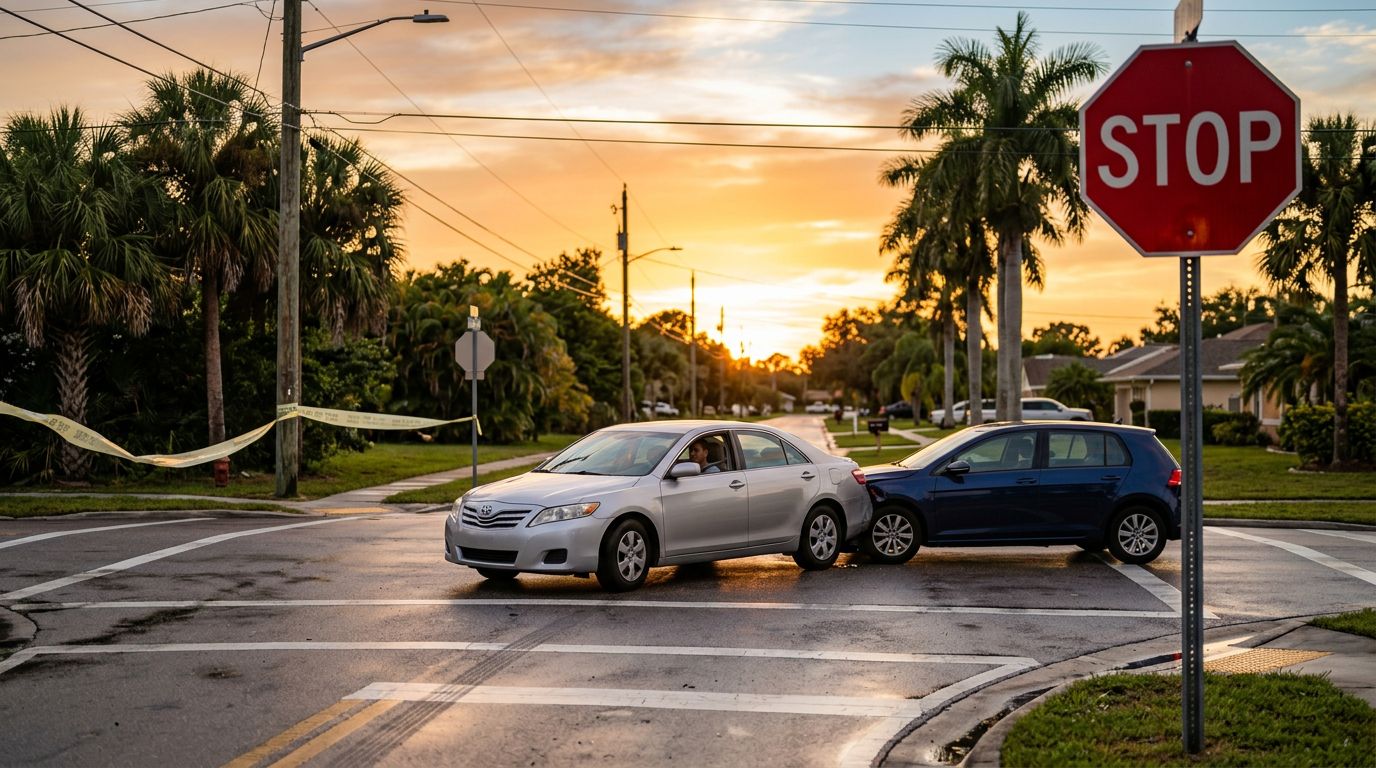
A Florida four-way stop accident can look simple at first. One driver says they stopped first. The other says the same. Yet that small timing dispute can shape fault, insurance payouts, and whether a claim gets paid at all.
At a stop sign, drivers often rely on memory, eye contact, or a quick wave. Those clues may help in the moment, but they do not always hold up after the crash. What matters later is proof.
Florida law and insurance rules make that proof matter even more. The sections below show how right-of-way works, what evidence matters, and how to protect a claim after the wreck.
How Florida right-of-way rules work at a four-way stop
At a four-way stop, the first vehicle to make a full stop usually gets to go first. When two cars stop at the same time, the driver on the right has priority. If two vehicles face each other and one plans to turn left, the left-turning driver yields to the car going straight or turning right.
Those rules sound basic, but they get messy fast when drivers arrive within seconds of each other. A rolling stop can blur the whole picture. A driver who slows down but does not fully stop may still claim the right of way, and the other driver may have had no time to react.
That is why a crash claim often turns on small details. Tire marks, front-end damage, and witness accounts can show whether the stop was real or only claimed after the fact. A wave across the intersection is not legal proof. Neither is a horn blast, a nod, or a quick glare through the windshield.
One driver may feel certain they were first. The law looks for something better than certainty. It looks for the order of arrival, the point of impact, and whether anyone entered the intersection too soon.
Why four-way stop crashes still turn into blame fights
Common crash patterns at a stop sign
A four-way stop rarely gives both drivers the same story. The same intersection can produce very different versions of the same event.
- Two cars arrive together and both pull forward.
- One driver pauses too long, then enters after assuming the other driver will wait.
- A left-turning driver misreads the other vehicle’s speed.
- A parked car, tree, or truck blocks the stop sign.
The law does not care which driver felt more confident. It cares which driver had the right of way and which driver created the danger.
These cases also get harder when visibility is poor. A tall SUV can hide a smaller car. Trees, utility poles, and parked vehicles can block the view of a stop sign. At busy intersections, drivers may have only a second to decide whether the other car has fully stopped.
That is where blame fights begin. One driver may swear the other “blew through” the stop. The other may insist they stopped and moved only after the lane was clear. Because crash scenes change fast, even small details like where the cars came to rest can shape the entire claim.
The evidence that can prove who had the right of way
Proof in a right-of-way dispute usually comes from several sources, not one big reveal. The strongest claims often combine scene photos, witness accounts, and video from a dashcam or nearby business. A single police report helps, but it rarely tells the whole story.
Here is a quick look at the kinds of evidence that can matter most.
| Evidence | What it can show | Weak spot |
|---|---|---|
| Dashcam video | Exact arrival order and movement through the intersection | Limited angle may miss a side impact |
| Witness statement | Who stopped, who entered first, and whether anyone rolled through | Memory fades and people disagree |
| Scene photos | Sign placement, lane position, skid marks, and vehicle rest points | Photos taken late miss key details |
| Police report | Officer observations, driver statements, and any citations | The report is not the final word |
| Nearby surveillance | The full sequence leading to impact | Video can be erased fast |
| Vehicle damage | Angle of impact and where each car was struck | Damage alone rarely proves right-of-way |
The best claim uses these pieces together. One photo may show the final position of the cars. A witness may explain which vehicle entered first. A video may settle the timing problem that memory cannot.
A citation can support a claim, but it does not settle civil fault by itself.
That matters because insurers often treat the report as a starting point, not the end of the analysis. They look for consistency between the written report, the photos, and what each driver said at the scene. If those facts line up, the claim gets stronger. If they clash, the fight gets longer.
How insurers read a four-way stop claim
Insurance adjusters study these crashes closely because a fault split changes the money. In most Florida negligence claims, a person who is more than 50% at fault cannot recover damages. That makes the first version of the story important.
After a stop-sign crash, an adjuster may ask whether you really stopped, whether you saw the other car, and whether you could have avoided the collision. They may also compare your statement with the damage pattern and the police report. A rushed answer can create trouble later, especially if you guessed about speed or distance.
Your own PIP coverage may handle part of the medical bill, but it does not settle the fault issue. If injuries are serious, the claim can also involve missed work, follow-up care, and pain that lasts far beyond the crash scene. When that happens, a personal injury law firm can connect the collision facts to the injury records and keep the paper trail in order.
If the other driver blames you, that does not end the claim. It means the evidence has to do the work. A Florida car accident lawyer can review the report, camera footage, witness names, and damage photos before the story hardens into something harder to challenge.
Steps that help a claim after a four-way stop collision
What you do in the first hours can matter more than what you say later. A clear record starts at the scene.
- Get medical care and keep every record, even for pain that feels minor at first.
- Photograph all approaches to the intersection, plus skid marks, stop signs, and the final vehicle positions.
- Ask witnesses for names and phone numbers before they leave.
- Report the crash promptly and ask whether nearby video may exist.
- Keep your statement short and factual, especially if an adjuster calls soon after the wreck.
Businesses often overwrite surveillance quickly, and weather can erase marks within hours. A stop-sign crash can also happen at an angle that makes damage hard to read. That is why the first photos and witness names matter so much.
It also helps to avoid guessing. If you do not know how fast the other driver was going, say so. If you did not see the exact moment of impact, do not fill in the gap. Claims stay cleaner when the facts stay plain.
Conclusion
Four-way stop crashes are often small in distance but big in dispute. When two drivers tell different stories, right-of-way proof decides what an insurer believes.
Photos, witnesses, video, and a fast report create that proof. Without them, the claim can turn into a memory contest.
The strongest cases start with the simple facts the road leaves behind. That is usually where the truth sits.