
Florida Funeral Procession Crash Claims and the Right‑of‑Way Proof That Matters
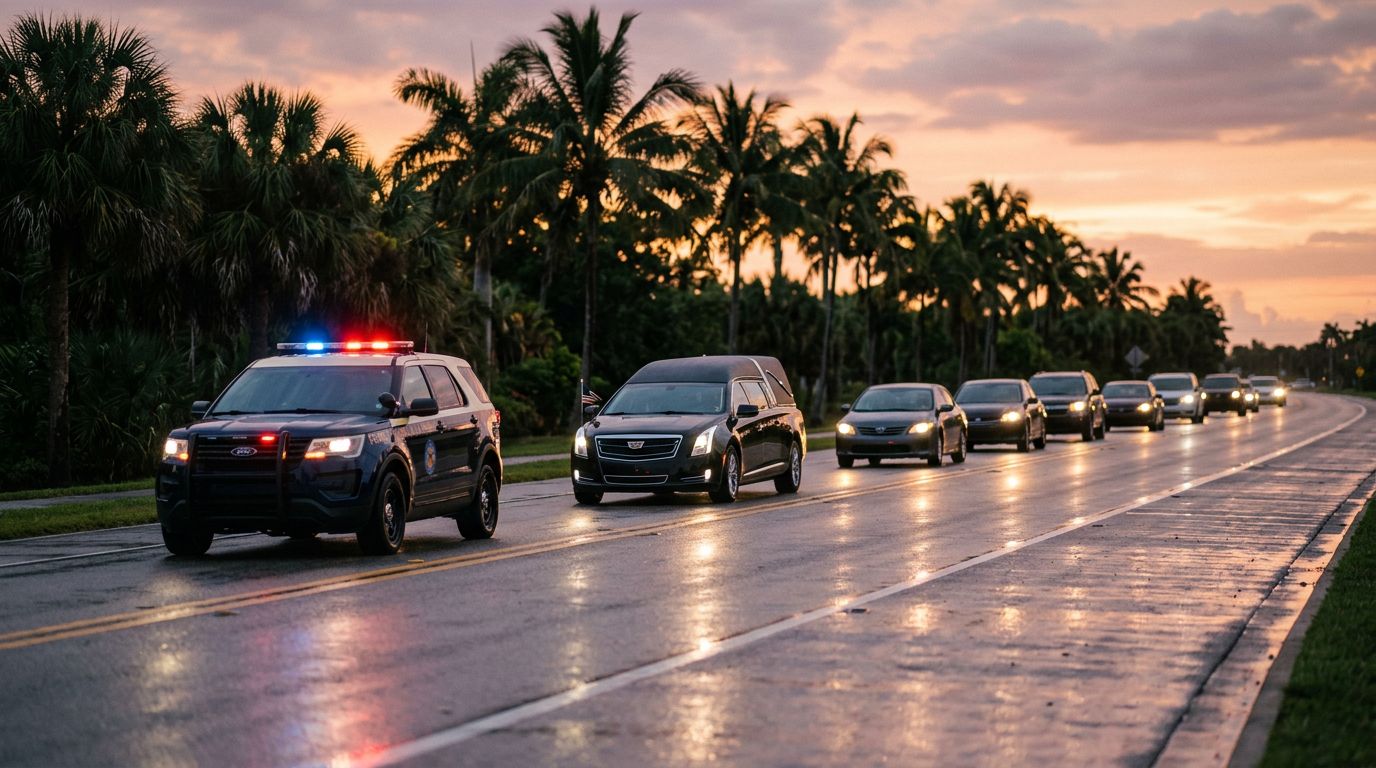
A funeral procession is one of the most recognizable sights in Florida. Long lines of cars with headlights on, mourning flags, and a hearse in the middle can be dramatic—but they also create unique legal questions when a crash occurs. Florida has a special traffic law for funeral processions, and understanding it can make the difference between an insurance company paying only basic benefits and recovering the full value of a serious injury claim.
This article explains what a funeral procession is under Florida law, why those vehicles have the right‑of‑way, and how to use that fact to strengthen a personal injury case. It also covers the practical steps to take after a collision with a funeral escort or hearse, including medical treatment, evidence collection, dealing with no‑fault insurance, and deciding whether you need a lawyer.
What counts as a funeral procession in Florida?
Under Florida Statute § 316.1974, a funeral procession means a group of vehicles accompanying a dead person to a funeral or burial. The law says that vehicles and pedestrians must yield the right‑of‑way to any vehicle that is part of a funeral procession. In plain English, if a hearse or lead car is in the line, everyone else has to let it go first even if there is no stop sign or traffic light controlling the intersection.
The statute sounds odd because most people think of funeral processions as a ceremonial custom, not a rule of the road. But Florida treats them like emergency vehicles: other traffic is expected to pull over and allow the procession to proceed. When a collision happens, the fact that the other vehicle was in a funeral procession can become powerful evidence of negligence—especially if it violated the special right‑of‑way rule.
Why the statute matters in a crash claim
Most Florida accident cases are governed by the state’s no‑fault system. Every driver first turns to his or her own Personal Injury Protection (PIP) coverage for medical bills, no matter who caused the wreck. That means your insurer pays a percentage of your losses regardless of fault—but if your injuries are serious or permanent, you may also have a claim against the negligent driver or funeral establishment.
Serious crash cases often exceed the limits of PIP, and then fault becomes central. If you can show that the other driver or entity broke a traffic law, created a dangerous condition, or failed to act reasonably, you can recover more than just no‑fault benefits. For a funeral procession collision, that proof usually involves showing the line of cars was part of a funeral and therefore had the right‑of‑way.
The key legal issue is usually negligence. Even though Florida uses a modified comparative negligence rule, the claimant still has to prove the other party was careless. In a funeral procession case, that often means establishing one or more of the following:
- the defendant was operating or walking in a vehicle that was part of a funeral procession;
- the procession had the right‑of‑way under § 316.1974;
- the driver failed to yield to the funeral escort vehicle;
- the defendant created a dangerous situation by not allowing the lead vehicle to proceed;
- the at‑fault party was more than 50 percent responsible for the crash, or intentionally caused harm.
If you are hit by a funeral procession vehicle, the first question is whether there really was a funeral procession and whether the other driver or pedestrian had the statutory right‑of‑way. Insurance companies look for proof such as photos, video, witness statements, and crash reports showing that the lead car was in a funeral cortege.
Understanding Florida’s no‑fault system
Florida is a pure no‑fault state for auto insurance. Your own insurer normally pays 80 percent of medical bills and 60 percent of lost wages, up to policy limits, regardless of fault. To protect those benefits, get medical treatment immediately and report the crash promptly—usually within 14 days for PIP and then as soon as possible if the injuries are catastrophic.
No‑fault benefits are only the first layer. PIP will not compensate you for everything, especially pain and suffering or any part of your case that exceeds your policy limits. If the injuries are serious or long‑lasting, or if there are large medical bills, then you should think about a third‑party claim early. A personal injury attorney can help with that.
That is where the right‑of‑way proof really matters. Florida’s modified comparative negligence rules can reduce compensation if you share blame, but they do not stop you from recovering damages from a negligent funeral home, driver, bar, restaurant, or another commercial defendant. In addition, proving fault preserves your right to sue even when your insurance company wants to settle.
Practical steps after the crash
- Get medical attention first. Your health comes before any legal claim. If you are badly hurt, call 911 and go to the emergency room or urgent care. Follow all medical advice and keep records of every diagnosis, treatment, prescription, and restriction.
- Report the crash. If police respond, ask for a report number. Take photographs of the vehicles, the funeral procession, the scene, skid marks, debris, and your injuries if possible. Get names, addresses, plate numbers, insurance information, and witness contact information.
- Notify your insurance company. Most policies require prompt notice, often within a day or two. Give only the basic facts until you speak with a lawyer. Avoid detailed statements, recorded interviews, or speculation before you know what happened.
- Preserve evidence. If there were bystanders, get their names and phone numbers. Look for nearby cameras, dashcam footage, or security videos. Keep damaged property and the vehicle in the same condition if you can.
- Do not give a recorded statement to the insurer before understanding the full situation. Florida insurers often use your own words against you; anything you say can be twisted into a claim denial. It is usually better to talk to a lawyer before a formal statement.
- Talk to a Florida personal injury attorney early. A lawyer can explain the deadlines, how to prove fault, and whether the right‑of‑way statute applies. A crash lawyer will help gather evidence, coordinate with insurance, and make sure you do not miss a lawsuit deadline. Avard Law handles these cases routinely.
How § 316.1974 works
The statute itself is short, but the way courts and insurers apply it can be confusing. The important language is that all vehicles in the procession have the right‑of‑way, even if they are not using sirens or police escorts. In real life, a funeral lead vehicle can be anything from a hearse to a family car carrying mourners or a minister to the graveyard.
What matters for a personal injury claim is not the funeral custom itself but whether the vehicle that hit you was “part of” a funeral procession as defined by the statute. Typical examples include a hearse, limousine, family van, pickup truck, car, or even a motorcycle or bicycle traveling with a funeral. The rule can also apply to pedestrians walking in the procession.
The key is to show that the defendant’s vehicle or presence qualified as a funeral procession. That can happen in a variety of contexts:
- A hearse or hearse-like vehicle was leading or participating in a funeral.
- A family member’s car was driving behind a funeral escort.
- A pickup carrying mourners was part of a funeral cortege.
- Several cars were traveling together from a funeral home to a cemetery.
- The vehicle was in a line of cars with headlights on and flags or hazards displayed.
- The procession was going to or coming from a funeral, wake, burial, church, or cemetery.
- It may have included mourners, family, friends, clergy, or pallbearers.
In Florida, funeral processions are common enough that police, juries, and insurance adjusters understand the concept. But outside the state, some readers may wonder why an article about funerals matters to car accident claims. The reason is simple: if the negligent party was in a funeral procession, there may be a statutory presumption or at least a strong argument of fault.
Proving fault in a funeral procession case
Proving a claim requires the same basics as most traffic cases: duty, breach, causation, and damages. You still need evidence that the defendant’s actions caused the crash and your injuries. Even with the funeral procession statute, you usually must show:
- the other vehicle/pedestrian was part of a funeral procession;
- the defendant did not yield to the procession and caused the collision;
- the driver violated § 316.1974 by not allowing the lead vehicle to go first;
- the at‑fault party entered or crossed the intersection when it was unsafe;
- the procession created an unreasonable risk of harm;
- the defendant’s negligence was a legal cause of the accident.
Proof can be built with witness testimony, crash reports, photos, or video. Objective evidence—such as vehicle damage, skid marks, police observations, and any available surveillance—helps a lot. A skilled lawyer will use those facts to argue both with the insurer and, if necessary, in court.
Common evidence used
- eyewitness statements describing the funeral procession;
- police report narrative about the procession and the crash;
- photographs of the lead vehicle, the hearse, or the whole funeral line;
- video or dashcam footage showing the procession or the intersection;
- names and contact information of all drivers and passengers;
- the funeral home, church, or cemetery involved;
- accident reconstruction, measurements, and scene diagrams;
- vehicle black-box data, event data recorder information, and cell phone records if the driver was distracted.
What if you were partly at fault?
Florida’s system means you can still collect some benefits even if you are partially to blame. However, your compensation will drop in proportion to your percentage of fault, and insurers can bar recovery altogether if you are more than 50 percent responsible. If you believe someone else shares blame, a lawyer can still help prove the other side’s negligence and pursue a third-party settlement or verdict.
Comparative negligence does not prevent a lawsuit. It only reduces damages. If the crash caused significant injury, lost wages, pain and suffering, or permanent disability, you may need more than PIP. An attorney can evaluate whether stepping outside no‑fault makes sense and how to coordinate those claims with the insurance carrier.
The role of a lawyer
A Florida personal injury lawyer can review the police report, interpret the statute, preserve evidence, and speak with the insurance adjuster. If your injuries are severe, permanent, or catastrophic, or if there are multiple vehicles and complex liability, legal help can protect your claim. The right attorney will know how to document the crash, fight for full compensation, and handle any comparative negligence issues that arise.
At Avard Law, attorneys regularly help clients with motor vehicle accident cases involving funeral processions, stop signs, roundabouts, and other right‑of‑way disputes. Because the firm focuses on personal injury, wrongful death, and disability claims, it understands both the insurance and medical sides of a serious Florida crash. The firm offers free case evaluations and can advise you whether the right‑of‑way proof matters enough to justify filing suit.
When to contact a lawyer
You should contact an attorney as soon as possible if:
- your injuries are serious or permanent;
- there is a death involved;
- multiple vehicles, pedestrians, or complicated insurance issues are present;
- the insurer denies the claim, delays treatment, or pushes you toward a low settlement;
- fault is disputed or there is any question about who pays.
A lawyer is especially important if the insurance company says the procession had the right‑of‑way and therefore you were at fault. That argument is common because insurers often claim you “should have seen” the funeral procession or avoided the collision. Counsel can challenge those positions and explain the evidence needed to overcome them.
Building a strong case
The best claims combine prompt medical treatment with strong evidence. Here are the main things you need to do:
1) Get immediate medical care
Seek emergency treatment right away. Follow up with specialists if needed. Save every bill, discharge paper, and prescription. Your medical records are part of the evidence.
2) Document the scene
Write down everything you remember about the accident while it is fresh. Take pictures from different angles. If possible, return to the scene and look for cameras or debris. Identify the funeral home, church, or cemetery.
3) Notify all insurers
Report the crash to every company that might provide coverage—auto, health, disability, life, and umbrella insurers if applicable. Use your own PIP first, then any health insurance, MedPay, Medicare, Medicaid, or disability coverage. If you have UM/UIM or employer benefits, report those too.
4) Consider a third‑party claim
If the damages are substantial, think about suing the negligent parties even after your own insurance pays. For very serious injuries, large medical bills, or permanent impairment, a liability case may be worth it. Counsel can help determine who else should be named in the suit.
5) Preserve proof of the procession
Evidence that the vehicle was part of a funeral procession is central. Show the procession had the right‑of‑way and that the defendant failed to yield. Demonstrate the connection between the line of vehicles and the collision. Use the statute, witness accounts, photos, video, and crash reconstruction.
6) Watch the deadlines
Florida’s no‑fault rules have strict filing deadlines, often as short as 14 days for PIP. A lawsuit usually must be filed before the statute of limitations expires, and serious injury thresholds can run out quickly. An attorney can keep you on track for treatment and the claim.
Frequently asked questions
Does the funeral procession statute automatically win my case?
No. The statute helps, but it does not automatically mean the funeral procession driver is liable for all your losses. The rule is just one piece of evidence. Insurance companies will still look at speed, inattention, lane position, signaling, visibility, and other conduct to decide fault.
Can I recover if I was also negligent?
Yes, sometimes. Because Florida uses a modified comparative negligence system, your recovery may be reduced if you were careless, distracted, impaired, speeding, intoxicated, texting, or otherwise contributed to the wreck. But you can still collect damages when the other party is mostly at fault, particularly if the evidence against them is strong.
What if the defendant says I “shared blame”?
That is a common defense. Insurers often argue that you should have noticed the funeral procession, maintained a safe distance, or avoided the line of cars. The counter is that the procession was obvious—headlights, flashing lights, hazard flags, and the hearse itself should have warned you.
Is a hearse enough to prove liability?
Not by itself. The fact that a hearse is in a funeral procession is relevant, but you still need to show that the defendant’s conduct was negligent and caused the accident. Objective proof makes the connection stronger: the lead vehicle was part of a funeral and had the right‑of‑way, yet it failed to exercise reasonable care.
Types of funeral procession scenarios
Florida cases have involved many different kinds of processions, such as:
- hearses traveling to a cemetery or funeral home;
- pickup trucks or vans carrying mourners to a church or burial;
- motorcycles or scooters accompanying a funeral;
- bicycles in a funeral cortege;
- family cars or limousines driving behind a funeral escort;
- vehicles with headlights on and flags displayed;
- pedestrians walking in a group after a funeral;
- multiple cars going to or from a memorial service.
The statute can also apply when the procession is returning from a graveyard or leaving a cemetery. Common examples include a line of mourners’ vehicles, a hearse with family members following, or a church funeral vehicle accompanied by friends and relatives. Any of these can create the right‑of‑way issue.
Intersections and roadway rules
If the crash occurs at an intersection, pay attention to:
- stop signs, traffic lights, and lane arrows;
- whether the procession had flashing lights or hazard signs;
- right turns, left turns, or crossing maneuvers;
- lane position, path of travel, and proximity;
- blocked sight lines, rain, fog, or other visibility issues;
- speed, acceleration, or braking;
- distraction, phone use, texting, or GPS;
- road conditions, weather, and lighting.
Even without a traditional stop sign or red light, the procession is treated as having the right‑of‑way. So the accident may happen where there is no signal, but the lead vehicle still has priority. That creates an argument that the other driver or pedestrian had a duty to yield.
Special situations
This rule can matter in:
- intersections controlled by police officers or funeral directors;
- traffic controlled by a church, cemetery, or funeral home;
- roads near a burial site or memorial service;
- processions to a funeral, wake, or visitation;
- lines of cars with a hearse in the middle;
- parades, escorts, or ceremonial motorcades.
In Florida, funeral processions are a serious and legal road hazard. If you were struck by one, it can affect everything from your health care to your insurance claim. Understanding the law helps you recover damages and can even influence who pays for a wrongful death if someone was killed.
Wrongful death and serious injury
When a funeral procession crash causes death, the statute can be central to a wrongful death case. If a loved one dies, Florida law can affect death benefits, funeral expenses, and the ability to sue the at‑fault party. Surviving family members may need to understand the rules to recover for wrongful death and funeral costs.
Serious injuries in funeral procession collisions can also be catastrophic. They often lead to large medical bills, lost wages, pain and suffering, disfigurement, disability, or long‑term care needs. The law matters for any high‑value claim where the injuries are permanent or the treatment is extensive.
PIP vs. liability claim
Your own PIP covers medical bills, but it does not compensate pain and suffering. If injuries are severe, catastrophic, or permanent, the no‑fault threshold can be exceeded, and a third‑party case may provide compensation beyond your policy limits. An attorney can assess whether the damages are large enough to justify stepping outside the no‑fault system.
Florida’s PIP usually pays 80 percent of medical expenses and 60 percent of lost wages, up to a limit such as $10,000. But if your claim is worth more than that, or if you need future medical treatment, pain and suffering, or disability compensation, you may want to file against another responsible person or business. Legal advice can help you calculate whether a liability case is worth pursuing.
Why right‑of‑way proof helps
Right‑of‑way proof can tip the balance in close cases. The fact that a funeral procession has the right‑of‑way may show the defendant violated a specific traffic duty. That evidence can be important where the crash facts are otherwise unclear. If the insurer is arguing you were at fault because you should have seen the procession, proof of the statutory duty can help overcome that defense.
Courts and adjusters care about showing that the procession really had the right‑of‑way and that the defendant failed to yield. Evidence such as witness statements, crash reconstruction, photos, and video can prove the line of cars was indeed a funeral procession. The more documentation you have, the stronger your case will be.
Summary
To maximize a Florida funeral procession claim, remember:
- get treated first and follow medical advice;
- document the procession, intersection, and all vehicles involved;
- report the crash promptly and notify every insurer;
- think about whether injuries exceed PIP limits;
- talk to a lawyer before giving a statement;
- watch deadlines and preserve evidence.
The rest of this article breaks these issues down in more detail and offers practical guidance on what to do after an accident with a funeral procession vehicle.
Florida funeral procession statute: the text
Here is the wording of Florida Statute § 316.1974 (current as of 2026, but unchanged for years). The same language appears in many editions of the Florida Statutes:
316.1974 Funeral procession right‑of‑way and liability.
(3) FUNERAL PROCESSION RIGHT‑OF‑WAY; FUNERAL ESCORT VEHICLES; FUNERAL LEAD VEHICLES.
(a) Regardless of any traffic control device or right‑of‑way provisions prescribed by state or local ordinance, pedestrians and operators of all vehicles, except as stated in paragraph (c), shall yield the right‑of‑way to any vehicle which is part of a funeral procession being led by a funeral escort vehicle or a funeral lead vehicle.
(c) Funeral processions shall have the right‑of‑way at intersections regardless of traffic control devices, subject to the following conditions and exceptions:
The statute is awkward because it sounds ceremonial, but the legal meaning is simple: any vehicle that is part of a funeral procession has priority over other traffic. So when a hearse, escort car, or any funeral vehicle is in the line, other drivers must let it proceed first. If you were hit by one of those cars, that fact may help prove negligence.
At first glance, this seems to help anyone injured in a crash with a funeral procession, but the way insurers and juries apply it can be surprising. Florida has long used a modified comparative negligence system for car accidents, meaning each driver looks to their own PIP first. Yet the funeral procession rule remains useful because it imposes a specific duty on the procession and can support a claim against a non‑procession driver.
How the statute affects a claim
The statute creates a special right‑of‑way that can matter in several ways:
- If the other vehicle was in the procession, it may have had the statutory right‑of‑way. That can be evidence that the defendant had a duty to yield.
- If the funeral escort vehicle failed to proceed lawfully, it can support negligence.
- If the lead vehicle entered an intersection or roadway without allowing others to go first, the statute may apply.
- If a pedestrian walking in the procession failed to yield, the same analysis can matter.
- Even if the procession was returning from a funeral and did not stop at a light or sign, it still has priority.
For a claim, you normally need to prove:
- the defendant was operating or walking in a vehicle that was part of a funeral procession;
- the procession had the right‑of‑way under the statute;
- the driver did not yield to the funeral lead vehicle;
- the at‑fault party created a dangerous condition by violating the special rule;
- the defendant’s vehicle was more than 50 percent responsible for the collision;
- the procession failed to exercise reasonable care.
In addition, it often helps to show:
- the line of vehicles was indeed part of a funeral;
- there was a hearse or lead car in the line;
- the procession consisted of cars accompanying a funeral;
- the vehicle was traveling to or from a cemetery or funeral home;
- the procession had headlights on, flags, or hazard signs;
- there were multiple cars together from a memorial service.
That kind of evidence is often enough to convince an adjuster or jury that the other driver was negligent. But because Florida is a modified comparative negligence state, the insurer will also look at your conduct. If the injuries are serious and the damages exceed PIP, a personal injury lawyer can help with the rest.
Florida no‑fault, PIP, and modified comparative negligence
Florida’s system can be confusing because it is not a pure fault state like some others. Instead, it uses modified comparative negligence. In practical terms:
- Your own insurer pays first for your injuries, no matter who caused them.
- PIP usually covers 80 percent of medical bills and 60 percent of lost wages up to a limit.
- If the claim exceeds those thresholds, you may need to pursue another negligent party.
- To get more than PIP, you must prove the other person or company was also negligent.
- Comparative negligence does not bar a lawsuit; it only reduces damages.
- A personal injury attorney can decide whether a third‑party claim is worth filing.
If you were in a crash with a funeral procession vehicle, you may have two different claims:
- A no‑fault claim under your PIP or MedPay coverage for medical bills and wage loss.
- A liability claim against the negligent driver, funeral home, bar, church, restaurant, or another defendant.
A lawyer can help you pursue both. This is where evidence about the procession’s right‑of‑way becomes valuable, because it can point to a specific negligent party.
Does it matter if you are partly at fault?
Yes—sometimes. Florida reduces compensation by your share of fault. If you are more than 50 percent responsible, you may be barred from recovering from the other side. But even if you were texting, distracted, or speeding, a lawyer can still recover more money if the evidence shows the procession had the right‑of‑way and the other driver was careless.
What should you do now?
The immediate practical steps are:
- seek medical care and follow up;
- collect evidence about the procession and the crash;
- report the accident to police and insurers;
- preserve proof for both your PIP and any third‑party case;
- speak with a lawyer before giving statements;
- track all filing deadlines.
The rest of the article explains each of these steps.
1. Get medical treatment immediately
Your health is the first priority. Call 911 if there are severe injuries. Go to the ER or urgent care, and tell providers exactly how the accident happened. Keep all medical records, bills, discharge papers, prescriptions, and work restrictions.
PIP deadlines
Florida’s PIP is fast. To preserve 100% no‑fault medical benefits, get treatment within 14 days of the accident and follow all doctor orders. If your injuries are catastrophic, see specialists quickly and keep proof of every diagnosis, treatment, prescription, and disability rating. These records can later support a serious injury claim.
2. Record and preserve evidence
Document everything while your memory is fresh. Take photographs, get witness names, and keep the damaged vehicles or property if possible. Police reports, dashcam video, scene diagrams, and accident reconstruction are powerful proof. The more detail you save, the easier it is for an attorney to help.
3. Notify the insurer and police
Report the crash to all insurance companies that may apply—auto, health, disability, life, and umbrella policies if relevant. Use your own PIP first, then any health insurance, MedPay, Medicare, Medicaid, or disability coverage. Get the police report number.
4. Talk to a lawyer
Do not give a recorded statement until you understand the situation and have legal counsel. A Florida personal injury attorney can explain the deadlines, gather evidence, and coordinate both insurance and medical issues. Avard Law provides free consultations and can tell you whether the right‑of‑way statute will help your case.
5. Think about a third‑party case
If your losses are substantial, permanent, or outside policy limits, consider suing the negligent party. A lawyer will evaluate whether stepping outside no‑fault makes sense. Florida’s no‑fault rules only handle the first layer; serious damages may justify a liability case.
6. Use the right‑of‑way proof
Show that the defendant’s vehicle was part of a funeral procession and therefore had a duty to yield. Demonstrate the connection between the line of cars and the collision. Photos, video, witness statements, and crash reports can prove the procession existed and had the statutory right‑of‑way.
These are the basics of a strong funeral procession accident claim. Next, let’s look at the legal elements in more detail.
2. Legal elements of a funeral procession claim
A funeral procession accident claim usually turns on four legal questions:
- Was there a funeral procession?
- Was the defendant’s vehicle part of it?
- Did the procession have the right‑of‑way?
- Did the defendant fail to yield?
Was there really a funeral procession?
Insurance companies often dispute whether the line of cars qualifies as a funeral procession. A hearse or escort vehicle may seem obvious, but you still need proof. The first issue is often whether the defendant’s vehicle or presence was actually part of a funeral procession as defined by the statute.
What counts as a “vehicle” in the procession?
The statute applies broadly. The procession vehicle can be almost any motor vehicle—car, truck, van, pickup, limousine, SUV, motorcycle, bicycle, or even a golf cart—so long as it is part of a funeral procession. Likewise, a pedestrian walking in the procession may qualify.
Who has the right‑of‑way?
Under the law, all vehicles in the procession have priority. That means if a hearse or lead car is in the line, other traffic must yield. Pedestrians and operators of all vehicles have to let a funeral procession go first even without a stop sign or signal.
What if the procession was coming from a funeral?
The statute still applies if the line of cars is returning from a funeral or leaving a cemetery. Common examples include a hearse traveling from a funeral home to the burial site, or a family van with mourners. A procession may also include friends, relatives, clergy, pallbearers, or people going to a memorial service.
Intersections and traffic control
If the crash happened at an intersection, ask:
- Was there a traffic light, stop sign, or lane arrow?
- Did the procession have flashing lights or hazard flags?
- Was the vehicle turning right or left, crossing, or changing lanes?
- What was the lane position, path of travel, and visibility?
- Were there blocked sight lines, rain, fog, or darkness?
- Was the driver speeding, braking, or distracted?
- Was the driver texting, on the phone, or using GPS?
A funeral procession is often treated like an emergency vehicle, so others should pull over and allow it to proceed. If a collision happens without a traditional red light or stop sign, the lead vehicle still has priority. That creates an argument that the other driver or pedestrian had a duty to yield.
More complicated scenarios
The rule can apply in many settings:
- intersections controlled by police or funeral directors;
- traffic near a church, cemetery, or funeral home;
- roads near a burial site or memorial service;
- a line of cars with a hearse in the middle;
- a parade, escort, or ceremonial motorcade.
Florida funeral processions are a road hazard with legal consequences. If you are struck by one, it can affect everything from your medical bills to your ability to sue. Understanding the rule helps you recover damages and, in a fatal case, may affect wrongful death or funeral expense claims.
3. No‑fault vs. third‑party liability
After a funeral procession crash, you often start with PIP, but serious injuries may require a lawsuit.
What PIP covers
Your PIP pays medical bills and a portion of wage loss regardless of fault. Florida no‑fault coverage generally pays 80 percent of medical expenses and 60 percent of lost wages, up to a cap. But it does not cover everything—pain and suffering, future treatment, and long‑term disability can exceed the policy’s limits.
If your claim is large, permanent, or serious, you may need to pursue another negligent person or business. Comparative negligence does not bar a suit; it only reduces damages. A personal injury attorney can tell you whether a liability case is worth it and how to coordinate with your insurer.
Why you may need a lawyer
Right‑of‑way proof often supports a third‑party claim. If the insurer says you should have noticed the procession, kept a safe distance, or avoided the line of cars, evidence of the statutory duty can help overcome that defense. Counsel can challenge the position that the hearse or funeral escort should have warned you.
Building proof
For a strong claim, use evidence such as:
- witness statements describing the funeral procession;
- police report narrative;
- photographs of the lead vehicle, hearse, or whole line;
- video or dashcam footage of the procession or intersection;
- names and contact info of drivers and passengers;
- accident reconstruction, measurements, or scene diagrams.
The better your documentation, the easier it is for a lawyer to help. But you still have to meet the no‑fault deadlines and preserve evidence.
4. Practical steps in detail
Medical care
See a doctor immediately after the crash. Emergency treatment comes first. Go to the ER, urgent care, or hospital, and tell the providers exactly how you were hurt. Follow all medical advice and save every bill, discharge paper, prescription, and work restriction. Keep your medical records.
Documentation
Write down everything you remember while it is fresh. Take pictures from different angles and gather witness names. Keep damaged vehicles or property, and look for cameras or debris. Police reports, dashcam video, scene diagrams, and accident reconstruction all help.
Insurance notice
Report the crash to all insurance policies that could apply. Use your own PIP first, then any health, disability, life, or umbrella insurance. Give the police report number, if any.
Lawyer consultation
Do not give a recorded statement to the insurer until you talk with a lawyer. A Florida personal injury attorney can explain deadlines, gather evidence, and coordinate insurance and medical issues. Avard Law gives free consultations.
Third‑party claim
If your losses are serious or outside policy limits, consider suing the negligent party. A lawyer can assess whether stepping outside no‑fault makes sense. Florida’s no‑fault rules only cover the first layer.
Right‑of‑way proof
Show that the defendant’s vehicle was part of a funeral procession and had a duty to yield. Demonstrate the connection between the line of cars and the collision. Photos, video, witness statements, and crash reports can prove the procession existed and had the statutory priority.
That is the key to a successful funeral procession claim. Below, we cover the main legal elements and practical issues you will encounter.
5. Proving the claim
To prove a Florida funeral procession case, focus on:
- whether the defendant’s vehicle/presence qualified as a funeral procession;
- whether there was a hearse or lead car in the line;
- whether the procession consisted of cars accompanying a funeral;
- whether the vehicle was going to or coming from a cemetery;
- whether the procession had headlights, flags, or hazard signs;
- whether there were multiple cars traveling together from a memorial service.
Insurance companies often question if the procession really existed. A hearse or escort vehicle may seem obvious, but proof is still needed. The issue is usually whether the defendant’s vehicle or presence was actually part of a funeral procession under the statute.
The statute itself
Fla. Stat. § 316.1974 is the central law:
(3) FUNERAL PROCESSION RIGHT‑OF‑WAY; FUNERAL ESCORT VEHICLES; FUNERAL LEAD VEHICLES.
(a) Regardless of any traffic control device or right‑of‑way provisions prescribed by state or local ordinance, pedestrians and operators of all vehicles, except as stated in paragraph (c), shall yield the right‑of‑way to any vehicle which is part of a funeral procession being led by a funeral escort vehicle or a funeral lead vehicle.
(c) Funeral processions shall have the right‑of‑way at intersections regardless of traffic control devices, subject to the following conditions and exceptions:
Florida’s statute sounds ceremonial, but the legal meaning is straightforward: any vehicle that is part of a funeral procession has priority over other traffic. If a hearse or lead car is in the line, everyone else has to let it go first even without a stop sign or light.
How it works in practice
This can be relevant when:
- the other vehicle was in the procession;
- the funeral escort vehicle failed to proceed lawfully;
- the lead vehicle entered an intersection or roadway without letting others go first;
- a pedestrian walking in the procession failed to yield;
- the procession was returning from a funeral and did not stop at a light.
That is what matters in a claim. You generally need proof that:
- the defendant was operating or walking in a vehicle that was part of a funeral procession;
- the procession had the statutory right‑of‑way;
- the driver did not yield to the funeral lead vehicle;
- the at‑fault party created a dangerous situation by violating the special rule;
- the procession failed to exercise reasonable care.
In practice, it also helps to show:
- the line of vehicles was indeed part of a funeral;
- there was a hearse or lead car in the line;
- the procession consisted of cars accompanying a funeral;
- the vehicle was traveling to or from a cemetery or funeral home;
- the procession had headlights on, flags, or hazard signs.
That kind of evidence can convince an adjuster or jury that the other driver was negligent. Florida’s modified comparative negligence system means the insurer will also examine your conduct. If the injuries exceed PIP, a personal injury lawyer can help with the rest.
6. Florida modified comparative negligence explained
Because Florida is not a pure fault state, your own negligence matters. Here is a simplified explanation:
- Your insurer pays first for your injuries regardless of who caused them.
- PIP generally covers 80 percent of medical bills and 60 percent of lost wages up to a limit.
- If the claim is large or serious, you may need another negligent person or business.
- To get more than PIP, prove the other person or company was also negligent.
- Comparative negligence does not bar suit; it only reduces damages.
A personal injury attorney can tell you whether a liability case is worthwhile and how to work with the insurer.
Example
Suppose a funeral procession vehicle runs a red light and hits you. Your own PIP may still pay a lot of the initial bills, but if the defendant was also texting or impaired, you can bring a third‑party claim for the rest. Right‑of‑way evidence becomes valuable because the other driver had a duty to yield.
Why the right‑of‑way matters
If the insurer says you should have noticed the procession, kept your distance, or avoided the line of cars, proof of the statutory duty can help overcome that defense. Counsel can challenge the idea that the hearse or funeral escort should have warned you. A strong case uses evidence like witness statements, police reports, photos, and video.
Evidence to gather
Collect:
- witness statements describing the funeral procession;
- police report narrative;
- photographs of the lead vehicle or whole line;
- video or dashcam footage of the procession/intersection;
- names and contact info of drivers and passengers;
- accident reconstruction or scene diagrams.
The more evidence you have, the easier it is for a lawyer to help. But you still must preserve your no‑fault deadlines and other proof.
7. What happens after the crash
Medical treatment
Go to a doctor immediately after the accident. Emergency treatment comes first. Go to the ER, urgent care, or hospital, and tell providers exactly how you were injured. Follow every medical instruction and save all bills, discharge papers, prescriptions, and work restrictions. Keep your medical records.
Scene documentation
Write down everything you remember while it is fresh. Take pictures from different angles and gather witness names. Keep damaged vehicles or property, and look for cameras or debris. Police reports, dashcam video, and accident reconstruction all help.
Notify insurers
Report the crash to every insurance policy that could apply. Use your own PIP first, then health, disability, life, or umbrella insurance. Get the police report number.
Lawyer advice
Do not give a recorded statement to the insurer until you talk with a lawyer. A Florida personal injury attorney can explain deadlines, gather evidence, and coordinate insurance and medical issues. Avard Law gives free consultations and case evaluations.
Third‑party lawsuit
If your losses are serious or outside policy limits, consider suing the negligent party. A lawyer can assess whether stepping outside no‑fault makes sense. Florida’s no‑fault rules only cover the first layer.
Proof of procession
Show that the defendant’s vehicle was part of a funeral procession and had a duty to yield. Demonstrate the connection between the line of cars and the collision. Photos, video, witness statements, and crash reports can prove the procession existed and had the statutory priority.
That is the foundation of a Florida funeral procession claim. Now let’s move on to common issues and defenses.
Common problems and defenses
Insurance companies and courts often raise these defenses:
- “You should have seen the funeral procession.”
- “The hearse was obvious.”
- “There were flashing lights / hazard signs.”
- “The vehicle had the right‑of‑way.”
- “The funeral escort was visible.”
- “The line of cars was clearly part of a funeral.”
These arguments are common because insurers say a reasonable person would notice the procession and avoid a collision. The counter is that the procession should have been obvious—headlights, flags, and the hearse itself provided warning. You need evidence that the defendant failed to yield and that this caused the crash.
Did you share any fault?
Sometimes the insurer argues you were distracted, texting, speeding, or otherwise contributed to the wreck. Florida reduces compensation according to your share of fault, and if you are more than 50 percent responsible you may be barred. But even if you were partly at fault, a lawyer can still recover more if the other side’s negligence is strong.
Can you still recover?
Yes. Although comparative negligence reduces damages, it does not stop you from filing a lawsuit. If the crash caused serious injury, large medical bills, lost wages, pain and suffering, or permanent disability, you may need more than PIP. A personal injury attorney can help determine who else should be named.
Why legal help matters
Right‑of‑way proof supports a third‑party claim. If the insurer says you should have noticed the procession, kept a safe distance, or avoided the line of cars, proof of the statutory duty can help overcome the defense. Counsel can challenge the position that the hearse or funeral escort should have warned you.
Building strong evidence
Use evidence such as:
- witness statements about the funeral procession;
- police report narratives;
- photos of the lead vehicle, hearse, or whole line;
- video or dashcam footage;
- names and contact info of all drivers and passengers;
- accident reconstruction and scene diagrams.
Documentation is key. Yet you also need to understand Florida’s no‑fault system and the role of right‑of‑way proof.
Florida no‑fault system and lawsuit strategy
Florida’s no‑fault rules often confuse accident victims from other states. The basic idea is:
- Your own insurer pays first for injuries, regardless of fault.
- PIP generally covers 80 percent of medical bills and 60 percent of lost wages.
- If the claim is serious or large, you may need another negligent person or business.
- To recover more, prove the other person or company was also negligent.
- Comparative negligence does not bar a suit; it only reduces damages.
If a liability case is worth pursuing, a personal injury attorney can explain how to step outside the no‑fault system and work with the insurer.
Example of a crash case
Imagine a hearse from a funeral home runs the intersection and hits you. Your own PIP may still cover initial medical bills, but if the defendant was also texting or impaired, you can bring a third‑party claim for the rest. Right‑of‑way evidence matters because the other driver had a duty to yield.
Why the statutory duty is important
If the insurer argues that you should have seen the procession, stayed back, or avoided the line of cars, proof of the statutory duty can help overcome that defense. Counsel can challenge the suggestion that the hearse or funeral escort should have warned you. A strong case combines witness statements, police reports, photos, and video.
Evidence to collect
Collect:
- witness statements describing the funeral procession;
- police report narrative;
- photographs of the lead vehicle or whole line;
- video or dashcam footage of the procession/intersection;
- names and contact info of drivers and passengers;
- accident reconstruction or scene diagrams.
More evidence makes it easier for a lawyer to help. The article now turns to specific legal concepts and practical tips.
Key legal concepts
Duty
A funeral procession case often turns on duty. The lead vehicle owes a special right‑of‑way. The legal question is whether the defendant had a duty to yield because the vehicle was part of a funeral procession. The existence of that duty can support negligence.
Breach
If the driver failed to yield, that is a breach of the statutory right‑of‑way. A procession that enters an intersection or roadway without allowing others to go first violates the rule. A pedestrian walking in the procession who fails to yield is also violating the statute.
Causation
The procession can create an unreasonable risk of harm. The defendant’s vehicle or presence may be more than 50 percent responsible for the collision. Failure to exercise reasonable care by a funeral procession can be the legal cause of the accident.
Damages
You must also prove damages—medical bills, wage loss, pain and suffering, disfigurement, disability, or long‑term care needs. The law matters for high‑value claims where the injuries are permanent or treatment is extensive. If your damages exceed PIP limits, a liability claim may provide compensation beyond the policy cap.
Comparative negligence
Because Florida is a modified comparative negligence state, your recovery may be reduced if you were careless, distracted, impaired, speeding, intoxicated, texting, or otherwise contributed to the wreck. But you can still collect damages if the other party is mostly at fault, especially when the evidence against them is strong.
An attorney can evaluate whether your conduct matters enough to justify a reduction. The best strategy is to understand both no‑fault benefits and the possibility of a lawsuit.
Insurance perspective
Florida insurers examine:
- whether you should have noticed the procession;
- whether you kept a safe distance or avoided the line of cars;
- whether a reasonable person would see the procession;
- whether the hearse was obvious with flashing lights or hazard signs;
- whether the vehicle had the right‑of‑way;
- whether the funeral escort was visible.
These defenses are common. The insurer may say the procession should have been obvious—headlights, flags, and the hearse itself warned you. To defeat that, you need proof that the defendant failed to yield and that the crash resulted.
What to prove
Evidence should show:
- the defendant’s vehicle or presence qualified as a funeral procession;
- there was a hearse or lead car in the line;
- the procession consisted of cars accompanying a funeral;
- the vehicle was going to or coming from a cemetery;
- the procession had headlights on, flags, or hazard signs.
That sort of proof can convince an adjuster or jury. Florida’s modified comparative negligence system means the insurer will also assess your conduct. If your injuries exceed PIP, a personal injury lawyer can help with the rest.
Florida law in practical terms
Because Florida is not a pure fault state, your own negligence matters too. Here is what that means:
- Your insurer pays first for your injuries regardless of fault.
- PIP generally covers 80 percent of medical bills and 60 percent of lost wages.
- If the claim is serious or large, you may need another negligent person or business.
- To recover more, prove the other person or company was also negligent.
- Comparative negligence only reduces damages.
A personal injury attorney can tell you whether a lawsuit is worthwhile and how to work with the insurer.
Hypothetical
Suppose a hearse from a funeral home runs the intersection and hits you. Your own PIP may still cover the initial medical bills, but if the defendant was also texting or impaired, you can bring a third‑party claim. Right‑of‑way evidence matters because the other driver had a duty to yield.
Why duty matters
If the insurer says you should have seen the procession, stayed back, or avoided the line of cars, proof of the statutory duty can help overcome that defense. Counsel can challenge the suggestion that the hearse or funeral escort should have warned you. A strong case combines witness statements, police reports, photos, and video.
Gathering evidence
Collect:
- witness statements describing the funeral procession;
- police report narratives;
- photos of the lead vehicle, hearse, or whole line;
- video or dashcam footage;
- names and contact information of drivers and passengers;
- accident reconstruction and scene diagrams.
Evidence is crucial. Yet you also need to understand deadlines, no‑fault benefits, and litigation strategy.
Deadlines and no‑fault benefits
Florida’s no‑fault system has strict deadlines. Important points:
- PIP is fast—get treatment within 14 days to protect full medical benefits.
- If your injuries are catastrophic, see specialists quickly and keep all records.
- Serious injury claims can run out quickly, so watch the clock.
- A lawyer can keep you on track for treatment and any future lawsuit.
PIP limits
Your own insurer usually pays 80 percent of medical expenses and 60 percent of lost wages, up to a limit like $10,000. But it does not cover everything—pain and suffering, future treatment, and long‑term disability may exceed those limits. If your claim is worth more than that, you may want to file against another responsible person or business.
Should you sue?
If your losses are substantial, permanent, or outside policy limits, consider suing the negligent party. A lawyer can assess whether stepping outside no‑fault makes sense. Florida’s no‑fault rules only handle the first layer; serious damages may justify a liability case.
How a lawyer helps
A Florida personal injury attorney can review police reports, interpret the statute, preserve evidence, and deal with the insurance adjuster. If your injuries are severe, permanent, or catastrophic, legal help can protect your claim. The right attorney knows how to document the crash and handle comparative negligence issues.
Contacting Avard Law
At Avard Law, attorneys regularly help clients with motor vehicle accident cases, including funeral processions and other right‑of‑way disputes. The firm focuses on personal injury, wrongful death, and disability claims, so it understands both insurance and medical issues. It offers free case evaluations and can advise whether right‑of‑way proof is enough to justify filing suit.
When to call
You should contact a lawyer as soon as possible if:
- your injuries are serious or permanent;
- there is a death involved;
- multiple vehicles or complicated liability issues are present;
- the insurer denies, delays, or pushes you to settle low;
- fault is disputed or there is any question about who pays.
A lawyer becomes especially important if the insurance company says the procession had the right‑of‑way and therefore you were at fault. Counsel can challenge those positions and explain the evidence needed to overcome them.
Quick guide to a funeral procession claim
- Get medical attention immediately.
- Report the crash to police and insurers.
- Document everything.
- Talk to a lawyer before giving any detailed statement.
- Think about a third‑party case if injuries are serious.
- Use the right‑of‑way proof to show the defendant’s duty.
The rest of this piece walks through these steps and gives practical guidance.
Common questions from clients
What is a funeral procession?
Under Florida law, a funeral procession is a group of vehicles accompanying a dead person to a funeral or burial. The statute says that vehicles and pedestrians must yield the right‑of‑way to any vehicle that is part of a funeral procession. So if a hearse or lead car is in the line, everyone else has to let it go first even without a stop sign.
Why does that matter in a crash?
Florida treats funeral processions like emergency vehicles: other traffic is expected to pull over. When a collision happens, the fact that the other vehicle was in a funeral procession can become powerful evidence of negligence—especially if it violated the special right‑of‑way rule.
Is it enough to prove the procession existed?
Not by itself. You still need to show that the defendant’s conduct was negligent and caused the accident. Objective proof makes the connection stronger: the lead vehicle was part of a funeral and had the right‑of‑way, yet it failed to exercise reasonable care.
What evidence should be used?
Use witness testimony, crash reports, photos, or video. A skilled lawyer will use those facts to argue with the insurer and, if needed, in court. Right‑of‑way evidence helps a lot when the crash facts are unclear.
Conclusion
Florida’s funeral procession statute can be a powerful tool in the right case, but it does not replace good medical care, timely reporting, and strong evidence. The best outcome usually comes from doing all of the following:
- get treated right away;
- preserve every piece of evidence;
- meet the PIP deadlines;
- speak with a lawyer early;
- consider a third‑party claim if damages are serious;
- prove the procession had the right‑of‑way and that the defendant failed to yield.
If you have been injured or lost a loved one in a crash involving a funeral procession, do not assume the insurance company or the police understand the law automatically. A knowledgeable personal injury lawyer can explain how the statute applies, whether the funeral procession matters, and what else may increase the value of your case.
For Florida accident victims, especially in serious injury or wrongful death cases, the right‑of‑way proof can make a significant difference. Understanding the statute, the no‑fault system, and the role of a third‑party claim may turn a weak case into a strong one. When in doubt, ask a lawyer who handles Florida car accident and personal injury claims.
At avardlaw.com, readers can find more information about personal injury, wrongful death, disability, and other Florida accident cases.
Florida funeral procession crash claims guide offers additional detail on these issues.