
Florida Motorcycle Left-Turn Crashes: Proving Fault With Video
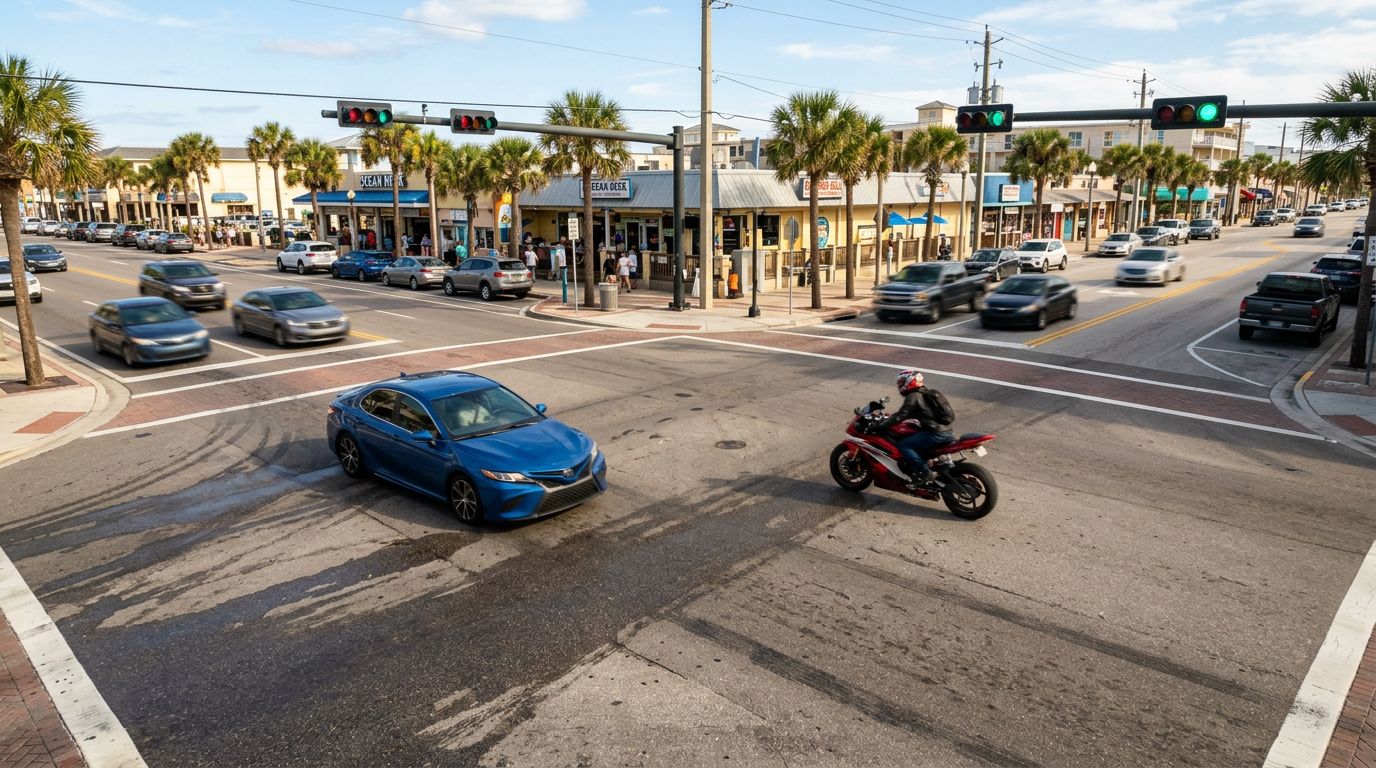
A left-turning car can cross a motorcyclist’s path in seconds, leaving serious injuries and disputed facts behind. In many Florida motorcycle left-turn accidents, intersection video provides the clearest evidence of who had the right of way.
However, footage can disappear quickly, and a video clip rarely answers every legal question by itself. The crash report, witness accounts, physical evidence, medical records, and insurance policies may all affect the claim. These steps can help protect your case.
Key Takeaways
- Florida drivers turning left must yield to an approaching motorcycle that creates an immediate hazard.
- Intersection video may show the traffic signal, vehicle movement, lane position, and impact.
- Traffic and business cameras can overwrite recordings within a short period.
- A motorcycle injury claim still requires proof of fault, causation, and damages.
- Florida deadlines and insurance rules make early legal guidance important.
Why Left-Turn Crashes Create Difficult Fault Disputes
Florida law requires a driver making a left turn to yield to a vehicle approaching from the opposite direction when that vehicle is close enough to create an immediate hazard. The rule applies to motorcycles as well as passenger vehicles. You can review the wording of Florida’s left-turn statute through the Florida Legislature.
A common crash occurs when a motorcycle travels straight through an intersection and a vehicle turns across its lane. The motorcycle may strike the vehicle’s side, or the rider may brake and fall while trying to avoid the collision. These crashes often cause broken bones, road rash, spinal injuries, traumatic brain injuries, and other serious harm.
The turning driver may claim the motorcycle was speeding, hidden behind another vehicle, or outside the driver’s view. The insurer may also argue that the rider entered on a yellow or red light, changed lanes suddenly, or lacked a working headlight. Those arguments can reduce or defeat a claim if evidence supports them.
A traffic citation may help, but it doesn’t automatically decide a personal injury case. The claim still requires proof that the driver’s conduct caused the crash and the resulting injuries. Florida also follows modified comparative negligence. If an injured person is found more than 50 percent responsible, the person generally can’t recover damages. A fault percentage of 50 percent or less reduces the award by that percentage.
The central question is often simple: What did each person see, and when did each person act? Intersection footage may answer that question more reliably than memories formed after a frightening collision.
What Intersection Video Can Show in a Motorcycle Claim
Video evidence can reveal details that no single witness remembers accurately. A camera may show the car’s approach, the motorcycle’s position, the traffic signal, and the driver’s turn. Even a recording that misses the impact can show what happened during the seconds before it.
Useful footage may establish:
- Whether the vehicle entered the intersection before turning
- Whether the motorcycle had a green light or a protected signal
- Whether the car stopped, rolled through, or turned without yielding
- The motorcycle’s lane position and travel direction
- Whether the driver used a turn signal
- Whether another vehicle blocked the driver’s view
- The distance between the motorcycle and the turning vehicle
- What happened immediately after the collision
The camera’s location matters. A signal-mounted camera may capture the light cycle but miss the impact. A business security camera may show the collision but not the traffic signal. A nearby driver’s dashcam could provide the best view of the motorcycle’s speed and lane position.
Video also has limits. A low frame rate can make a fast-moving motorcycle appear to jump between positions. A camera may have the wrong time, poor lighting, glare, or an obstructed view. Footage usually can’t establish exact speed without additional measurements. A short clip can also omit events that happened before the recording begins.
For that reason, attorneys compare video with other evidence. The point of impact, skid marks, debris, vehicle damage, 911 calls, witness statements, and photographs can help explain what the recording shows.
A clip should remain in its original form. Edited videos, screen recordings, or social media uploads may raise questions about missing frames and authenticity. Save the original file, preserve its metadata, and record who provided it and when.
How to Preserve Traffic and Business Camera Footage
The first step after a Florida motorcycle crash is to identify every camera near the intersection. Look for traffic-signal equipment, gas stations, restaurants, banks, apartment buildings, homes, schools, toll facilities, and nearby vehicles with dashcams.
Don’t assume a government camera continuously records. Some systems monitor traffic conditions or control signals without storing usable video. Other systems retain footage for a limited period. A public agency may also have different procedures for traffic video, records requests, and crash investigations.
Request preservation as soon as possible. A written preservation letter should identify:
- The exact intersection and travel direction
- The date and approximate time of the crash
- The camera location, if known
- A reasonable time window before and after impact
- The request to preserve native files and related metadata
- The request to preserve maintenance and time-synchronization records
A private business may not release footage without the owner’s approval, a subpoena, or another legal process. Still, a prompt request can prevent an owner from deleting or overwriting the recording before formal discovery begins.
Government records can involve a public-records request. The Florida Highway Safety and Motor Vehicles crash-report page provides information about obtaining crash reports and related records. The responding agency may include a city police department, sheriff’s office, county traffic division, or the Florida Department of Transportation.
Keep a record of every contact. Save emails, letters, response dates, and the name of each person who handled the request. If an agency says it has no recording, ask what system manages the camera and how long that system retains data.
An attorney can send a formal litigation hold and pursue a subpoena when necessary. A court may require the camera owner to produce the original recording, identify the system, and explain how the file was stored. Those details can matter when the other side challenges authenticity.
Evidence That Supports Video Proof
Video works best when it fits with independent evidence. The crash report may contain the officer’s diagram, statements from drivers and witnesses, weather conditions, road layout, and information about citations. Obtain the report, but don’t treat it as the final decision on liability. Officers often arrive after vehicles move, witnesses leave, or important camera footage is lost.
Photographs can preserve the intersection’s condition. Take images of lane markings, turn arrows, stop lines, signal visibility, lighting, sight obstructions, skid marks, debris, vehicle damage, and the motorcycle’s position. If you can’t take photographs because of your injuries, ask someone to document the scene promptly.
Witness information is also important. A witness who saw the signal may answer a question that a camera cannot. Get names and contact information, but avoid coaching anyone or asking a witness to change a statement.
The motorcycle itself may contain evidence. Don’t repair, sell, discard, or alter it before documenting the damage. Preserve the helmet, clothing, gloves, and other equipment. Scrapes, broken parts, and impact marks can help establish the direction and force of the collision.
Medical records connect the crash to the injuries. Follow treatment instructions and tell providers how the injuries occurred. Keep bills, prescription costs, mileage records, work restrictions, and proof of lost income. A claim can include more than emergency treatment when the evidence shows continuing pain, impairment, or future care.
Your phone may contain useful information, including photographs, location data, messages, or a dashcam file. Don’t delete or edit relevant material. Also avoid posting crash details, photographs, or comments about fault online. An insurer may use an isolated statement against you.
A Florida personal injury attorney can evaluate the footage alongside the physical and financial evidence. Avard Law Offices provides information about its Florida personal injury practice and handles vehicle accident matters.
Insurance, Damages, and Florida Filing Deadlines
Motorcycle claims differ from ordinary car claims because Florida’s required personal injury protection coverage generally doesn’t cover injuries sustained while operating or riding a motorcycle with fewer than four wheels. Your policy may contain optional medical payments or other coverage, so review the declarations page and endorsements.
The at-fault driver may have bodily injury liability insurance, but Florida doesn’t require most drivers to carry that coverage. If the driver has no coverage or insufficient limits, uninsured or underinsured motorist coverage may provide another source of recovery if your policy includes it.
Potential damages can include emergency care, surgery, rehabilitation, medication, future medical treatment, lost wages, reduced earning capacity, pain, disability, disfigurement, and loss of enjoyment of life. The value depends on the records and the effect on your daily activities, not on a fixed formula.
Florida’s filing deadline also matters. For most negligence claims accruing on or after March 24, 2023, the statute of limitations is generally two years. Older crashes may involve different rules. You can review the current language in Florida’s statute of limitations.
Claims against a government entity can involve additional notice requirements and shorter practical timelines. A wrongful death claim has separate rules. Because the correct deadline depends on the date, parties, and legal theory, don’t wait for an insurer to finish its investigation before getting advice.
When an Insurer Disputes the Intersection Evidence
An insurance adjuster may accept that the car turned left but still argue that the motorcycle rider shared fault. The adjuster may request a recorded statement, medical authorization, social media access, or a broad settlement release.
Give accurate information, but don’t guess about speed, signal timing, or distance. A statement such as “I don’t remember” is more accurate than an unsupported estimate. Before signing a release or giving a detailed recorded statement, consider speaking with a lawyer.
A claim may require collecting the original video, taking sworn witness testimony, consulting an accident reconstruction professional, and comparing the footage with vehicle damage. An attorney can also identify all potentially responsible insurance policies and calculate damages before negotiations begin.
The strongest presentation usually connects the evidence in order: the motorcycle’s approach, the signal phase, the vehicle’s turn, the impact, and the injuries that followed. Video becomes persuasive when the surrounding records support the same sequence.
Conclusion
A left-turning vehicle often creates the central liability issue in a Florida motorcycle crash, but the result depends on evidence. Intersection footage can show the signal, timing, lane positions, and driver’s failure to yield, while reports and medical records establish the rest of the claim.
Preserve recordings before they disappear, keep the original files, document the scene, and protect your insurance information. When video proof and independent evidence tell the same story, an injured rider has a stronger basis to pursue full compensation.