
Florida Parent Liability After a Teen Driver Crash
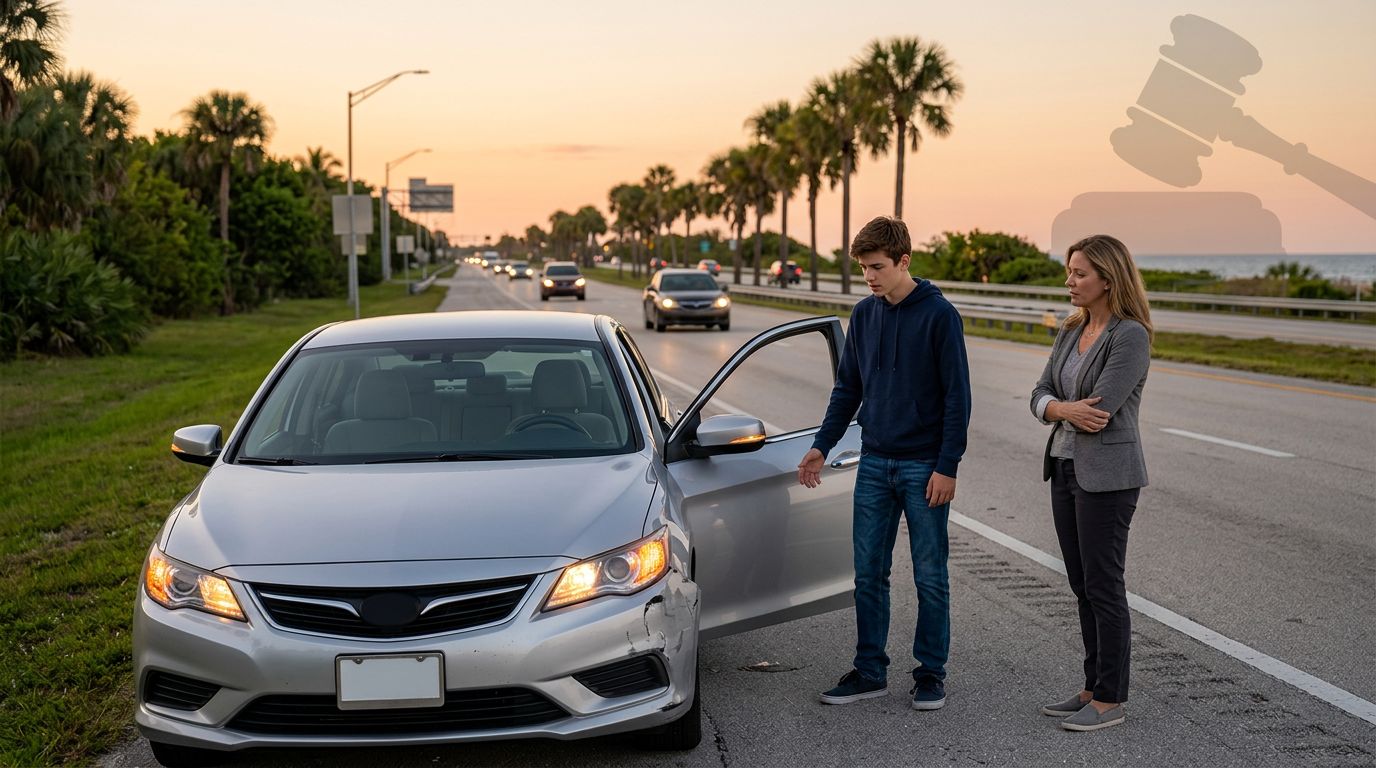
A teen driver crash can pull an entire family into one claim. In Florida, the injured person may pursue the teen, the vehicle owner, and sometimes a parent who never set foot in the car.
That happens because florida parent liability does not rest on one rule alone. It usually depends on the teen’s age, who signed the license papers, who owned the car, and what the parent knew before the wreck. Once you understand those links, the proof becomes much clearer.
When Florida law makes a parent part of the claim
If the driver is under 18, a parent or guardian who signed the minor’s license application can be liable for that teen’s negligence. The core rule appears in Florida Statute 322.09 on minor license applications. As of April 2026, that basic framework has not materially changed. In plain terms, the signature is more than permission to drive. It can also tie the signer to the damages the teen causes.
That is only one path. Florida also has strong owner-liability rules. If a parent owns the vehicle and gives the teen permission to use it, the parent may be responsible as the owner, even apart from the minor-license statute. This can matter when the driver is 18 or older, because owner liability often survives after the teen ages out of the minor-signature rule.
Another route is negligent entrustment. That claim focuses on what the parent knew before the crash. If a parent let a teen drive despite a suspended license, repeated reckless driving, prior crashes, or clear phone-use problems, the parent may face separate liability for handing over the keys.
Here is the short version:
| Liability theory | What must be shown | Common proof |
|---|---|---|
| Signed minor application | Teen was under 18, parent signed application | License records, DMV file, birth date |
| Vehicle owner liability | Parent owned car and allowed its use | Title, registration, insurance, permission evidence |
| Negligent entrustment | Parent knew teen was unsafe to drive | Prior tickets, crash history, texts, restrictions |
The strongest cases do not guess which theory fits. They match the facts to the right one.
What proof matters most in a Florida teen driver crash case
A crash claim has two layers. First, you must prove how the collision happened. Then you must prove why the parent is legally tied to it. Many people gather photos of the vehicles and stop there. That proves impact, not parent liability.
Start with the basics. Get the crash report, witness names, scene photos, vehicle damage photos, and medical records. Then go one step deeper. Find out who owned the car, whether the teen was under 18, who signed the license application, and whether the parent had reason to know the teen was a risky driver.
In many teen crash cases, the fight is not over whether the wreck happened. The fight is over ownership, permission, and prior knowledge.
Negligent entrustment claims often rise or fall on records that existed before the crash. A parent may say, “I had no reason to think my teen was dangerous.” That defense gets weaker if the file shows prior speeding tickets, earlier at-fault crashes, a revoked permit, or household driving restrictions that the parent set because of known bad behavior. Text messages can matter too. So can insurance documents listing the teen as a household driver.
The best evidence file usually includes:
- the crash report and all witness contact details
- the vehicle title, registration, and insurance declarations page
- proof of the teen’s age and license status
- records showing who signed the minor’s application
- prior citations, prior crashes, or written driving restrictions
Speed matters because records disappear. Phone data gets lost, vehicles get repaired, and people forget details. Early documentation also makes it easier to follow the car accident claim process in Cape Coral or anywhere else in Florida.
How teen driver crash claims move from insurance to lawsuit
Florida still follows a no-fault system in 2026. That means Personal Injury Protection, or PIP, often pays first for medical care and part of lost wages, no matter who caused the wreck. If you are dealing with the first stage of a claim, it helps to understand how Florida’s no-fault law impacts a car accident claim. Quick treatment matters, because missing the medical deadline can hurt the claim before fault is even argued.
Serious injuries change the picture. Once losses move beyond PIP, the case shifts to bodily injury damages, and that is where parent liability becomes more important. The claim may reach the teen’s policy, the parent’s auto policy, and sometimes umbrella coverage. If the teen borrowed a family car, the owner-liability issue can become central. If the teen used a friend’s car, the owner of that car may also enter the case.
Fault still matters. Even when a teen driver caused the crash, the insurer may argue the injured person shared blame by speeding, stopping short, or using a phone. Florida’s current rules on shared blame can reduce a recovery, and in many negligence suits a claimant who is more than 50 percent at fault may recover nothing. Avard Law’s explanation of Florida’s modified comparative negligence rule gives the practical effect of that defense.
After a teen driver crash, a few early steps protect the claim:
- get medical care right away and follow through
- preserve photos, dashcam footage, and phone screenshots
- identify the owner of the vehicle as soon as possible
- avoid guessing about fault in recorded insurance statements
A parent-liability case is like a chain. If one link is missing, the insurer will pull on that gap.
A strong claim shows three things at once: the teen caused the crash, the parent is legally connected to that driving, and the injuries and losses are real. When those points line up with documents, not assumptions, the case becomes much harder to dismiss.
That is the heart of a Florida teen driver crash claim. Proof wins these cases, and the proof must connect the wreck to the right parent, the right vehicle, and the right legal theory.