
Florida Crosswalk Pedestrian Crash Claims: Timing and Video Proof
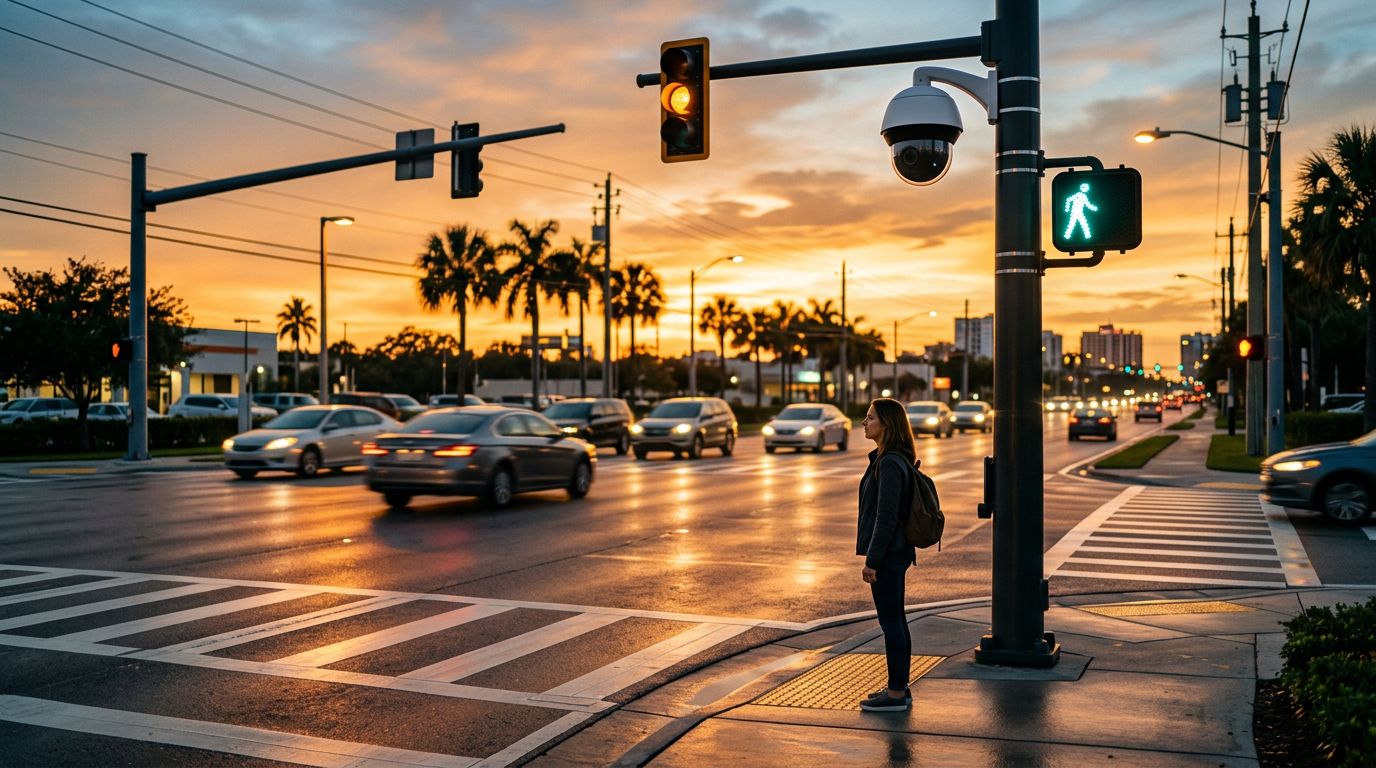
A crosswalk crash can turn on a few seconds, not a few feet. In Florida, that tiny slice of time often decides who had the signal, who had the duty to stop, and whether a driver had a clear chance to avoid impact.
That is why Florida pedestrian crash claims often rise or fall on signal timing and video proof. A witness may remember the light was green, but a camera may show it was already flashing. A driver may say the pedestrian crossed late, yet the footage may show the walk signal was still active.
Florida remains one of the most dangerous states for people on foot, so these details matter. The next sections show how signal timing works, what video can prove, and why the first hours after a crash matter so much.
Why signal timing matters in a Florida crosswalk claim
Signal timing is the skeleton of many pedestrian claims. Without it, the story often rests on memory, and memory gets shaky fast.
At a signalized intersection, the exact phase matters. Was there a steady green, a flashing hand, a steady red, or a turn arrow? Did the driver turn on red? Did the pedestrian enter on a permitted signal? Small changes in timing can shift the fault analysis.
Florida law gives both drivers and pedestrians clear duties. Under section 316.130, a driver at a signalized intersection must stop before the crosswalk and remain stopped for a pedestrian with a permitted signal. Under section 316.075, pedestrians may cross on a green signal, but they should not start on a steady yellow or steady red.
That means the timing file matters as much as the crash report. If the walk phase was short, or the clearance interval ended too soon, the evidence may show the pedestrian was still crossing legally when the car entered the crosswalk.
A green light does not give a driver a free pass through a crosswalk.
This is especially important at turn lanes. Drivers often watch oncoming cars and miss a person already in the crossing. A crash that looks simple at first can turn into a question about signal phase, turn timing, and sight lines.
Right turns on red often create the dispute
Right turns on red cause many crosswalk strikes. The driver stops, scans for traffic, then moves forward without checking the crosswalk closely enough.
That is why turn-on-red claims often depend on whether the driver yielded before moving. If the light allowed a right turn, the driver still had to watch for pedestrians in the crossing. If the signal or sign blocked the turn, fault can become even clearer. For more detail on those cases, see Florida turn-on-red pedestrian claims.
Florida signal rules that shape liability
Not every crosswalk case starts with a flashing beacon or a high-tech signal. Many start with a plain intersection and a driver who ignored what the light meant.
Florida law treats pedestrian movement as part of the signal system. A green light for cars does not erase a walker’s rights if the pedestrian entered on a permitted signal. On the other hand, a pedestrian who starts on a steady red can face blame arguments. That is why both the signal state and the exact second of entry matter.
A few timing issues show up again and again:
- Short walk phase: The walk sign ends before slower pedestrians can clear the lane.
- Permissive turn: A driver gets a green light or arrow while a pedestrian is still in the crossing.
- Late start by a driver: The car moves before the pedestrian finishes the crosswalk.
- Right turn on red: The driver rolls forward, then clips a person in the crosswalk.
Signal plans can help sort these out. They show how long the walk interval lasted, when the flashing hand began, and whether cars had a concurrent green. That timing file can be more persuasive than a witness who only saw part of the event.
Florida has also seen more attention on pedestrian safety upgrades in 2026, including flashing crosswalk beacons and better signal setups in some areas. Those changes matter because many crashes happen at intersections where drivers and walkers are both trying to beat a short clock.
If you need a broader look at what proof belongs in a crash file, this guide on evidence needed for car accident claims helps frame the basics.
Video proof that can settle a crosswalk dispute
Video can do what people cannot. It can freeze the signal, show the driver’s path, and confirm the timing of the impact.
A good video record often answers the questions insurers fight about most. Was the walk signal on? Did the driver stop before the crosswalk? Did the pedestrian step off the curb too early, or was the car already turning? Footage can show the whole sequence in seconds.
Here’s a quick look at the most useful sources.
| Video source | What it can show | Why it matters |
|---|---|---|
| Traffic camera | Signal phase, timing, vehicle movement | Helps prove who had the active signal |
| Store or apartment camera | Side view of the intersection | Shows the pedestrian path and driver angle |
| Dashcam | Exact movement before impact | Captures speed, lane position, and turn behavior |
| Phone video | Scene conditions right after the crash | Records the signal head, markings, and debris |
The best footage has a timestamp. It is even better when the camera angle shows the crosswalk, the signal head, and the curb line together. That lets an investigator match the video to the signal timing plan.
Still, video is fragile. Many systems overwrite files in days, sometimes sooner. A dashcam may be cleared. A business camera may record over itself. A city camera may need a formal request before anyone preserves the footage.
That is why speed matters. If you were hurt in a crash, the first step is to protect the evidence before it disappears. If you want a practical checklist for those early hours, the first 48 hours after a Florida pedestrian crash resource is a helpful place to start.
What to do before the footage disappears
The scene changes fast after a pedestrian crash. Cars get towed. Workers repaint lanes or clean the road. Rain, traffic, and time all erase details.
So, the proof file should start right away. The goal is simple. Lock down the scene, the signal, and the witnesses before anyone can rewrite the story.
A strong early file usually includes:
- The crash report and case number
- Photos of the crosswalk, signal heads, and lane markings
- Names and phone numbers for witnesses
- Medical records from the first treatment visit
- Any nearby video source, such as a store, bus, or apartment camera
If you can safely return to the area, photograph the intersection from the driver’s point of view and the pedestrian’s point of view. Capture the signal heads and the distance from the curb to the impact point. Those images help show what each person could actually see.
Preservation letters also matter. They put businesses, cities, and insurers on notice that the footage must be saved. That step can make the difference between a clear claim and a blank screen.
How insurers try to shift blame
Insurance carriers often look for one weak detail and build around it. They may say the walker crossed late, stepped out from behind a car, or wore dark clothing. They may argue the driver had no time to stop.
That is why signal timing and video work so well together. Timing can show the pedestrian had the right to be there. Video can show the driver had enough room and time to yield.
Florida uses comparative fault rules, so blame percentages matter. If the insurer can move some fault onto the pedestrian, it may reduce the payout. Video often pushes that fight back into the facts where it belongs.
In some cases, the issue is not speed alone. It is turn timing, poor lighting, blocked sight lines, or a driver who never looked into the crosswalk. The footage may show all of it in one frame.
Conclusion
Florida crosswalk claims are often decided by seconds, not speeches. The signal phase, the pedestrian’s location, and the driver’s movement can tell the real story when memories differ.
When a crash happens in a marked crossing, video proof and signal timing are often the strongest tools available. They can show who had the right to move, who failed to yield, and whether the signal system itself played a part.
If the footage still exists, move fast. Once it is gone, the claim gets much harder to prove.