
Florida RV Crash Claims: Proof That Helps Not-At-Fault Drivers
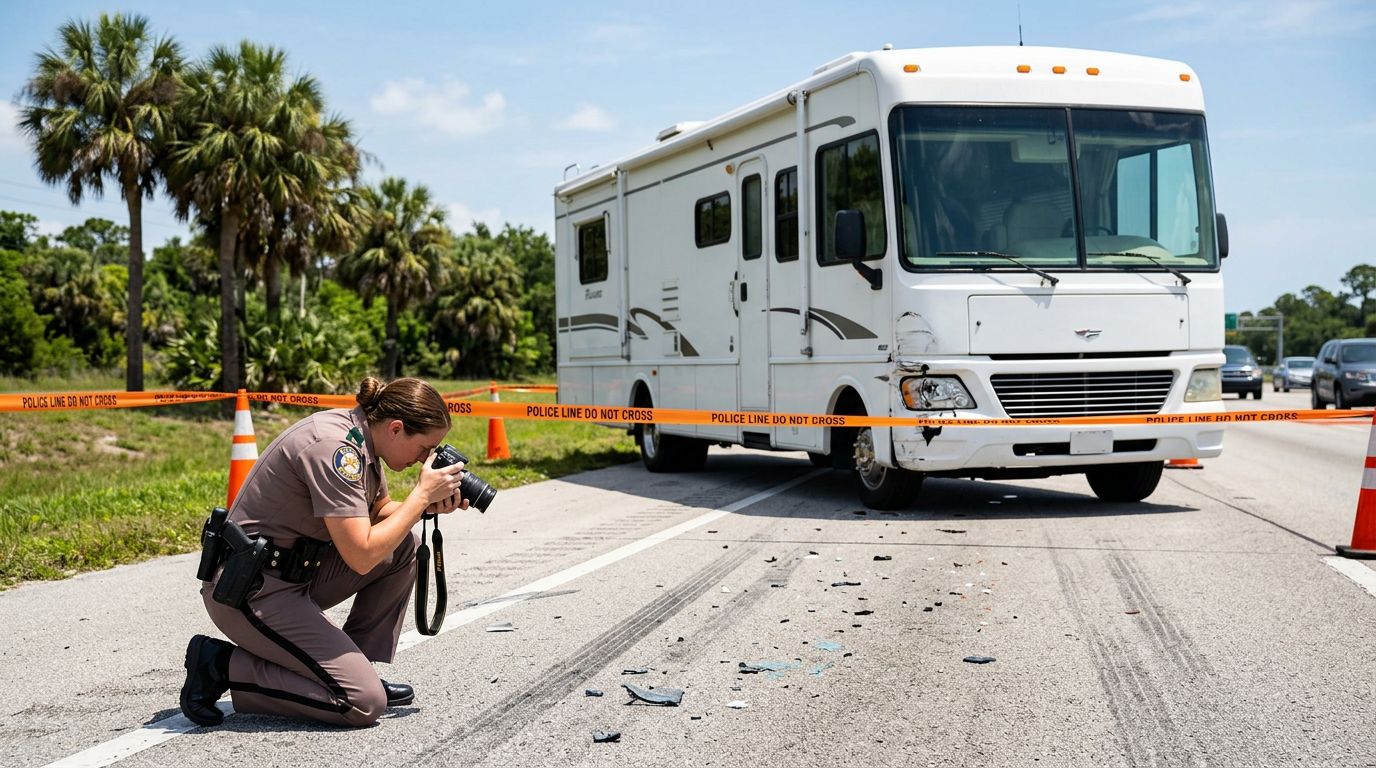
An RV crash can turn a clear case into a mess within hours. The vehicle is larger, the damage pattern is stranger, and more than one insurance policy may be in play.
That is why Florida RV crash claims often rise or fall on proof, not on who sounds more believable. If you were not at fault, the job is simple to say and harder to do: lock down the facts before the RV is moved, repaired, or blamed on someone else.
Why RV crashes create proof problems fast
RV wrecks are not standard fender benders. A crash may involve a motorhome, a pickup towing a travel trailer, a rented camper, or a fifth-wheel with separate owners and insurers. As of April 2026, public data still does not cleanly break out Florida RV crashes in the state’s crash data resources. That gap makes your case file more important, because the claim will turn on the facts you preserve.
The scene also changes quickly. RVs are often towed fast because they block lanes. Debris gets cleared. Detached trailers get moved. People who saw the crash leave before anyone gets their names. If the RV caused a chain reaction, impact order matters, and this guide to Florida multi-car accident claims shows how those details can shape fault.
This is the evidence that usually carries the most weight:
| Proof to save | Why it matters |
|---|---|
| Wide scene photos and video | Shows lane position, shoulder space, skid marks, and where the RV ended up |
| RV identifiers | Links the driver, owner, rental company, and insurer to the right vehicle |
| Hitch, trailer, and tire images | Helps prove detachment, sway, blowout, or bad loading |
| Witness names and nearby cameras | Cuts through blame shifting |
| Same-day medical records | Connects symptoms to the crash, not a later event |
Start wide, then move close. Photograph the road, traffic lights, lane lines, shoulder, debris field, and final rest positions. After that, capture damage points on every vehicle.
RV-specific details matter more than many drivers expect. Get the plate, VIN if visible, company decals, rental tags, and any markings on the trailer or tow vehicle. If a trailer separated, photograph the coupler, safety chains, electrical connector, and hitch receiver before anyone touches them. One missing photo in that area can change the whole case.
How not-at-fault drivers prove liability after an RV crash
Fault in RV cases is often about movement. A motorhome may drift across lanes. A trailer may swing wide in a turn. A driver may back up with a poor view, or lose control because the load was not balanced.
The best proof usually comes from several small facts that all point the same way. Vehicle damage can show angle and force. Tire marks can show sudden braking or a lane departure. Witnesses can confirm whether the RV crossed the center line or clipped another car during a turn. Nearby businesses, toll cameras, and dash cams can fill in the gaps when drivers tell different stories.
Get the report number at the scene if you can. Then review the final report through Florida’s official crash report request page. Also, follow the basic steps in FLHSMV’s guide on what drivers should do after a crash, because early mistakes can hurt a later claim.
A not-at-fault claim gets stronger when photos, witness accounts, vehicle damage, and medical timing all tell the same story.
Words matter too. Do not guess in a recorded statement. If you do not know the RV’s speed or exact distance, say you do not know. A polite guess can sound like an admission later.
Insurance coverage can add another layer. If your own PIP coverage applies, it may handle part of your medical bills first even when the RV driver caused the crash. That does not wipe out the at-fault claim for vehicle damage, pain and suffering in qualifying cases, or losses beyond PIP. For a plain-language overview, see this guide to Florida no-fault after a crash. The path can differ when the RV was a motorhome instead of a towed trailer, so do not assume one policy answers every question.
The records that turn a good claim into a strong one
Even when liability looks clear, weak damages proof can shrink a case. That is why medical timing matters. RV crashes can throw people sideways, pin them against doors, or whip the neck and back with more force than a normal car crash. Pain may build over a day or two, but the records need to start early.
If your own PIP coverage applies, timing can affect benefits. Even outside PIP, a treatment delay gives the insurer room to say the crash was minor or the symptoms came from something else. Save every urgent care note, imaging report, prescription receipt, and follow-up instruction.
Lost income needs clean proof as well. Get a wage statement from your employer, or collect invoices and bank records if you work for yourself. Keep a short log of missed work and daily limits. You do not need a novel. You need a timeline that makes sense.
Insurers also like the old-injury defense. If you had prior neck, back, or shoulder issues, gather earlier records and compare them with your post-crash findings. This article on prior injury defenses after a crash explains how those arguments show up and how better records can answer them.
Property damage deserves the same care. Keep repair estimates, total loss valuations, towing and storage bills, and photos of personal items damaged inside the vehicle. In RV cases, those items can include tools, electronics, bikes, medical equipment, and travel gear. If you cannot prove what was there, the insurer may treat it like it never existed.
Read every release before signing it. A fast check for the vehicle should not end your injury claim while treatment is still unfolding. That is where many not-at-fault drivers lose ground without seeing it happen.
Large vehicles create large disputes. In Florida RV crash claims, the safest move for a not-at-fault driver is to save the scene, protect the medical timeline, and keep every record that ties the crash to the losses.
When the other side starts shifting blame, missing proof gives them room. Clear proof closes that room fast.