
Florida School Zone Crash Claims: Crossing Guard and Camera Proof
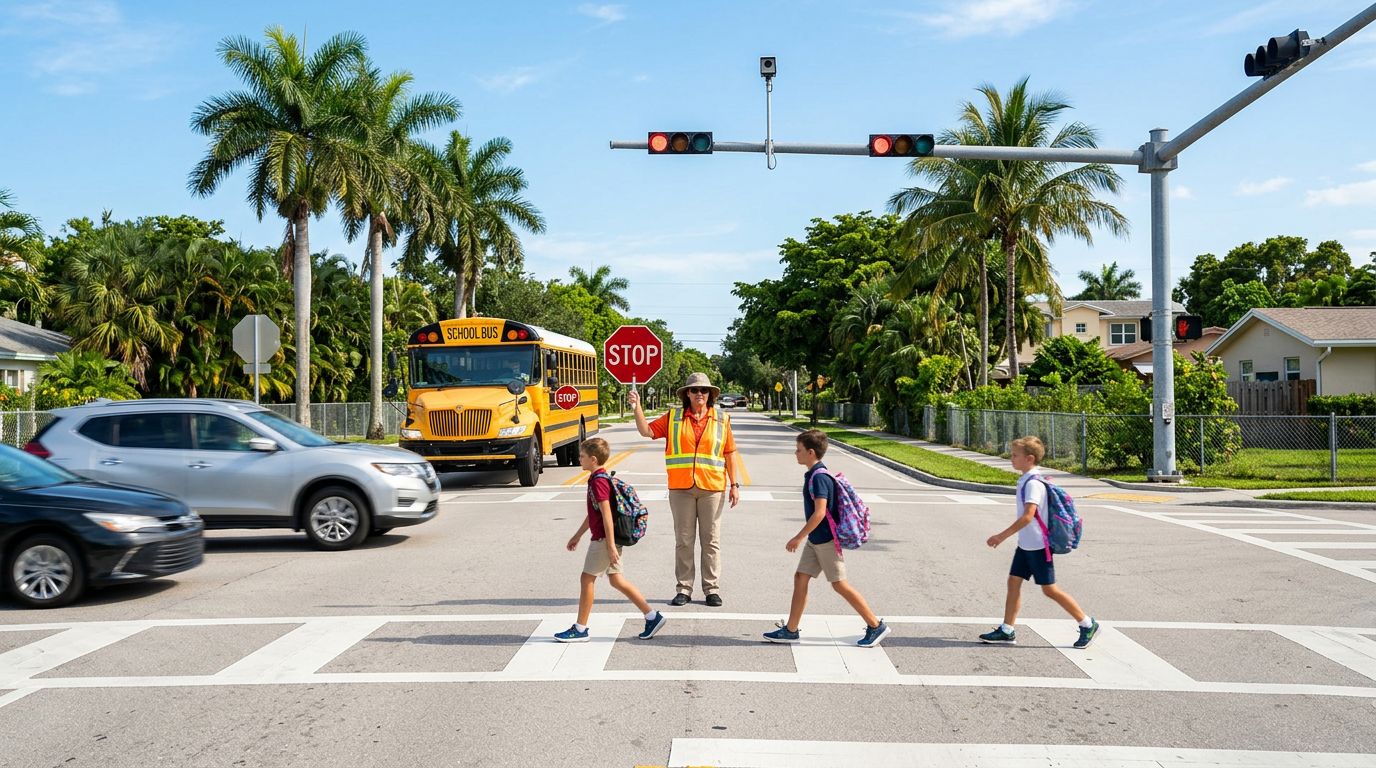
Florida school zone crash claims can turn on one short moment. A driver may have rolled through a crosswalk, a child may have stepped out too soon, or a guard may have signaled traffic to stop. When the facts are disputed, crossing guard testimony and camera footage can make the difference between a weak claim and a clear one.
The problem is speed. Witnesses leave, video gets erased, and memories fade fast. If you know which proof matters, you can protect the claim before it disappears.
Why Florida school zone crash claims depend on quick proof
School zones are busy in a way that regular streets are not. Cars line up near drop-off points, buses stop and start, parents hurry, and children cross in groups. That mix creates more chances for a driver to miss a sign, ignore a guard, or move too fast for the scene.
In many cases, the fight is not about whether a crash happened. The fight is about how it happened. Was the driver speeding through the school zone? Did the child have the right to cross? Was the guard already in position? Those details matter because they shape fault and damages.
When the scene changes every minute, early proof matters more than a long story later.
Insurance companies know that school zone cases often hinge on small facts. If the other side can muddy those facts, they can reduce the value of the claim. That is why the first hours after the crash matter so much.
What a crossing guard can prove
A crossing guard may be the strongest live witness in the case. The guard is often watching traffic before anyone else sees trouble. That means the guard can describe whether a vehicle slowed, whether the driver looked distracted, and whether the child was already in the marked crossing.
The guard can also help place the crash in context. If the school had a predictable dismissal pattern, the guard may know that children were crossing at that time every day. That matters because it shows the driver should have expected foot traffic.
A guard’s account can also fill gaps that a crash report misses. Police arrive after the impact. A guard saw the lead-up.
The details that matter most
The best crossing guard statements usually cover simple points. Where was the guard standing? Did the driver stop before the crosswalk? Were flashing lights on? Did the guard signal traffic to wait? Was the child already in the lane when the vehicle moved?
Small facts like these can settle larger disputes. For example, a driver may claim the crosswalk was clear. A guard may say the child had already reached the middle of the street. That difference can shape the whole claim.
Guard records can help too. Shift times, school schedules, and incident notes may support the timeline. Just as important, the guard’s name and contact information should be saved right away. People move on, and school staff change assignments. A witness is much easier to reach on day one than week three.
Camera footage that can make or break the case
Cameras can show what no witness can hold in memory perfectly. They may capture speed, lane position, braking, child movement, or the exact moment a driver entered the crosswalk. In a school zone, that footage may come from several places at once.
If a bus was part of the crash scene, related proof issues can overlap with Florida school bus crash claims.
Which cameras to look for
Before anyone assumes the scene is lost, it helps to think about every possible angle.
| Camera source | What it may show | Why it matters |
|---|---|---|
| School entrance or crosswalk camera | Traffic near the school, children crossing, guard signals | Can show the full school-zone pattern |
| Traffic signal or city camera | Lane movement, signal timing, vehicle path | Helps confirm the driver’s route and speed |
| Dash cam | Driver behavior, braking, impact, statements after the crash | Often gives the clearest view of the event |
| Nearby business or home camera | Approach to the school zone, crash impact, vehicle leaving the scene | May capture angles the school camera missed |
| Bus camera, if a bus was involved | Stop-arm use, children boarding, passing vehicles | Important when a school bus is part of the event |
One clip may not tell the whole story. Two or three clips often line up like puzzle pieces. Together, they can show a crash that sounds uncertain in a statement but looks clear on video.
Why video beats arguments
Video does not forget, but it can disappear. Some systems keep footage only for a short time, and others overwrite it quickly. That is why a preservation request matters so much.
Camera footage can also cut through common arguments. A driver may say the school zone was empty. Video can show a child crossing. A driver may say traffic was moving slowly. Video can show a car coming in too fast. A driver may say the guard was not present. Video may show the guard in the frame before impact.
The same footage can also help with visibility. Was it raining? Was the sun in the driver’s eyes? Were school signs blocked? Good video answers those questions without guesswork.
What to do after a school zone crash
The first steps after the crash can protect the claim, or weaken it if they are skipped. A calm checklist helps.
- Get medical care right away. Even a minor injury should be checked, especially if a child was hit or knocked down.
- Report the crash and get the police report information. The report may not tell the whole story, but it gives the case a starting point.
- Take photos of the scene. Capture the crosswalk, school signs, flashing lights, vehicle damage, skid marks, and the guard’s position if possible.
- Gather witness names. The crossing guard, parents, teachers, bus drivers, officers, and nearby workers may all have useful details.
- Ask someone to preserve video fast. School cameras, traffic cameras, bus cameras, and nearby business footage can vanish quickly.
It also helps to keep a simple file. Save medical bills, discharge papers, therapy notes, missed work records, and receipts for child care or travel tied to treatment. If a child missed school or activities, note those dates too.
How an attorney connects the evidence
A strong claim rarely rests on one piece of proof. It usually comes from a chain of evidence that matches up. The guard’s statement may match the video. The video may match the damage to the vehicle. The damage may match the medical records. When those pieces align, the claim gets harder to dispute.
A Florida injury lawyer can also act fast on records that other people cannot easily get. That may include letters to preserve footage, requests for school or city records, and follow-up with witnesses before memories fade. If a government entity may be involved, special notice rules and shorter deadlines can also matter.
That early work can be important in a child injury case too. Parents are often dealing with treatment, school absences, and stress at home. Meanwhile, the claim still needs proof. The right legal help keeps those tasks from slipping.
Conclusion
Florida school zone crash claims often turn on the same question, what can prove the truth before it disappears? A crossing guard may confirm the child’s path. A camera may show the driver’s speed or failure to stop. Together, they can turn a confusing scene into a clear case.
The first move matters most. When the proof is gathered early, the claim has a much stronger foundation.