
Florida Workers Comp for Forklift Accidents and Leg Injuries
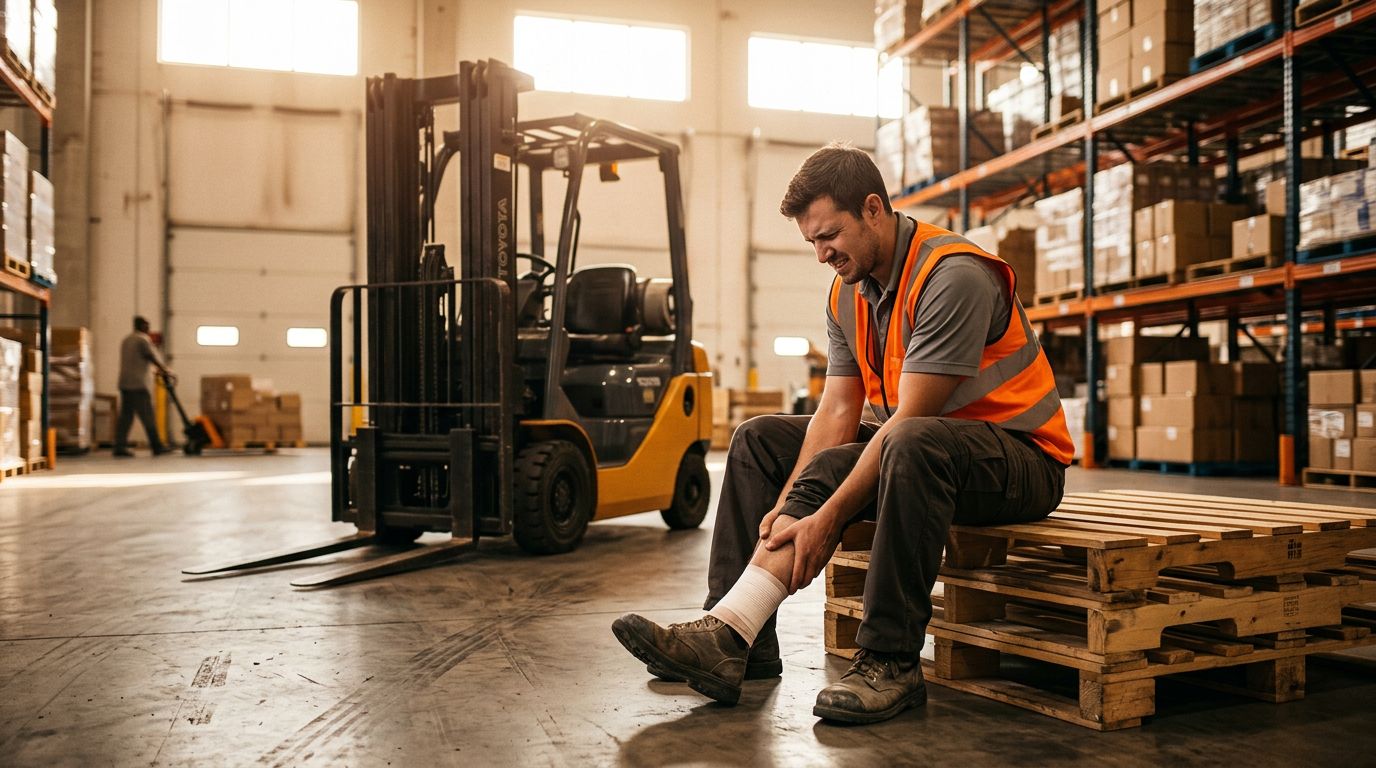
A forklift can turn an ordinary shift into a long recovery in seconds. When the injury hits your leg, the medical bills, missed paychecks, and claim forms can pile up fast.
If the accident happened at work in Florida, Florida forklift accident workers comp may cover treatment and wage benefits, even if the crash seemed simple or partly your fault. The hard part is usually not the injury itself. It’s the proof, the deadlines, and the paper trail.
How Florida workers’ comp treats a forklift leg injury
Florida workers’ compensation is a no-fault system. That matters because a leg injury from a forklift does not have to happen because someone acted carelessly for benefits to apply. If you were working when the forklift struck you, pinned you, or caused you to fall, the injury may be covered.
Forklift accidents often cause broken bones, crushed feet, torn ligaments, knee damage, nerve problems, and amputations. Some workers recover in a few months. Others need surgery, rehab, or a permanent work restriction.
The first legal issue is usually notice. Florida generally expects you to report the injury quickly, and Florida workers comp deadlines guide explains why waiting can make an otherwise valid claim harder to prove. A delay gives the insurance carrier room to argue that something else caused the injury.
That is why the details matter. Where were you standing? Was the forklift backing up? Did the load shift? Did your leg get trapped between the machine and a rack? Small facts can shape the whole claim.
The benefits that matter most after a leg injury
Workers’ comp does not pay for pain and suffering. It does, however, cover the parts of the injury that keep life moving.
| Benefit type | What it can cover | Common forklift leg examples |
|---|---|---|
| Medical care | Authorized doctor visits, tests, surgery, therapy, medication, and travel for treatment | Fracture repair, casts, knee surgery, physical therapy |
| Wage benefits | Part of the wages you lose while you cannot work or can only work light duty | Time off after surgery, reduced hours, restricted standing |
| Impairment benefits | Payment for lasting loss of function | Permanent limp, stiffness, nerve damage, limited range of motion |
| Retraining help | Support if you cannot return to your old job | A warehouse role that is no longer safe for your leg |
The medical side usually begins with an authorized doctor. In Florida, the carrier often controls that choice, so following the process matters. If you go outside the system without permission, the carrier may refuse to pay.
Wage benefits depend on your average weekly wage and how much work you miss. The amount changes with the facts of the case. A short absence after a simple fracture looks very different from a crush injury that needs several surgeries.
A clean claim still needs clean records. The injury may be obvious, but the file is what usually gets tested.
Why forklift claims get delayed or denied
Forklift claims are often disputed for reasons that have little to do with the actual injury. Employers and insurers may focus on notice, witness statements, prior medical issues, or gaps in treatment.
One common problem is the unwitnessed accident. If no one saw the forklift hit you, that does not end the claim. It does mean your medical notes, your report to the employer, and your own timeline become more important. Florida claims without eyewitnesses can still move forward when the facts line up.
Another issue comes up when an employer does not pass the report along. If your boss stalls, ignores the injury, or says it is “not a comp case,” the delay can hurt care and benefits. What to do if employer delays injury report explains the next steps when the report gets stuck at the workplace.
Insurers also look for pre-existing problems. A bad knee from years ago does not automatically defeat a claim. Still, the carrier may argue that the forklift accident did not cause the current pain. That is why early medical records matter. They show what hurt, when it hurt, and how the injury changed after the accident.
What to do in the first 24 hours after the accident
The first day after the injury can shape the rest of the case. Keep the steps simple and do them in order.
- Report the injury in writing.
Tell a supervisor as soon as you can, then follow up by text or email. Include the date, time, location, and how the forklift injury happened. - Get medical care right away.
If the leg looks deformed, swollen, numb, or badly crushed, get emergency help. Even a pain that seems minor can hide a fracture or ligament tear. - Save details before they fade.
Take photos if you can, name any witnesses, and write down the forklift model, the aisle, and what was being moved. - Track the claim from the start.
Ask who reported the injury, who the adjuster is, and where you should go for treatment. The Florida workers comp claim timeline can help you see what usually happens next.
Do not wait for the pain to get worse before acting. A delayed report gives the other side more room to challenge the claim.
Severe leg injuries can change the whole case
Some leg injuries heal with time. Others leave lasting damage. A broken tibia that heals in a cast is one thing. A crush injury that damages nerves or destroys the foot is something else.
When the injury keeps you from returning to your old job, the claim may move beyond temporary wage checks. You might need permanent impairment benefits, more treatment, or help finding different work. In the worst cases, the injury may meet the standard for permanent total disability.
For workers with major leg loss, paralysis, or a severe injury that keeps them from gainful work, Florida workers comp PTD benefits may become part of the discussion. Those claims are strict, so the medical proof has to be strong.
Long-term leg problems also affect your future choices. A warehouse job may no longer be safe if you cannot climb, lift, balance, or stand for long periods. That is why permanent restrictions matter. They shape both the value of the claim and your next job options.
When another company may also be responsible
Workers’ comp is usually the main remedy after a job injury. Still, a forklift accident sometimes involves a third party.
A separate claim may exist if:
- the forklift had a defect or brake failure,
- another company serviced the machine incorrectly,
- a contractor created the hazard,
- or a product defect made the accident worse.
That kind of claim is different from workers’ comp. It can open the door to damages that workers’ comp does not pay, including pain and suffering. The facts have to support it, so it helps to look at the machine, the maintenance records, and the role of every company on site.
These cases can overlap. You may have a workers’ comp claim for medical care and wage loss, plus a third-party claim against a manufacturer or contractor. If that applies, the details matter even more because one case can affect the other.
Conclusion
A forklift leg injury can upend your work, your mobility, and your income at the same time. The claim often turns on fast reporting, clear medical records, and proof that ties the injury to the job.
The strongest cases are usually the ones that start early and stay organized. Deadlines, treatment, and documentation matter more than guesswork or promises from the employer.
If the injury is severe, unwitnessed, or tangled up with an employer dispute, the claim deserves a closer look before the record starts to drift.