
Florida Roundabout Crashes: A Proof Checklist For Not-At-Fault Drivers
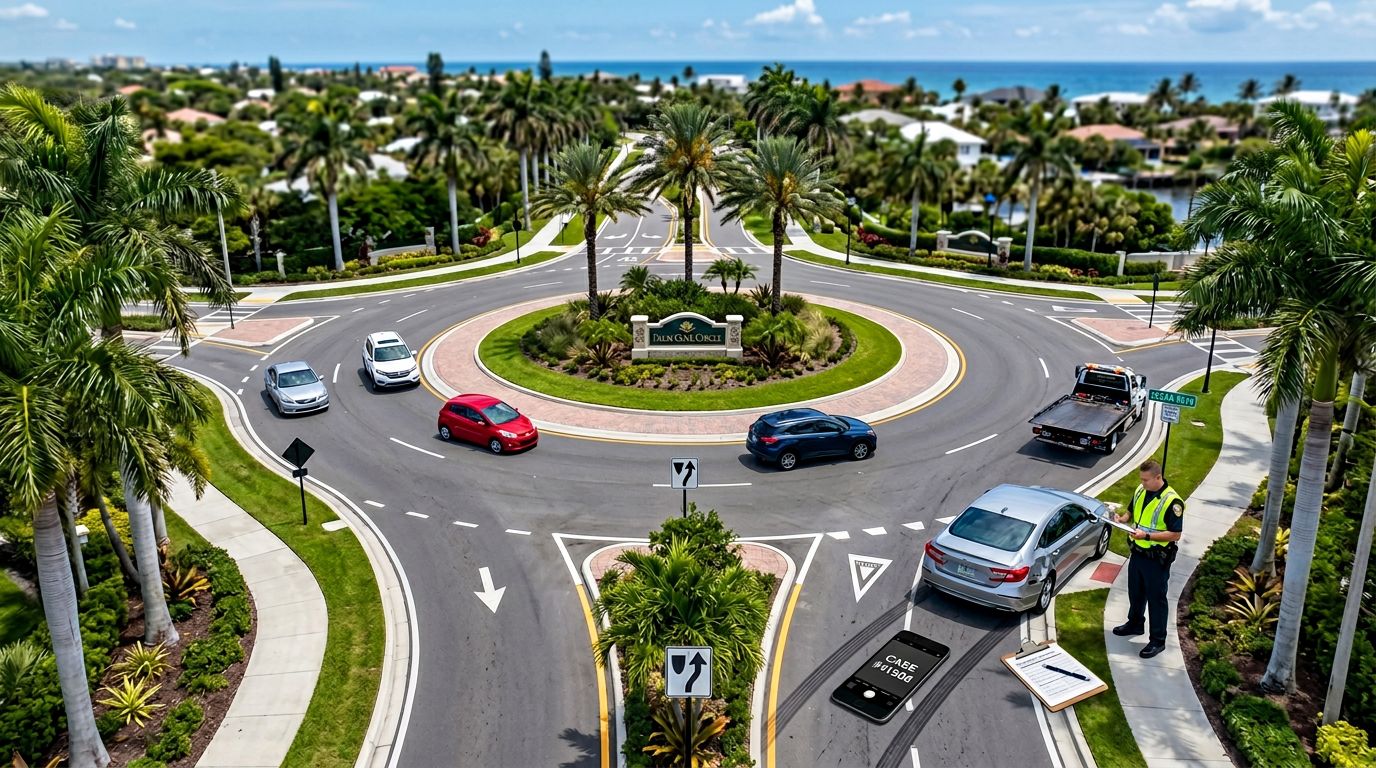
Roundabouts can feel calm until they aren’t. One driver rolls through a yield, another changes lanes mid-circle, and suddenly you’re dealing with a crash that looks “minor” but turns into a major insurance fight.
If you’re not at fault in Florida roundabout crashes, proof is the difference between a fair claim and a blame-shift. The catch is that roundabout evidence disappears fast, traffic keeps moving, debris gets cleared, and security video can be overwritten within days.
This guide lays out what to collect, when to collect it, and why it matters, so you can protect your case from the start.
Why proof gets tricky in Florida roundabout crashes
Roundabouts reduce severe injuries because most vehicles slow down and there are fewer right-angle impacts. Federal and state guidance explains the safety goals and design features, including the yield-on-entry setup and lane geometry (see the FHWA roundabout informational guide and Florida’s FDOT modern roundabout design criteria).
Still, “less severe” doesn’t mean “simple.” Roundabout crashes often turn into word-versus-word disputes because:
- Right-of-way depends on timing. Who entered first, and who was already circulating, matters.
- Lane rules matter more than people think. A sideswipe can happen when someone drifts out of their lane or exits from the wrong lane.
- Insurance adjusters love shared fault arguments. If they can pin even partial blame on you, they may reduce payouts. Florida’s modified comparative fault rules can also bar recovery if you’re found more than 50% at fault in many negligence claims.
Driver confusion also spikes in newer roundabouts. Even when the other driver is clearly wrong, they may claim they “didn’t see” you, or that you were “going too fast.” That’s why your proof needs to show what the roundabout required, and what actually happened.
The best roundabout claim file answers three questions: where each car was, who had the right-of-way at that moment, and what physical evidence backs it up.
Before you get pulled into calls with insurers, it helps to review the immediate steps after a Florida wreck so you don’t miss basic protections while you gather roundabout-specific evidence.
The at-the-scene proof checklist (before the circle clears)
Your goal at the scene is simple: lock in the facts that won’t be there tomorrow. If you can safely do so, take a breath and document the roundabout like you’re drawing a map for someone who has never seen it.
Photos and video that win roundabout disputes
Take wide shots first, then close-ups. Walk the perimeter if it’s safe.
Focus on:
- Approach direction and entry point (your lane, their lane, and the yield line).
- Lane arrows and signage that show permitted movements.
- Splitter islands and crosswalks (they help prove the path each driver should have taken).
- Final rest positions of vehicles before they move (if possible).
- Damage on both vehicles, including transfer paint and scrape direction.
- Debris field and gouge marks, which often show where contact occurred.
If you have dashcam footage, save it immediately. Don’t trim it. Back it up to cloud storage and email a copy to yourself.
This quick table shows what evidence tends to matter most and how to get it fast:
| Evidence | What it proves | Best way to capture it |
|---|---|---|
| Wide-angle roundabout photos | Entry lane, yield control, layout | Step back, shoot from each approach |
| Lane arrow and sign photos | Who was allowed to exit or continue | Close-up, then include context shot |
| Damage pattern photos | Sideswipe vs. rear-end vs. angle hit | Shoot both cars, multiple angles |
| Witness details | Neutral story of who entered or yielded | Get name, number, short statement |
| Dashcam video | Speed, timing, lane use, signals | Save original file, back it up |
Witnesses and statements (what to say and what not to say)
Roundabouts usually have witnesses because traffic keeps flowing. Look for drivers who stopped, pedestrians, cyclists, delivery drivers, and nearby workers.
Keep it short:
- Ask what they saw, then record it on your phone (with permission).
- Get contact info, and ask if they’ll answer a call later.
When you speak to police and insurers, stick to facts. Don’t guess about speed. Don’t say “I’m sorry,” because it can sound like fault. You can say, “I entered at the yield after checking traffic,” or “I was already circulating when they entered.”
If you want a simple safety refresher to compare against what the other driver did, FDOT’s public education material is helpful (see the Alert Today Florida roundabout guide).
The next 14 days: medical proof, insurance proof, and fault-proofing your claim
In many crashes, your injuries show up later. Roundabout impacts can still cause neck and back injuries, even at lower speeds. The problem is that insurers often treat delayed care as “not related.”
Medical documentation that strengthens a not-at-fault claim
Get checked promptly, then follow through. Gaps in care give insurers room to argue you weren’t hurt, or you got hurt somewhere else.
Also, describe the mechanics clearly. Tell the provider you were hit in a roundabout, note the direction of force (left side, right side, rear), and list symptoms as they happen. Those details end up in records.
For a deeper look at injury patterns after Florida wrecks, see common car crash injuries in Florida.
Florida PIP deadlines and paper trails
Florida’s no-fault system means you often start with your own PIP coverage, even when the other driver caused the crash. Deadlines matter, and billing mistakes are common.
If you’re dealing with treatment, bills, and adjuster requests at the same time, review Florida PIP benefits after a Cape Coral crash so you understand the 14-day treatment rule, paperwork issues, and how payment disputes can derail care.
The roundabout fault arguments insurers use (and how proof beats them)
Expect these themes, especially in Florida roundabout crashes:
- “You failed to yield”: Your photos of the yield line, dashcam timing, and witness statements can show you entered properly or were already circulating.
- “You were in the wrong lane”: Lane arrows, signage, and a simple diagram of each car’s path can shut this down.
- “You changed lanes in the circle”: Damage location and scrape direction often reveal who drifted.
- “Your injuries were preexisting”: Prior records matter, but so does proving aggravation and new symptoms. If this is a concern, read about handling preexisting conditions post-accident.
One more practical step: request any nearby video quickly. That can include business cameras, HOA cameras, or traffic cameras. Many systems overwrite footage in days, not weeks.
Treat the first week like a proof window. After that, you’re often stuck arguing from memory.
Conclusion
Roundabouts are designed to reduce the worst outcomes, but insurance fights still happen every day. If you’re not at fault, your best move is building proof early: roundabout layout photos, lane signage, dashcam video, witness contacts, and clean medical records. When the other driver blames “confusion,” your file should show facts, not opinions. If you’re facing pushback, getting legal help sooner can keep a roundabout claim from turning into shared fault.