
Florida Government Vehicle Crashes: Notice Deadlines and Claims
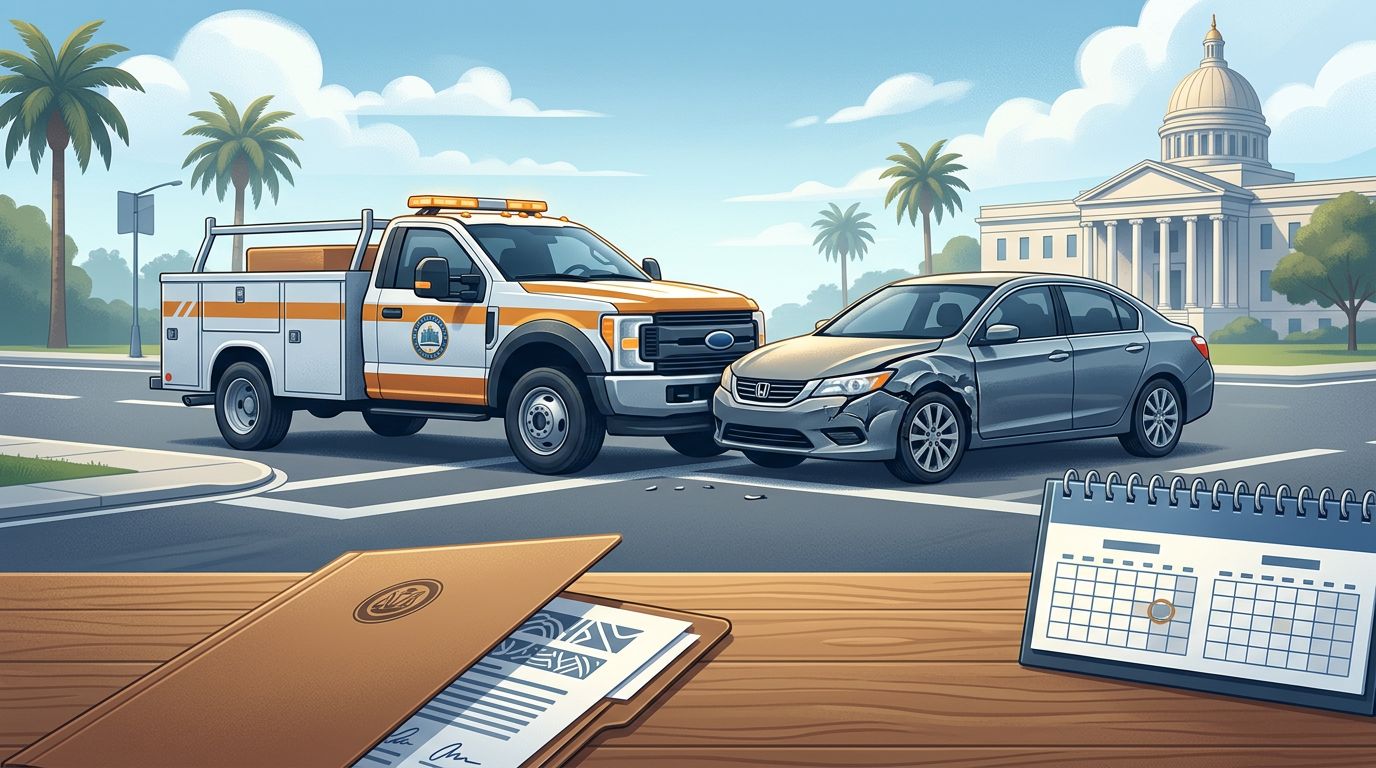
A collision with a city truck, county bus, police cruiser, or state vehicle can create a legal deadline that ordinary drivers may not face. Florida government vehicle crash claims require written notice to the right public agency, and missing that step can prevent you from filing a lawsuit.
The notice deadline is usually three years for injury claims and two years for wrongful death claims. However, the time to file a lawsuit can be shorter, and the government gets up to 180 days to investigate after receiving proper notice. Knowing which agency is responsible and acting early can protect your claim.
Key Takeaways
- Most Florida government negligence claims require written notice within three years after the claim accrues.
- Wrongful death claims generally have a two-year notice period.
- Notice usually goes to the responsible government entity and, when required, the Florida Department of Financial Services.
- The government generally has 180 days to investigate before you can file suit, unless it denies the claim sooner.
- Government liability is usually capped at $200,000 per person and $300,000 per incident, although a claims bill may provide another route for additional compensation.
Why Government Vehicle Crashes Follow Different Rules
Florida law waives some sovereign immunity protections when a government employee causes injury while acting within the scope of employment. That waiver allows an injured person to pursue a negligence claim under certain circumstances. It doesn’t place the government in exactly the same position as a private driver or business.
Florida Statute Section 768.28 controls many claims against the state and its agencies. The statute also addresses claims involving counties, municipalities, and certain public authorities. You can review the Florida sovereign immunity statute for the statutory language and limits.
A government vehicle crash may involve:
- A city sanitation or public works truck
- A county bus or maintenance vehicle
- A police, sheriff’s office, or state law enforcement vehicle
- A state agency car or utility vehicle
- A school district vehicle
- A public hospital or transportation vehicle
The vehicle’s appearance doesn’t always identify the proper defendant. A contractor may operate a bus or collect garbage under a government contract. In that situation, the responsible party may be a private company rather than the government agency. Different deadlines and legal rules may apply.
The driver’s employer, vehicle owner, and agency responsible for the driver’s conduct must be identified before notice is sent. If the wrong entity receives the notice, the government may argue that you failed to satisfy the statutory requirement.
Government ownership also doesn’t automatically prove liability. You still need evidence that the driver or agency acted negligently and that the negligence caused your injuries. Common issues include speeding, distracted driving, failure to yield, unsafe backing, poor vehicle maintenance, and inadequate training.
Florida government vehicle crash claims: Which deadline applies?
The most important deadline usually concerns pre-suit notice, not the date you first speak with an insurance adjuster. Under Section 768.28, most claims for personal injury caused by a state or local government entity must be presented in writing within three years after the claim accrues.
For a wrongful death claim, the notice period is generally two years. The shorter period makes early action especially important because family members may need time to obtain death records, medical records, accident reports, and information about the government vehicle.
The deadlines can be summarized this way:
| Type of claim | General notice period | Important point |
|---|---|---|
| Personal injury caused by government negligence | 3 years | Written notice must reach the proper recipients |
| Wrongful death | 2 years | The deadline is shorter than most injury claims |
| Property damage | Often 4 years under ordinary rules | Government notice requirements may still apply |
| Lawsuit for negligence after March 24, 2023 | Generally 2 years | The lawsuit deadline may arrive before the notice deadline |
These time limits are not interchangeable. Serving notice does not automatically give you additional time to file a lawsuit. A person may have three years to provide government notice but only two years to file a negligence lawsuit under Florida’s current limitations rules.
The date of the crash, the type of claim, and the identity of the government entity can change the analysis. Older accidents may fall under different limitations rules. Claims involving minors, delayed discovery, fraud, or other special circumstances may also require separate legal review.
A police report is not the same as statutory notice. Reporting the crash may document the event, but it usually doesn’t satisfy the written claim requirement.
Who must receive your written notice?
For a claim against a state agency, notice generally must go to the agency involved and the Florida Department of Financial Services. A claim involving a municipality or county may fall under a statutory exception to the DFS service requirement, but the responsible local government still must receive proper written notice.
This distinction matters because sending a letter to only one recipient may create a defense for the government. The notice should identify the agency, department, or public entity connected to the vehicle and crash. If you aren’t certain whether the vehicle belonged to a city, county, sheriff’s office, or state agency, investigate before relying on a single address.
Possible notice recipients include:
- The city or town that owns the vehicle
- The county department responsible for the vehicle
- The sheriff’s office or police department
- The state agency that employs the driver
- The public authority that owns or operates the vehicle
- The Florida Department of Financial Services, when the statute requires it
Don’t assume that notice to the driver, the driver’s supervisor, the government vehicle’s insurer, or a general customer service address is enough. A notice letter should go to an address that allows the government entity to receive and process legal claims.
Use a delivery method that creates proof of receipt. Keep copies of the letter, attachments, mailing records, delivery confirmation, and any response. An attorney can help determine the proper recipient and whether a particular entity requires additional local procedures.
Identifying the agency may require public records research. The crash report may list the vehicle owner, unit number, driver’s employer, and investigating agency. Photographs of the vehicle, witness statements, and video footage can also help establish ownership.
If the vehicle left the scene or the driver gave you incomplete information, report the crash and request records quickly. Government records may include dispatch logs, radio traffic, body-camera footage, vehicle GPS data, maintenance records, and internal incident reports.
What should a Florida government claim notice include?
Florida law doesn’t require a particular statewide notice form. A short letter can satisfy the basic purpose if it clearly communicates the claim. Still, vague or incomplete notice creates avoidable risk.
A strong notice typically includes:
- Your full name, address, telephone number, and email address
- The date, time, and exact location of the crash
- A description of the government vehicle and its identifying information
- The driver’s name, agency, or badge information, if known
- A clear description of how the collision occurred
- The injuries and medical treatment you received
- Property damage and other losses
- The names of witnesses, if available
- Copies of relevant records or photographs
- A statement that you are presenting a claim under Section 768.28
You don’t need to provide every piece of evidence before sending notice. However, the letter should give the agency enough information to identify the incident and begin an investigation.
Avoid guessing about facts you haven’t confirmed. State what you know and identify information that remains under investigation. Don’t minimize your injuries because symptoms may worsen after the collision. You can supplement the notice as additional records become available.
The notice also should avoid unnecessary admissions. Statements such as “I wasn’t paying attention” or “I may have caused the crash” can affect fault disputes. Give accurate information, but let the evidence establish responsibility.
A written notice doesn’t replace a demand package or lawsuit. It is a required pre-suit step in many government claims. The agency may request records, interview witnesses, inspect vehicles, or ask for a medical authorization during its review.
The 180-day government investigation period
After proper notice, the government generally has 180 days to investigate and evaluate the claim. During that time, the agency may accept the claim, negotiate, request more information, or deny responsibility.
You usually cannot file suit during the 180-day period unless the government formally denies the claim earlier. If the agency takes no final action during the six-month period, the claim may be treated as denied under the statute.
The investigation period can feel long when medical bills arrive and income has stopped. It also creates a reason to send complete notice early. Waiting until the end of the notice period can delay the investigation and leave less time to resolve filing issues.
The agency’s investigation isn’t the same as a court proceeding. Its conclusions aren’t final proof of fault, and a denial doesn’t mean the claim lacks value. Government adjusters and risk managers assess claims from the agency’s perspective. They may dispute the driver’s conduct, causation, injury severity, or the amount of damages.
Keep treating with appropriate medical providers and save all related records. Maintain a file with bills, insurance explanations of benefits, wage-loss documents, prescriptions, mileage, photographs, and correspondence. Don’t sign a broad release or accept a settlement before understanding the effect on future claims.
The waiting period also interacts with the lawsuit deadline. If the ordinary statute of limitations expires before the 180 days ends, filing the notice late can leave no practical time to sue. An attorney should calculate both deadlines, not focus on the notice period alone.
What compensation may be available?
A government vehicle claim may seek compensation for losses caused by the crash. The value depends on the injury, treatment, permanency, income loss, fault allocation, available insurance, and statutory limits.
Potential damages can include:
- Emergency care, hospital treatment, and follow-up medical bills
- Future medical treatment related to the crash
- Lost wages and reduced earning capacity
- Vehicle repair or replacement costs
- Damage to personal property
- Physical pain and limitations
- Emotional distress connected to the injury
- Permanent impairment or disfigurement
- Wrongful death damages for eligible survivors
Florida’s no-fault system may require you to first use your own personal injury protection coverage for certain medical and wage-loss benefits. Florida law generally requires initial medical treatment within 14 days after the crash for PIP benefits. A government vehicle claim doesn’t eliminate the need to follow your own insurance policy’s reporting and treatment requirements.
PIP is not the same as a full negligence recovery. If you suffer a serious injury, you may be able to pursue damages against the at-fault government entity outside the no-fault benefits system. Florida law defines serious injury through factors such as significant and permanent loss of an important bodily function, permanent injury within reasonable medical probability, or significant and permanent scarring or disfigurement.
Fault still matters. Florida’s modified comparative negligence rule can reduce compensation when an injured person shares responsibility. Under the current rule, a person found more than 50% at fault generally cannot recover damages in a negligence action. At 50% or less, the award is reduced by the person’s percentage of fault. Learn more about the Florida modified comparative negligence law before making statements about how the crash occurred.
Government damage caps can limit recovery
Florida generally limits the government’s payment under its sovereign immunity waiver to $200,000 for one person’s claim and $300,000 for claims arising from one incident. The cap applies to the government’s legal liability under the statute, not necessarily to the full value of the injury.
For example, one injured person with extensive permanent injuries may have damages above $200,000. The statutory cap can still restrict the amount recoverable directly from the government. If several people are injured in the same crash, the combined limit may apply to the occurrence.
A claims bill is a separate legislative process that may seek payment above the statutory cap. It isn’t automatic, and approval isn’t guaranteed. The process can take substantial time and requires a detailed record supporting the injury and the government’s responsibility.
Insurance may affect the available recovery. A public entity could have coverage, self-insurance, or other risk-management arrangements. Those details don’t remove the need to comply with Section 768.28. The claim must still be presented correctly and within the applicable time.
Damage calculations should account for health insurance, PIP payments, Medicare or Medicaid interests, workers’ compensation liens, and other reimbursement rights. Settling without identifying these interests can create later financial problems.
A settlement also may release every related claim. Before signing, review whether it covers future treatment, wage loss, property damage, derivative claims, and any claim by a spouse or surviving family member. The language matters as much as the dollar amount.
Evidence that can support your claim
Government vehicles often generate records that private drivers don’t have. A city truck may have route information, onboard cameras, maintenance files, or GPS data. A police cruiser may have body-camera footage, dispatch recordings, dash-camera video, and radio communications.
Request preservation of evidence as soon as possible. Some records may be overwritten, deleted, or retained under limited schedules. A preservation letter can identify the crash date, vehicle number, driver, location, and categories of records that should be maintained.
Useful evidence may include:
- The traffic crash report and supplemental reports
- Photographs of vehicles, road conditions, signs, and visible injuries
- Medical records, bills, and diagnostic images
- Video from nearby businesses, homes, traffic cameras, or vehicles
- Witness names and contact information
- Vehicle maintenance and inspection records
- Driver training, employment, and disciplinary records when relevant
- Dispatch, GPS, body-camera, and dash-camera records
- Pay stubs, tax documents, and employer wage statements
- A personal record of symptoms and daily limitations
You should also preserve your own vehicle and damaged property until an inspection can occur. Do not repair or discard important parts without photographs and documentation. Keep the original files for photos and videos when possible because metadata may help establish when they were created.
A detailed record of medical symptoms can support a claim, but it shouldn’t replace professional treatment. Follow medical instructions and tell providers about changes in pain, mobility, sleep, work ability, and daily activities. Gaps in treatment can give the agency an argument that the injury healed or wasn’t caused by the crash.
For more practical guidance, review this evidence guide for car accident claims. Government cases often require the same basic proof as other injury claims, along with records that show how the public agency operated and maintained its vehicle.
Common mistakes that damage government vehicle claims
The first mistake is waiting because the government vehicle was clearly at fault. Fault and deadlines are separate issues. Even a strong claim can fail if notice goes to the wrong recipient or arrives too late.
Another problem is treating the incident like a routine insurance claim. Calling the government agency may open a file, but a phone call usually doesn’t substitute for a written statutory notice. Ask where formal claims must be sent, then verify the information.
Other common errors include:
- Sending notice only to the driver
- Failing to identify the correct city, county, or state agency
- Assuming the crash report satisfies the notice requirement
- Waiting for a final diagnosis before preserving evidence
- Giving a recorded statement before understanding the facts
- Signing a release for quick payment
- Ignoring the 14-day PIP treatment rule
- Forgetting the separate lawsuit limitations period
- Failing to document lost wages and future medical needs
- Assuming the government cap equals the value of the entire claim
Social media can create additional problems. Posts, photographs, comments, and public activity may be used to challenge the severity of an injury. Avoid discussing fault, settlement negotiations, or medical opinions online.
You also should not assume that a government vehicle’s emergency status ends the inquiry. Police, fire, and ambulance drivers may have special duties and defenses, but emergency driving doesn’t make every collision legally excused. The facts, agency policies, traffic laws, warnings, and driver’s conduct all matter.
Steps to take after a Florida government vehicle crash
Start with immediate safety and medical care. Call 911 when someone is injured, request an official crash report, and obtain the government vehicle’s identifying information. If possible, photograph the vehicle, its markings, the intersection, traffic controls, and the surrounding conditions.
Next, notify your own insurer and seek medical evaluation. Ask the provider to document that the visit relates to the crash. Keep copies of every bill, explanation of benefits, prescription receipt, and wage-loss record.
Then identify the responsible entity. Review the crash report and look for the vehicle owner, driver’s agency, unit number, and employer. If the report is unclear, a lawyer can help investigate public records and send preservation requests.
After that, calculate the deadlines. Mark the three-year notice period, the two-year wrongful death period when applicable, the ordinary lawsuit limitation period, and the 180-day investigation period. Do not rely on one date written on a calendar.
Finally, prepare and send legally sufficient notice. Keep proof of delivery and every response. A lawyer can evaluate whether the government waiver applies, whether an exception defeats the claim, and whether the agency received proper notice.
A free case evaluation can help you understand the next step before you communicate with the government or its insurer. Bring the crash report, photographs, medical records, insurance information, and any letters you received.
Conclusion
A government vehicle collision can look like an ordinary crash at the scene, but the claim process is different. Florida government vehicle crash claims require timely written notice, careful identification of the responsible entity, and attention to the shorter lawsuit deadline.
Report the collision, seek medical care within the required time, preserve evidence, and avoid statements that assign blame before the facts are clear. The strongest claim is protected early, before a notice deadline, evidence problem, or statutory cap limits the recovery.