
Florida Seat Belt Failure Claims: Proving Crash Injuries
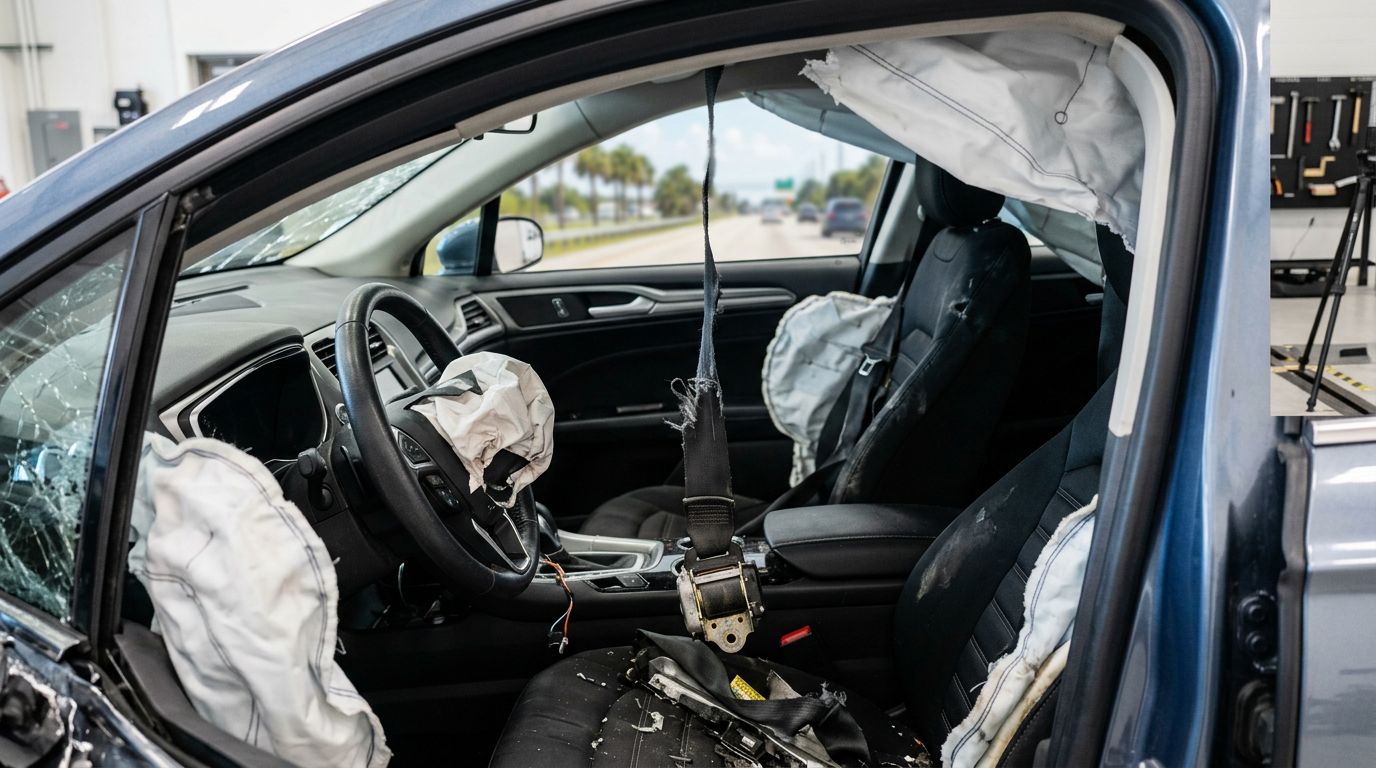
A seat belt that fails during a collision can turn a survivable crash into a serious injury case. Florida seat belt failure claims often depend on evidence that shows what happened inside the vehicle, whether the restraint system worked, and how the failure affected the injuries.
Crash reports and statewide statistics provide useful context, but they rarely prove an individual claim by themselves. The strongest cases connect vehicle data, physical evidence, medical records, recall information, and expert analysis. Florida law also allows an insurer or defendant to argue that an occupant’s failure to use a working seat belt increased the injuries.
Key Takeaways
- Florida’s observed seat belt use rate reached 90.8% in 2025, but individual crash evidence still controls a specific claim.
- A seat belt failure case may involve the other driver, a vehicle manufacturer, a parts maker, a repair facility, or more than one responsible party.
- Crash data can show belt status, impact forces, vehicle movement, and restraint-system performance, but experts must interpret the information.
- A recall supports investigation, but it doesn’t automatically prove that a defective part caused a particular injury.
- Preserve the vehicle, seat belt components, electronic data, photographs, medical records, and repair or salvage records as soon as possible.
What Florida Seat Belt Failure Claims Usually Involve
A seat belt injury case can arise in several different ways. The buckle may release during impact. The webbing may tear. The retractor may fail to lock. The pretensioner may not tighten the belt, or it may deploy improperly and cause additional harm.
A pretensioner tightens a seat belt during a crash or sudden stop. A retractor stores the belt and locks it when the vehicle decelerates. The buckle holds the belt in place. Each part can affect whether the restraint protects the occupant.
The claim may focus on a defective vehicle or component. For example, a manufacturer could face a product-liability claim if a seat belt had a manufacturing defect, a defective design, or inadequate warnings. A repair shop could become involved if poor work caused the restraint to malfunction. A vehicle owner may also face liability if a known safety problem went unrepaired and contributed to the collision or injury.
In other cases, the seat belt worked, but the occupant did not wear it. The at-fault driver’s negligence may still have caused the crash. However, the defense may argue that the occupant’s nonuse increased the severity of the injuries.
That distinction matters. A seat belt issue may affect the amount of damages without changing who caused the collision. A defective restraint may also create a separate claim against a manufacturer, even when another driver caused the impact.
Common failure scenarios
The physical details often point toward the legal theory. Examples include:
- The belt buckle opens during impact without a normal release.
- The belt stays loose because the pretensioner or retractor doesn’t function.
- The webbing separates, tears, or pulls away from an anchor.
- A front airbag deploys while the seat belt fails to restrain the occupant.
- A defective buckle prevents a rear passenger from securing the belt.
- A pretensioner releases metal fragments into the passenger compartment.
A lawyer and qualified engineer may need to inspect the belt assembly before anyone repairs, replaces, or destroys it. Once the vehicle goes to a salvage yard, important evidence can disappear.
Florida Crash Data and Seat Belt Statistics
Crash statistics help explain why restraint evidence matters. Florida’s statewide observational seat belt use rate was 89.4% in 2023, up from 88.3% in 2022. The rate rose to 90.0% in 2024 and 90.8% in 2025.
Florida’s 2023 rate was below the national observational rate of 91.9%. The difference is small, but thousands of crashes occur across the state each year. A small percentage change can involve many occupants.
National fatality data shows the relationship between restraint use and serious outcomes. According to NHTSA’s 2023 occupant protection data, 49% of passenger-vehicle occupants killed in traffic crashes were unrestrained, based on cases where restraint use was known.
NHTSA also reported that 22,713 passenger-vehicle occupants died in 2024, and nearly half of those killed were not buckled when restraint use was known. The agency’s seat belt safety information explains how restraints reduce the risk of ejection and serious injury.
Fatal crash statistics can show the danger of nonuse, but they don’t determine whether a particular belt failed or whether nonuse caused a particular injury.
A Central Florida figure reported by the Florida Department of Transportation placed the share of people killed in car crashes without a seat belt at 26% during the cited period. That number is not a statewide rate, and it doesn’t identify the cause of each death. Still, it shows why investigators examine restraint use in fatal and catastrophic crashes.
Statistics can support a broader investigation, but they don’t replace vehicle-specific proof. A claim needs evidence tied to the actual belt, buckle, retractor, pretensioner, impact, and injury.
How Florida Law Treats Seat Belt Evidence
Florida requires drivers and passengers to use available seat belts, subject to statutory exceptions. A person who violates the law may receive a traffic citation, but the citation alone doesn’t resolve a personal injury claim.
Florida courts have recognized a seat belt defense under Insurance Co. of North America v. Pasakarnis, 451 So. 2d 447 (Fla. 1984). In general, a defendant seeking to use this defense must present evidence that:
- A working seat belt was available.
- The injured person failed to use it.
- The failure contributed to the injuries or increased their severity.
The defense concerns causation. It isn’t enough to show that someone wasn’t buckled. The defendant must connect that fact to the harm claimed.
For example, an occupant may have suffered a fractured arm because the vehicle struck another car. The defense may argue that a working shoulder belt would have prevented a head injury, but it cannot automatically blame the occupant for every injury caused by the crash.
Florida’s modified comparative negligence law also affects these cases. Under section 768.81, a claimant who is more than 50% at fault may not recover damages. If the claimant is 50% or less at fault, the court reduces damages according to the claimant’s share of fault.
The parties may dispute whether the person wore the belt, whether the belt functioned, and whether a different restraint position would have changed the outcome. Those questions usually require more than a police report or an insurance adjuster’s opinion.
Evidence That Can Prove a Seat Belt Failure
The best evidence often comes from the vehicle itself. Do not allow the car to be scrapped before preservation issues are addressed. If the vehicle is totaled, ask the insurer where it will go and send a written request to preserve the restraint components.
Useful evidence may include:
| Evidence | What it may help establish |
|---|---|
| Belt, buckle, retractor, and pretensioner | Whether a component broke, released, or failed |
| Event data recorder | Speed, braking, impact changes, and some restraint information |
| Crash photographs and video | Occupant position, damage, and impact direction |
| Medical records | The timing, type, and likely cause of injuries |
| Recall and repair records | Known safety issues or prior work on the restraint system |
| Expert inspection | Whether the failure resulted from a defect, misuse, or crash damage |
Photograph the belt before cleaning or moving it. Capture the buckle, latch plate, webbing, anchor points, airbag deployment, interior damage, broken glass, and occupant contact marks. Preserve the clothing worn during the collision when it contains tears, cuts, or belt marks.
A police report may list the occupant as restrained or unrestrained. That entry can help, but it may rely on a witness statement, an officer’s observation, or a post-crash assumption. It doesn’t always show whether the belt remained buckled during impact.
Witnesses may have seen the belt before the crash. Passengers may know whether the buckle latched. Vehicle cameras, nearby surveillance systems, and photographs taken shortly after the collision may also reveal occupant position or restraint use.
People should also collect emergency records, diagnostic images, hospital bills, therapy notes, work-loss documentation, and photographs of visible injuries. A documentation checklist for a crash can help organize records while memories and physical evidence remain fresh.
Electronic vehicle data
Many vehicles contain an event data recorder, often called an EDR. Depending on the make, model, year, and available module, the system may record information such as:
- Vehicle speed before impact
- Brake application
- Throttle position
- Change in velocity
- Airbag deployment
- Seat belt buckle status
- Whether a crash event triggered the recording
EDR information has limits. It may not record every detail, and the available data varies by vehicle. A buckle-status reading may show whether the system detected a latched belt, but it may not prove that the belt stayed properly positioned or that the restraint performed correctly.
A trained crash-data technician or reconstruction engineer should download and interpret the data. Investigators must also preserve the vehicle’s battery, airbag control module, seat position, and other parts that may affect the recording.
Medical and biomechanical evidence
Medical records connect the restraint event to the injury. Doctors may identify belt abrasions, chest trauma, abdominal injuries, spinal damage, traumatic brain injury, fractures, or ejection-related injuries. The absence of a visible belt mark doesn’t prove that the belt worked or that the person wasn’t wearing it.
A biomechanical expert may examine the occupant’s size, seating position, direction of movement, vehicle deformation, airbag deployment, and injury pattern. The expert may compare the injuries with expected outcomes under different restraint conditions.
That analysis is especially important when the defense claims that a person would have suffered the same injuries with a functioning belt. The central question becomes whether the alleged failure caused the injury, increased its severity, or had no effect.
Recalls and Defective Restraint Systems
A vehicle recall can provide a valuable lead. It may identify the affected model years, the part involved, the failure mechanism, and the manufacturer’s repair instructions. However, a recall doesn’t automatically prove liability in an individual case.
Recent recall examples involve several manufacturers and different failure types. More than 300,000 Honda HR-V and Accord vehicles were recalled over a missing seat belt rivet or related part that could cause a pretensioner to fail. Hyundai recalled more than 47,000 Kona and Kona Electric vehicles because the rear center seat belt buckle might not function properly.
Ford also recalled certain Fusion, Lincoln MKZ, and Mondeo vehicles after reports that a pretensioner could overheat and fail. Another Ford recall involved front seat belt retractor pretensioners in certain Expedition and Navigator vehicles.
A Florida-filed class action described a Hyundai recall involving pretensioners that could explode and scatter metal fragments. These examples don’t establish that every affected vehicle caused an injury. They show why an investigator should check the VIN, recall status, repair history, and component condition.
Owners can search recalls through NHTSA’s vehicle safety resources. A recall may support a claim when the following facts align:
- The vehicle falls within the affected production range.
- The specific defective component was installed in the vehicle.
- The recall repair had not occurred, or the repair failed.
- The component malfunctioned during the crash.
- The malfunction caused or worsened the claimed injuries.
No recall doesn’t mean no defect. A vehicle may have an individual manufacturing error, an undiscovered design problem, or a repair-related failure. Engineers may need to inspect the part and compare it with design specifications and other vehicles.
Insurance Claims and Recoverable Damages
Florida is a no-fault insurance state. After a crash, personal injury protection, or PIP, generally pays a portion of medical expenses and lost income regardless of fault. Florida policies commonly provide up to $10,000 in PIP benefits, with coverage percentages and eligibility rules that depend on the policy and treatment timing.
PIP doesn’t cover the full value of a serious injury. A person may also pursue bodily injury damages against a negligent driver when the injuries meet Florida’s legal threshold. A defective seat belt may create a separate product-liability claim against a manufacturer or another responsible business.
Potential damages may include:
- Medical treatment and future medical care
- Lost wages and reduced earning ability
- Physical pain and limitations
- Scarring or disfigurement
- Emotional distress associated with qualifying injuries
- Property damage
- Wrongful death damages for eligible survivors
Uninsured or underinsured motorist coverage may also apply when the at-fault driver lacks enough insurance. The available policies, liability theories, and deadlines must be reviewed together.
Insurance companies often focus on the belt issue because it can reduce the value of a claim. An adjuster may ask for a recorded statement or request access to the vehicle. Before giving a detailed statement about restraint use or signing a release, get advice about how the statement may affect the claim.
Steps to Take After a Suspected Seat Belt Failure
Prompt action protects evidence. After receiving medical care, take these steps:
- Report the crash and obtain records. Request the crash report, 911 records, photographs, witness information, and citation details.
- Preserve the vehicle. Tell the insurer, owner, repair facility, and storage yard not to discard, repair, or alter the belt system.
- Document the restraint. Photograph the buckle, webbing, retractor, pretensioner, anchor, airbag, and interior damage.
- Save the clothing and personal items. Belt marks, tears, blood, and damage can help experts assess movement.
- Check the VIN for recalls. Record the recall number, date, affected component, and whether a repair was completed.
- Continue medical care. Tell medical providers about the crash and report symptoms accurately.
- Avoid speculation. Don’t guess whether the buckle was latched or whether a defect caused the injury.
- Get legal advice early. A lawyer can arrange preservation letters, vehicle inspections, expert review, and insurance communications.
If a police report is missing, a claim may still move forward. Medical records, photographs, repair records, witnesses, vehicle data, and scene evidence can establish what happened. Guidance on filing a Florida crash claim without a police report explains why other proof may still matter.
Time also matters because evidence can disappear and legal deadlines apply. Product-liability and negligence claims may follow different rules. The date of the crash, the date of death, the defendant’s identity, and the type of claim can affect the deadline.
Defenses Insurers Commonly Raise
Insurers and defense lawyers may argue that the occupant wasn’t wearing a belt, used it incorrectly, or suffered the same injuries even if the belt had worked. They may also claim that crash damage, rather than a pre-existing defect, caused the component to break.
Other arguments include misuse, failure to maintain the vehicle, an expired recall repair opportunity, lack of medical causation, and the driver’s comparative fault. The defense may also dispute the speed, direction, or severity of the impact.
Each argument requires evidence. A buckle that appears open after a crash may have released during impact, been unlatched beforehand, or broken because of crash forces. An expert must examine the fracture pattern and surrounding damage rather than rely on appearance alone.
The claim becomes stronger when the evidence answers the defense directly. Vehicle inspection, EDR data, recall records, witness testimony, medical opinions, and crash reconstruction can show whether the belt was available, whether it operated correctly, and what injuries followed.
Conclusion
Florida seat belt failure claims require more than a statistic or a notation on a crash report. The case must connect a particular restraint system to a particular impact and a particular injury.
Florida’s seat belt data shows why restraints matter, while crash evidence determines what happened in an individual case. Preserve the vehicle, document the belt system, review recall information, obtain medical records, and seek legal guidance before critical evidence disappears. A working seat belt can reduce injury, but a failed restraint can create serious questions about who should pay for the harm.