
VA Elbow Ratings: Proving Motion Loss in 2026
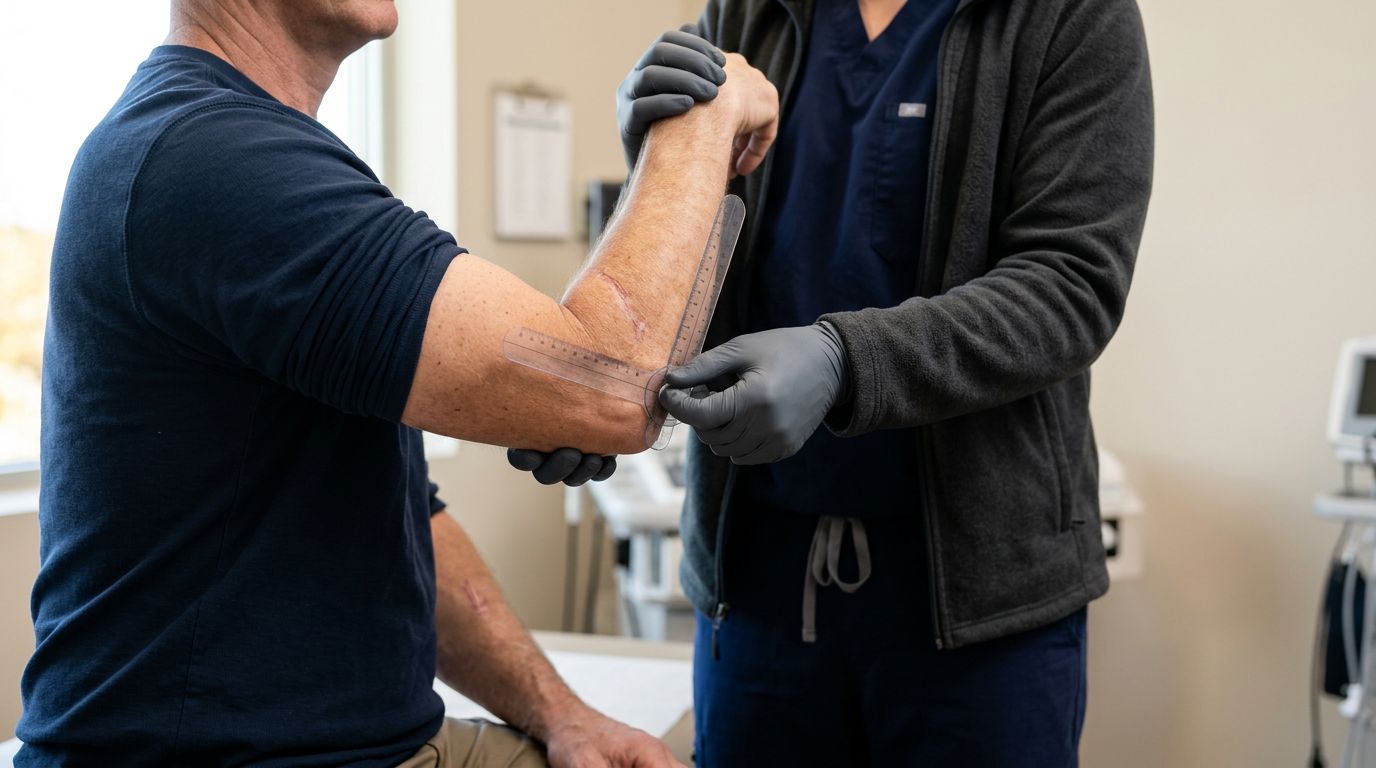
Elbow pain can affect lifting, reaching, gripping, dressing, and ordinary work. For veterans seeking VA elbow ratings, the measured loss of motion often determines whether the condition receives a compensable percentage.
The VA does not rate an elbow only by its diagnosis. A service connection, current medical findings, painful movement, weakness, and functional loss all matter. Strong evidence should show how far the elbow moves, what happens after repeated use, and how flare-ups limit daily activity.
How VA elbow ratings measure motion loss
For claims evaluated in 2026, the primary schedule is 38 C.F.R. § 4.71a. The key elbow range-of-motion diagnostic codes are:
- Diagnostic Code 5206 rates limited flexion.
- Diagnostic Code 5207 rates limited extension.
- Diagnostic Code 5208 rates certain combined flexion and extension restrictions.
- Diagnostic Code 5213 rates limited pronation or supination.
- Other codes address ankylosis, joint replacement, impairment of the radius or ulna, and elbow flail joint.
The VA generally considers normal elbow movement to be extension at 0 degrees and flexion at 145 degrees. Normal forearm pronation is 0 to 80 degrees, while normal supination is 0 to 85 degrees.
Flexion measures how far you can bend the elbow. A lower flexion number means greater restriction. For example, an elbow that bends only to 70 degrees has more severe flexion loss than one that bends to 110 degrees.
Extension measures how far you can straighten the arm. If the elbow stops 45 degrees short of straight, the extension limitation is recorded as 45 degrees. A larger extension number usually indicates more severe impairment.
The VA also separates the major extremity from the minor extremity. The major arm is usually the dominant arm. Because some criteria provide different percentages, you should identify which elbow is dominant in your claim and medical records.
A diagnosis such as tennis elbow, bursitis, arthritis, tendon damage, or a surgical residual does not automatically produce a specific rating. The rating depends on the actual functional impairment and the diagnostic code that best describes it.
Veterans who are still establishing service connection should review the basics of veterans disability compensation, because a favorable motion measurement cannot substitute for proof that the elbow condition relates to military service.
VA elbow ratings for flexion, extension, and rotation
The percentage depends on the measured motion and the affected arm. The following table summarizes the principal flexion and extension thresholds.
| Diagnostic code | Major arm | Minor arm | Motion measured |
|---|---|---|---|
| DC 5206 | 10% at 100°, 20% at 90°, 30% at 70°, 40% at 55°, 50% at 45° | 10% at 100°, 20% at 90° or 70°, 30% at 55°, 40% at 45° | Flexion |
| DC 5207 | 10% at 45° or 60°, 20% at 75°, 30% at 90°, 40% at 100°, 50% at 110° | 10% at 45° or 60°, 20% at 75° or 90°, 30% at 100°, 40% at 110° | Extension |
| DC 5208 | 20% | 20% | Flexion limited to 100° and extension limited to 45° |
A flexion measurement at 110 degrees generally falls within the noncompensable range under DC 5206. However, a noncompensable result does not always end the analysis. Painful motion, weakness, fatigability, or functional loss can support a compensable evaluation in some circumstances.
The combined limitation code, DC 5208, has a specific requirement. The elbow must have flexion limited to 100 degrees and extension limited to 45 degrees. Meeting only one part of that combination does not satisfy the code.
Rotation is different. Pronation turns the palm downward, while supination turns it upward. Restriction in either direction can affect tasks such as turning a screwdriver, opening a jar, using tools, or carrying objects with the palm facing up.
A veteran may also have ankylosis, a prosthetic elbow, impairment of the radius or ulna, or loss of effective use of the hand. Those conditions may require review of other diagnostic codes. A rating should not focus on flexion alone when the records show a different or broader impairment.
The official musculoskeletal rating schedule contains the full criteria, including provisions for elbow ankylosis and other joint problems. The exact diagnosis and medical findings determine which code applies.
What motion loss evidence supports a higher rating?
The strongest evidence gives the VA a consistent picture. A single number on one examination may not capture the veteran’s actual condition, especially when symptoms increase after work or during flare-ups.
A compensation and pension examination should record active and passive range of motion when appropriate. It should also address pain, weakness, fatigability, incoordination, and pain during repeated use. If testing cannot be completed safely, the examiner should explain why.
Medical records are especially useful when they show measurements over time. Orthopedic visits, physical therapy notes, occupational therapy evaluations, imaging reports, and surgical follow-up records can establish whether the restriction is persistent or worsening.
The record should also connect the measurement to function. Useful details include:
- How far the arm can bend before pain stops movement.
- Whether the veteran can fully straighten the elbow.
- Whether repeated lifting causes additional loss of motion.
- Whether rotation affects tools, driving, writing, or household tasks.
- Whether swelling, instability, weakness, or locking limits use.
- How often flare-ups occur and how long they last.
A veteran’s statement can support the medical evidence. Describe specific activities rather than using only general terms such as “severe pain.” For example, explain whether you cannot place a hand behind your head, lift a grocery bag, turn a key, or perform a job task after repeated elbow use.
The VA may discount evidence when reports conflict. If one examination shows nearly normal movement while treatment records show substantial restriction, the claim should address the difference. Symptoms may vary by day, and the examiner may have tested the joint before ordinary activity caused additional limitation.
A VA Board decision involving elbow evaluations discussed DCs 5206, 5207, and painful motion. It can provide an example of how these issues appear in an actual record, although individual Board decisions generally apply only to the veteran involved. Review the VA decision addressing elbow motion codes for that context.
Pain, flare-ups, and repeated use matter
The VA must consider functional loss, not only the final range-of-motion number. Under the musculoskeletal rating rules, pain may affect movement, strength, endurance, and ordinary use.
Pain alone does not automatically justify the highest possible percentage. The evidence must show how pain limits function. A veteran who reports increased pain after lifting, carrying, or repeated bending should explain the resulting loss of ability.
Flare-ups require careful documentation. A flare-up may cause the elbow to bend less, straighten less, or become too painful for normal use. The medical examiner should consider the veteran’s description and, when feasible, estimate additional functional loss during those episodes.
A statement that an examination did not occur during a flare-up should not be the only analysis. The examiner should gather information about frequency, duration, triggers, severity, and functional effects. Treatment notes from a flare-up can provide valuable support.
Repeated-use testing also matters. A veteran may perform several movements in a clinic but lose function after hours of work. That difference should appear in the record. Explain what happens after repetition and how long recovery takes.
A range-of-motion measurement taken before activity may not show the limitation that appears after a full workday or repeated lifting.
Common problems with elbow claims
Many elbow claims fail to receive the expected rating because the evidence does not answer the questions used by the rating schedule.
One problem is relying on a diagnosis without documenting motion. “Elbow arthritis” or “chronic tendonitis” describes the condition, but the rating depends on the resulting impairment.
Another problem is failing to identify the dominant arm. The major and minor extremities can receive different evaluations under the same diagnostic code.
Some examinations also omit passive motion, repeated-use effects, or flare-up estimates. If the report leaves out important testing, review whether clarification or a new examination is necessary.
A veteran should also report symptoms affecting both elbows separately. The VA evaluates each service-connected joint based on its own evidence. Similar diagnoses do not mean the limitations are identical.
Finally, a claim may involve more than one rating issue. Separate manifestations, such as limited motion and instability, require careful review because the VA cannot compensate the same symptom twice, but distinct impairment may warrant separate consideration.
Veterans filing or appealing a claim should organize service records, treatment notes, examination reports, imaging, medication history, and lay statements. The steps for filing a successful VA disability claim can help identify the evidence needed to establish service connection and severity.
Conclusion
VA elbow ratings depend on measurable motion loss and the functional problems that accompany it. Flexion, extension, pronation, and supination each follow different criteria, while the dominant arm can change the percentage.
Before accepting an evaluation, compare the rating decision with the actual range-of-motion findings. Check whether the examination addressed painful movement, repeated use, weakness, and flare-ups. Complete evidence can show the difference between a diagnosis on paper and the real limits of your elbow.