
National Guard VA Disability Claims: Proving Duty Status
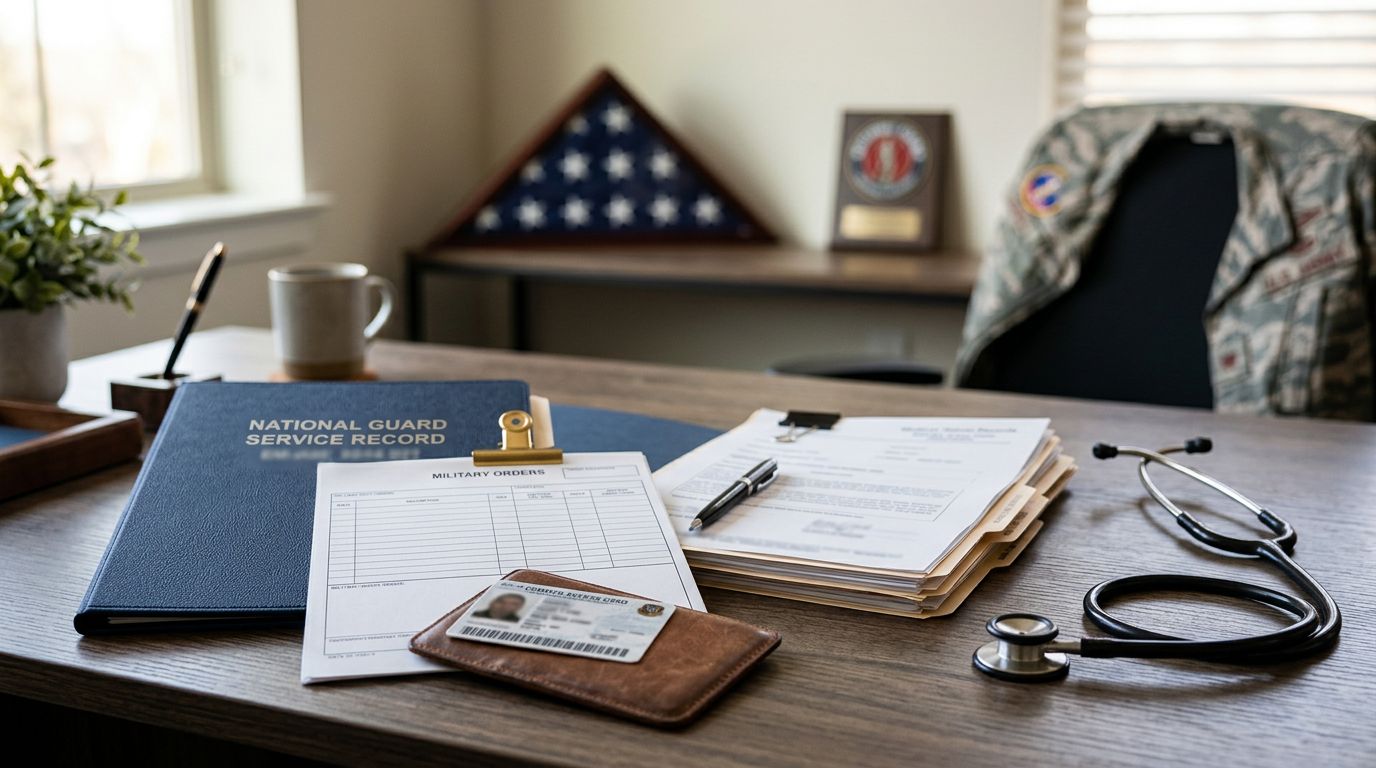
A missing order can make a valid National Guard claim look unrelated to military service. National Guard VA disability claims often turn on one narrow question: what duty status were you in when the injury, illness, or worsening occurred?
Guard service includes drill weekends, annual training, Title 10 activations, and Title 32 missions. Each period may require different proof. Medical records show what happened to your body, but orders and personnel records show why the event may qualify for VA benefits.
For Florida Guard members, the strongest file connects the date, duty authority, medical event, and current disability. Start with the duty-status evidence.
How National Guard VA disability claims depend on duty status
VA evaluates National Guard VA disability claims under service-connection rules, not simply based on membership. Generally, you must show a current disability, an injury or disease during qualifying service, and a link between the current condition and that service. A diagnosis alone doesn’t establish that connection.
The legal category matters because the same medical event may receive different treatment depending on your status. A full-time Title 10 activation is active service. Annual training and similar full-time training generally fall under active duty for training, or ACDUTRA. A typical drill weekend usually falls under inactive duty training, or INACDUTRA.
During ACDUTRA, VA may recognize a disability caused or aggravated by an injury or disease incurred in the line of duty. During INACDUTRA, the usual rule focuses on an injury incurred or aggravated in the line of duty. Certain acute cardiac and cerebrovascular events receive separate statutory treatment.
A chronic disease diagnosed during a drill weekend therefore requires careful analysis. The statement “I became sick at drill” may not establish entitlement without evidence showing the applicable duty status and legal basis for service connection.
Title 32 status also requires close review. It involves state-controlled duty performed under federal authority, but the order’s authority, dates, and purpose can affect the claim. A Title 32 order doesn’t automatically make every condition service connected. The absence of a Title 10 DD214 doesn’t automatically defeat a claim either.
The VA’s National Guard and Reserve benefits guidance explains how active service affects benefit eligibility. Your evidence must still establish what happened during your particular duty period.
The strongest duty-status proof answers three questions: what orders covered you, what happened on that date, and how the event caused or worsened your disability.
What documents prove a Guard member’s duty status?
Orders are usually the starting point. They can identify the service dates, location, mission, authority, and type of duty. Submit every order that covers the date of the injury, exposure, first symptoms, diagnosis, or worsening.
A useful claim file may include:
- Official activation or training orders that identify the applicable Title 10 or Title 32 authority.
- A line-of-duty investigation, often called an LOD, that documents the event and whether it occurred in the line of duty.
- DD Form 261, when the military completed a formal line-of-duty determination.
- DA Form 2173, or a comparable service document, recording the medical examination and duty status.
- A leave and earnings statement, pay record, or other official document showing payment for the relevant training or service period.
- An NGB Form 23A or retirement point statement showing dates credited as training or qualifying duty.
- Service treatment records from the unit, military clinic, or installation.
- Civilian emergency-room, hospital, urgent-care, or specialist records created soon after the event.
- Statements from fellow service members, supervisors, family members, or others who witnessed the event or observed the symptoms afterward.
No single document always decides the claim. An LOD is valuable because it can confirm both the event and the duty period, but it doesn’t automatically establish a current disability or medical nexus. The VA still needs evidence connecting the documented event to the condition for which you seek compensation.
Pay records and retirement points can fill important gaps. For example, an order may show that you were scheduled for training, while an LES or muster record can show that you actually reported. Those records become more useful when they match the date on your medical documentation.
A missing LOD doesn’t necessarily end the claim. Request the investigation from your unit, state National Guard records office, or other records custodian. If no investigation exists, explain that fact and submit other records that establish your status and the event.
Drill weekend, annual training, and deployment proof
The type of Guard duty changes the evidence that matters most. Organize your records around the specific period instead of sending VA a disorganized collection of documents.
Drill weekend and inactive duty training
Drill weekend is commonly treated as INACDUTRA. An injury during physical training, a vehicle accident, equipment operation, or another identifiable event may support service connection if the records establish that you were performing authorized duty.
The file should show the drill dates, your attendance, the incident, and medical treatment. An LOD, DD Form 261, DA Form 2173, or equivalent record can help establish those facts.
INACDUTRA claims can become difficult when a condition developed gradually rather than after a specific injury. A claimant who develops back pain after repeated training may need detailed medical records and a physician’s opinion explaining whether an injury occurred or whether the training aggravated a prior condition.
Annual training and ACDUTRA
Annual training is generally documented as ACDUTRA. This category can support service connection for an injury or disease incurred or aggravated during the training period, provided the evidence supports the other requirements.
Keep the annual-training orders, travel or attendance records, treatment notes, and follow-up care. If you returned home before seeking treatment, explain the timing. A short delay may have a reasonable explanation, such as the end of training, travel, or an attempt to continue working through symptoms.
Title 10 deployments and Title 32 missions
Title 10 orders often provide clear proof of federal active service. A DD214, deployment orders, service treatment records, and post-deployment medical assessments can establish the relevant period.
Title 32 missions require a closer look at the exact order. Submit the order itself, including the cited authority, date range, location, and mission. Also provide unit records showing attendance and medical records from the time of service.
For National Guard VA disability claims, the words “Title 10” or “Title 32” are only part of the analysis. The evidence must show the duty period when the condition began, was diagnosed, or became worse.
How to build a stronger duty-status evidence file
A clear file makes it easier to connect military records with medical records. Use this process before submitting your application or responding to a VA development letter.
- Create a date-by-date timeline. List each relevant order, drill, training period, injury, first symptom, medical visit, diagnosis, and follow-up appointment. Use exact dates whenever possible.
- Match every medical event to a duty record. Place the order or attendance record next to the treatment note for that date. If a civilian provider treated you after training ended, include the order showing when the symptoms began.
- Request unit and personnel records. Ask for LOD investigations, DA Form 2173, duty rosters, muster records, training schedules, pay documents, and service treatment records. Keep copies of your requests and responses.
- Explain gaps in writing. State why treatment occurred off base, why an LOD was never completed, or why the available order doesn’t cover the full period. A short, factual explanation is more useful than leaving the VA to guess.
- Address the medical connection. Your records must show more than treatment during service. A medical opinion may need to explain how the event caused the current disability, aggravated a preexisting condition, or produced continuing symptoms.
- Submit the correct claim evidence. VA Form 21-526EZ is used for an initial disability compensation claim. Include available separation documents, service treatment records, personnel records, medical evidence, and lay statements. Identify the specific Guard unit and duty period involved.
A personal statement can help explain what official records omit. Describe what you were doing, where the event occurred, when symptoms started, who saw it, and how the condition affected you afterward. Avoid broad statements that don’t identify dates or facts.
The best National Guard VA disability claims don’t rely on a single declaration that the injury happened during service. They use several records that point to the same date and duty period.
When VA questions your duty status
A denial may state that VA found no qualifying service, no in-service event, or no connection between the event and current disability. Read the decision closely. The favorable findings may identify facts VA already accepted, while the reasons section shows the missing proof.
If the problem is missing or misunderstood duty evidence, obtain the order, LOD, pay record, or personnel document that addresses it. If the denial rests on medical evidence, a new medical opinion or additional treatment record may be more useful than another copy of the orders.
The available appeal option depends on the reason for the decision and the evidence you have. A Supplemental Claim can include new and relevant evidence. Higher-Level Review generally relies on the existing record and argues that VA made an error. A Board appeal asks a Veterans Law Judge to review the case, with hearing and evidence options that require careful attention to deadlines.
Florida veterans can review the VA appeal options for Florida veterans before choosing a path. A VA-accredited attorney can also compare the orders, duty records, medical evidence, and denial language as one file. Learn more about the benefits of legal representation in VA cases when the service-status issue is disputed or the claim has already been denied.
Conclusion
National Guard VA disability claims require more than proof of Guard membership. Your file should identify the exact duty status, establish what happened during that period, document the current disability, and connect the two with medical evidence.
Orders, LOD records, pay documents, retirement points, personnel records, and witness statements can work together when one record is incomplete. The strongest claim gives VA a clear answer to the question that often decides the case: what qualifying duty were you performing when the disability began or worsened?