
Florida Brake Failure Claims and Vehicle Inspection Evidence
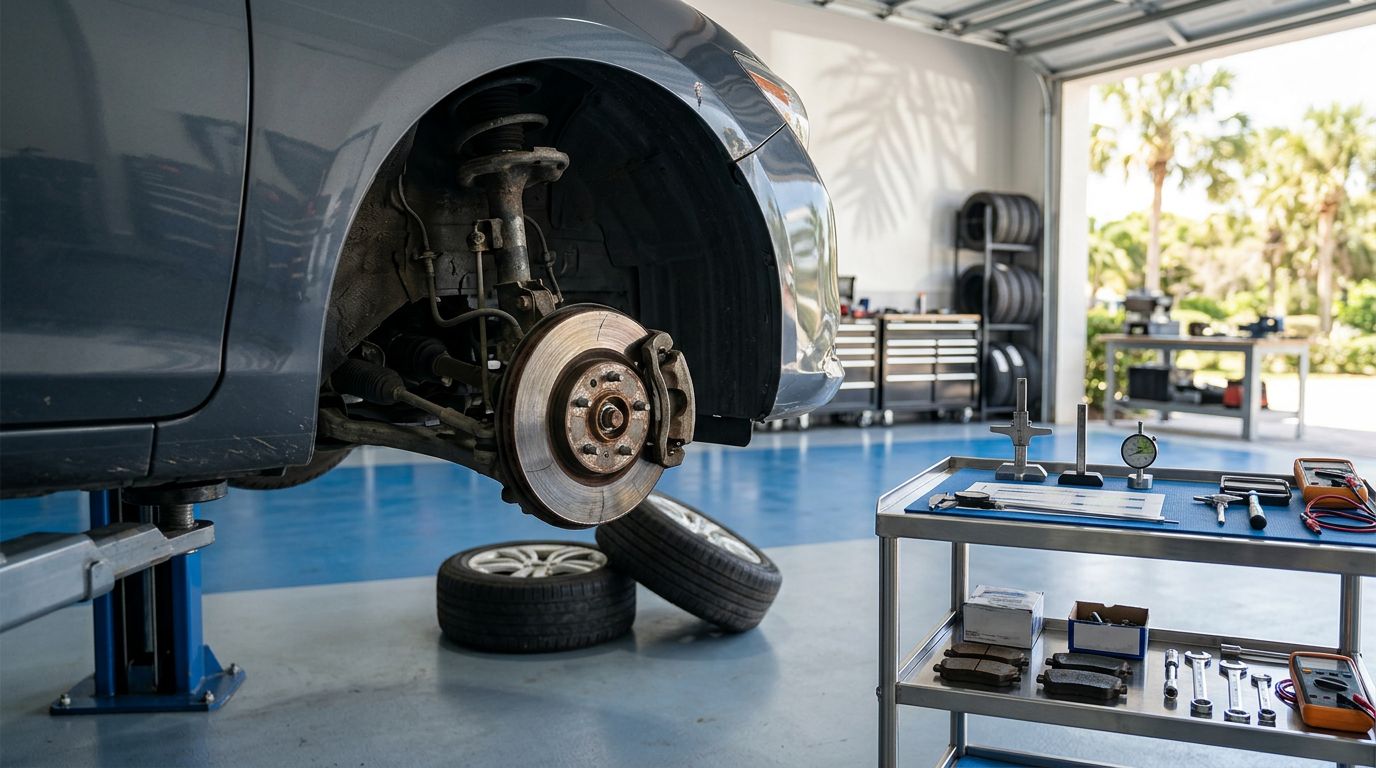
Brake failure can make an ordinary rear-end collision far more complicated. Florida brake failure claims often turn on what happened inside the braking system, not only on where the vehicles landed.
If the other driver says the brakes suddenly failed, an insurer may treat that explanation as a defense. However, the defense must match physical evidence, maintenance records, electronic data, and witness accounts. A careful vehicle inspection can show whether the brakes failed without warning or whether poor maintenance caused the crash.
How Florida brake failure claims are proven through inspection evidence
Most crash claims require proof that another person or business acted negligently and caused the injuries. In a brake-related collision, the central question is often whether the vehicle owner, driver, employer, repair shop, or manufacturer had responsibility for the brake condition.
A driver may be responsible for ignoring warning signs such as grinding, a soft pedal, pulling to one side, a brake warning light, fluid loss, or longer stopping distances. An owner may face liability if the vehicle was not maintained. A trucking company may have responsibility if inspection records show repeated brake problems. A repair facility may be involved if a recent brake job left a component loose or improperly installed.
The driver who struck another vehicle usually cannot establish sudden brake failure with a statement alone. The evidence must show:
- The braking system actually failed.
- A particular component or condition caused the failure.
- The failure occurred before or during the collision.
- The driver could not reasonably have discovered or prevented it.
- The failure caused the impact or made the injuries worse.
A rear-end collision often begins with a presumption that the following driver failed to use reasonable care. Still, a sudden and unforeseeable mechanical failure can affect that analysis. The inspection must separate a true brake malfunction from ordinary collision damage, driver inattention, speeding, following too closely, or an intentional brake check.
A claimed brake failure is a conclusion, not a finding. The finding comes from preserved parts, records, and data.
In Florida brake failure claims, timing also matters. Brake parts may be replaced within hours or days after a wreck. Once that happens, important evidence can disappear.
Florida brake standards shape the inspection
Florida law provides an objective starting point. Section 316.262 requires motor vehicles and vehicle combinations to meet brake performance standards under all loading conditions when the service brake is applied. The law includes testing for braking force, deceleration, and stopping distance at 20 miles per hour. The test surface must be substantially level, dry, smooth, hard, and free of loose material, with a grade no greater than plus or minus 1 percent. You can review Florida’s brake-performance statute through the Florida Senate.
That standard does not automatically prove negligence in a personal injury case. A post-crash examination still must identify the defect and connect it to the collision. However, test results and inspection findings can contradict an unsupported claim that the brakes failed without warning.
Florida law also gives officers authority to inspect vehicles that appear unsafe. Under section 316.610, an officer may require an unsafe vehicle to be inspected and may remove it from service when continued operation creates an unusually hazardous condition. The unsafe-vehicle inspection statute can help explain why an officer, commercial inspector, or qualified investigator examined the vehicle.
Commercial vehicles require additional attention. The Florida Highway Safety and Motor Vehicles CDL materials describe air-brake checks that include pressure readings, emergency brake operation, leaks, and whether the vehicle pulls when the service brake is applied. The Florida CDL supplement states that an air system’s gauge and governor cutoff should build to approximately 120 to 140 psi. It also identifies a parking or emergency brake valve pop-out range of 20 to 45 psi.
These figures apply to air-brake systems, not every passenger car. They can provide useful benchmarks when a tractor-trailer, bus, delivery truck, or other commercial vehicle caused the crash.
What a post-crash vehicle inspection should examine
The vehicle should be preserved before anyone repairs, dismantles, sells, or disposes of it. A lawyer may send a preservation letter to the driver, vehicle owner, insurer, towing company, storage facility, employer, or repair shop. The letter identifies the vehicle and requests that relevant parts and records remain untouched.
A qualified mechanic or forensic engineer may examine the master cylinder, brake fluid reservoir, hydraulic lines, hoses, vacuum booster, calipers, wheel cylinders, brake pads, shoes, rotors, drums, ABS module, sensors, and related hardware. The examiner will look for leaks, fractures, corrosion, contamination, excessive wear, heat damage, improper installation, missing fasteners, and evidence that a component failed before impact.
Collision forces can also damage brake parts. For that reason, the examiner must distinguish impact damage from a pre-crash defect. A broken line caused by the wreck does not prove the line caused the wreck. A severely worn pad, old leak, or improperly secured component may tell a different story.
Several evidence sources often work together:
| Evidence | What it may help establish |
|---|---|
| Brake components and fluid | Whether a leak, break, wear pattern, or contamination existed |
| Repair and maintenance records | Prior warnings, service history, and notice of a developing problem |
| EDR or vehicle data | Speed, braking input, and timing before impact, when available |
| Photos, video, and scene evidence | Brake lights, skid marks, fluid stains, road conditions, and vehicle positions |
| Witness statements and 911 calls | Driver behavior, warnings, sudden maneuvers, and statements made after the crash |
Electronic data requires prompt attention. An event data recorder may show whether the driver pressed the brake pedal, how fast the vehicle traveled, and when the vehicle began slowing. Data availability varies by vehicle, crash severity, and the system’s ability to record the event. A qualified examiner should preserve the original data and explain its limits.
Skid marks also require careful interpretation. Vehicles with anti-lock brakes may leave little or no traditional skid pattern. Therefore, the absence of visible skid marks does not by itself prove that the driver never braked.
For more guidance about preserving photos, medical records, witness information, and other essential evidence for a car accident claim, keep records in their original form and avoid editing images or deleting messages.
When a driver claims the brakes failed suddenly
A sudden-failure defense depends on cause and foreseeability. If a brake line ruptured without prior warning, the driver may argue that the failure could not have been discovered during reasonable use. If records show repeated complaints about a soft pedal or a mechanic’s warning that the brakes were near the wear limit, the defense becomes harder to support.
Service records may include more than final invoices. Repair estimates, parts receipts, warranty files, dealership notes, oil-change inspections, fleet maintenance logs, and text messages can reveal what the driver or owner knew. A note about a fluid leak may matter even if the owner postponed the repair.
Commercial air-brake cases may involve pressure and leakage testing. Federal Motor Carrier Safety Administration training materials describe static leakage tests and other inspection steps for air-brake systems. The FMCSA vehicle inspection training can provide useful background for understanding those tests.
The inspection should also address the driver’s conduct. A vehicle may have a brake problem, yet the crash may still involve excessive speed, distraction, unsafe following distance, or delayed reaction. Conversely, a driver may claim brake failure when video shows intentional hard braking to intimidate or punish a following motorist. The available evidence must support the explanation that actually fits the event.
Who may be responsible for a brake-related crash?
Liability depends on the vehicle and the failure’s source. Potentially responsible parties can include:
- The driver, if the driver ignored known symptoms or drove carelessly.
- The vehicle owner, if the owner failed to maintain an unsafe car or truck.
- An employer or fleet operator, if inspection and maintenance duties were neglected.
- A repair shop, if a defective repair or installation caused the malfunction.
- A parts or vehicle manufacturer, if a defective product caused the braking failure.
Evidence must connect each proposed defendant to a duty and a specific act or omission. Ownership alone does not prove that the owner caused the failure. A repair invoice alone does not prove that the mechanic performed negligent work.
Florida’s no-fault system may require an injured person to begin with personal injury protection coverage for certain medical expenses and lost income. A serious injury can also support a claim against the at-fault party for losses that PIP does not cover, depending on the injury and the facts. These may include additional medical costs, reduced earning ability, pain, and other damages. See types of compensation in car accident cases for a broader discussion.
Shared fault can reduce recovery. Florida’s modified comparative negligence rule generally bars recovery when an injured person is more than 50 percent responsible, and an award can be reduced when the person is 50 percent or less at fault. Learn how Florida’s modified comparative negligence rule can affect an auto accident claim.
Steps to take after a suspected brake failure crash
After receiving emergency medical care and reporting the collision, take steps that protect both safety and evidence:
- Ask the towing company and vehicle owner where the vehicle will go. Record the location, date, and condition of the vehicle.
- Tell the insurer that the vehicle may contain evidence of a brake-related crash. Do not authorize repairs, salvage, or disposal before an inspection.
- Photograph the vehicles, dashboard warning lights, brake lights, roadway, debris, fluid stains, tire marks, and nearby surveillance cameras.
- Save the crash report, repair estimates, medical records, bills, wage information, photographs, videos, and communications with insurers.
- Write down what you observed before impact, including unusual sounds, warning lights, pedal feel, traffic conditions, and statements made at the scene.
- Contact a Florida personal injury attorney before giving a detailed recorded statement or accepting a settlement.
Act quickly if the vehicle belongs to a business or commercial fleet. Companies may have electronic logs, inspection schedules, GPS data, camera footage, and maintenance systems that can be overwritten or deleted under routine policies. A formal preservation request can help protect those materials.
Conclusion
Florida brake failure claims depend on more than the driver’s explanation after a collision. Preserved brake components, maintenance records, vehicle data, scene evidence, and witness accounts can show whether a failure was sudden, preventable, or unrelated to the crash.
If you were injured, protect the vehicle and related records before repairs change the evidence. The condition of the brakes may determine who caused the collision, and a timely inspection can keep that answer from being lost.