
Florida Ovarian Torsion Malpractice Claims After ER Delays
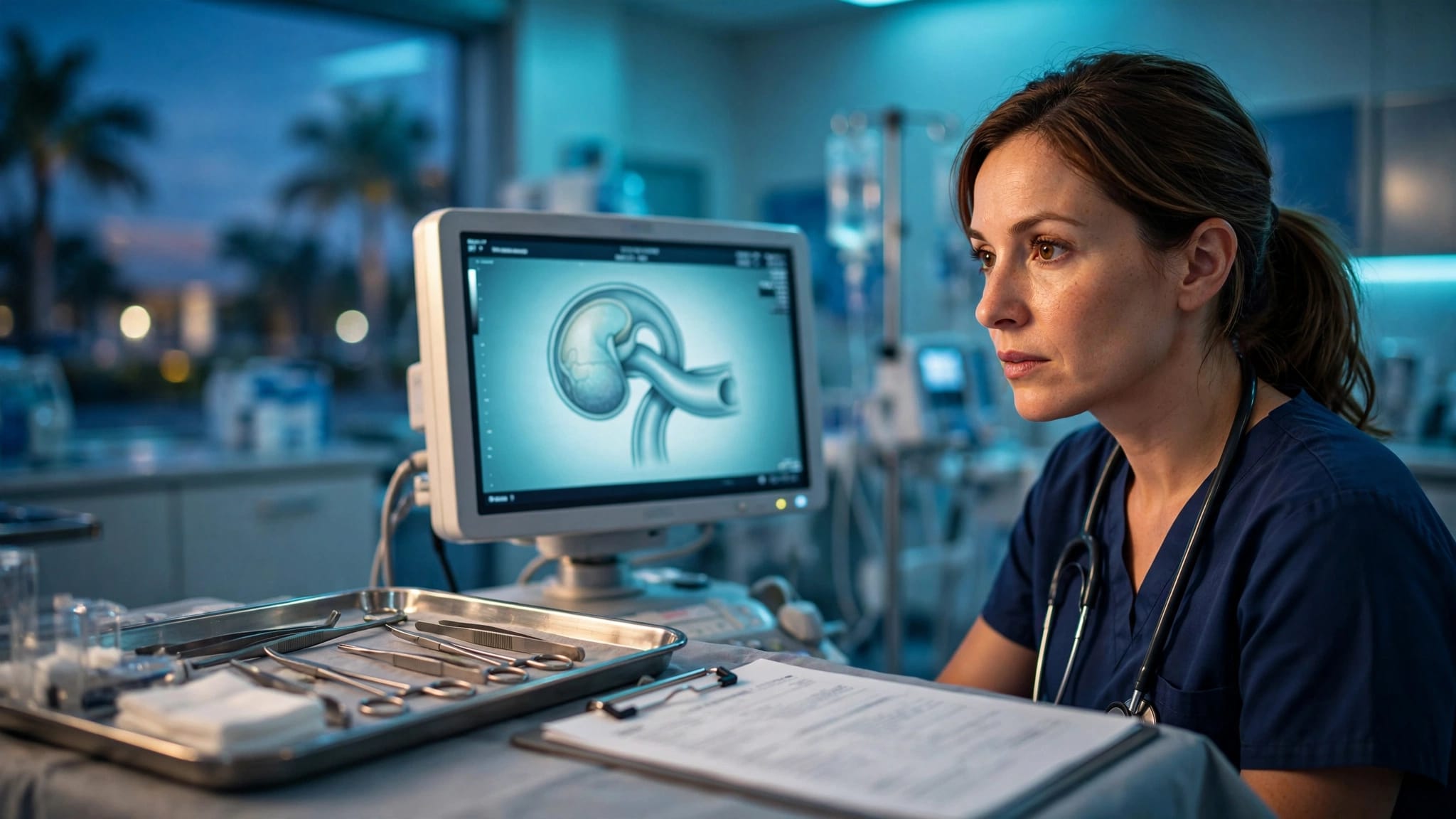
A missed ovarian torsion can turn hours of severe abdominal pain into emergency surgery, loss of an ovary, and lasting fears about fertility after an emergency room visit. Ovarian torsion malpractice claims may arise when providers overlook warning signs or delay appropriate care, but a missed diagnosis alone doesn’t establish liability.
A Florida claim generally requires proof of a provider’s duty, a departure from the applicable standard of care, a connection to the outcome, and legally recognized harm. A difficult diagnosis, intermittent symptoms, or a reassuring scan doesn’t by itself establish medical negligence. The issue is whether the response was reasonable based on the information available at the time.
A careful review starts with the medical timeline. It asks whether earlier evaluation, specialist involvement, or timely surgery probably would have changed the outcome. Losing one ovary doesn’t necessarily mean infertility, although the consequences can be significant.
Key Takeaways
- An ovarian torsion malpractice claim requires proof of duty, a departure from the applicable standard of care, causation, and legally recognized damages; a missed diagnosis or lost ovary alone does not establish negligence.
- Sudden unilateral pelvic pain, nausea, vomiting, an enlarged ovary, recurrent symptoms, and repeat emergency visits may require careful evaluation, even when ultrasound or Doppler findings appear reassuring.
- Causation often depends on whether earlier gynecology involvement or surgery probably would have preserved the ovary or reduced the harm. Medical timelines, imaging, consultation records, operative reports, and qualified expert opinions are important evidence.
- Florida medical negligence claims involve strict deadlines and a presuit investigation, including an expert opinion and notice of intent before filing suit in many cases.
- Losing one ovary does not automatically cause infertility, but reproductive, physical, emotional, and financial consequences may be recoverable when supported by medical and other documentation.
Ovarian torsion malpractice starts with the medical timeline
Ovarian torsion occurs when an ovary twists around the tissues supporting it, sometimes with a fallopian tube. The twist can obstruct venous drainage first, then compromise arterial inflow. Without timely treatment, the ovary may swell, become ischemic, and lose viability.
The strongest cases usually turn on what the patient reported, what the care team observed, and what happened next. An emergency room record may show a worsening pattern that called for more than pain medicine and discharge instructions.
Symptoms that should prompt a torsion workup
Sudden pelvic pain on one side of the lower abdomen is a common warning sign. Severe abdominal pain may occur with nausea, vomiting, tenderness, or pain that worsens with movement. Recurrent episodes can also warrant a torsion workup, although these symptoms overlap with other urgent conditions.
The Merck Manual’s clinical overview of adnexal torsion describes severe pelvic pain with nausea and vomiting, along with ultrasound evaluation and prompt treatment.
An ovarian cyst or enlarged ovary can increase torsion risk. However, ovarian torsion can occur without a known cyst. Age, pregnancy status, prior conditions, and pain location all matter, but no single factor settles the diagnosis.
Why an emergency room misdiagnosis can happen
The symptoms overlap with appendicitis, kidney stones, ruptured cysts, urinary infections, gastrointestinal illness, and ectopic pregnancy. An ER physician may reasonably consider those conditions. The legal issue is whether the provider also considered torsion when the complete clinical picture required it.
For example, a patient with severe unilateral symptoms, vomiting, an enlarged ovary on imaging, and repeated emergency visits may need a prompt gynecology consult. Whether discharge was appropriate depends on the full clinical picture and the applicable Florida legal standard.
A patient may temporarily improve with intermittent torsion, when the ovary twists and then untwists. Looking well between episodes does not rule out a serious problem.
Why an ultrasound may miss ovarian torsion
Pelvic ultrasound is an important diagnostic tool, but it isn’t a final answer. It may show an enlarged ovary, cyst or mass, free pelvic fluid, or an abnormal ovarian position. Yet some ovarian torsion cases produce uncertain or incomplete findings.
A record should show how the clinician interpreted the scan alongside the patient’s symptoms, examination, lab results, and history. Treating a test report as more important than a concerning clinical picture can contribute to misdiagnosis.
Normal Doppler flow does not rule out torsion
Doppler ultrasound assesses blood flow. However, arterial blood flow may remain visible despite torsion because the ovary has a dual blood supply. Partial twisting can also allow some blood flow through the tissue.
ACOG guidance on adnexal torsion states that Doppler flow alone should not guide clinical decision-making. Its guidance also recognizes sudden, intermittent pelvic pain with nausea and vomiting as a common presentation.
Therefore, a report showing preserved flow does not automatically support discharge or independently rule out torsion. The response depends on the complete examination, history, imaging, and clinical judgment. A normal Doppler result alone doesn’t establish a breach, and an abnormal result alone doesn’t prove one. This distinction matters when evaluating a delayed diagnosis.
Intermittent pain can obscure the emergency
Intermittent torsion creates a special diagnostic problem. The ovary may twist, then undergo temporary detorsion. Pain may improve before the ultrasound occurs, and Doppler findings may appear reassuring during that interval.
A patient might visit urgent care with severe pain, improve after medication, then return hours or days later with worse symptoms. Improvement in pelvic symptoms after medication doesn’t necessarily eliminate concern. Those separate encounters should be reviewed together. Earlier triage notes, nursing records, imaging reports, and discharge instructions can show whether clinicians missed a pattern.
When suspicion remains substantial, surgical intervention may be necessary. A gynecology consult can help determine whether direct visualization through laparoscopy is appropriate. Laparoscopy can confirm ovarian torsion, permit detorsion of the adnexa, including the fallopian tube when involved, and assess whether the ovary can be preserved.
When a missed torsion becomes medical negligence
A poor outcome doesn’t automatically establish medical malpractice. Loss of an ovary or a missed or delayed diagnosis of ovarian torsion alone doesn’t prove negligence. Ovarian torsion can progress rapidly even when a patient seeks care promptly. A Florida claim requires a provider-patient duty, breach of the applicable standard of care, medical causation, and damages.
The Florida medical malpractice law guide explains these core issues. The Florida statutory standard for medical negligence focuses on whether the provider met the prevailing professional standard. Qualified medical experts usually assess that question after reviewing the complete chart.
Care that may fall below the standard
The applicable standard of care depends on the patient’s presentation and the provider’s role. An emergency physician, radiologist, OB-GYN, advanced practice provider, nurse, or hospital may each have different responsibilities.
Potential evidence of a breach can include:
- Failing to perform an adequate pelvic or abdominal examination when severe abdominal pain or other symptoms called for one.
- Ignoring severe unilateral pain, vomiting, a known ovarian cyst, or repeat visits for the same complaint.
- Ordering an ultrasound but failing to arrange a timely gynecology consult despite concerning findings.
- Treating preserved blood flow on Doppler as proof that torsion was impossible.
- Discharging a patient without clear return precautions or urgent follow-up when the diagnosis remained uncertain.
The Florida statutory standard for medical negligence focuses on whether the provider met the prevailing professional standard. Qualified medical experts usually assess that question after reviewing the complete chart.
Proving that delay caused the loss
Causation is often the contested issue. A hospital may argue that the ovary was already beyond saving when the patient first arrived. The claimant must establish that timely specialist care and surgical intervention, potentially including detorsion, would probably have preserved tissue or reduced harm.
Timing matters. Records may document when pain began, when the patient arrived, when imaging was ordered, when a specialist was contacted, and when surgery occurred. Operative notes may describe a necrotic ovary, the number of twists, the condition of the fallopian tube, or whether the surgeon had to perform an oophorectomy.
An expert opinion can compare that timeline with expected care under similar circumstances, supporting evaluation without guaranteeing success. The focus isn’t hindsight; it’s the information reasonably apparent to clinicians at each decision point.
Records that can reveal a preventable delay
Medical records are the backbone of a claim involving a preventable diagnostic error. The evidence should show what care was missed and whether that missed care changed the outcome. Requesting only the hospital discharge summary is not enough. That document may omit when symptoms escalated or how long the patient waited for imaging and consultation.
Request records promptly through each provider’s authorized process. Consult counsel about preservation requests or subpoenas when needed. Florida providers may maintain separate systems for the emergency department, radiology, billing, outpatient follow-up, and surgery.
Request the complete chart and imaging
A useful records request should seek:
- Triage notes, vital signs, nursing notes, physician notes, medication administration records, and timestamps for entries.
- The complete ultrasound report, CT images if performed, other radiology reports, and any addenda to imaging reports.
- Laboratory results, pregnancy testing, consultation requests, transfer documentation, phone logs, portal messages, and discharge instructions.
- Operative reports, anesthesia records, pathology reports, and postsurgical follow-up notes.
- Records from earlier urgent-care visits, primary care appointments, or emergency visits involving similar pain.
Don’t rely only on a portal summary. Preserve the original ultrasound images and other imaging files. An image review alone can’t substitute for a qualified medical review of the entire chart. A qualified medical reviewer may provide an expert opinion after assessing the images, timestamps, triage, consultation decisions, and operative findings.
Also preserve text messages, appointment records, photographs, employment records, and treatment records while the events remain clear.
Build a time-by-time account
Create a timeline beginning with the first pain episode. Record symptom onset, vomiting or fever, each call for help, and every emergency room arrival and discharge time. Note when surgery occurred.
Then compare the timeline with the chart. A discrepancy may matter, such as a nurse recording pain at 10 out of 10 while a later note describes symptoms as mild. A discharge record may recommend follow-up, even though no prompt appointment was available.
This approach also helps distinguish one error from a series of missed opportunities when symptoms come and go. Intermittent torsion may connect pain episodes, return visits, and changing imaging findings.
A detailed review of Florida ovarian torsion misdiagnosis illustrates why the full sequence matters. The medical and legal record often tells a clearer story than any one imaging report.
Florida deadlines and the Chapter 766 process
Florida imposes strict filing rules for negligence claims. A delayed diagnosis involving ovarian torsion can make timing critical. Waiting for recovery to feel complete can put a claim at risk, so seek legal advice and preserve records early.
Florida generally allows two years after a patient discovers, or reasonably should have discovered, the injury and possible causation. A four-year statute of repose generally runs from the incident, subject to statutory exceptions and tolling rules. Review the current Florida Statutes section 95.11(4)(b) for the governing text.
Presuit investigation comes before a lawsuit
Florida requires a reasonable presuit investigation before filing. The claimant generally must obtain a verified written medical expert opinion supporting reasonable grounds for a medical negligence claim.
See Florida Statutes section 766.102 and section 766.104 for related statutory requirements.
The claimant also sends each prospective defendant a notice of intent to initiate litigation. Under Florida Statutes section 766.106, defendants generally receive a 90-day presuit screening period to investigate and respond before a lawsuit may proceed.
During that period, parties may exchange information, investigate the claim, negotiate, or discuss settlement. The pre-suit process may affect timing through statutory tolling, so review the current statutory language with qualified counsel.
A notice must be accurate and supported for each provider named. That makes early expert review and complete records essential.
Florida statute of limitations and repose
The statute of limitations can involve discovery dates, concealment, minority, presuit notice, tolling, and other statutory exceptions. Miscalculating it can end an otherwise valid case.
The current Florida Statutes section 95.11(4)(b) should guide any review of the state’s medical malpractice time limits. Do not assume the clock starts on the surgery date or when a provider finally explains what happened.
A qualified Florida medical malpractice attorney can assess the applicable dates promptly.
Damages after a lost ovary or delayed surgery
In a Florida medical malpractice case, damages depend on documented injury and its effects. They may include emergency care, surgery, past and future medical expenses, and lost income. Physical pain, emotional distress, and loss of enjoyment of life may also be recoverable when supported by the evidence.
If ovarian torsion leaves a nonviable ovary, surgical intervention may include an oophorectomy. Earlier laparoscopy may sometimes allow tissue-preserving treatment, while later surgery may be necessary when the ovary is no longer viable. A necrotic ovary may require removal, and the fallopian tube may also be affected.
The personal consequences require proof
An oophorectomy may involve physical recovery, surgical scarring, pelvic pain, and anxiety during later pain episodes. It may also create fear about future pregnancy and concerns about fertility.
Losing one ovary doesn’t automatically cause infertility. Many people retain fertility with one functioning ovary. However, damage to the remaining ovary, bilateral injury, reduced ovarian reserve, early menopause, or medically necessary fertility treatment may materially affect reproductive plans. In some cases, these effects can involve loss of reproductive capability.
Medical records, fertility specialist opinions, counseling or mental-health records, employment documentation, and family testimony can help show the full impact of an avoidable delay. These damages should reflect the person’s documented medical effects and actual losses, rather than fear or speculation.
Frequently Asked Questions
Does a missed ovarian torsion diagnosis automatically mean malpractice?
No. A claim generally requires proof that the provider departed from the applicable standard of care and that the departure probably caused compensable harm. The diagnosis must be evaluated based on the information reasonably available at each decision point.
Can normal Doppler blood flow rule out ovarian torsion?
No. Blood flow may remain visible because the ovary has a dual blood supply or because the torsion is partial or intermittent. Doppler findings must be considered together with symptoms, examination findings, history, and other testing.
What evidence may support an ovarian torsion malpractice claim?
Important evidence can include triage and nursing notes, physician records, imaging and original image files, timestamps, consultation and transfer records, discharge instructions, and operative reports. A qualified medical expert generally reviews the complete timeline to evaluate breach and causation.
Can losing one ovary cause infertility?
Losing one ovary does not automatically cause infertility because many people retain fertility with one functioning ovary. Fertility may be materially affected by injury to the remaining ovary, bilateral damage, reduced ovarian reserve, early menopause, or the need for fertility treatment.
How long do I have to pursue a Florida ovarian torsion malpractice claim?
Florida medical negligence deadlines can depend on discovery, repose, presuit notice, tolling, and other statutory exceptions. Because the timing rules are strict and a presuit investigation is generally required, consult a qualified Florida medical malpractice attorney promptly.
A Clear Path After a Missed Ovarian Torsion
A missed or delayed diagnosis of ovarian torsion, including a misdiagnosis, doesn’t automatically establish negligence. These Florida claims require a record-based showing of warning signs, a breach of the applicable standard of care, and a causal connection to compensable harm. The evidence must show that timely treatment likely would have prevented the harm.
Preserve the records, write down the timeline, and have qualified medical professionals review the care. Any claimed loss of reproductive capability must be supported by medical evidence; it isn’t presumed from the loss of one ovary. Consult a qualified Florida medical malpractice attorney promptly about Florida presuit requirements, limitation periods, repose, and available options.
This article provides general information about Florida medical and medical-malpractice law and is not legal advice or medical advice. It does not create an attorney-client relationship and is not a substitute for evaluation by a qualified Florida medical malpractice attorney or a licensed healthcare professional. Deadlines and medical decisions depend on the specific facts.