
Florida Roundabout Crash Claims: Proving Right of Way
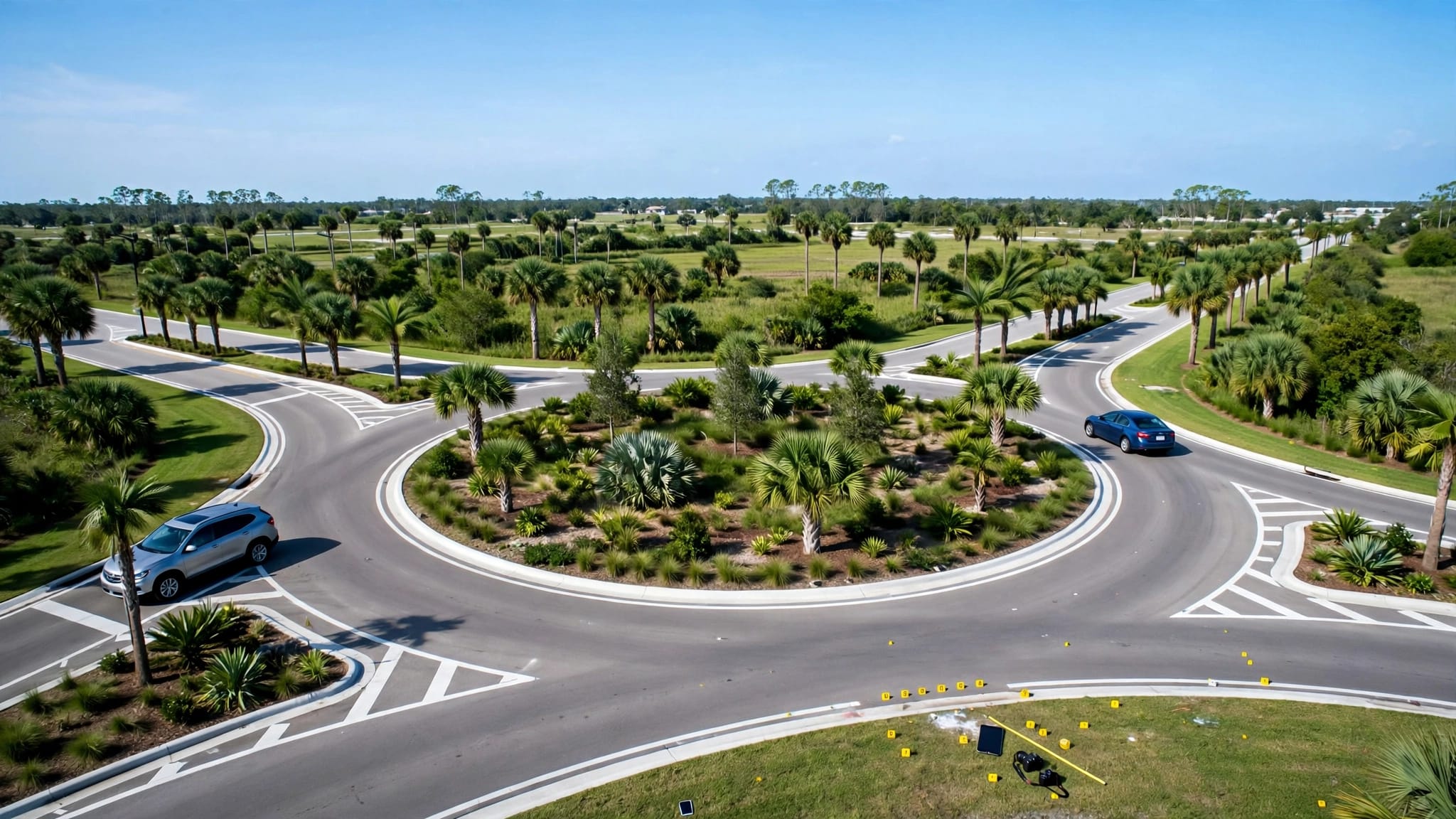
A roundabout collision can happen in seconds, yet the dispute over fault may last months. In Florida roundabout crash claims, the central question is usually who had the right of way when the vehicles met.
Drivers often remember the impact but disagree about the seconds before it. One may say they were already circulating. The other may insist there was enough space to enter. Strong evidence turns that disagreement into a claim supported by facts.
Florida Roundabout Crash Claims Start With the Yield Rule
Florida roundabouts move traffic counterclockwise. Drivers entering the circular roadway must yield to vehicles already inside it. The Florida Driver License Handbook gives that instruction plainly: yield before entering the roundabout.
This rule often places responsibility on the driver entering from an approach road. Still, right of way is not automatic proof of fault. The circulating driver must also use the correct lane, follow posted signs, and drive with reasonable care.
An entering driver must wait for a safe gap
Most Florida roundabouts have a yield sign and yield line at each entrance. Those controls matter because they establish the entering driver’s duty.
Photos should capture the full approach, including:
- The yield sign, yield line, lane arrows, and pavement markings.
- The driver’s view to the left before entering the circle.
- Any vegetation, construction, parked vehicles, or signs that blocked visibility.
- The location where each vehicle entered or attempted to enter.
Florida Statute section 316.121 also requires a driver approaching an intersection to yield to traffic already in the intersection. Although a roundabout has its own traffic pattern, that principle supports the common-sense rule: a driver cannot move into an occupied path without a safe opening.
Circulating traffic also has limits
A vehicle already in the roundabout usually has priority, but that driver does not have permission to drift across lanes or cut off another car. Multi-lane roundabouts create harder cases because each approach may permit different exits or lane movements.
For example, a driver in the outside lane may have limited exit options based on posted arrows. If that driver continues around the circle across another vehicle’s path, the lane-use evidence can change the fault analysis.
In a multi-lane roundabout, the right-of-way question often depends on lane assignment, not simply which vehicle entered first.
Reconstruct the Crash Before Vehicles Disappear
Tow trucks, rain, and traffic quickly erase important details. If you can safely do so, document the scene before vehicles move. If injuries require immediate medical care, put health first and ask a family member or attorney to help preserve evidence later.
A useful claim tells a clear sequence: where each car came from, when each entered, which lane each occupied, and where the impact occurred.
Photos reveal the road design
Take wide shots from every entrance and close photos of all signs and lane markings. Include skid marks, debris, broken glass, gouges in the pavement, and damage to curbs or landscaping.
Then photograph each vehicle from several angles. A front-corner impact may support a failure-to-yield theory. Side damage may show that one car was already established in its lane. Those patterns are not conclusive on their own, but they give an accident reconstruction expert a factual starting point.
Also preserve clothing, child seats, helmets, and damaged personal property if they show the force or direction of impact.
Video can settle timing disputes
Dashcam footage is often the strongest evidence because it can show the approach, speed, traffic gap, and point of entry. Nearby businesses, homes, delivery vehicles, and government cameras may also have useful recordings.
Request video quickly. Many systems overwrite footage within days or weeks. Write down the business name, camera location, and estimated crash time. A formal preservation request may be needed before an owner deletes or records over relevant footage.
Traffic video is most useful when it captures more than the collision itself. It may show whether the entering driver rolled through a yield line or whether the circulating driver changed lanes without room.
The Crash Report Is a Starting Point, Not the Whole Case
Law enforcement officers complete crash reports under Florida’s reporting system, and the Florida Highway Safety and Motor Vehicles crash report page explains how reports are handled and distributed. The report may identify witnesses, list vehicle damage, include a diagram, and note citations or contributing factors.
Florida’s crash coding system recognizes roundabouts as a crash location type. It also includes “failure to yield right-of-way” as a driver-contributing factor. Those entries can support a claim, but the underlying evidence remains more important.
Review the officer’s narrative closely
Read the report as soon as it becomes available. Check the street names, vehicle numbers, travel directions, lane positions, witness information, and diagram. A small mistake in the diagram can create a large dispute later.
If the report says Vehicle 1 entered from the east but it actually entered from the south, correct that issue early. You generally cannot rewrite an officer’s opinion, but you can preserve evidence that shows an inaccurate description.
The Florida crash-report frequently asked questions page directs eligible requesters to the state crash portal for report copies.
A citation does not decide civil liability
A ticket for failure to yield can strengthen an injury claim. However, a civil insurer or court may still examine speed, lane position, distraction, weather, visibility, and each driver’s actions.
Likewise, the absence of a ticket does not prove that nobody was negligent. Officers arrive after the crash and may not have video or a complete witness account. The evidence gathered after the collision can fill those gaps.
Right-of-Way Evidence Should Tell One Consistent Story
The strongest Florida roundabout crash claims do not depend on one person’s memory. They combine independent records that point to the same sequence.
A witness who saw the vehicles approach the yield line can be more persuasive than someone who arrived after hearing the impact. Ask witnesses for names, phone numbers, email addresses, and a brief statement while details remain fresh.
| Evidence | What it may establish |
|---|---|
| Dashcam or security video | Entry order, vehicle speed, lane movement, and impact sequence |
| Yield-sign and road photos | Traffic controls, sight lines, lane-use rules, and approach design |
| Vehicle damage and debris | Impact angle, point of contact, and vehicle movement |
| Neutral witness statement | Whether a driver yielded, stopped, signaled, or changed lanes |
| Electronic vehicle data | Braking, speed, steering input, or throttle activity before impact |
Together, these records can rebut a claim that the collision was unavoidable or that both drivers entered at the same time.
Preserve digital and physical records
Save the original video file, not only a clip posted to social media. Keep the original photos with date information intact. Do not repair or dispose of the vehicle until it has been photographed and, when needed, inspected.
Phone records may matter if distraction is alleged. Vehicle event-data recorders can also hold information that disappears after repairs or storage-yard handling. An attorney can send preservation letters to protect evidence held by the other driver, a business, or an insurer.
For related intersection disputes, Florida T-bone crash camera evidence explains why footage often matters more than conflicting accounts after a side-impact collision.
Shared Fault Can Reduce a Florida Injury Recovery
Florida uses a modified comparative negligence system for most negligence claims. Under current law, a person who is more than 50 percent at fault generally cannot recover damages. A person who is 50 percent or less at fault may recover a reduced amount.
That means a driver with the right of way can still face a fault argument. The other insurer may claim the driver traveled too fast for conditions, failed to use an assigned lane, did not signal an exit, or had time to avoid the impact.
Insurers look for conduct before impact
An entering driver’s failure to yield is serious evidence. Still, insurers often study whether the circulating vehicle accelerated into a narrowing gap, crossed lane lines, or passed another vehicle inside the roundabout.
Do not guess about speed or apologize for causing the wreck. Give police accurate facts, seek treatment, and avoid broad statements before the evidence is reviewed.
A detailed explanation of Florida’s 51% fault rule can help injured drivers understand why each percentage matters in a disputed accident claim.
Road design may also matter
Some collisions involve more than driver conduct. Faded lane arrows, missing signs, obstructed views, poorly timed construction changes, or confusing multi-lane markings can affect fault.
Photograph the location repeatedly if conditions are changing. A contractor or government agency may alter signs or pavement markings after the crash. Those changes do not prove prior negligence, but early images preserve what drivers actually encountered.
Medical Records Connect the Collision to Your Losses
A right-of-way violation alone does not establish the value of an injury case. You must also show that the roundabout crash caused the medical condition and financial losses claimed.
Get medical attention promptly. Explain every symptom, including headaches, neck pain, dizziness, back pain, numbness, sleep problems, and anxiety while driving. Follow-up records often matter because some soft-tissue injuries and concussion symptoms become clearer over time.
Keep records beyond the emergency visit
Save discharge papers, imaging results, prescription receipts, therapy notes, medical bills, mileage records, and proof of missed work. If injuries limit household tasks or prevent you from returning to the same work, document those changes as well.
Avoid posting crash details, activities, or recovery updates on social media. Insurers may review public posts and use isolated images to question injuries.
A careful damages record gives your attorney the material needed to connect the physical impact, diagnosis, treatment, lost income, and future care needs.
Do Not Wait to Protect a Claim
Florida’s deadline for many negligence injury claims is now two years for claims accruing on or after March 24, 2023. Older cases may follow a different deadline. The date can change based on the claim type and facts, so prompt legal review protects against a costly mistake.
Time also affects evidence. Surveillance footage disappears. Witness memories fade. Vehicles are repaired, sold, or destroyed.
Speak with an attorney before accepting a settlement
An early insurance offer may cover immediate vehicle repairs but ignore future treatment, lost earnings, or permanent limitations. Once a release is signed, you may lose the right to seek additional compensation.
Bring the crash report, photos, medical records, insurance information, witness contacts, and any video to a consultation. A lawyer can evaluate the yield rule, lane evidence, available coverage, and whether another party shares responsibility.
Final Thoughts on Roundabout Collision Claims
A roundabout claim becomes stronger when the evidence shows who entered first, what lane each driver used, and whether the entering vehicle yielded. Right of way must be proved with facts, not only asserted after the crash.
Quick action preserves the details that matter most. Clear scene evidence, reliable video, accurate medical records, and timely legal advice can protect your ability to pursue fair compensation.