
Florida Rollover Crash Claims When Forced Off the Road
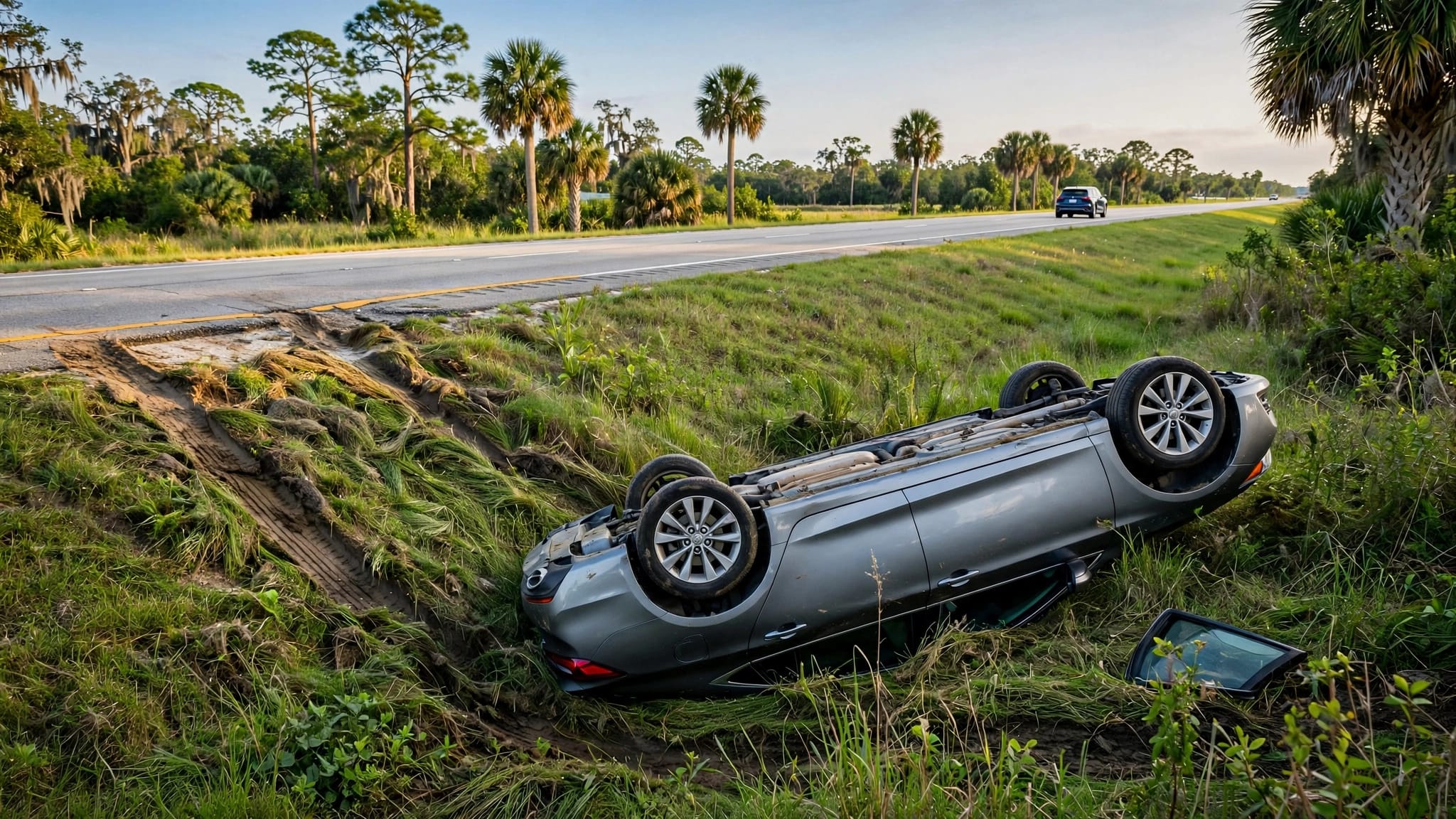
Another driver can cause your vehicle to roll without ever touching it. Florida rollover crash claims can proceed after an unsafe merge, lane departure, or passing maneuver forces you off the road.
However, insurers may describe the wreck as a single-vehicle accident and question your reaction. Your claim needs evidence of causation connecting the other driver’s conduct to the rollover and your injuries.
Start by separating what caused you to leave the pavement from what happened afterward.
Proving Florida Rollover Crash Claims Without Contact
An unsafe maneuver can establish negligence
Physical contact isn’t required to establish that another driver negligently caused your crash. A motorist who enters your lane or crosses the center line may create an immediate hazard that forces evasive action.
Florida’s careless-driving statute requires careful and prudent driving under the circumstances. However, proving negligence also requires connecting the unsafe conduct to the crash and resulting harm.
The investigation should establish each vehicle’s lane position, direction, and movement before you left the roadway. An independent witness who saw the other vehicle enter your lane can help explain why the rollover occurred.
Your response matters, but hindsight isn’t enough
Insurers may argue that you overcorrected, drove too fast, or could have braked instead of swerving. Those allegations require examination against the time and space available when the danger appeared.
Roadway photographs can show a narrow shoulder, steep embankment, drainage ditch, or curb that affected what happened after your evasive move. Meanwhile, footage may show how abruptly the other driver created the hazard.
Having the right of way doesn’t eliminate every shared-fault argument. Still, a broad claim that you “should have avoided it” doesn’t establish that your conduct caused the wreck.
Preserve Evidence Before the Vehicle Disappears
Document the roadway and identify witnesses
Call 911 after an injury crash and follow emergency responders’ instructions. Don’t enter traffic or approach unstable wreckage to collect evidence.
If conditions permit, photograph lane markings, tire tracks, debris, signs, shoulder conditions, and the vehicle’s final position. Include wide views that connect the roadway to the rollover location.
Get witnesses’ names and contact information. Ask whether they saw the other vehicle’s movement, rather than only the overturned car.
The Florida crash report process provides access to law enforcement records. Reports can identify witnesses and document observations, but they don’t decide civil liability. Check whether the report accurately records your account of the other vehicle.
Keep the vehicle and electronic evidence available
A totaled vehicle can contain evidence even when its resale value is minimal. Roof deformation, tire condition, restraint systems, and damage patterns may help explain the rollover and injury mechanisms.
Avard Law Offices’ discussion of roof crush evidence addresses why documenting the passenger compartment matters after a rollover.
Before authorizing disposal or repairs, ask counsel about inspection and preservation. Address storage charges promptly while arranging access to the vehicle.
Save original dashcam files rather than only edited clips. Nearby businesses may overwrite footage, and vehicle electronic data may require specialized retrieval. An attorney can send preservation requests to parties controlling relevant records.
How Florida’s Shared-Fault Rule Affects Recovery
Your percentage can reduce or bar damages
Florida uses modified comparative negligence in most current vehicle injury cases. If your fault is 50% or less, your share generally reduces recoverable damages.
A person found more than 50% responsible for their own harm generally cannot recover in a covered negligence action. Under that rule, a $100,000 damages finding reduced by 20% fault leaves $80,000 before other claim issues.
Avard Law Offices explains Florida’s modified comparative negligence rule and why disputed percentages deserve attention. An adjuster’s allocation isn’t a court finding, and you don’t have to accept it without examining its factual basis.
Challenge unsupported claims about your driving
An insurer may focus on speed, distraction, lane position, or delayed braking. Ask what evidence supports the allegation and how that conduct contributed to the crash.
Video and vehicle data may confirm or contradict an initial account. However, not every vehicle records every detail needed for reconstruction.
Be truthful in insurance communications and comply with your own policy’s notice and cooperation requirements. If you don’t know your exact speed or reaction time, don’t guess. Consider legal advice before giving the other driver’s insurer a detailed recorded statement.
Medical Care and Compensation After a Rollover
PIP benefits are separate from the fault dispute
Don’t wait for an insurer to accept liability before seeking treatment. A rollover can cause head, neck, spinal, and internal injuries that need prompt evaluation.
Florida’s PIP statute generally requires initial medical services within 14 days to qualify for benefits. Subject to statutory and policy terms, PIP pays 80% of qualifying medical expenses and 60% of covered lost income.
The combined medical and disability benefit limit is generally $10,000. Without a qualifying emergency medical condition determination, medical benefits may be limited to $2,500.
PIP payments don’t establish another driver’s fault. They also don’t automatically compensate you for every loss.
Serious injuries require medical proof
A liability claim may include medical expenses, future treatment, lost earnings, and reduced earning capacity. Keep bills, work restrictions, pay records, and documentation of ongoing limitations.
Pain-and-suffering damages in covered motor vehicle cases generally require an injury meeting Florida’s statutory injury threshold. Qualifying categories include significant permanent loss of an important bodily function, permanent injury within reasonable medical probability, significant permanent scarring or disfigurement, or death.
The rollover’s severity alone doesn’t establish permanence. Imaging, treatment records, and medical opinions must support the claimed injury and its connection to the crash. Tell providers about previous conditions accurately so they can distinguish new injuries or aggravation.
Finding Coverage When the Other Driver Leaves
When the motorist stops, obtain identifying and insurance information through safe, lawful channels. If the driver leaves, report the vehicle’s description, direction of travel, and any plate information you actually observed.
An unidentified driver creates additional proof and coverage questions. No-contact crashes need evidence showing that another vehicle caused the evasive maneuver. A vehicle description, witness account, or recording can help distinguish a forced-off-road crash from an unexplained loss of control.
Available uninsured or underinsured motorist coverage may provide an avenue for injury compensation when a responsible driver is unidentified, uninsured, or inadequately insured. However, coverage depends on the policy, applicable law, and proof of the claim.
Avard Law Offices’ guidance on Florida underinsured motorist claims explains why the other driver’s liability limits may not cover serious injuries.
Your own collision coverage may address vehicle damage, subject to policy terms and a deductible. PIP, collision coverage, and UM coverage protect against different losses; a payment under one doesn’t resolve every claim.
Protect Filing Deadlines During the Investigation
For many Florida negligence claims arising on or after March 24, 2023, the lawsuit deadline is generally two years. Florida’s limitations statute controls, but the applicable deadline can depend on the crash date, claim type, defendant, and other circumstances.
An open insurance claim or ongoing settlement talks don’t automatically extend the time to sue. Therefore, confirm the deadline while evidence collection and treatment continue.
Keep the 14-day PIP treatment requirement separate from lawsuit deadlines and policy notice requirements. Meeting one doesn’t satisfy the others.
Early legal review also helps identify what must be preserved before an insurer declares the vehicle a total loss. For Florida rollover crash claims, waiting until negotiations fail can leave little time to inspect wreckage, locate witnesses, or evaluate competing explanations.
Key Takeaways
- Another driver can cause a rollover without vehicle-to-vehicle contact, but you must prove the connection.
- Preserve roadway photographs, witness information, video, vehicle condition, and available electronic data promptly.
- Shared fault can reduce compensation, and fault above 50% generally bars recovery in covered negligence actions.
- Medical treatment, insurance notice, and lawsuit filing have separate timing requirements.
Frequently Asked Questions
Does a single-vehicle crash report prevent a claim?
No. A report describing only your vehicle doesn’t necessarily establish that you alone caused the rollover. Another vehicle may have created the hazard without making contact. Witness statements, footage, and physical evidence can support a different account. However, the claim still needs proof connecting that driver’s maneuver to your departure from the road.
Can I settle before doctors know my prognosis?
A settlement release can permanently close claims covered by its terms, even if treatment later becomes more expensive. Before accepting payment for injuries, review your diagnosis, expected treatment, work restrictions, and unresolved medical questions. Also confirm whether the proposed release affects other insurance claims. A vehicle-damage payment and an injury settlement may involve different documents.
What should I bring to a lawyer’s case evaluation?
Bring the crash report number, photographs, witness contacts, insurance declarations, claim correspondence, and available medical records. Include towing information and the location of the damaged vehicle. An attorney can then evaluate fault, coverage, preservation needs, and deadlines. You don’t need a complete investigation before seeking help, particularly when footage or wreckage may disappear.
Build the Claim Around Evidence
Florida rollover crash claims are strongest when the evidence explains both the dangerous maneuver and the injuries that followed. A single-vehicle label or unsupported blame percentage shouldn’t replace that investigation.
Protect your health, preserve the wreckage and recordings, and confirm the applicable deadlines. A case evaluation with Avard Law Offices can help identify the evidence and coverage issues that need attention before your claim moves forward.