
Florida Move Over Law: Claims After a Roadside Crash
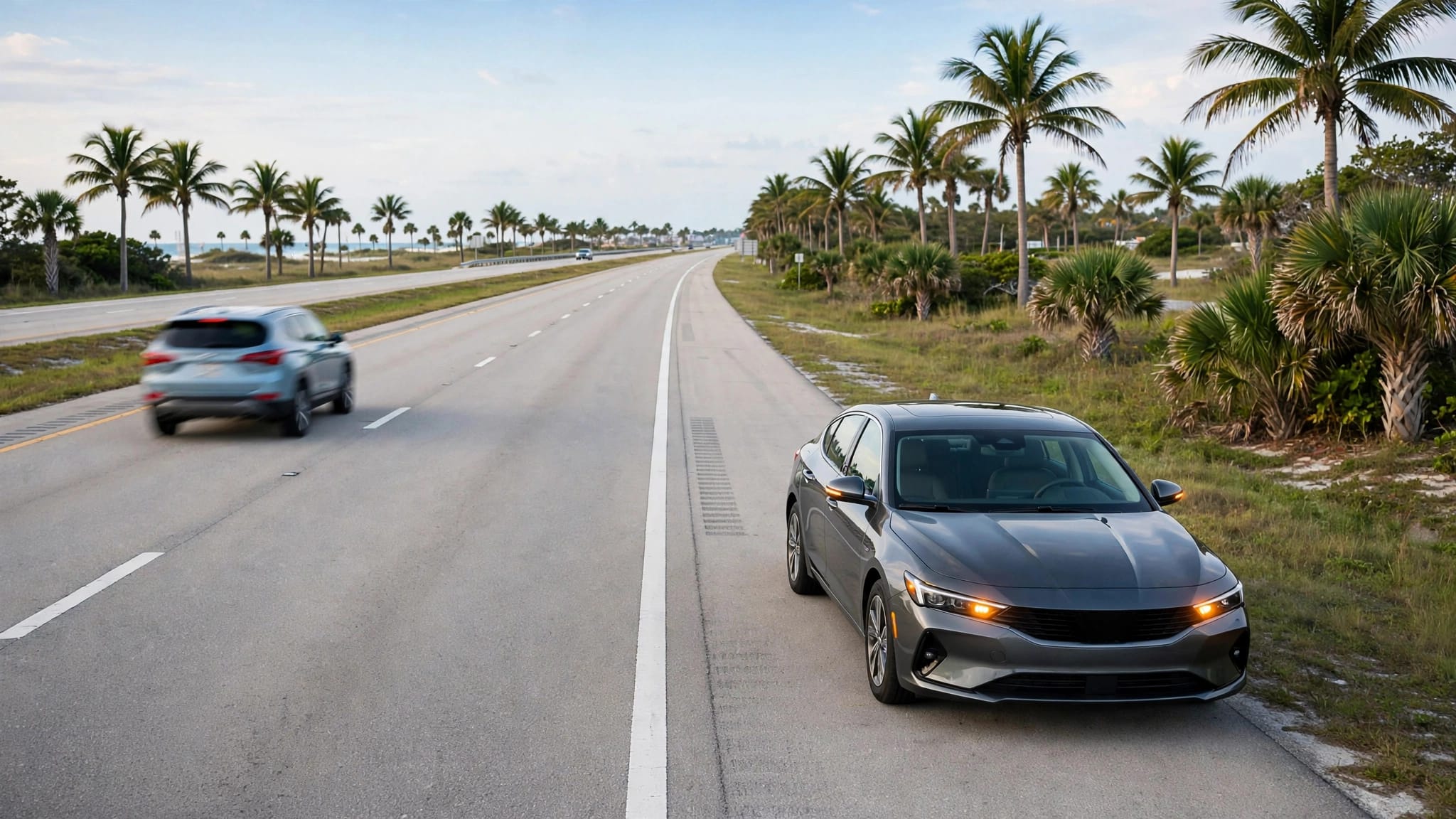
A driver who hits your stopped vehicle may have ignored a legal duty to give you space. The Florida Move Over Law can support your injury claim, but you still need evidence connecting the driver’s conduct to the collision.
Your claim may also involve an unsafe lane change if someone swerved toward you while passing a roadside vehicle. Start with safety and medical care, then preserve the facts that explain why the impact happened.
Key Takeaways
- Florida’s move-over requirements protect qualifying roadside vehicles, including disabled vehicles with warning signals or a person visibly present.
- A violation can support negligence, but compensation still depends on proof of fault, injuries, losses, and available coverage.
- Initial medical care within 14 days matters for PIP medical benefits. Preserving video and vehicle evidence promptly also protects your claim.
What the Florida Move Over Law Requires
Florida Statutes section 316.126 establishes duties for drivers approaching certain roadside vehicles. The required response depends on the roadway and whether a lane change is safe.
Which stopped vehicles qualify
The law covers authorized emergency vehicles displaying visual signals and qualifying tow trucks, sanitation vehicles, and utility service vehicles.
It also protects a disabled motor vehicle stopped roadside when it displays warning or hazard lights, uses emergency flares, posts emergency signage, or has someone visibly present. These are separate qualifying conditions. A stranded driver doesn’t need every warning device for the law to apply.
Under Florida’s roadside driving requirements, the vehicle’s location and qualifying circumstances matter. Evidence should establish those details before addressing the approaching driver’s response.
When drivers must change lanes or slow down
On roads with two or more lanes traveling in the same direction, drivers must vacate the lane nearest the stopped vehicle when safe.
If they can’t safely move over, they must slow down. On a two-lane road, the law also requires reduced speed.
When the posted limit is at least 25 mph, the required reduction is 20 mph below that limit. Where the limit is 20 mph or less, drivers must travel at 5 mph. For example, a 55-mph limit requires slowing to 35 mph when the reduced-speed requirement applies.
These duties apply unless a law enforcement officer directs otherwise.
How a Move-Over Violation Supports Your Claim
An injury claim needs evidence of a duty, a breach, causation, and damages. A traffic violation can help establish unsafe conduct, but it doesn’t automatically prove every part of the case.
When a driver strikes your roadside vehicle
Evidence should show why your vehicle was stopped, its position, the warning conditions, and the approaching driver’s actions.
Visibility also matters. Investigators may examine lighting, weather, sight distance, traffic, and whether the driver had room to change lanes safely.
If moving over wasn’t safe, the investigation should address whether the driver reduced speed. Claiming that another lane was occupied doesn’t eliminate the statutory slowing requirement.
When a driver moves over into your lane
The law requires a safe lane change. It doesn’t authorize someone to cut across your path or sideswipe your vehicle.
A driver who abruptly merges while passing a stopped vehicle may face liability for an unsafe maneuver. Your claim should identify lane positions, available space, signals, and the impact sequence.
Our guidance on Florida sideswipe accident claims addresses evidence that can resolve disputes about merging and blind spots.
Preserve Evidence of the Roadside Conditions
Call 911 after an injury crash and follow emergency responders’ instructions. Don’t enter moving traffic or approach unstable wreckage to collect photographs.
Document warnings, positions, and witnesses
When conditions permit, photograph the shoulder, lane markings, signs, debris, tire marks, and each vehicle’s final position. Include wide views showing the roadway and close photographs of damage.
Capture hazard lights, flares, emergency signs, or other visible warnings. Witnesses may also establish whether someone stood near the disabled vehicle before impact.
Get witnesses’ names and contact information. Ask whether they saw the approaching driver’s movement, rather than only the crash aftermath.
A traffic crash report may identify witnesses and document an officer’s observations. The state’s crash report access information explains how reports are available through its crash portal.
Protect recordings and damaged vehicles
Save original dashcam files and photographs with their date information intact. Nearby camera recordings may disappear through routine overwriting, so prompt preservation matters.
A damaged vehicle can retain evidence after an insurer declares it a total loss. Contact points, paint transfer, wheel damage, and crushed panels may help explain the impact.
Some vehicles also store event data, including speed, braking, or throttle activity. Available information varies by vehicle and collision.
An attorney can seek preservation of vehicles, recordings, and electronic records before repairs or disposal remove useful evidence.
Medical Care and PIP Benefits After the Crash
A liability investigation shouldn’t delay treatment. Prompt care supports your health and creates a record connecting your symptoms to the collision.
Initial treatment must begin within 14 days
Florida generally requires initial services and care within 14 days after the crash for PIP medical-benefit eligibility. This is a deadline to begin qualifying care, not to finish treatment.
Tell providers how the collision occurred and describe all symptoms, including dizziness, headaches, numbness, or restricted movement. Also explain prior injuries so records distinguish earlier problems from crash-related changes.
Keep discharge papers, imaging results, prescriptions, therapy records, and work restrictions. These documents help establish both your treatment needs and the effects on daily life.
PIP pays specified losses regardless of fault
Personal Injury Protection generally pays 80% of eligible medical expenses and 60% of eligible lost income, subject to statutory conditions and policy limits.
The Florida insurance requirements describe medical coverage of up to $10,000. However, without a qualifying emergency medical condition determination, PIP medical benefits are generally limited to $2,500.
Deductibles and other coverage terms can affect payment. PIP also doesn’t pay for vehicle repairs or pain and suffering.
Because these benefits don’t decide liability, receiving PIP payments doesn’t establish who caused the crash. A separate claim may address losses beyond available no-fault benefits.
Compensation Beyond No-Fault Benefits
A claim against a responsible driver may seek unpaid medical expenses, future treatment costs, lost earnings, and reduced earning capacity. Vehicle damage involves separate property-damage or collision coverage.
For each loss, keep supporting records. Medical bills establish charges, while work restrictions and income documents help explain employment losses. Future care requires medical support rather than an unsupported estimate.
Florida limits pain-and-suffering recovery in covered motor vehicle cases. Its motor vehicle injury threshold includes permanent injury within a reasonable degree of medical probability, significant and permanent loss of an important bodily function, or significant and permanent scarring or disfigurement.
Available insurance also affects recovery. The investigation may involve the driver’s bodily injury coverage, applicable uninsured or underinsured motorist coverage, or commercial policies.
If the driver was working, employment and vehicle-use records may help identify additional responsible parties. Company ownership alone doesn’t settle liability.
Shared Fault Can Reduce or Block Recovery
An insurer may argue that your vehicle extended into traffic, lacked visible warnings, or stopped where approaching drivers couldn’t see it. If you were moving, it may allege speeding or an unsafe lane change.
Those allegations require evidence connecting your conduct to the harm. A claim should address the actual roadside conditions and vehicle movements.
Under Florida’s comparative-fault statute, your share of fault reduces recoverable damages in a covered negligence action. A finding of more than 50% fault bars recovery. Exactly 50% doesn’t trigger that bar, although it reduces damages by half.
A traffic citation and an insurer’s blame percentage answer different questions. Neither automatically decides civil liability.
Our discussion of Florida comparative negligence explains how shared-fault disputes can affect an injury claim.
Filing Deadlines and When Legal Help Matters
For most Florida negligence claims arising after March 24, 2023, the general lawsuit filing period is two years. Different defendants, claim types, and circumstances can affect the applicable deadline.
An open insurance claim doesn’t itself extend the lawsuit deadline. Settlement discussions can continue while the time to file runs out.
Legal help is especially useful when injuries require ongoing care, fault is disputed, a commercial vehicle is involved, or several drivers contributed to the collision. These cases may require records beyond the crash report, including onboard video, dispatch communications, or electronic vehicle data.
Bring available photographs, witness contacts, insurance declarations, medical records, claim correspondence, and the damaged vehicle’s location to a consultation. You don’t need a complete evidence file before seeking help.
At Avard Law Offices, our attorneys handle Florida car accident claims, and we offer free consultations.
Frequently Asked Questions
Can I pursue a claim if the driver wasn’t ticketed?
Yes. The absence of a citation doesn’t establish that the driver acted safely. Video, witnesses, damage patterns, and vehicle data may support negligence even when an officer didn’t issue a ticket. The claim still needs proof connecting that conduct to your injuries and losses.
What if police didn’t prepare a crash report?
A missing report doesn’t automatically defeat your claim, although required reporting obligations still matter. Photos, medical records, witness accounts, and recordings can provide other proof. Our guidance on claims without a police report addresses how to build that evidence.
Does using hazard lights guarantee compensation?
Hazard lights can establish a qualifying warning condition for a disabled roadside vehicle, but they don’t guarantee payment. Your claim must also establish negligent driving, causation, damages, and available coverage. The vehicle’s position, visibility, and the approaching driver’s opportunity to respond remain important.
Build Your Claim Around the Crash Evidence
The Florida Move Over Law can establish an important duty when a driver strikes your roadside vehicle. A strong claim connects that duty to the driver’s actions and your documented losses.
Prioritize medical care and evidence preservation before recordings disappear or vehicles are repaired. Those steps protect your ability to address fault disputes and pursue compensation supported by the facts.