
Florida Wide-Turn Truck Claims: Proving Lane Intrusion
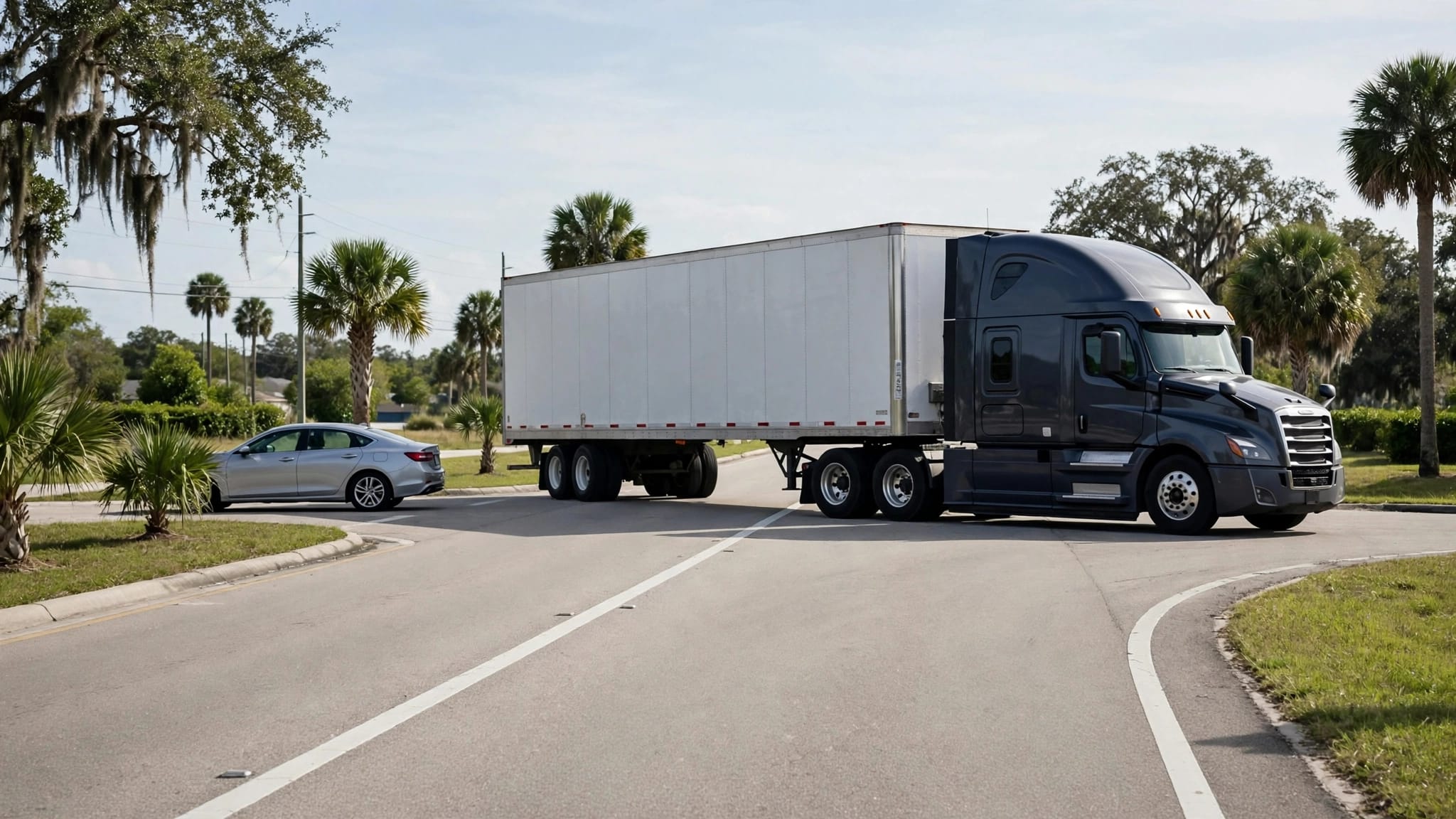
To prove a wide-turn truck accident claim in Florida, connect the trailer’s movement to your lane position, the impact, and your injuries. Photographs, original video, roadway measurements, and vehicle damage can establish that sequence more clearly than either driver’s account alone.
A tractor can clear your car while its trailer cuts across your lane or swings into it. The investigation starts by identifying which part of the trailer crossed the lane boundary, then preserving evidence of that movement.
Key Takeaways
- Document lane markings, vehicle positions, and damage when it’s safe, without entering traffic.
- Preserve original recordings and arrange vehicle inspections before repairs or salvage change the evidence.
- Electronic driving logs and crash-event data answer different questions; neither necessarily records the trailer’s precise path.
- Florida’s shared-fault rules can affect recovery, and insurance negotiations don’t automatically extend the lawsuit deadline.
How a Turning Trailer Can Enter Your Lane
A tractor-trailer doesn’t follow one continuous tire path through a turn. The tractor, trailer wheels, and trailer rear can move along different paths. Identifying the movement matters because similar-looking collisions can involve different driving errors.
The trailer wheels cut inside the tractor’s path
During a turn, the trailer’s rear wheels generally follow a tighter curve than the tractor’s front wheels. This movement, called offtracking, can bring the trailer across a neighboring lane or over a curb.
A driver must account for that geometry before starting the maneuver. Evidence should show the tractor’s approach, the trailer’s position, and where your vehicle traveled before contact.
The truck’s turn signal may help establish timing. However, a signal doesn’t establish that the driver had enough clearance to complete the turn safely.
The trailer’s rear swings outward
The portion behind the trailer’s rear wheels can swing outward as the truck turns. That movement can strike a vehicle beside the trailer even while the tractor moves away.
An investigation should distinguish rear-corner contact from contact near the wheels or farther forward along the trailer. Photographs of the trailer’s damage, its dimensions, and the roadway can help explain which movement occurred.
Describing the truck as “turning wide” leaves these separate mechanics unresolved.
Evidence That Shows the Trailer Crossed Your Lane
The strongest proof connects your vehicle’s location with the trailer’s path at the same moment. A photograph taken after responders move the vehicles may show damage, but it may not establish their positions at impact.
Match roadway evidence with vehicle damage
When conditions permit, photograph lane boundaries, turn arrows, curbs, debris, tire marks, and pavement gouges. Include wide views that connect those details to the intersection or driveway.
Then document each vehicle from several angles. Close photographs should capture paint transfer, scrape direction, crushed panels, mirrors, wheels, and trailer contact points.
A reconstruction specialist may compare those details with lane widths, trailer dimensions, and turning geometry. Final resting positions also matter, although vehicles can move substantially after contact.
Our discussion of lane-position evidence in sideswipe claims addresses similar disputes about which vehicle moved across a lane boundary.
Preserve the approach, not only the collision
Video showing several seconds before impact may establish whether you were already alongside the truck, stopped in traffic, or approaching an opening.
Save the original dashcam file rather than only a cropped clip or screenshot. Nearby businesses, residences, and other vehicles may also have recordings, so prompt preservation requests matter.
Witnesses can fill gaps outside a camera’s view. Record their contact information and what they actually observed. Someone who watched the trailer move across a lane offers different evidence than someone who heard the impact and turned around.
Camera angle, blocked views, and uncertain timestamps still require careful interpretation.
Preserve Trucking Records Before They Disappear
The carrier may control the truck, trailer, onboard cameras, and electronic records. Meanwhile, repairs, routine data overwriting, and salvage handling can remove evidence before the injury claim develops.
Separate driving logs from crash-event data
An electronic logging device, or ELD, primarily documents driving time and duty status. It generally doesn’t provide a frame-by-frame record of the trailer’s lane position.
Depending on the equipment and event, engine or crash-event data may record speed, braking, or throttle activity. GPS and telematics records may help establish route and timing, but their precision varies.
The FMCSA’s ELD retention guidance requires carriers to retain ELD records of duty status and supporting documents for six months.
That six-month requirement doesn’t mean a carrier must keep every camera recording or electronic record for the same period.
Direct preservation requests to the right parties
An attorney can send preservation notices identifying the crash, vehicles, and records that need protection. Relevant material may include onboard video, dispatch messages, inspection records, maintenance history, and available electronic data.
A notice may also seek preservation of the tractor and trailer for inspection before repairs change their condition. Your own vehicle deserves the same attention, even after an insurer declares it a total loss.
Our guidance on trucking-company records in injury claims explains why driver qualification and employment records may also matter.
A missing recording alone doesn’t prove intentional destruction.
Florida Turning Duties and Shared-Fault Arguments
Proving lane intrusion is central, but liability also depends on the driver’s conduct, your conduct, and the circumstances surrounding the turn.
The turning rule accounts for practical conditions
Section 316.151, within Florida’s traffic-control statutes, generally requires drivers approaching and making a right turn to stay as close as practicable to the right-hand curb or roadway edge. Official traffic-control devices may direct a different course.
For a truck crash, the investigation should examine lane-use markings, available clearance, the approach, and whether the driver could complete the maneuver safely.
The truck’s size explains why turning geometry matters. It doesn’t answer whether the driver used reasonable care in the actual circumstances.
Fault percentages must rest on evidence
An insurer may argue that you passed on the right, entered a visible turning gap, drove too fast, or failed to react.
Those allegations require a timeline. Video may show that you were already stopped beside the trailer before it moved. Other evidence may show that you approached while the turn was underway.
Under Florida’s comparative-fault law, fault reduces damages proportionately in covered negligence claims. A claimant found more than 50 percent responsible generally cannot recover.
An adjuster’s proposed percentage isn’t a court finding. Evidence of both vehicles’ movements remains essential.
Connect the Turn to the Responsible Parties and Your Injuries
A truck driver may face liability for an unsafe maneuver. The motor carrier may also bear responsibility under applicable employment principles or for its own negligent conduct.
However, every company connected to the shipment isn’t automatically liable. A claim against a maintenance contractor, for example, needs evidence connecting its work or failure to the collision. Ownership, dispatch arrangements, employment records, and vehicle condition can help identify the proper defendants.
The injury claim also needs proof of causation and losses. Seek prompt medical care and describe your symptoms accurately, including when they began. Keep treatment records, bills, work restrictions, and documentation of missed income.
Medical records can help distinguish new injuries from aggravation of an existing condition. Future treatment or earning limitations may require medical or vocational support.
Compensation may include medical expenses, lost earnings, property damage, and pain and suffering when Florida law permits recovery. The trailer’s lane intrusion establishes only part of that claim; the evidence must also connect the crash to the losses requested.
The Filing Deadline Continues During Negotiations
For many Florida negligence claims accruing after March 24, 2023, the general lawsuit filing period is two years under Florida Statutes section 95.11.
Older claims, different legal theories, government defendants, and statutory exceptions can require a different deadline analysis. An open insurance claim doesn’t preserve the right to sue, and settlement discussions don’t automatically stop the clock.
Evidence can disappear much sooner than the filing period expires. Early legal review allows time to identify defendants, preserve records, inspect vehicles, and prepare a lawsuit if negotiations don’t resolve the claim.
Waiting for a final medical prognosis before addressing preservation can leave important factual questions unanswered.
Frequently Asked Questions
Does a “wide turns” sign on the trailer defeat my claim?
A warning sign can be relevant to what drivers could see, but it doesn’t decide liability. The investigation still must establish the truck’s path, your position, the available clearance, and each driver’s conduct. A sign alone doesn’t prove that you caused the collision or that the truck driver used reasonable care.
Can I pursue a claim if the police report blames me?
Yes. A report may identify witnesses and record useful observations, but it doesn’t decide civil liability. Compare its lane descriptions and diagram with original footage, physical evidence, and witness accounts. An officer who arrived afterward may not have observed the turning movement that caused the crash.
What should I bring to an attorney evaluation?
Bring the report or report number, original photographs and video, witness contacts, insurance correspondence, and available medical records. Include towing information and the locations of your vehicle and the trailer, if known. Repair estimates, work restrictions, and any settlement offer also help. You don’t need a complete evidence file before seeking legal help.
Build the Claim Around the Trailer’s Actual Path
A Florida wide-turn truck accident claim needs a clear account of where the trailer traveled and how that movement caused injury. Prompt preservation gives photographs, recordings, vehicle inspections, and trucking records a better chance to answer those questions.
We offer free case evaluations at Avard Law Offices for people seeking help with Florida injury claims. Bring the evidence you have so we can discuss the liability, preservation, and deadline issues affecting your claim.