
Florida Parking Lot Accidents: Proving Right of Way
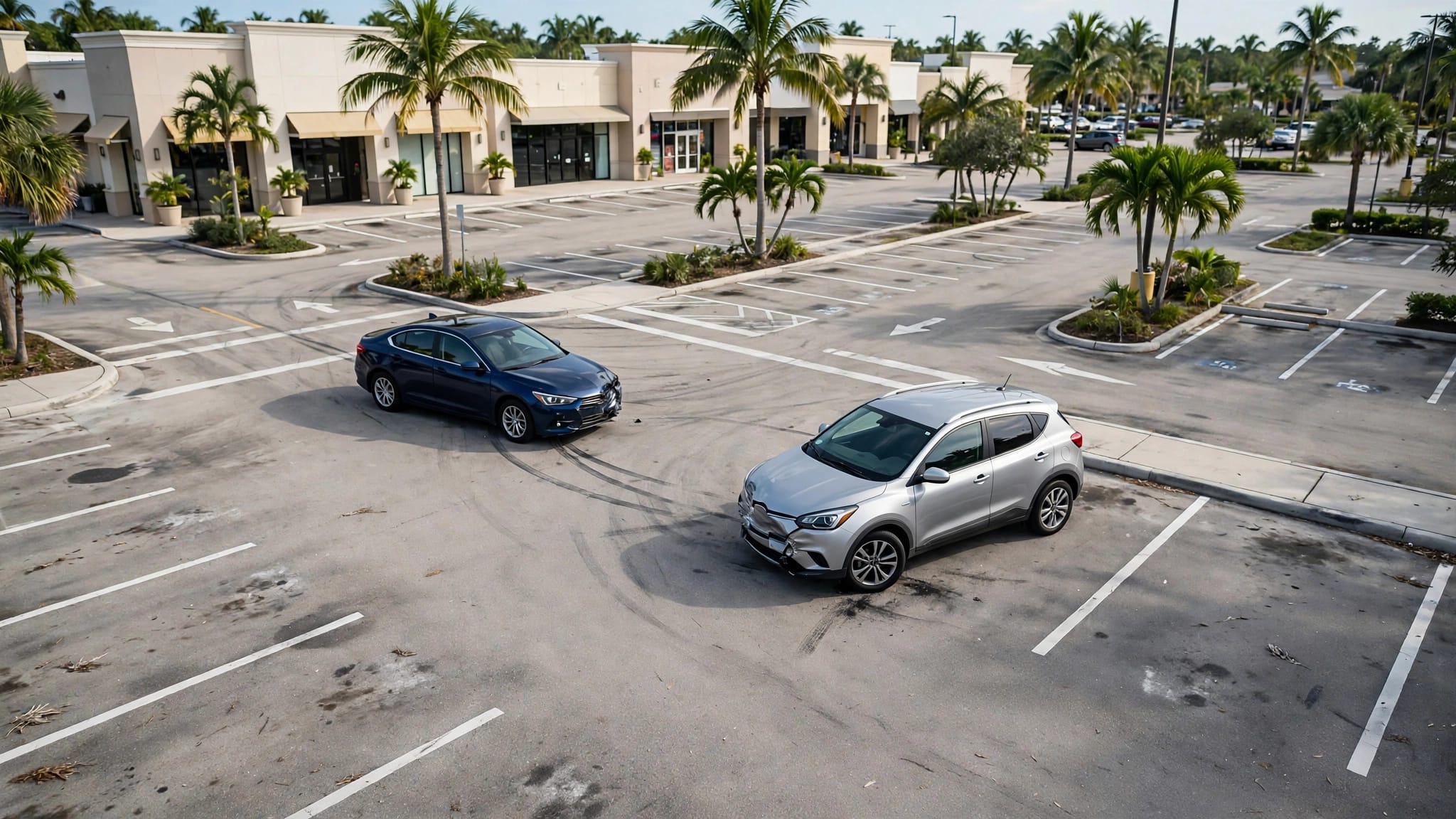
The other driver says you should have stopped, but you were already traveling through the parking aisle. In Florida parking lot accidents, proving who had priority requires more than competing accounts of what happened.
Signs, vehicle movements, visibility, and the collision timeline can determine responsibility. Private property also creates legal distinctions that don’t arise in an ordinary street intersection.
Start by separating the right-of-way question from the evidence needed to support your injury claim.
Key Takeaways
- Parking-lot fault depends on the layout, signs, visibility, and each driver’s conduct, rather than an automatic rule assigning blame.
- Preserve photographs, original recordings, witness information, and vehicle damage before evidence disappears.
- Shared fault can reduce compensation or bar recovery in covered negligence actions. Medical care, reporting duties, and filing deadlines remain separate concerns.
Understanding Right of Way in Florida Parking Lot Accidents
Private parking aisles require a fact-specific analysis
An ordinary private parking lot doesn’t automatically follow every rule that applies to public-road intersections. Whether a traffic provision applies depends on the location and the provision itself.
A claim still requires proof that a driver failed to use reasonable care and caused harm. Investigators examine who occupied the aisle, who entered it, and whether either driver could see approaching traffic.
Distinguish an internal-lot collision from a crash at the street exit. Rules governing entry onto a highway don’t establish priority between every pair of parking aisles.
Signs and movements help establish priority
Stop signs, directional arrows, and marked travel paths help explain what each driver should have done. However, a sign alone doesn’t resolve every civil fault dispute.
Photograph the sign from the approaching driver’s viewpoint. A close-up won’t show whether a truck, tree, or poorly placed sign blocked the view.
The movement sequence also matters. A driver entering an occupied aisle may have failed to wait for passing traffic. Meanwhile, the approaching driver’s speed or distraction may contribute to the collision.
Your evidence should explain both drivers’ actions before impact, rather than simply identify which vehicle struck the other.
Backing Out and Crossing Aisles: Common Fault Disputes
When one vehicle reverses into moving traffic
A driver reversing from a space must account for vehicles and people behind the car. Mirrors, blind spots, parked vehicles, and the driver’s ability to stop all matter.
However, reversing doesn’t automatically establish complete responsibility. The investigation should determine whether the other vehicle was already approaching or entered the area after reversing began.
A stopped vehicle presents another issue: did the backing driver continue moving into it? Video and independent witnesses can help answer that question.
Avard Law Offices’ guidance on Florida backing-up accident claims addresses the evidence needed when drivers disagree about a reverse collision.
When both vehicles move or cross an aisle
Two drivers backing from opposite spaces may each bear responsibility. There is no automatic requirement to divide fault equally.
The sequence matters. One driver may have stopped before impact, while the other continued reversing. Damage locations and recordings can help distinguish those movements.
Similarly, an aisle-crossing collision requires a close look at lane direction, signs, and sight lines. A wider aisle may indicate the intended traffic flow, but width alone doesn’t establish a universal statutory priority rule.
Document whether either driver cut across empty parking spaces. That route can affect what the other driver could reasonably see or anticipate.
Evidence That Can Prove Who Should Have Yielded
Photograph the layout and physical damage
If it’s safe, take wide photographs before vehicles move. Include parking rows, travel lanes, arrows, stop signs, crosswalks, and obstructions.
Then photograph each vehicle’s damage, license plate, and position relative to marked spaces. Capture debris and tire marks where present.
Timing matters because a later photograph may show a different scene. Delivery trucks leave, lighting changes, and damaged vehicles move.
Repair estimates and inspection records can supplement photographs. However, interpreting vehicle damage may require professional analysis when both drivers dispute the movement sequence.
A contact point identifies where vehicles met. Establishing who should have yielded requires evidence about their positions and movements before contact.
Preserve recordings and independent accounts
Ask nearby businesses whether cameras cover the aisle, entrance, or parking row. Request preservation promptly because recording systems may overwrite footage.
Keep original dashcam files, including the moments before and after impact. An edited clip may omit the approach or create questions about context.
Also collect witnesses’ names and contact information. Ask what they observed, without suggesting an answer or pressing them to estimate speed.
Vehicle electronic data may help, but availability depends on the vehicle and event. Don’t assume a backup camera saved a recording.
Avard Law Offices explains how parking lot accident evidence can support a claim. An attorney can also request preservation of records held by businesses, drivers, or insurers.
Police Reports Help, but Don’t Decide Civil Fault
Call law enforcement after an injury crash and provide accurate information. Certain collisions trigger reporting duties even when they occur away from a typical roadway.
If an officer prepares a report, obtain it and check the identifying details, diagram, and recorded accounts. The state’s crash-report information from FLHSMV explains how to request available records.
A report can help an investigation, but it doesn’t conclusively determine civil responsibility. Its significance depends on the facts and applicable evidence rules.
Likewise, an officer’s absence doesn’t automatically defeat a claim. Photographs, witnesses, recordings, repair documents, and medical records may establish what happened.
The process for filing without a police report differs from satisfying reporting duties. If law enforcement doesn’t investigate, determine whether you must submit a written crash report. When required, that submission may carry a 10-day deadline.
How Shared Fault Changes Your Potential Recovery
Having priority doesn’t prevent an insurer from questioning your driving. It may allege that you sped, looked at a phone, failed to brake, or drove against posted arrows.
Each allegation needs evidence connecting your conduct to the collision. Ask which photographs, recordings, observations, or vehicle records support the proposed allocation.
Under Florida’s comparative-fault statute, your responsibility generally reduces damages in a covered negligence action. A finding of more than 50% fault generally bars recovery in that action. Exactly 50% doesn’t exceed the threshold.
For example, a 20% fault finding generally reduces $100,000 in established damages to $80,000 before other claim issues.
An adjuster’s proposed percentage is not a court finding. You can challenge it with evidence rather than accept an unsupported assessment.
Stay factual during claim communications. If you don’t know your speed, distance, or reaction time, say so. Guessing can create a contradiction when later evidence becomes available.
Medical Care and Loss Records Support a Separate Part of the Claim
You don’t have to resolve the right-of-way dispute before seeking treatment. Prompt care protects your health and creates records of your symptoms after the collision.
Florida’s personal injury protection requirements generally require initial medical services within 14 days for qualifying PIP benefits. Eligibility and payment also depend on statutory and policy requirements.
PIP benefits are separate from proving another driver’s liability. They generally cover limited qualifying medical expenses and lost income, rather than pain and suffering.
For a liability claim, preserve treatment records, bills, work restrictions, and documentation of missed earnings. Future treatment should have medical support rather than an early guess.
Pain and suffering claims against another driver may depend on Florida’s motor-vehicle injury threshold. An attorney can evaluate that requirement alongside fault and available coverage.
Low-speed Florida parking lot accidents can still produce disputed injury claims. Vehicle damage alone doesn’t establish the full extent of an injury. Medical findings and the treatment timeline need their own review.
Protect the Filing Deadline While Evidence Is Reviewed
For many recent Florida negligence claims, the general lawsuit filing period is two years. The correct deadline depends on the crash date, claim type, defendant, and applicable exceptions.
An open insurance claim doesn’t automatically extend that period. Settlement discussions and requests for records don’t automatically stop the filing clock either.
Keep reporting obligations, the PIP treatment window, and the lawsuit deadline on separate calendars. Meeting one doesn’t satisfy the others.
An attorney can review deadlines while seeking footage, identifying coverage, and examining disputed fault. Claims involving a public entity may require additional procedures.
Before repairs or disposal, document the vehicle and ask whether an inspection is necessary. At the same time, address towing and storage charges promptly. Preserving evidence shouldn’t mean allowing avoidable expenses to accumulate while everyone waits.
Frequently Asked Questions
Do I have to give the other driver’s insurer a recorded statement?
You don’t ordinarily have to provide a recorded statement solely because the other driver’s insurer requests one. Consider legal advice before giving a detailed account, especially when responsibility is disputed.
Your own insurance policy may impose notice and cooperation duties, so distinguish the two insurers’ requests. In any statement, describe only what you remember firsthand. Don’t adopt an adjuster’s estimate of speed, distance, or reaction time when you don’t know whether it is accurate.
Should I accept a settlement while right of way is disputed?
Review both the proposed fault percentage and the losses included before accepting. A settlement may reflect incomplete evidence, unresolved treatment needs, or an allocation of blame you can challenge.
Also examine the release. Signing it can end claims covered by its terms, even if additional evidence or medical expenses emerge later.
An attorney can assess the available proof, insurance coverage, and release language. That review helps you understand what the payment resolves and which rights you would give up.
Build Your Claim Around the Collision Evidence
A parking-lot right-of-way dispute is strongest when the layout, movement timeline, and physical evidence support the same account. An unsupported accusation shouldn’t determine your share of responsibility.
Preserve evidence early, obtain medical care, and protect the applicable deadlines while the claim develops.
If fault or compensation remains disputed, contact Avard Law Offices for a free case evaluation. Bring your photographs, insurance correspondence, report information, and treatment records so an attorney can review the claim.