
Florida DoorDash Driver Crash Claims: App Status and Insurance Proof
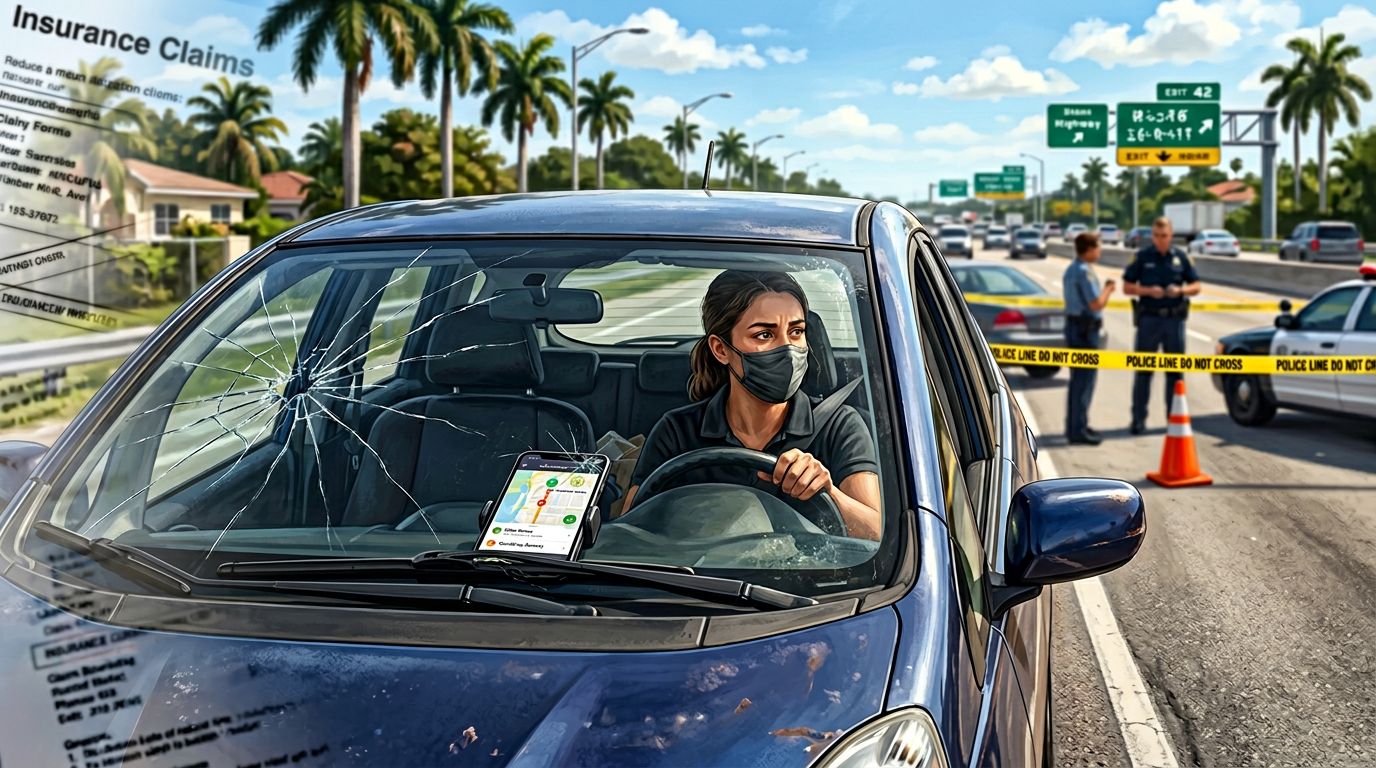
A DoorDash crash can turn into a coverage fight fast. The first question is usually not who hit whom, it is what the app showed at the moment of impact.
That detail can change which policy pays first, which insurer pushes back, and whether the claim is treated like an ordinary car wreck or a business-use crash. For people dealing with DoorDash accident claims in Florida, the paper trail matters as much as the damage to the cars.
Why app status decides the first insurance answer
As of May 2026, DoorDash says its insurance changes with the driver’s app status. That matters because a driver can move through different coverage layers in a few minutes, and each one can lead to a different claim path. You can see DoorDash’s own explanation on its insurance coverage page.
Here is the basic breakdown.
| App status | What the driver is doing | Main coverage question |
|---|---|---|
| App off | Not working for DoorDash | Personal auto insurance and Florida PIP usually come first |
| App on, waiting | Logged in, no order accepted yet | Personal insurer may deny a business-use claim |
| Order accepted, heading to pick up | Delivery has started | DoorDash’s extra liability layer may begin after personal coverage responds |
| Food in car, heading to drop-off | Active delivery | DoorDash says its liability coverage can reach up to $1 million for third-party claims |
That table is the heart of the case. A driver who was not yet on an active delivery may be left with a personal policy dispute. A driver on an active run may bring DoorDash’s added liability coverage into the picture.
The app screen at impact can matter as much as the police report.
That is why a DoorDash crash often looks a lot like a Florida company vehicle accident claims case. The insurer wants to know whether the car was being used for business, and the answer changes the file.
Evidence that proves a DoorDash driver was working
App status is easy to argue and hard to prove if the proof disappears. The best evidence is the kind that shows time, place, and activity, not guesses or memory after a stressful crash.
Start with screenshots. If you can safely do it, capture the app screen, the order screen, the trip status, and anything that shows the driver was logged in. Save the time stamp, because a picture without timing can leave too much room for dispute.
Then gather the rest of the digital trail:
- App screenshots showing the order was accepted or active.
- Text messages with the driver, customer, or restaurant.
- Dashcam footage, if anyone has it.
- Photos of the vehicles, road, and crash scene.
- Witness names and phone numbers.
- Tow records, repair estimates, and vehicle damage photos.
- A written denial from the driver’s personal insurer, if one is issued.
The same kind of electronic proof that helps in Florida Amazon delivery van crash claims can help here. Route data, timestamps, and app records often tell the story better than anyone’s memory.
If the claim is contested, early records matter even more. A driver may log out, delete app history, or claim they were not delivering. Once that happens, the dispute can move from the crash scene to the records room.
For a clean claim file, the habits in Florida head-on collision proof checklist still apply, photos, witness names, medical records, and a clear timeline. Those details make it harder for an insurer to blur the facts.
How Florida no-fault rules fit with DoorDash claims
Florida still uses no-fault rules for most car crashes, so Personal Injury Protection, or PIP, often pays first. For a fuller look at the medical side, see who pays medical bills after Florida car accident.
PIP usually pays part of medical bills and lost wages, up to the policy limit. In many cases, treatment also has to start within 14 days of the crash. If that deadline is missed, the PIP claim can get harder fast.
That matters in DoorDash crashes because app status does not erase Florida no-fault rules. Even if DoorDash coverage may apply later, the injured person often starts with PIP first. If the injury is serious enough, the claim may then move to the at-fault driver’s liability coverage or to DoorDash’s commercial layer, depending on what the app shows.
DoorDash’s own insurance maintained for drivers page says the company provides extra liability coverage during active deliveries. It also shows why personal insurance still matters. Florida drivers need their own policy, and many personal policies will not cover delivery work the same way a family errand would.
That creates a common gap. The app is on, the driver is waiting, and the personal carrier says the car was being used for business. In that moment, the claim can stall unless the records show exactly what the driver was doing.
If the injured person was the DoorDash driver, the coverage picture is different. DoorDash’s liability policy is mainly for third-party injuries and damage. It is not a simple answer for the driver’s own car damage or pain and lost wages. Another option may be the driver’s own PIP, collision coverage, or uninsured motorist coverage, depending on the facts.
For driver injury questions, DoorDash also publishes an occupational accident FAQ. That page can help drivers sort through separate benefit questions.
Common mistakes that slow Florida DoorDash crash claims
Most claim problems come from missing proof, not missing outrage. The insurance companies are less interested in how bad the crash felt and more interested in what can be verified.
One mistake is waiting too long to get medical care. In Florida, that 14-day PIP window matters. If you feel pain later, the delay can still hurt the claim.
Another mistake is giving a recorded statement before the app status is clear. A simple answer like “I was driving for work” can trigger a business-use review, and the insurer may dig for reasons to narrow coverage. If the claim involves delivery work, the paperwork should be lined up first.
A third mistake is fixing the car before the photos, tow notes, and repair estimates are saved. Once the vehicle is repaired, some of the best physical proof is gone. That is a hard loss in a claim where the app status is already under dispute.
The final mistake is assuming one policy will cover everything. Florida no-fault, personal auto coverage, DoorDash’s liability layer, and any other driver’s insurance can all play a part. A claim that starts with the wrong policy can waste time and weaken the file.
When a crash happens, the best move is simple. Lock down the proof, save the app records, and keep the medical timeline clean. That gives the claim a real foundation.
Conclusion
DoorDash crash claims in Florida turn on one main issue, app status. If the driver was off the app, the case usually starts with personal insurance and Florida no-fault rules. If the driver was on an active delivery, DoorDash’s added liability coverage may come into play.
The strongest claims are the ones backed by screenshots, timestamps, witness names, and prompt medical care. Those records show what the app said, what the driver was doing, and which policy should answer first.
When the first question is answered clearly, the rest of the claim gets easier to sort.