
Florida Box Truck Accident Claims: Proof You Weren’t at Fault
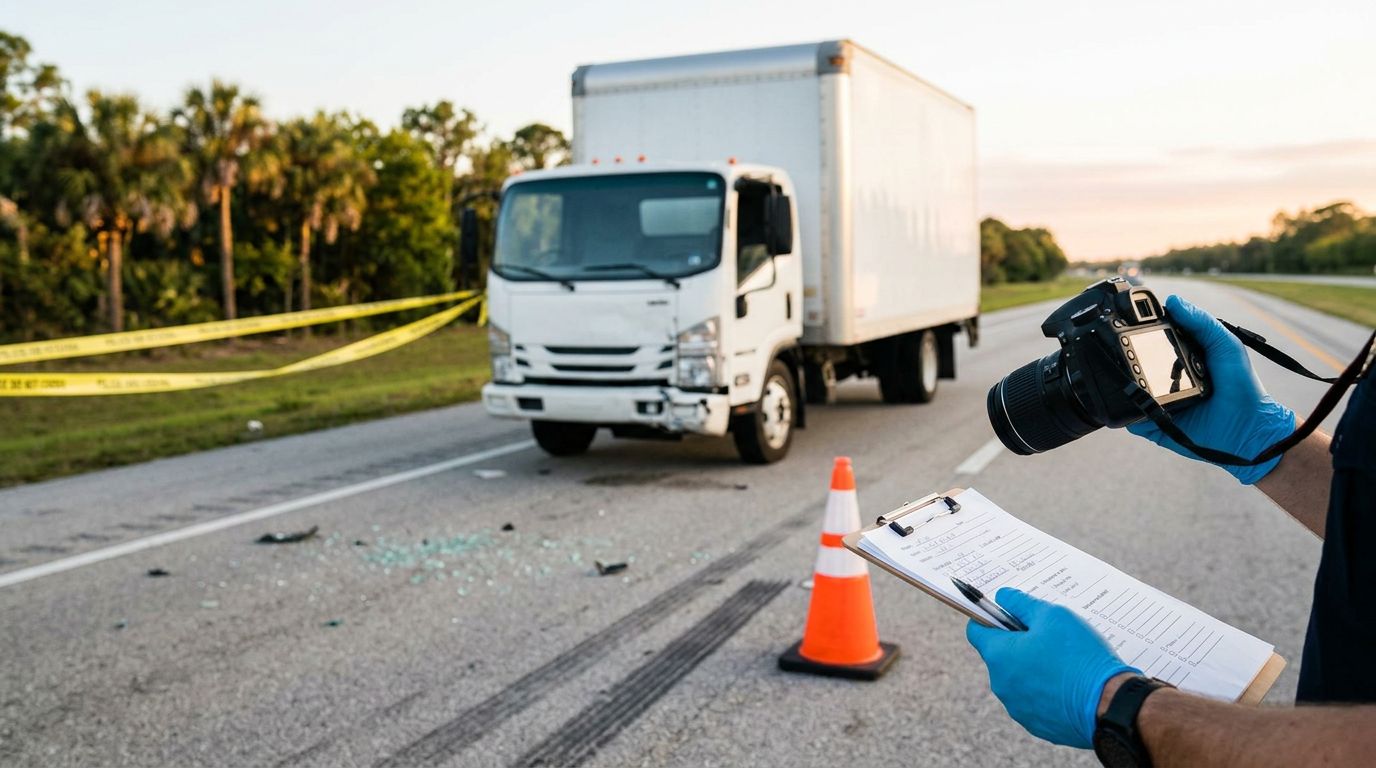
The crash may last three seconds, but the blame fight can drag on for months.
After a Florida box truck accident, the driver may deny fault, the company may point elsewhere, and the insurer may start building its story before you’ve even left the hospital. If you weren’t at fault, proof is what keeps that story honest.
Why proof matters so much after a Florida box truck accident
Box truck crashes often look simpler than semi-truck wrecks. They usually aren’t. These trucks make local deliveries, back into tight spaces, stop without much warning, and turn wide on crowded roads. Because of that, a claim can turn on small details, such as lane position, brake timing, or whether the truck was backing out of a loading area.
The legal side gets complicated fast, too. The driver may work for a delivery company, a contractor, or a business that rented the truck for the day. That means fault may involve more than one party. In some cases, the real fight is over who controlled the driver, who maintained the truck, and what records still exist.
Florida adds another layer. Under Florida’s no-fault law, your own PIP coverage may pay initial medical bills and some lost income, often up to $10,000, no matter who caused the crash. Still, if your injuries meet the serious injury threshold, you may step outside no-fault and pursue the at-fault driver and other liable parties.
Fault still matters because Florida uses modified comparative fault in most negligence cases. If an insurer pins part of the blame on you, your recovery can shrink. If they push your share over 50 percent, recovery may be barred.
That risk is real. Public reporting from early 2026 described serious Florida box truck crashes in Palm Beach County, Gainesville, and Ormond Beach. Yet fault findings were still pending when those reports ran. That is common in commercial vehicle cases. The truck gets inspected, the company reviews records, and the public waits.
In truck claims, the first clear proof often matters more than the first loud opinion.
The evidence that shows you weren’t at fault
Start with the basics, then move fast. Florida drivers can review FLHSMV’s crash instructions for reporting and scene steps. After that, the focus should shift to evidence that disappears first.
Box truck cases often happen near stores, warehouses, apartment complexes, and business entrances. That helps you, because cameras may be nearby. It also hurts you, because many systems overwrite footage within days. Ask about doorbell cameras, loading dock video, gas station footage, and dashcams from nearby drivers.
These items usually carry the most weight:
| Proof | What it can show | Why speed matters |
|---|---|---|
| Scene photos and video | Lane position, turn angle, debris, skid marks, traffic signals | The road changes fast after towing |
| Truck identifiers | Company name, plate, unit number, rental markings, lift-gate details | It ties the crash to the right business |
| Witness names | Whether the truck backed, drifted, stopped short, or turned wide | Memories fade within days |
| Medical records | Injury timing, pain complaints, work limits | Gaps in care give insurers an opening |
| Truck data and company records | GPS, dashcam, dispatch logs, brake events, maintenance history | Electronic records may be overwritten |
Wide shots come first. Photograph the whole road, nearby businesses, curb lines, signs, and final resting positions. Then move close and capture impact points, paint transfer, broken lights, and the truck’s markings. If the box truck was backing, get photos of the area behind it. If it was turning, show the lane lines and curb.
Electronic proof can be strong. Some box trucks store telematics, hard-braking data, GPS routes, or inward and outward camera footage. Dispatch texts and delivery schedules may show the driver was rushing. Maintenance logs may show overdue brake work or repeat complaints. If loss of control is part of the dispute, this guide to Florida jackknife truck claims with black box data shows why truck data and brake proof can matter.
Don’t forget your own vehicle. Damage patterns, crush depth, airbag data, and paint transfer can all help reconstruct the hit. In severe impacts, preserving both vehicles is even more important. This Florida truck underride evidence checklist explains why damaged vehicles should not disappear into a salvage yard before the facts are locked down.
The pattern is simple. The proof that fades fastest often matters most.
Common defense tactics, and how to protect your claim
Insurers rarely start by admitting fault. They look for gaps. A missed photo, delayed treatment, vague statement, or repaired vehicle gives them room to argue that the box truck driver wasn’t the real cause.
One common tactic is to turn your own words against you. If you guess at speed or distance in a recorded statement, that guess can come back as an “admission.” Stick to what you know. If you didn’t see the truck until it backed out or cut across your lane, say that plainly. Don’t fill in blanks for them.
Another tactic is paperwork confusion. A box truck may belong to one company, be leased by another, and be driven by a worker for a third. Meanwhile, the business may say the driver was an independent contractor. Save every clue that links the truck to the job being done, including delivery slips, business names, uniforms, and app screenshots.
Timing also matters. Four mistakes hurt good claims fast: waiting too long for medical care, repairing the vehicle before it is well documented, posting about the crash online, and signing a release that closes more than the property damage claim.
Commercial truck evidence also has a short shelf life. Video gets recorded over. GPS data may be lost in routine system updates. Trucks get fixed and sent back out. The same pressure shows up in Florida jackknife truck crash proof, where early preservation often decides whether the victim can prove what happened.
When the other side starts shifting blame, speed matters almost as much as accuracy.
The bottom line after the wreck
A Florida box truck accident claim is built on facts, not assumptions. Get medical care, identify the truck and company, protect the vehicles, and secure video before it disappears.
If you weren’t at fault, strong proof is what keeps the insurer from rewriting the crash. When a company truck and its carrier start pointing fingers, early evidence is often the difference between a weak allegation and a claim that holds up.