
Florida E-Bike Crash Claims: Proving Failure to Yield
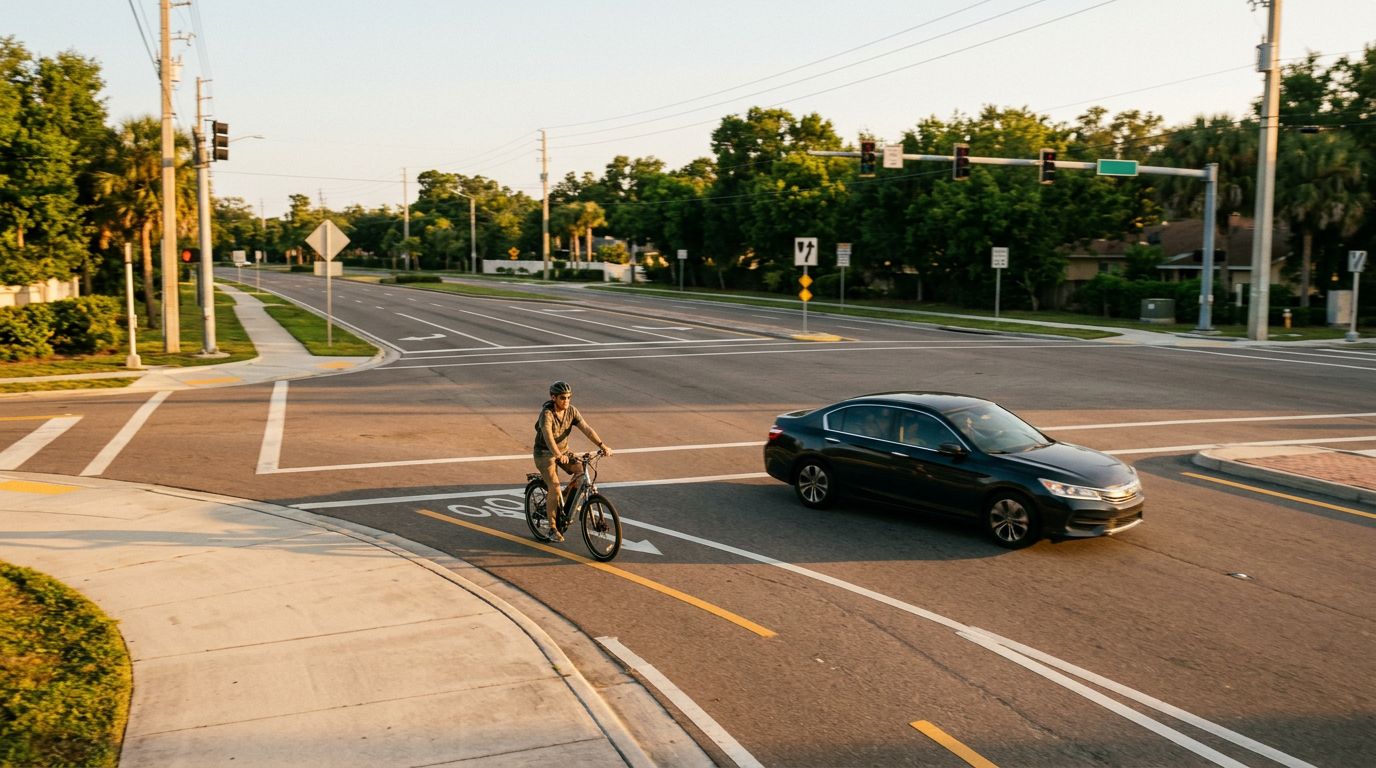
A driver can cause life-changing injuries in seconds by turning across an e-bike rider’s path or pulling into traffic without looking. Florida e-bike crash claims often depend on proving that the motorist had the right-of-way duty and failed to follow it.
Florida law generally treats an electric bicycle as a bicycle, not a motor vehicle. That gives riders many of the same roadway rights and duties as other bicyclists. However, the driver, rider, road design, and available evidence all matter when insurance companies assess fault.
A strong claim connects the driver’s conduct to the collision and the rider’s injuries. The right evidence can make that connection clear.
Key Takeaways
- Florida e-bike riders generally have roadway rights and duties similar to bicyclists.
- A failure-to-yield case requires proof of the driver’s duty, breach, causation, and damages.
- Video, witness accounts, crash-scene photographs, vehicle data, and medical records can support liability.
- A rider’s traffic violation may lead to comparative fault and reduce financial recovery.
- Injury claims arising after March 24, 2023, generally have a two-year negligence filing deadline, subject to exceptions.
How Florida e-bike crash claims prove driver negligence
Florida personal injury claims usually rely on negligence. The injured rider must show that the driver owed a duty of reasonable care, breached that duty, caused the crash, and caused legally recognized damages.
Drivers must watch for bicyclists and e-bike riders, follow traffic controls, maintain a proper lookout, and yield when traffic rules require it. A motorist may breach that duty by:
- Turning left across an approaching e-bike
- Turning right across a bike lane or roadway shoulder
- Pulling out from a driveway, parking lot, or side street
- Entering an intersection against a traffic signal
- Changing lanes without checking for a rider
- Merging too closely in front of an e-bike
- Passing without leaving a safe distance
The location of the collision often provides the first clue. A crash at an intersection may involve a left-turn failure. A collision near a shopping center may involve a driver exiting private property. A rear-end impact may show that the motorist followed too closely or failed to see the rider.
Florida’s bicycle statute gives riders rights and responsibilities on public roads. The statute addresses roadway operation, traffic devices, bike lanes, signaling, and other conduct. You can review Florida’s bicycle traffic statute for the rules that may apply to a particular crash.
A rider doesn’t lose the right to seek compensation because the collision involved an e-bike instead of a car. The important issue is whether the motorist violated a traffic rule or acted unreasonably under the circumstances.
Florida’s e-bike classifications can also matter. Class 1 and Class 2 e-bikes generally have assisted speeds up to 20 mph, while Class 3 e-bikes can provide assistance up to 28 mph. The bike’s classification, factory label, equipment, and location at the time of the crash may become relevant if the driver disputes how the e-bike was being operated.
What must be shown when a driver did not yield
A traffic citation can help, but it isn’t required to prove a personal injury claim. A police officer may issue no citation even when the evidence supports civil liability. Insurance adjusters and courts examine the full sequence of events.
The claim should answer four basic questions:
Did the driver have a duty to yield?
Traffic signals, stop signs, lane markings, turn rules, and right-of-way laws can establish the driver’s duty. The driver may also have a general duty to use reasonable care, even when no officer issued a ticket.
For example, a motorist turning left must account for oncoming traffic. An e-bike rider traveling lawfully in the opposite direction may have the right-of-way. Likewise, a driver leaving a driveway usually must yield to roadway traffic and bicyclists.
What did the driver do?
The evidence should show the driver’s specific action. Saying that a driver was careless is less useful than identifying what happened.
A clear account might show that the driver stopped at a stop sign, looked only toward moving cars, and then crossed the bike lane directly into the rider’s path. Another case may involve a motorist who began a right turn without checking a blind spot.
Did that conduct cause the crash?
The rider must connect the failure to yield with the impact. Photos may show the point of contact, damage pattern, debris, and final positions. Witnesses may explain who entered the intersection first. Video can show the traffic signal, vehicle movement, and the rider’s position before impact.
Causation can become disputed when the driver claims the rider appeared suddenly or had enough time to avoid the crash. Reconstruction evidence may help determine speed, visibility, stopping distance, and reaction time.
What losses followed?
Medical records should connect the injuries to the collision. Treatment may include emergency care, surgery, physical therapy, medication, diagnostic testing, and follow-up visits. The claim may also include lost wages, reduced earning ability, property damage, pain, and limitations on daily activities.
A failure-to-yield case is strongest when the evidence tells one consistent story about the driver’s movement, the rider’s position, the point of impact, and the resulting injuries.
Evidence that can establish fault
Evidence disappears quickly after an e-bike crash. Road conditions change, surveillance footage may be overwritten, and witnesses may forget important details. Start preserving information as soon as possible.
Request the crash report and obtain the driver’s insurance information. Then photograph the scene, including:
- Traffic lights, stop signs, and lane markings
- Bike lanes, shoulders, sidewalks, and nearby paths
- Sight obstructions such as parked vehicles or landscaping
- Vehicle damage and damage to the e-bike
- Skid marks, debris, and roadway conditions
- Street signs, construction areas, and lighting
Video is often decisive. Nearby businesses, residences, traffic cameras, and vehicle dash cameras may have recorded the collision. A lawyer can send preservation letters to prevent a business or government agency from deleting relevant footage.
Witnesses should provide their names and contact information. Their statements may address the driver’s speed, turn, position, signal, and reaction. A witness who saw the car enter the rider’s path can be more useful than someone who arrived after the impact.
Preserve the e-bike, helmet, clothing, lights, and other equipment. Don’t repair or discard the bicycle before its condition is documented. An inspection may reveal whether the bike’s brakes, lights, steering, or motor functioned properly.
Keep photographs of injuries over time. Save medical bills, discharge instructions, appointment records, wage information, and communications with insurers. Also write down symptoms and limitations while the details remain fresh.
The Florida Bicycle Law Enforcement Guide provides a public reference for traffic rules involving bicycles, right-of-way, and motorist conduct. The guide doesn’t decide who is liable in a particular case, but it can help identify the rules that investigators may consider.
Comparative fault can affect the value of a claim
The driver may argue that the rider caused or contributed to the collision. Common defenses include claims that the e-bike rider:
- Entered against a red light or stop sign
- Rode against traffic
- Failed to use required lights or signals
- Moved outside a designated path in violation of an applicable rule
- Traveled too fast for conditions
- Failed to yield to a pedestrian on a sidewalk or shared path
- Was distracted by a phone or other device
Florida uses a modified comparative negligence system. If both parties acted negligently, a jury may assign each person a percentage of fault. That percentage can reduce the injured rider’s recovery. If the rider is found more than 50 percent responsible, Florida law may bar recovery in a negligence action.
The defense must still prove its position. A driver cannot avoid responsibility by making a general accusation about the e-bike. The evidence must show what the rider did, whether that conduct violated a rule, and whether it caused or worsened the crash.
The rider’s location matters. E-bikes may operate on many Florida roadways, but local restrictions, posted signs, designated paths, and pedestrian-area rules can affect the analysis. Florida also has rules requiring riders to yield to pedestrians in certain areas and give an audible warning before passing. Updated rules taking effect July 1, 2026, address speed near pedestrians on sidewalks and pedestrian-designated areas.
A lawyer should examine these facts before discussing settlement. Accepting an insurer’s fault assessment too early can reduce the claim before all evidence is collected.
Injuries, insurance, and the filing deadline
E-bike riders can suffer fractures, road rash, spinal injuries, traumatic brain injuries, internal injuries, and permanent scarring. Even when the rider wears a helmet, a crash with a vehicle can produce serious harm.
Report the collision and seek medical care promptly. Tell the provider that the injuries resulted from the e-bike crash. Gaps in treatment can give an insurer an argument that the condition was unrelated or less serious than claimed.
Florida’s no-fault personal injury protection system generally applies to covered motor vehicles, not to the e-bike itself. As a result, payment for treatment may involve the driver’s bodily injury liability coverage, the rider’s health insurance, available uninsured or underinsured motorist coverage, or other sources. The available insurance depends on the policies and people involved.
Don’t give a recorded statement or sign a broad medical authorization without understanding the consequences. Adjusters may ask questions that focus on speed, path selection, or prior medical problems. Those details can affect fault and damages.
For injuries occurring on or after March 24, 2023, Florida’s general deadline for negligence lawsuits is usually two years after the crash. Exceptions may apply, including claims involving government entities, wrongful death, minors, or unusual discovery issues. A lawyer should review the deadline promptly because waiting can end the right to sue.
People seeking Florida personal injury legal representation can benefit from an early review of the crash report, insurance policies, medical records, and available video. If the collision involved a motor vehicle, Florida car accident attorneys may also assess the driver’s insurance and liability issues.
Choosing legal help after an e-bike collision
A lawyer evaluating Florida e-bike crash claims should ask detailed questions about the intersection, traffic signal, bike lane, path, rider’s direction, vehicle movement, and witnesses. The lawyer should also identify whether cameras, vehicle data, 911 calls, and phone records may exist.
Bring the following to an initial consultation:
- The police or crash report
- Driver and insurance information
- Photographs and videos
- Witness names and contact details
- Medical records and bills
- Proof of missed work or reduced income
- Photos of the e-bike, helmet, and clothing
The attorney may investigate the scene, obtain video, consult an accident reconstruction professional, review vehicle damage, and compare the accounts of each person involved. Those steps help separate a supported failure-to-yield claim from an insurer’s unsupported denial.
The goal is not merely to show that a driver and e-bike touched. The evidence must show why the collision happened and how it affected the rider’s life.
Conclusion
Florida e-bike crash claims often turn on a few seconds before impact. If a driver turned, merged, entered traffic, or crossed a bike lane without yielding, the crash evidence may establish negligence.
Preserve the scene, seek medical care, protect the e-bike and related records, and act before the filing deadline. The clearest claim links the driver’s failure to yield directly to the collision, the injuries, and the financial losses that followed.