
Florida Flashing Yellow Arrow Crash Claims: Timing and Witness Proof
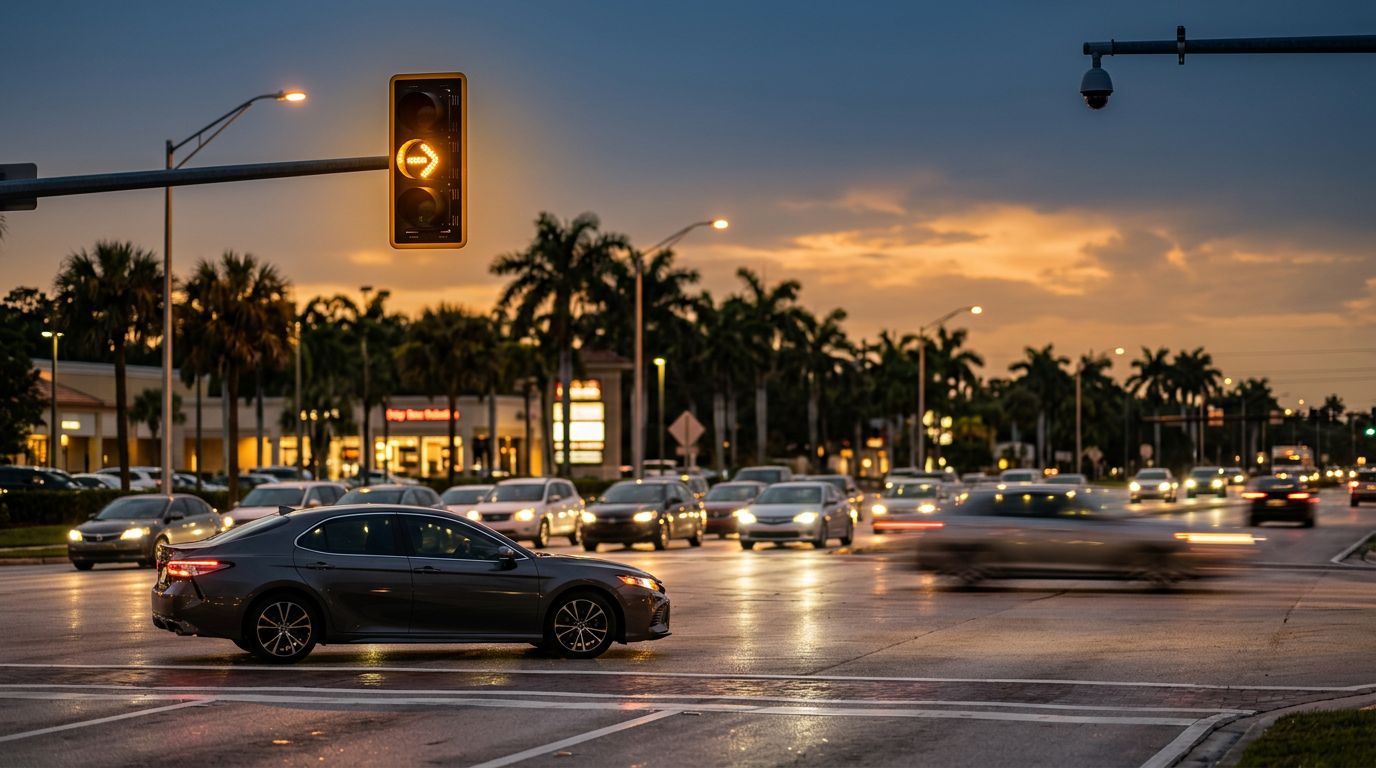
A Florida flashing yellow arrow can look simple from the driver’s seat. After a crash, though, it often becomes the center of a fight over seconds, distance, and who should have yielded.
That fight matters because left-turn crashes rarely come down to one fact alone. Signal timing, nearby cameras, and witness accounts can decide whether the claim is clear or contested.
What Florida law says about a flashing yellow arrow
Florida law treats a flashing yellow arrow as a caution signal. It means a driver may turn, but only while yielding to oncoming traffic, pedestrians, and bicyclists already in the intersection or crossing it. The Florida flashing signal statute says drivers may proceed only with caution, and the FDOT traffic signal FAQ explains that signals do not eliminate crashes or replace safe driving.
The key point is simple. A flashing yellow arrow gives permission to turn. It does not give priority.
| Signal type | What it means | What the driver must do |
|---|---|---|
| Steady yellow arrow | The protected turn is ending | Prepare to stop and yield if needed |
| Flashing yellow arrow | The turn is allowed with caution | Yield, then turn only when the path is clear |
That difference sounds small. In a claim, it can be the whole case.
A flashing yellow arrow is not a promise that cross traffic will stop.
Why left-turn crashes turn into fault disputes
Most claims at these intersections start the same way. One driver says they had room to turn. The other says the turning car cut across traffic.
That conflict is common because left-turn lanes create a short decision window. The turning driver has to judge speed, distance, and gaps in traffic in real time. Meanwhile, oncoming drivers often say they had the right to keep going straight.
This is where side-impact crashes get messy. A hard hit to the side often points to a left-turn mistake, but it does not tell the whole story. A driver in the opposing lane may have been speeding, running a stale yellow, or entering after the turn started. For those reasons, claims tied to Florida T-bone crash claims often depend on the details around the signal, not just the damage on the vehicles.
The same is true for left-turn cases. Small changes in lane position or signal phase can change liability. If the arrow was flashing, the question is not whether turning was allowed. The question is whether the turn was safe at that moment. That is why Florida left-turn accident checklist style proof matters so much.
In other words, the crash scene tells a story, but it does not always tell the truth by itself.
Signal timing records can confirm or weaken the claim
Signal timing evidence can be powerful because it ties the crash to a specific phase. If the intersection uses a protected-permissive left-turn setup, the timing plan may show when the arrow was flashing, when the opposing traffic still had green, and how long the yellow intervals lasted.
That matters in three ways. First, it can support a driver who turned after yielding correctly. Second, it can challenge a witness who remembers the light wrong. Third, it can show whether the intersection was operating as expected that day.
The records that may matter include:
- signal timing plans or phase sheets
- maintenance or calibration logs
- nearby traffic camera footage
- dash cam video
- photos that show the signal head and lane position
- event data from the vehicles, when available
The problem is timing data does not stay in one place forever. Video can be overwritten. Camera systems may have short retention periods. Local agencies may update signal settings. That is why fast preservation matters.
If you need a crash report after the fact, the Florida crash report portal is the state’s official starting point. It helps identify the report number, the responding agency, and other basic facts that can support later requests for records.
Signal timing records help most when they match photos and witness accounts. On their own, they often leave room for argument.
A strong claim uses the timing data to answer one question: who had the legal duty to wait?
Witness proof matters when the signal data is thin
Not every intersection has a camera. Even when it does, the footage may not show the whole approach. That leaves witness proof to fill the gaps.
The best witnesses are usually the ones who were close enough to see the signal and the cars. They do not need perfect memory. They need clear facts. A witness who watched the turn, saw the oncoming lane, and heard the impact can help sort out the sequence.
A useful witness statement usually covers:
- what color or arrow the witness saw
- which car entered first
- whether the turning driver slowed or stopped
- whether pedestrians or bicyclists were in the crossing
- how fast the oncoming traffic seemed to move
- whether the witness saw any distraction, like a phone
Independent witnesses matter more than passengers. Passengers usually care about the person they rode with. A bystander has less reason to shade the story.
Also, timing matters here too. A witness statement taken at the scene is often stronger than one collected days later. Memory fades quickly, especially after a loud crash and a busy intersection.
For clients, this is where a careful evidence review helps. A witness can confirm the turn, but a lawyer can line that statement up with the signal phase, the crash report, and the vehicle damage. That combination is what makes the account hold up.
Steps that protect a Florida crash claim
The first few minutes after a crash are often the best chance to gather proof. Even if the intersection seems chaotic, a few actions can protect the claim later.
- Take photos of the whole intersection. Get the signal head, lane markings, stop lines, crosswalks, and vehicle positions.
- Ask for witness names and phone numbers. Independent witnesses are far more useful than vague descriptions later.
- Look for cameras. Nearby businesses, homes, and dash cams may have footage before it disappears.
- Get medical care quickly. Injuries can show up later, and treatment records connect the crash to the harm.
- Keep your statement consistent. Do not guess about signal timing if you are unsure.
If the crash caused injury, Florida’s no-fault system may still control the first part of the claim. The basics of that process are explained in Florida no-fault claim rules. That matters because medical treatment and recordkeeping can shape the rest of the case.
A turning crash at a flashing yellow arrow may look open-and-shut. It rarely is. The driver, the signal, and the witnesses all matter.
Conclusion
A crash at a flashing yellow arrow intersection often turns on one thing, whether the turn was made with real caution. That means signal timing records, camera footage, and witness statements can carry as much weight as the damage to the cars.
If the other side is already telling a different story, the claim needs proof that reaches beyond memory. The sooner you gather it, the better the chances that the facts stay intact.