
Florida Hospital Liability After Nurse Negligence
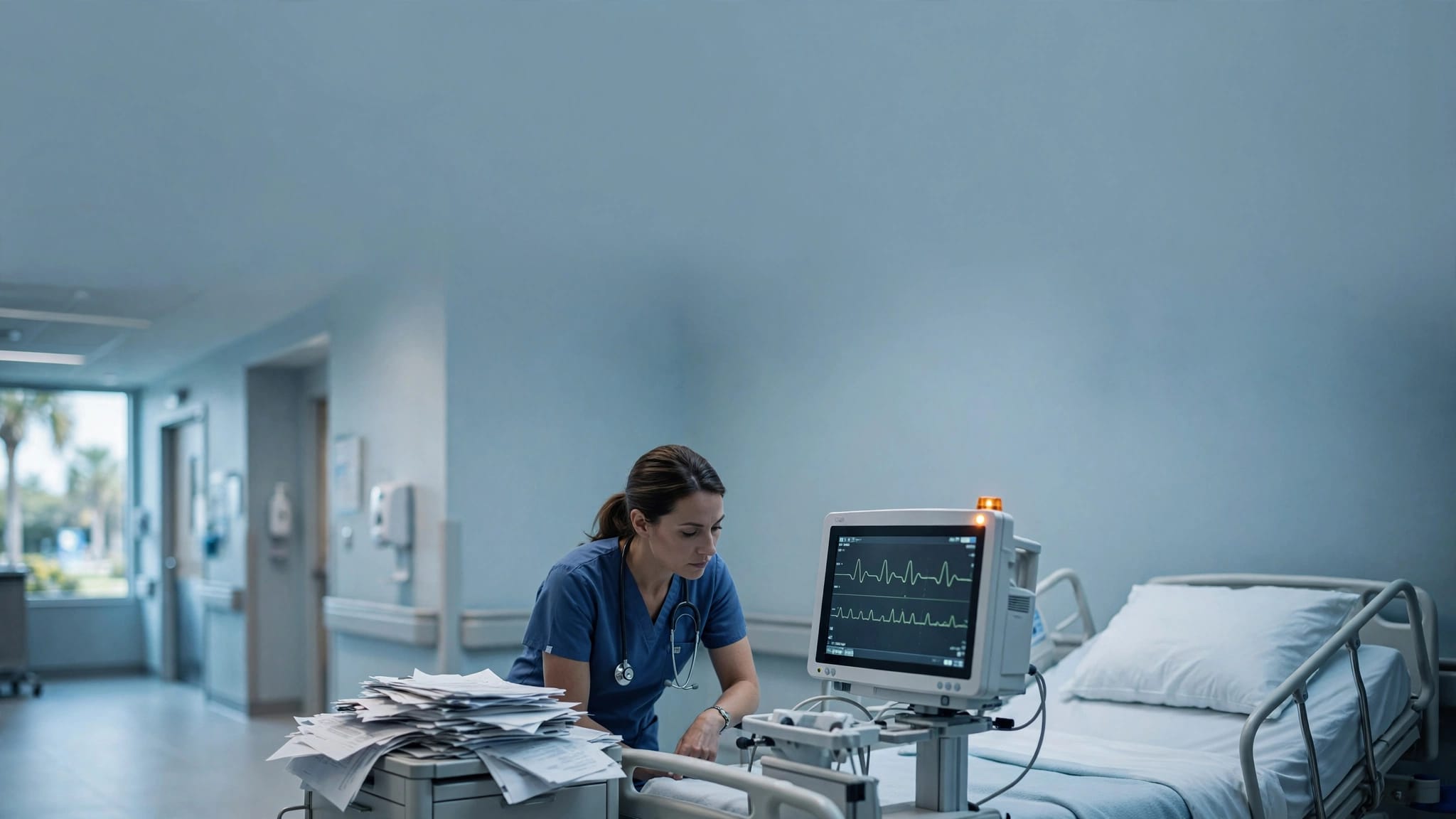
A missed change in vital signs, a medication mix-up, or a delayed call to a physician can turn a hospital stay into a life-altering injury. When that happens, patients often focus on the nurse involved, yet the hospital’s role may be just as important.
When a nurse’s mistake harms a patient, three questions matter: Was the nurse negligent? Was the hospital responsible for the employee’s conduct? Did the hospital itself fail through unsafe staffing, weak supervision, poor training, or broken reporting systems? A poor outcome or nursing error alone doesn’t establish responsibility.
A careful review should look beyond the final error and trace how staffing, supervision, training, communication, and reporting systems affected patient safety.
This article is for general informational purposes only and is not legal advice; outcomes depend on the facts, applicable deadlines, and available evidence.
Key Takeaways
- A Florida hospital negligence claim generally requires proof of a professional duty, breach, causation, and legally recoverable damages; a poor outcome or nursing error alone is not enough.
- A hospital may be vicariously liable for a nurse’s negligent conduct within the scope of employment, and it may face direct liability for unsafe staffing, inadequate training, poor supervision, or defective safety systems.
- Medical records, audit trails, medication records, staffing schedules, alarm logs, policies, and reporting materials can help show what happened, when staff recognized a problem, and whether delayed care caused the injury.
- Florida medical malpractice claims involve strict pre-suit procedures and deadlines, and public hospitals may raise additional sovereign-immunity and notice requirements.
- Potential damages must be tied to the injury caused by the alleged negligence and may include medical costs, lost income, disability, pain, suffering, and other legally supported losses.
Florida hospital liability starts with the duty of care
A poor medical outcome alone doesn’t prove medical malpractice. Under Florida Statutes section 766.102, a claimant generally must establish the applicable prevailing professional standard, a breach, medical causation, and legally recoverable damages.
For a nurse negligence claim, the standard depends on the nurse’s role, training, circumstances, and care setting. Charted symptoms, medication records, hospital protocols, and testimony from a qualified expert witness may help establish breach and causation.
What a patient must prove
A viable claim generally requires proof of four connected facts:
- The hospital or nurse owed the patient a professional duty of care.
- The nurse or hospital breached the applicable standard of care.
- That breach caused an injury or made an existing condition worse.
- The patient suffered damages, such as added medical costs, lost income, disability, non-economic damages, or other losses.
Causation matters as much as the error itself, because proximate cause asks whether the breach led to the injury. For example, a nurse might fail to report falling blood pressure. A claim becomes stronger only when expert evidence, not speculation, shows that timely escalation probably would have prevented organ damage, cardiac arrest, or another serious outcome.
A hospital’s own obligations can include exercising due care regarding staff competence and patient-care systems. A direct claim against the hospital requires evidence that the hospital itself breached a duty and that breach caused injury. A nurse’s negligence may also support a separate theory based on the hospital’s responsibility for an employee’s conduct, as discussed in the next section.
When a nurse’s negligence becomes the hospital’s responsibility
Hospitals commonly employ registered nurses, licensed practical nurses, nurse assistants, and other bedside staff. When an employee acts negligently during assigned work, the hospital may face vicarious liability under respondeat superior.
That theory doesn’t apply automatically just because treatment occurred inside a hospital. The nurse must have acted within the scope of assigned employment, and the hospital’s potential liability is derivative of the employee’s conduct.
Vicarious liability for nurse errors
Nursing negligence can involve one serious mistake or a chain of smaller failures. Examples include medication errors, missed monitoring, inaccurate documentation, delayed escalation, or delayed emergency treatment.
A nurse who fails to follow a doctor’s order may support a claim against the nurse and a derivative claim against the hospital. The same may apply when staff ignore medication-administration policies or escalation procedures.
For a closer explanation of employment relationships and bedside-care failures, see Florida nurse negligence claims.
Direct hospital negligence and corporate negligence
A hospital may also bear responsibility for its own conduct. This theory, often called corporate negligence, requires proof of the hospital’s conduct and a connection between that conduct and the patient’s injury.
Direct claims may involve:
- Inadequate staffing that leaves nurses responsible for too many patients.
- Inadequate orientation for a nurse assigned to a specialized unit.
- Failure to investigate prior complaints or unsafe practices.
- Poor medication-dispensing, alarm-monitoring, handoff, or escalation systems that undermine patient safety.
- Possible negligent hiring or credentialing concerns, depending on the evidence and applicable law.
Section 395.0197 addresses a hospital’s internal risk management program and adverse-incident reporting duties. Separate Florida provisions address financial responsibility, but meeting those requirements doesn’t by itself establish negligence or causation.
A hospital may face corporate negligence when its staffing, training, supervision, or safety policies helped cause the injury, even if the bedside mistake appears isolated.
Independent contractors, emergency care, and teaching hospital liability
Hospitals may dispute responsibility for a physician by arguing that the physician or group was not an employee. That defense may matter for independent contractor physicians, but it doesn’t resolve a separate direct-negligence claim against the hospital.
It also doesn’t ordinarily change the analysis for a hospital-employed nurse. These cases may still involve doctors, nurse practitioners, anesthesiologists, emergency-care groups, and specialists. Diagnostic errors or surgical errors can raise separate physician issues, but the primary focus remains nurse care and hospital conduct. Each party’s role should be examined early.
Apparent agency and physician responsibility
Apparent agency is a fact-specific doctrine. It asks whether the hospital held the physician out as its provider and whether the patient reasonably relied on that appearance.
The emergency department is a common setting for an apparent agency dispute. A patient rushed to the ER rarely chooses a particular emergency physician or negotiates the physician’s employment status. Hospital signage, registration forms, billing notices, staff badges, and treatment documents can all matter.
Hospital representations and disclaimers remain central to the fact-specific apparent agency inquiry. A disclaimer in paperwork doesn’t automatically defeat or establish liability. Courts assess what the hospital communicated and what the patient reasonably understood at the time of treatment.
Teaching hospital liability and resident supervision
Teaching hospital liability requires closer review. A resident doctor may work under supervising physicians and have ties to a medical school, university, or public entity. Employment relationships and statutory notice requirements may also matter.
Teaching hospital liability also depends on how the hospital supervised the resident doctor. That supervision question is separate from apparent agency, a fact-specific inquiry into the hospital’s representations and the patient’s reasonable reliance. A resident’s involvement doesn’t automatically make the hospital liable. Questions include whether the attending physician provided adequate supervision, hospital policies limited authority, and warning signs were reported and addressed.
When a resident participates in care, obtain records identifying every treating provider, including each resident doctor, their titles, employers, university affiliations, and who approved key decisions. For teaching hospital liability and apparent agency, those records can show hospital representations, patient reliance, supervision, and policy limits. Possible defenses include nonemployee status, lack of scope of employment, lack of reasonable patient reliance, adequate supervision, lack of causation, and alternative causes. The result depends on the specific facts and records. A signature block may reveal more than the discharge summary.
Medical records can reveal delayed care and system failures
Hospital charts are often the starting point, not the whole story. Electronic health records can show when staff documented observations, placed orders, acknowledged alarms, reviewed lab results, or contacted a physician.
A chart that says “physician notified” may not show when the nurse first recognized the problem. Audit trails, medication-administration records, records of medication errors, alarm logs, staffing records, and rapid-response notes can reveal notice, escalation, and system involvement. They can also show whether patient safety concerns reached the right decision-maker.
Preserve the evidence before records disappear
Patients or authorized family members should promptly request complete medical records. A useful request includes nursing notes, physician orders, medication records, lab results, imaging, discharge instructions, and itemized billing records.
Some additional materials may require formal discovery or a court order. An attorney may later seek electronic audit logs, staffing schedules, policies, training records, internal messages, and prior incident information when legally available.
Florida confidentiality and privilege rules vary by document and context. Florida Statutes section 395.0197 addresses hospital risk-management records and adverse-incident reporting, while applicable AHCA rules may govern related reporting duties. Some internal materials may be confidential or privileged. Incident reports may be discoverable in some circumstances, but admissibility is a separate question. Florida’s constitutional Amendment 7, found in article X, section 25, may also affect access to adverse-incident information.
Look for the missing minutes
Many serious patient injuries involve a period of worsening symptoms before a crisis. Evidence may show a patient became confused, short of breath, feverish, unresponsive, or hypotensive hours before a physician evaluated them.
Those details may matter in a failure-to-rescue case when qualified evidence connects the missed response to the injury. A nurse’s duty may have included reassessment, physician notification, rapid-response activation, or transfer to a higher level of care. Review hospital malpractice for delayed treatment for examples of how missed deterioration can support a claim.
Hospital-acquired infection claims also require a timeline. Culture results, wound notes, isolation orders, and catheter records may show when staff recognized an infection. Infection-control practices may help assess whether treatment was prompt, but infection alone doesn’t establish negligence.
Medical malpractice deadlines and the statute of limitations
Medical malpractice claims have strict deadlines. Florida’s general discovery rule appears in the current 2026 version of section 95.11. It generally starts the statute of limitations when the injury is discovered.
The patient must also discover, or reasonably should have discovered, the injury’s possible connection to negligence. Although two-year and four-year periods are often cited, neither is a universal outcome. Exceptions and special rules can change the calculation.
Section 95.11 also includes a separate statute of repose, measured from the negligent act or omission. Its duration and application require review under the 2026 text. Fraud, concealment, intentional misrepresentation, and certain injuries involving young children may alter the analysis.
Pre-suit investigation comes before filing suit
Before filing a medical malpractice lawsuit, a claimant must complete a pre-suit investigation under section 766.106. The process requires a reasonable investigation, a written medical opinion corroborating negligence, and notice of intent to each prospective defendant. That pre-suit opinion supports the claim, but it isn’t the same as later testimony from an expert witness.
Once notice of intent is served within the applicable deadline, the prospective defendant generally has 90 days to investigate and respond. Under section 766.106, suit may generally be filed after that response period, subject to other applicable requirements.
Because this process is procedural, an incomplete or late notice can create serious problems. Early legal review may identify issues, but it can’t guarantee that a claim will be preserved.
Public hospitals and sovereign immunity protections
A government-owned hospital, county hospital authority, university-affiliated facility, or public health system may assert sovereign immunity under section 768.28. Whether it applies depends on the entity, claim, and statutory requirements.
Section 768.28 provisions, statutory damage caps, claim procedures, and legislative-claims-bill rules must be checked as of 2026. Sovereign immunity limits aren’t universal, and any dollar figures require confirmation of the current statute and amendments.
Public hospitals may also require compliance with Chapter 766 medical-negligence procedures and section 768.28 notice requirements. Liability insurance, self-insurance, and statutory limits are separate financial-responsibility issues.
The hospital’s name alone doesn’t settle the issue. Ownership, management contracts, provider employment status, and the legal entity listed in the records can change the analysis. That legal entity controls how sovereign immunity applies.
Damages after hospital negligence causes harm
Damages in a Florida hospital negligence case must be tied to the injury actually caused by the alleged breach. Economic damages may include additional treatment, rehabilitation, medication, home modifications, lost income, and diminished earning capacity. Whether any category is recoverable depends on the evidence and applicable law.
Non-economic damages may address pain, suffering, mental anguish, disability, and loss of enjoyment of life. These losses are evaluated differently from economic losses and depend on the evidence and applicable law. If negligence causes death, a wrongful death claim may include non-economic damages and other survivor losses. Eligibility, survivor damages, estate issues, and deadlines are governed by Florida’s Wrongful Death Act and the facts of the death.
A thorough claim identifies every potentially responsible party. Surgical errors or diagnostic errors may involve nurses, hospitals, staffing entities, physician groups, contractors, or public entities. Each defendant must be connected to a negligent act, breach, and causal injury. Their involvement alone does not establish liability.
Damages and defenses can vary with causation, preexisting conditions, comparative-fault issues where applicable, mitigation, public-entity protections, and proof of future losses. No category is automatically recoverable, and future losses generally require supporting evidence.
Frequently Asked Questions
Can a hospital be liable for a nurse’s mistake in Florida?
A hospital may be vicariously liable when an employee nurse acts negligently within the scope of assigned employment. The patient still generally must prove a breach of the applicable standard of care, causation, and damages.
Can I sue a hospital for inadequate staffing or poor supervision?
Possibly. A direct hospital negligence claim may exist when inadequate staffing, training, supervision, hiring, credentialing, or safety systems breached a hospital duty and caused injury.
What evidence can help prove hospital negligence?
Medical records, nursing notes, medication-administration records, audit trails, alarm logs, staffing schedules, policies, training records, and rapid-response documentation may help establish notice, delayed care, or system failures. Some internal materials may require formal discovery and may be subject to confidentiality or privilege rules.
How long do I have to bring a Florida hospital malpractice claim?
Florida medical malpractice claims are subject to statutes of limitation and repose, along with a pre-suit investigation and notice process. The deadline can depend on when the injury and possible negligence were discovered, the defendant’s status, and statutory exceptions, so prompt legal review is important.
Does sovereign immunity protect a public hospital from liability?
A government-owned or publicly affiliated hospital may assert sovereign immunity under Florida law, but whether it applies depends on the legal entity, claim, notice requirements, and other statutory rules. Public-hospital cases may also involve medical-malpractice pre-suit procedures and statutory limits.
Final Thoughts on Hospital Responsibility
Florida hospital liability often turns on whether a nurse acted carelessly, whether the hospital bears responsibility for that conduct, or whether the hospital created unsafe conditions itself. The strongest cases examine records, staffing, communication, supervision, and causation together.
A careful review must also consider the facts, available defenses, deadlines, public-entity status, and supporting expert evidence. Prompt action can help preserve records and legal options, but it doesn’t guarantee a particular result.
This article is for general informational purposes only and is not legal advice.