
Florida Motorcycle Lane Splitting Crash Claims and Fault
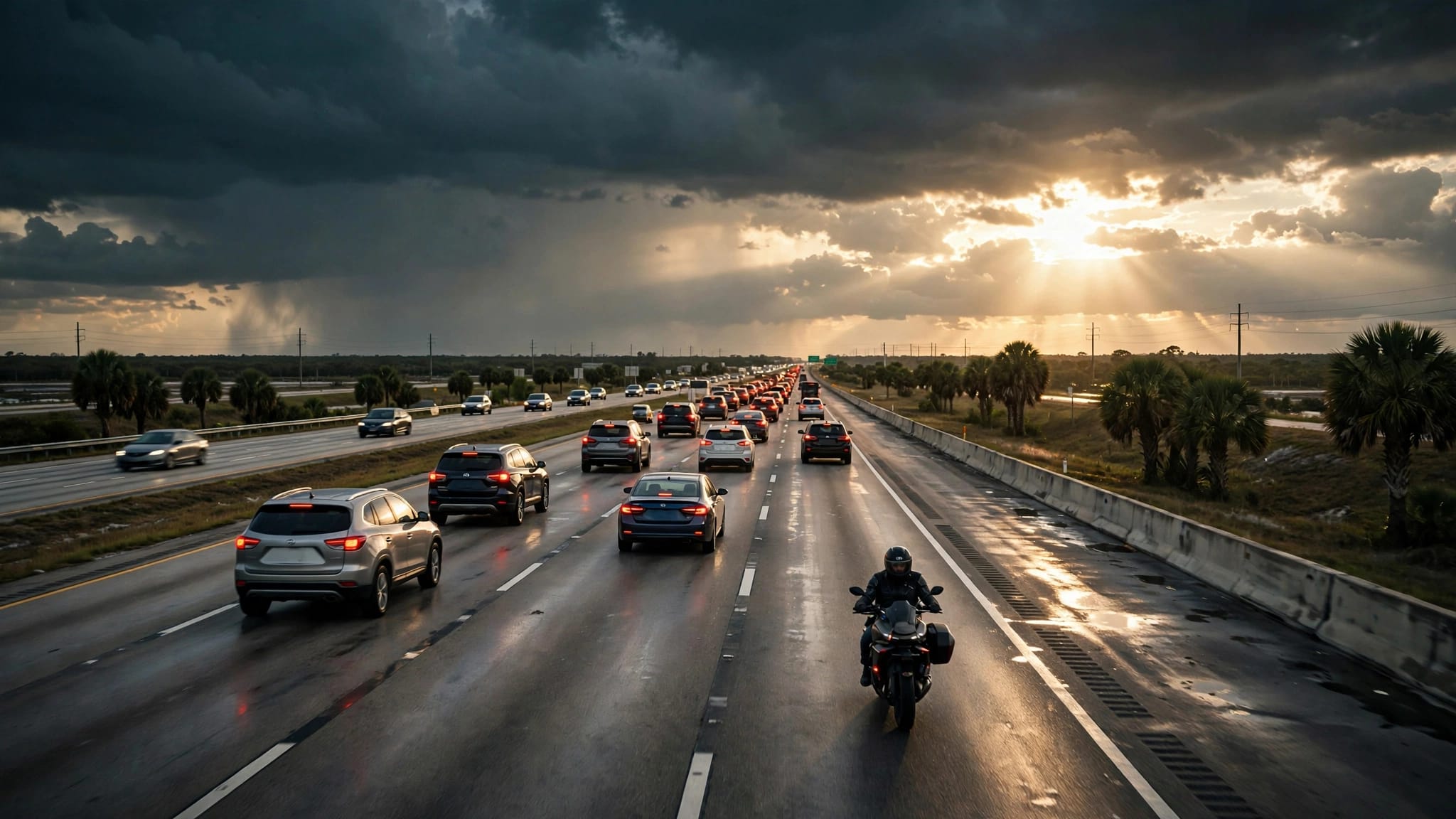
A motorcycle collision can happen in seconds when traffic slows and vehicles begin changing lanes. Yet Florida motorcycle lane splitting can shape an injury claim long after the ambulance leaves the scene.
Riders often assume an illegal maneuver ends any chance of compensation. It doesn’t. The real issue is how the rider’s actions and the driver’s actions caused the crash, supported by evidence that can withstand an insurer’s scrutiny.
Florida Motorcycle Lane Splitting Is Illegal
Florida law gives a motorcycle the full use of a traffic lane. However, riders cannot use that right to pass a vehicle within the same lane or travel between lanes of traffic.
Under Florida Statute section 316.209, a motorcyclist may not operate between adjacent lines or rows of vehicles. The statute also bars passing another vehicle in the same lane that vehicle occupies.
Lane splitting and lane filtering have the same problem
Lane splitting usually means riding between moving lines of traffic. Lane filtering often describes moving between stopped or slow vehicles at a light or in congestion.
In Florida, both actions fall under the restriction against operating between lanes or rows of vehicles. A rider filtering through stopped cars on I-95 faces the same statutory problem as a rider moving between vehicles at highway speed.
This rule does not prevent two motorcycles from riding side by side in one lane. State law permits no more than two motorcycles abreast. It also provides narrow exceptions for police officers and firefighters performing official duties.
A traffic citation is not the end of the case
A violation of the lane-use law is a noncriminal traffic infraction treated as a moving violation. It can become powerful evidence for an insurer or defense lawyer, but it does not decide civil liability by itself.
The driver still had duties to keep a proper lookout, use turn signals when required, check mirrors and blind spots, and avoid unsafe lane changes. A crash claim requires a fuller account than a ticket can provide.
Fault After a Lane-Splitting Motorcycle Crash
In a collision involving Florida motorcycle lane splitting, both parties may share responsibility. The case turns on the sequence of events, traffic conditions, speed, visibility, and each person’s choices in the moments before impact.
For example, a rider may have been filtering between slow vehicles when a driver suddenly moved into the gap without signaling. The rider violated the lane-splitting rule. Still, the driver may have made an unsafe lane change or failed to check for nearby traffic.
The driver’s conduct still matters
Drivers sometimes claim they had no reason to expect a motorcycle beside them. That argument can carry weight, particularly when a rider traveled quickly through a narrow gap.
However, drivers cannot make careless lane changes because traffic is congested. Relevant questions include:
- Did the driver signal before moving over?
- Did the driver look in mirrors or check the blind spot?
- Was the vehicle stopped, crawling, or moving at normal speed?
- Did the driver drift across a lane line or make a sudden turn?
- Could the driver have seen the motorcycle before impact?
Vehicle damage, video, and independent witnesses often answer these questions better than either driver’s memory.
Florida’s 51 percent fault bar
Florida follows a modified comparative negligence system for most injury cases. Under Florida’s comparative fault statute, an injured person who is more than 50 percent at fault cannot recover damages.
A rider found 30 percent responsible can still seek 70 percent of proven damages. If a jury assigns 51 percent or more of the blame to the rider, recovery is barred.
Illegal lane splitting can reduce a rider’s recovery, but it does not automatically excuse a driver who made an unsafe lane change, turned without care, or drove while distracted.
Insurers know this rule creates pressure. They may emphasize the rider’s lane position while ignoring evidence that the other driver created the immediate danger.
Evidence That Can Prove What Happened
Lane-splitting cases often become disputes about inches, timing, and visibility. The driver may say the motorcycle appeared “out of nowhere.” The rider may say the driver moved without warning. Physical and digital evidence can fill the gap.
Video can establish lane position and movement
Helmet-camera footage, dashcam video, business security cameras, traffic cameras, and nearby vehicles can show where the motorcycle traveled before the collision. The best recordings also capture brake lights, turn signals, traffic speed, and the driver’s lateral movement.
Act quickly. Many businesses overwrite recordings within days. A written preservation request can ask a store, apartment complex, transit agency, or fleet owner to retain footage before it disappears.
Video rarely tells the entire story. Still, it can challenge a claim that a rider was speeding recklessly or prove a driver crossed a lane line without looking. Learn more about using video to prove a Florida motorcycle crash claim.
Photos and damage patterns tell a story
Take wide photographs of the roadway, lane markings, intersections, debris, skid marks, traffic signs, and sight lines. Then photograph both vehicles from several angles before repairs erase important details.
Damage on the motorcycle’s front fork, handlebars, side fairing, or saddlebag may help reconstruct the angle of impact. Damage near the side of a car can support a claim that the vehicle moved into the motorcycle’s path. Repair estimates and event-data records may also help establish the force and direction of the collision.
Witnesses and records add needed context
Independent witnesses often matter because they have no financial stake in the result. Get their names and contact information before they leave. A passenger in the other vehicle can also provide important information, even when their account supports the driver.
Police reports are useful starting points, but they are not the final word on fault. Florida Highway Safety and Motor Vehicles explains how to obtain Florida traffic crash reports, which are generally available through the state’s Crash Portal for a fee.
Medical records also connect the collision to the injuries claimed. Prompt treatment, diagnostic imaging, physician restrictions, and follow-up records make it harder for an insurer to argue that pain or impairment came from another event.
Damages and Insurance Issues for Injured Riders
A lane-splitting allegation affects fault, not the seriousness of an injury. Riders may suffer fractures, spinal trauma, road rash, internal injuries, traumatic brain injuries, or lasting nerve damage even in a low-speed crash.
A strong claim documents the financial and personal effect of those injuries. That can include emergency treatment, surgery, physical therapy, prescription costs, missed income, reduced earning ability, and pain and suffering.
Motorcycles usually do not have PIP benefits
Florida’s no-fault Personal Injury Protection system applies to many car occupants. Motorcycles generally fall outside that system, which can leave riders without the immediate PIP medical coverage that people expect after a vehicle crash.
Health insurance, MedPay coverage, uninsured or underinsured motorist coverage, and the at-fault driver’s liability policy may become central. Each policy has its own limits, exclusions, and notice requirements. The process of paying motorcycle crash medical bills without PIP can involve medical liens and reimbursement claims that affect a final settlement.
Do not accept a quick percentage assignment
An adjuster may tell a rider that lane splitting makes the case worth little. That statement is an opening position, not a legal finding.
Before discussing a settlement, identify every available policy and calculate the full damages. Early offers often arrive before surgery, future treatment needs, wage loss, or permanent limitations are clear. A settlement release usually ends the right to seek additional compensation later.
What to Do After a Florida Lane-Splitting Collision
Your health comes first. Then preserve the facts before memories fade, vehicles are repaired, and videos are overwritten.
Take practical steps at the scene and afterward
If you can do so safely, take these actions:
- Call law enforcement and request medical care if you are hurt. Do not minimize symptoms such as dizziness, numbness, neck pain, or confusion.
- Exchange information with every driver involved, including insurance details, vehicle information, and phone numbers.
- Photograph the motorcycle, vehicles, roadway, lane markings, debris, injuries, and the broader traffic scene.
- Ask witnesses for names and contact information. A short phone video can preserve an account while events are fresh.
- Save the original helmet-camera or dashcam file. Do not edit it, add music, or post it on social media.
- Keep medical bills, discharge instructions, work-loss records, prescriptions, and receipts in one file.
Statements made after a crash can be misunderstood. Stick to observable facts when speaking with police, medical providers, and insurers. Do not guess about speed, distance, or fault.
Avoid social media and recorded statements
Insurance companies often search public posts for material that conflicts with an injury claim. A photo from a family gathering may be used to suggest someone has recovered, even if that person attended while in pain.
You may need to report the claim, but you do not have to provide a detailed recorded statement to the other driver’s insurer before understanding the evidence and your injuries. For serious claims, Florida motorcycle accident attorneys can evaluate the evidence, handle insurer communications, and pursue available coverage.
Filing Deadlines and Claim Obstacles
For most negligence claims arising from a Florida crash on or after March 24, 2023, the deadline to file a lawsuit is generally two years from the crash date. The current text of Florida Statute section 95.11 sets that two-year period for actions founded on negligence.
Waiting until the deadline approaches can damage a case. Witnesses become hard to locate, surveillance video vanishes, and vehicle repairs remove evidence.
Some cases have different deadlines
Claims involving a government vehicle, a wrongful death, a minor, or an incapacitated person can involve different procedural rules. Insurance policies also may require prompt notice even when the lawsuit deadline is later.
A lawyer can review the crash date, parties involved, available policies, and evidence before time limits create an avoidable problem. This matters when a rider faces a disputed fault allegation from the start.
A Fair Claim Depends on the Full Story
Florida motorcycle lane splitting can create a serious hurdle after a crash, especially when an insurer argues the rider caused the collision. Yet fault is not determined by one label, one citation, or one driver’s version of events.
Clear video, reliable witnesses, vehicle damage, medical proof, and a prompt investigation can show how both parties contributed to the wreck. The percentage of fault matters, and the evidence often determines that percentage.