
Florida Pothole Crash Claims: Records That Matter
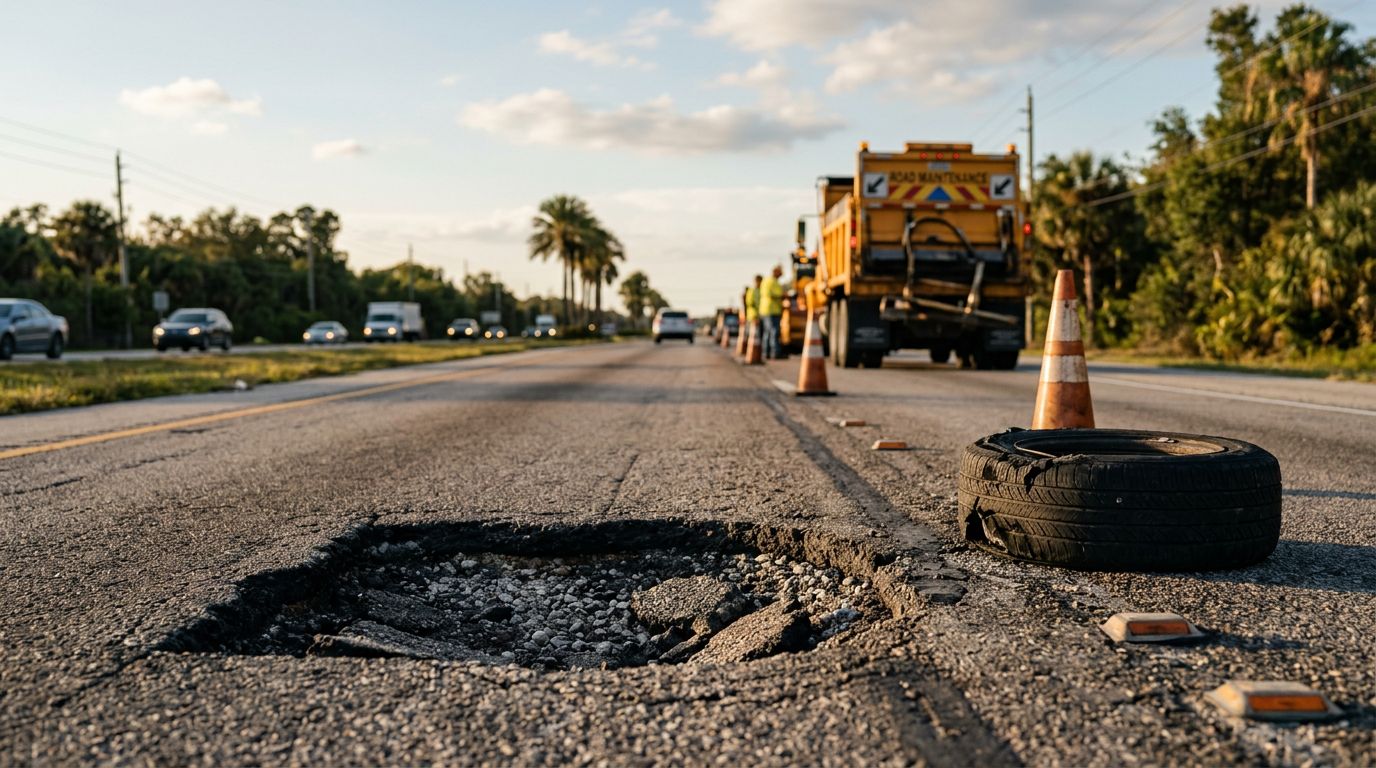
A pothole can damage a vehicle in seconds, but proving who should pay often takes much longer. Florida pothole crash claims usually depend on records showing who owned the road, when officials learned about the defect, and whether anyone inspected or repaired it.
Photos and repair bills matter, but they rarely tell the entire story. Road maintenance logs, prior complaints, work orders, inspection reports, and crash records can connect the roadway defect to the agency’s failure to address it. The process starts with identifying the road owner and preserving evidence before records disappear or conditions change.
Key Takeaways
- The correct defendant may be FDOT, a county, a city, a contractor, or a private road owner.
- Prior complaints and inspection records can show actual or constructive notice of a dangerous pothole.
- A public records request should identify the precise location, lane, direction, dates, and record types sought.
- Florida government claims involve special notice requirements, investigation periods, and damage limits.
- Scene photographs, witness information, vehicle records, and medical documentation must support the maintenance records.
Why Road Records Matter in a Florida Pothole Case
A road agency usually isn’t automatically liable because a driver hits a pothole. A successful claim must connect the defect to a legal duty and a failure to perform that duty with reasonable care.
That often requires proof of several facts:
- The agency or another responsible party controlled the road.
- The pothole created an unreasonable roadway hazard.
- The responsible party knew about the pothole, or it existed long enough that reasonable inspections should have discovered it.
- The party failed to repair, warn about, or reasonably address the condition.
- The pothole caused the crash, vehicle damage, bodily injury, or other losses.
A maintenance record can answer questions that photographs cannot. For example, a work order may show that a resident reported a pothole three weeks before a collision. An inspection log may show that the agency inspected the road but failed to record or repair the defect. A repair invoice may establish that the agency knew the location required attention.
Prior complaints are especially important. A complaint submitted through 311, a city service portal, SeeClickFix, or a road department website may establish actual notice. That means the responsible party received information about the defect before the crash.
Other evidence can establish constructive notice. This generally involves showing that the pothole existed long enough, or was obvious enough, that reasonable maintenance procedures should have revealed it. The law applies to the facts of each case, so the age, size, location, traffic volume, lighting, and inspection practices can all matter.
The Florida Department of Transportation’s public records page is a starting point for records involving state roads. County and city records must be requested from the local agency that controls the roadway.
Identify the Road Owner Before Requesting Records
Road ownership is the first research problem. Sending a request to the wrong agency can delay the investigation and leave important records in another department’s files.
FDOT generally maintains state roads, including major highways and interstate routes. A pothole on I-4, I-95, or another state-maintained roadway may require records from FDOT and, in a construction zone, from a project contractor.
County governments commonly maintain county roads, bridges, drainage systems, and related rights-of-way. The responsible department may be called Public Works, Road and Bridge, Transportation, or Traffic Engineering.
Cities and towns often control local streets, sidewalks, traffic signals, and drainage features within municipal boundaries. A street’s name alone doesn’t establish whether the city or county owns it.
Private parties may control roads in subdivisions, shopping centers, apartment communities, office parks, or gated developments. A private property owner, homeowners’ association, property manager, paving company, or maintenance contractor may have relevant records.
The crash location should be described with more detail than a street name. Include the nearest intersection, direction of travel, lane, mile marker, nearby business or address, and any GPS coordinates available from a phone. A broad request for “the pothole on Main Street” may produce an incomplete search.
Martin County provides a useful example of why ownership matters. Its road ownership information distinguishes county-owned rights-of-way from state-owned rights-of-way. Other counties and municipalities use different maps or service systems.
When the road is near a boundary, request ownership confirmation in writing. If an agency says it doesn’t control the location, ask which agency does. Keep that response with the rest of the claim file.
Maintenance Records That Can Establish Notice
A strong records request covers more than repair invoices. Agencies often keep information in separate systems, and the most useful document may not be labeled “pothole record.”
| Record type | What it may show |
|---|---|
| Service requests and 311 complaints | When residents, drivers, or businesses reported the defect |
| Inspection logs | Whether employees inspected the road and what they observed |
| Work orders | Whether repairs were assigned, delayed, completed, or closed |
| Crew dispatch records | Dates and locations of maintenance activity |
| Repair invoices and material records | What work occurred and when |
| Internal emails | Discussions about the pothole, safety concerns, or scheduling |
| Road photographs and video | The condition before or after the crash |
| Maintenance policies | The agency’s inspection and repair standards |
| Contractor records | Work-zone duties, inspections, and reports |
Prior complaints often provide the clearest timeline. A service request may include the original caller’s description, photographs, location data, employee notes, and the date the agency closed the request.
A closed work order doesn’t always prove the problem was fixed. It may show that an employee inspected the area, placed temporary material, created a follow-up assignment, or marked the request complete without a lasting repair. The entire record matters, including attachments and status notes.
Inspection policies can also be important. If an agency claims it had no direct report before the crash, its inspection schedule may show whether employees should have discovered the pothole during ordinary roadway checks. A gap between the agency’s written policy and its actual inspection records can raise additional questions.
Repair history may reveal a recurring condition. If crews filled the same pothole several times, the claim may involve more than a single missed report. The records could show drainage problems, pavement failure, utility work, poor compaction, or another condition that caused the hazard to return.
A post-crash repair doesn’t erase earlier evidence. Request records for the period before the collision and after it. A repair made immediately after the crash can help document the location and condition, although it doesn’t by itself prove the agency was negligent.
How to Write a Useful Public Records Request
Florida’s public records law allows people to request records from government agencies, but the request should be clear and targeted. A vague demand can create delays, especially when an agency maintains millions of roadway records.
Identify the road, exact location, travel direction, lane, and date range. Request records for a reasonable period before and after the crash. For many cases, the request may cover the 12 to 24 months before the collision and several months afterward, although the proper range depends on the facts.
Ask for records connected to the specific location, including:
- Pothole complaints, 311 reports, service requests, and online submissions
- Inspection reports, route logs, patrol records, and supervisor reviews
- Work orders, repair tickets, crew notes, and completion records
- Emails, photographs, videos, maps, and attachments
- Roadway condition surveys and pavement inspection data
- Policies describing inspection, reporting, warning, and repair procedures
- Contractor communications, daily reports, and payment records
- Records identifying the person or department responsible for the area
Use the exact location repeatedly. Include the crash date and explain that the request concerns a roadway defect involved in a motor vehicle collision. Ask the agency to preserve potentially relevant electronic and paper records.
A request might state:
Please provide all complaints, service requests, inspection records, work orders, repair records, photographs, videos, emails, and contractor records concerning the pothole or pavement defect located in the eastbound right lane near [specific location], from [date] through [date]. Please include attachments, status history, closure notes, and records identifying the employees or contractors assigned to inspect or repair the location.
Keep the submission confirmation, response, invoices, agency correspondence, and names of employees who handle the request. If the agency produces no records, retain that response. It may become relevant if the agency later claims it performed an inspection or repair.
Some records may be withheld or redacted under a public records exemption. An exemption doesn’t necessarily end the inquiry. Ask the agency to identify the legal basis for withholding the material and produce all nonexempt portions.
Request the Crash Report and Related Safety Data
Maintenance records show what the road agency knew or did. The crash report helps establish what happened at the scene.
Florida Highway Safety and Motor Vehicles provides information about obtaining Florida traffic crash reports. The report may identify the roadway, location, vehicles, witnesses, contributing conditions, citations, and officer observations.
Review the report carefully. A generic description such as “vehicle struck object” may not fully describe a pothole. If the report mentions roadway conditions, tire damage, loss of control, or a sudden lane change, those details may help connect the defect to the collision.
Other crash-related records may include:
- Photographs taken by law enforcement
- 911 calls and dispatch information
- Body-camera footage, when available
- Traffic camera footage
- Witness statements
- Roadway or highway incident logs
- Towing records
- Insurance photographs and estimates
FDOT also publishes crash data and safety information. Statewide data won’t prove that a particular agency caused one crash, but it may help identify recurring safety concerns at a location or roadway segment.
Evidence should be collected quickly. Traffic cameras may overwrite recordings. Witnesses may forget details. A repaired pothole may look different within days. Take close photographs of the defect, wider photographs showing its position, and images of nearby signs, intersections, lane markings, and fixed landmarks.
Record the date, time, weather, lighting, traffic conditions, and exact direction of travel. If the vehicle can be moved safely, don’t put yourself or another person in danger to photograph the roadway.
Link the Pothole to the Collision and Your Losses
Records showing that a pothole existed aren’t enough by themselves. The claim also must show that the defect caused the crash or damage.
The physical evidence should match the driver’s account. For example, a front-wheel impact, bent suspension component, damaged tire, steering problem, or sudden loss of control may support the explanation that the vehicle struck a pothole. A mechanic’s inspection can document the damage and identify whether it is consistent with a road impact.
Preserve the vehicle’s condition until it has been inspected. If repairs are necessary, photograph the vehicle first and keep the estimates, invoices, replaced parts, towing bill, and rental-car records. Do not discard a damaged tire or wheel before asking whether it should be preserved.
For an injury claim, medical records should connect the symptoms to the collision. Seek appropriate medical care and describe the event accurately. Gaps in treatment, prior injuries, and unrelated conditions may become issues during an insurance or legal review.
A pothole crash can produce several categories of loss:
- Vehicle repairs or total-loss value
- Towing, storage, and transportation expenses
- Medical bills and future treatment
- Lost wages or reduced earning ability
- Pain, physical limitations, and emotional distress
- Property damage to items inside the vehicle
Florida’s no-fault insurance system may affect initial medical benefits after a motor vehicle crash. Your own policy may also provide collision coverage for vehicle damage. Those insurance sources don’t necessarily determine whether another party is legally responsible, so report the incident promptly and preserve every payment and denial.
Driver conduct also matters. Speed, distraction, visibility, weather, lane position, and attempts to avoid the pothole may affect comparative fault. Florida’s modified comparative negligence rule can reduce recovery, and a person found more than 50 percent responsible may be barred from recovering damages under current law. The facts and date of the crash matter.
Special Deadlines Apply to Claims Against Government Agencies
A claim against FDOT, a county, or a city has requirements that don’t apply in the same way to a claim against a private driver or business.
Florida Statute § 768.28 partially waives sovereign immunity for certain negligence claims against government entities. The statute generally requires written notice of the claim within three years after the loss. Notice usually must go to the appropriate agency and the Florida Department of Financial Services, depending on the defendant.
The agency generally receives up to 180 days to investigate the claim before a lawsuit may proceed. That investigation period doesn’t mean the agency will accept responsibility. It also doesn’t eliminate the need to gather records, document damages, and evaluate the claim.
Government claims generally have damage limits of $200,000 per person and $300,000 for the same incident involving a government entity. Exceptions, settlements, and legislative claims bills can affect the final recovery, so these limits require case-specific legal analysis.
The three-year notice period isn’t a safe deadline for every step. A separate statute of limitations may apply to filing suit, and Florida negligence laws have changed over time. Missing a notice requirement or filing deadline can defeat an otherwise strong claim.
Send notice promptly, especially when serious injuries or ongoing treatment are involved. A lawyer can identify the proper agency, determine where notice must be sent, calculate deadlines, and avoid treating a public records request as a substitute for formal legal notice.
If you’re weighing your options, reviewing whether you need a lawyer for a Florida car accident claim can help clarify when legal assistance becomes important. Government liability and roadway records often make early legal review more useful than waiting for an insurer’s decision.
When a Lawyer Can Help With the Records
A pothole case may appear straightforward when the vehicle damage is visible. Government liability can make the underlying investigation much more demanding.
An attorney may help by identifying every potential defendant, sending preservation letters, preparing public records requests, reviewing agency policies, and comparing the maintenance timeline with the crash evidence. The lawyer may also investigate whether a construction contractor, private property owner, utility company, or another party controlled the roadway condition.
Records can contain technical language and incomplete entries. A lawyer may recognize that an inspection route omitted the crash location, that a repair ticket was closed without proof of completion, or that a contractor had responsibility for the lane during a work-zone project.
Legal representation is also useful when an insurer minimizes the claim because the damage initially appears limited. Neck, back, joint, and neurological symptoms may develop after a collision. A prompt evaluation protects both the evidence and the injured person’s ability to make informed decisions.
You can contact Florida car accident attorneys at Avard Law Offices for a case evaluation involving roadway hazards, vehicle damage, or crash injuries. Bring photographs, the crash report, medical records, repair documents, insurance correspondence, and any agency responses to the consultation.
Conclusion
A pothole crash claim depends on more than showing that a dangerous hole existed. The strongest cases connect the defect to the responsible road owner, establish prior notice or an unreasonable inspection failure, and document the crash and resulting losses.
Request the right records early, preserve the vehicle and scene evidence, and treat government deadlines as separate from ordinary insurance procedures. When maintenance logs and crash evidence tell the same story, they can provide the factual foundation needed to pursue fair compensation.