
Nursing Home Abuse Bruising Claims in Florida
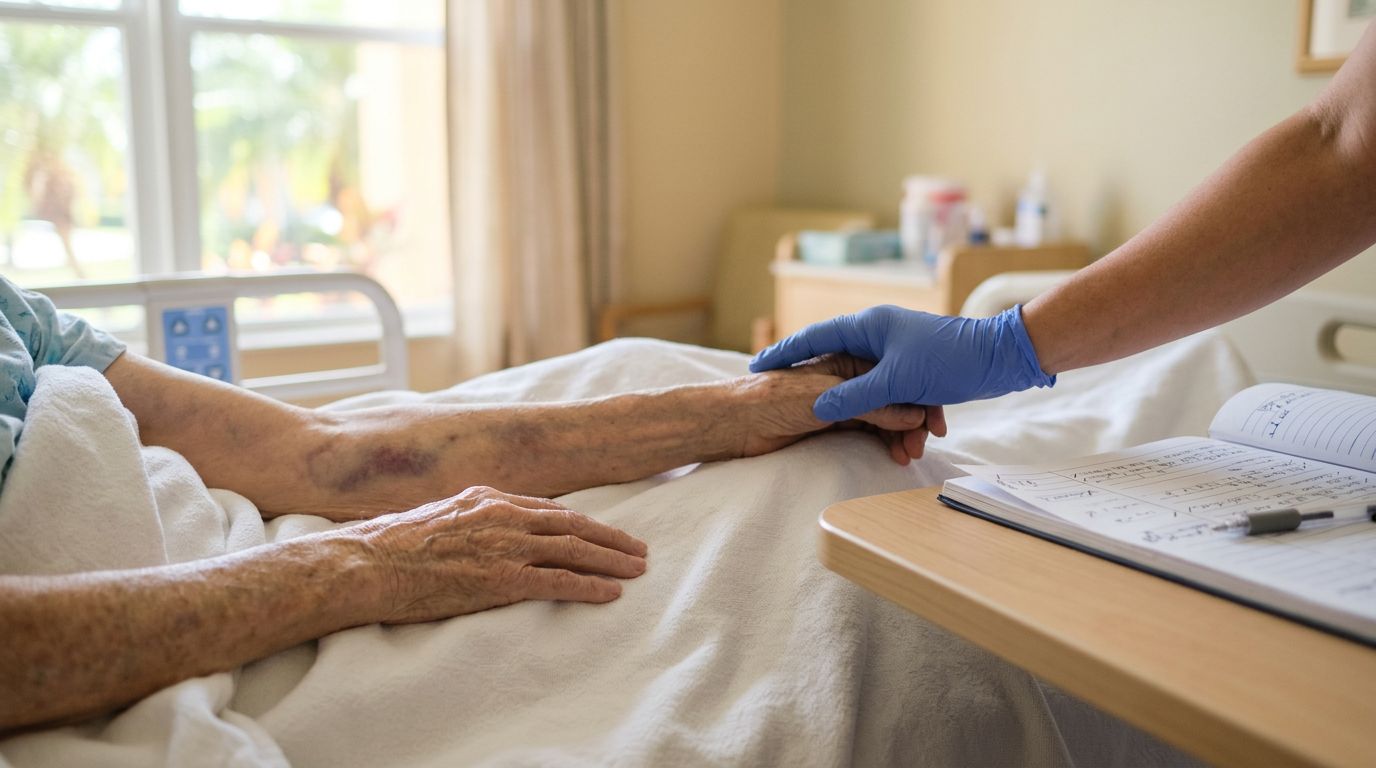
One bruise can raise an urgent question: how did your loved one get hurt? When nursing home abuse bruising appears without a clear explanation, families should treat it as a possible warning sign of physical abuse, improper handling, a fall, restraint misuse, or neglect.
A bruise alone doesn’t prove wrongdoing. However, the facility should be able to explain when and how the injury happened, who witnessed it, what care the resident received, and why staff documented the incident in a particular way. Early medical care, reporting, and evidence preservation can protect both the resident and a potential legal claim.
Why unexplained bruising requires immediate attention
Older adults often bruise more easily because of fragile skin, certain medications, or medical conditions. That doesn’t make every bruise harmless. A sudden injury, repeated bruising, or a bruise in an unusual location deserves a careful investigation.
Common causes of bruising in nursing homes
A resident might develop a bruise after a documented fall, a difficult transfer, or contact with furniture. Blood thinners, steroid medications, low platelet counts, and other health conditions can also increase bruising.
The important issue is whether the facility identified and recorded the cause. Staff should document the injury, assess pain and mobility, notify the appropriate people, and arrange medical care when necessary. A vague statement such as “the resident bumped into something” may leave important questions unanswered.
Families should compare the explanation with the resident’s condition. A bruise paired with fear of a particular caregiver, a new reluctance to move, torn clothing, or inconsistent staff accounts may require further action. More warning signs of Florida nursing home neglect can help families identify patterns that might otherwise be overlooked.
Patterns that may point to abuse or neglect
Certain facts can make unexplained bruising more concerning:
- Bruises appear repeatedly without incident reports or consistent explanations.
- Injuries occur on the upper arms, wrists, neck, face, or other areas that may indicate forceful contact.
- Staff delay notifying the family or provide conflicting accounts.
- The resident reports being grabbed, pushed, restrained, or handled roughly.
- The facility fails to obtain medical treatment despite pain, swelling, limited movement, or worsening symptoms.
- The resident’s care plan identifies fall or behavior risks, but staff don’t follow the required precautions.
These facts don’t establish liability by themselves. They do create a reason to protect the resident and obtain records before evidence disappears.
How nursing home abuse bruising claims are evaluated in Florida
Florida law gives nursing home residents specific protections. A civil claim also requires proof connecting the facility’s conduct to the resident’s injury and losses.
Residents have a right to freedom from abuse
Under Florida Statute section 400.022(1)(o), nursing home residents have the right to be free from mental and physical abuse, sexual abuse, neglect, exploitation, corporal punishment, extended involuntary seclusion, and physical or chemical restraints.
The full protections appear in Florida’s Chapter 400 nursing home statutes. These rights apply regardless of whether the resident pays privately, receives Medicaid, or has family members closely involved in care.
A facility may violate those rights through direct physical conduct. It may also violate them through neglect, such as failing to provide safe transfers, adequate supervision, proper skin checks, or timely treatment after an injury.
What a civil claim must show
A nursing home abuse bruising claim usually focuses on several connected issues. The evidence may need to show that:
- The facility or caregiver owed the resident a legal duty of care.
- The defendant violated that duty or a protected resident right.
- The violation caused the bruise or related medical injury.
- The resident suffered measurable damages.
A direct assault is only one possible theory. Negligent transfers, poor fall prevention, unauthorized restraints, understaffing, delayed treatment, and inaccurate records may also support a claim when the facts establish the required connection.
Medical records can help determine whether the injury is consistent with the facility’s explanation. Photographs, witness statements, staffing information, and incident reports can help establish what happened before and after the bruise appeared.
What to do after finding a bruise
Families should act quickly but avoid confronting staff in a way that places the resident at greater risk. The first priority is safety and medical evaluation.
Protect the resident and obtain medical care
If the resident faces immediate danger, serious pain, bleeding, confusion, breathing problems, or a suspected head injury, call 911. Ask the emergency provider to document the bruise’s size, color, location, tenderness, and the resident’s account of what happened.
If the situation isn’t an emergency, request an examination by the resident’s physician or another independent medical provider. Ask for written findings and copies of imaging, treatment notes, discharge papers, and follow-up instructions.
A family member should record:
- When the bruise was first noticed.
- Who discovered it and who was present.
- What the resident said happened.
- What each staff member said about the injury.
- Whether the resident reported pain, fear, weakness, or limited movement.
- Whether similar injuries appeared before.
Take clear photographs with the date and time. Use both close-up images and wider photographs that show where the bruise is located on the body. Continue photographing it as the color, swelling, or size changes.
Report suspected abuse or neglect
Florida families can report suspected abuse, neglect, or exploitation of an elderly or vulnerable adult to the Florida Abuse Hotline at 1-800-962-2873. If the resident is in immediate danger, contact law enforcement or 911 first.
Families can also file a facility complaint with the Florida Agency for Health Care Administration. AHCA accepts quality-of-care complaints involving licensed nursing homes. Its official complaint instructions list the complaint process and provide the AHCA complaint number, 1-888-419-3456.
A report to the state or police doesn’t replace a civil claim. Regulatory agencies may investigate and impose penalties, but they don’t necessarily recover compensation for the resident’s medical bills, pain, or other losses.
Preserve records before they disappear
Send the facility a written request to preserve evidence. Ask it to retain surveillance video, incident reports, electronic records, staffing schedules, care plans, transfer records, medication records, skin assessments, and internal communications related to the injury.
Surveillance footage may be overwritten on a short schedule. A written preservation request creates a record that the facility knew the evidence could matter.
Keep copies of clothing, bedding, bandages, or other items that show blood, tears, or damage. Place each item in a clean bag, label it with the date, and avoid washing it. Also save photographs, text messages, emails, voicemail messages, and notes from calls with the facility.
Building a Florida nursing home abuse case
An attorney evaluates more than the bruise itself. The surrounding records often show whether staff followed the resident’s care plan and whether the facility responded appropriately.
Potentially responsible parties
Florida’s nursing home civil enforcement laws may apply to the facility licensee, certain management or consulting companies, managing employees, and direct caregivers. The correct defendants depend on the facility’s ownership, employment relationships, contracts, and the facts of the injury.
A facility may attempt to blame the resident’s medical condition or deny that the injury happened while the resident was in its care. Medical records, time-stamped photographs, witness accounts, and staffing evidence can test those defenses.
When a fall may have caused the bruise, preserve records about fall-risk assessments, prior near-falls, transfer assistance, alarms, supervision, and changes in mobility. Families can review guidance about what to do after a nursing home fall when a fall is part of the suspected cause.
Florida’s presuit process and filing deadlines
Florida Statute section 400.0233 requires presuit notice for many claims involving nursing home negligence or violations of resident rights. Under the statute, a lawsuit generally can’t be filed for 75 days after the notice is mailed to a prospective defendant. The statute also addresses investigation, responses, negotiation, and tolling during that period. Review the Florida nursing home presuit notice statute with a lawyer before sending notice.
The applicable filing deadline depends on the legal theory, the date the injury was discovered, the resident’s death, and other facts. Presuit notice must be handled within the applicable limitations period. Reporting the incident to AHCA or the Abuse Hotline doesn’t automatically preserve the right to sue.
Because records can disappear and deadlines can run while an investigation continues, contact a Florida nursing home abuse attorney promptly. Don’t sign a release, settlement agreement, or facility statement about the injury before receiving legal advice.
Compensation may cover more than medical bills
A successful claim may seek compensation for emergency treatment, hospital care, diagnostic testing, medication, rehabilitation, and future medical needs. The resident may also have a claim for pain, disfigurement, disability, emotional distress, and reduced quality of life.
The value of a case depends on the injury and the available proof. A small bruise may become more significant when it reveals repeated abuse, a fracture, untreated pain, or a broader failure to protect the resident.
If the resident dies because of the injury or related neglect, the personal representative may pursue a wrongful death claim for eligible survivors and the estate. Funeral expenses, medical expenses, lost support, and loss of companionship may be available when supported by the facts and Florida law.
How an attorney can help investigate bruising
A lawyer can request records, identify missing documentation, interview witnesses, consult medical professionals, and determine whether the facility followed the resident’s care plan. The investigation may also compare staff schedules with medication administration records, call logs, transfer notes, and hospital records.
In addition, counsel can handle communications with the facility and insurer. That matters when the nursing home changes its explanation, minimizes the injury, or pressures the family to accept a quick resolution.
Families don’t need to know the exact legal label before seeking help. They should bring photographs, medical records, facility correspondence, witness names, and a timeline of events if those materials are available.
Conclusion
Unexplained bruising in a Florida nursing home deserves prompt attention, especially when staff provide inconsistent answers or the resident shows pain or fear. Protect the resident, obtain independent medical documentation, report suspected abuse, and preserve records and photographs.
A bruise may be the first visible sign of a larger failure in care. When the evidence supports a claim, timely legal advice can help a family pursue accountability and compensation while protecting the resident’s rights.