
Florida Railroad Crossing Crash Claims: Using Signal Data
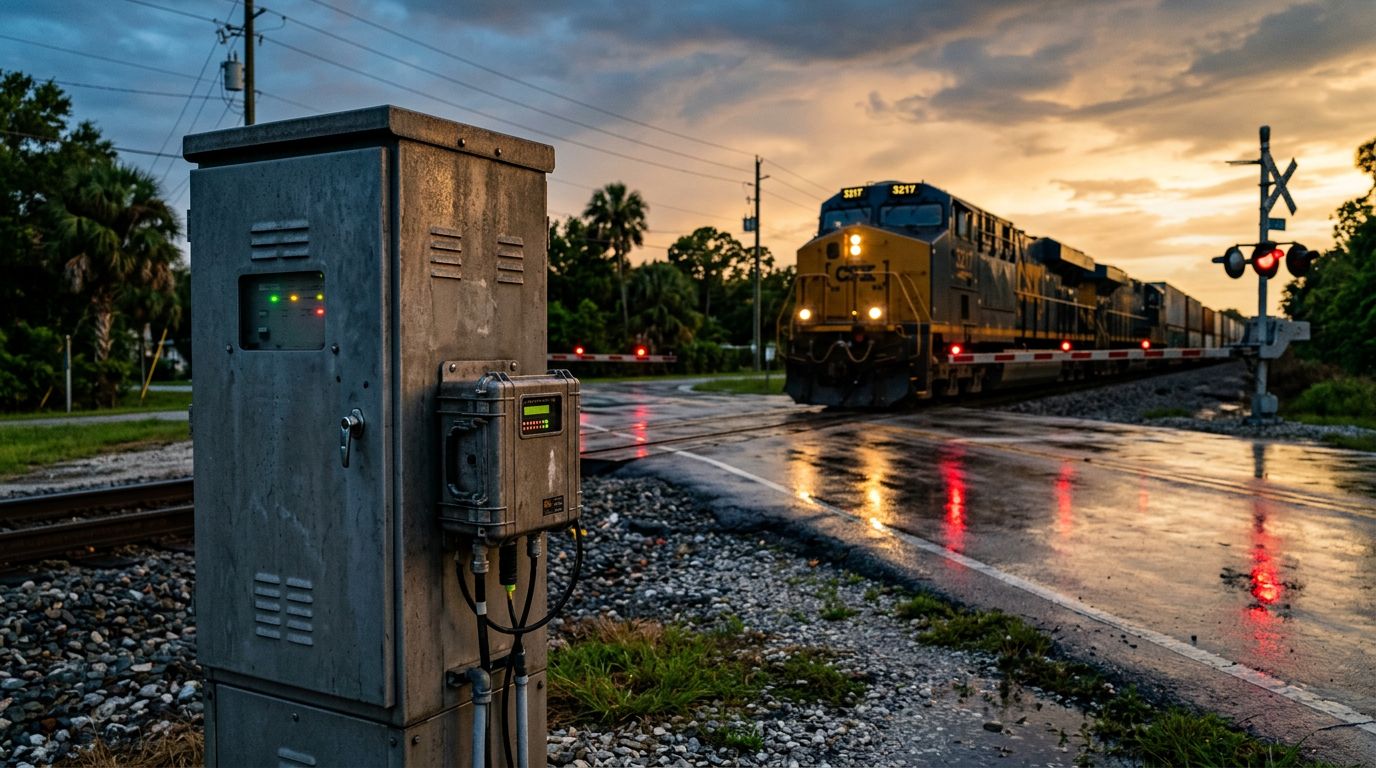
A railroad crossing crash can turn on a few seconds that no witness can remember perfectly. Signal logs, locomotive event data, and vehicle records may show what happened before anyone reached the tracks.
These records can help answer whether warning lights activated, when gates lowered, whether a train braked, and whether a system fault existed. They can also reveal missing evidence when a railroad or agency fails to preserve records after a serious collision.
Key Takeaways
- Florida crossing cases often depend on signal timing, gate position, train speed, and braking data.
- Crossing equipment may record system events, but it doesn’t always create a complete video-like history.
- Locomotive event recorders and vehicle electronic data recorders contain different information.
- An attorney may need to send preservation demands quickly because logs, video, and diagnostic files can be overwritten.
- Liability may involve a railroad, government agency, maintenance company, vehicle driver, or more than one party.
Why Signal Records Matter After a Florida Crossing Crash
Railroad crossing claims rarely depend on one piece of evidence. A police report may describe the scene, but it usually doesn’t answer every timing question. A witness may remember flashing lights, while a railroad employee may describe the system as operating normally. Signal data can test those accounts against recorded system activity.
The central issue is often timing. Did the warning lights activate before the vehicle entered the crossing? Did the gates reach the lowered position? Did the train approach at the expected speed? Did the system lose power, fail to detect the train, or produce an error?
A claim may involve several separate duties. A railroad may have failed to maintain equipment or provide adequate warning. A public agency may have failed to correct a dangerous roadway condition. A motorist may have crossed against an active signal. A trucking company may have assigned a route that required a commercial vehicle to use a crossing without enough clearance.
The records can help separate those possibilities.
For example, a crossing controller may show that the lights activated at 8:14:03 and the gate reached its lower position at 8:14:19. A locomotive recorder may show the train entered the crossing at 8:14:47. Investigators can compare those times with photographs, vehicle damage, traffic-camera footage, and witness statements.
The data may support a defense, a claim, or both. If the warning system activated long before the collision, a railroad may argue that the driver ignored a clear warning. If the records show delayed activation or a malfunction, they may support a claim against the railroad or another responsible party.
Florida drivers have a legal duty to stop when a railroad signal is active. The required distance is generally at least 15 feet and no more than 50 feet from the nearest rail. Florida’s official rail guidance provides additional information about crossing laws and safety requirements in Florida’s railroad crossing laws.
Those duties don’t eliminate the need to investigate the crossing itself. A driver may have faced blocked sight lines, confusing roadway markings, a malfunctioning gate, poor lighting, or an obstruction near the tracks. The full record matters.
People injured in these collisions may need Florida personal injury legal representation while the evidence is still available. Medical bills and insurance communications often begin immediately, but signal evidence may require formal requests, subpoenas, and technical review.
How Florida Railroad Crossing Signals Activate
Most active warning systems use track circuits to detect a train. Steel wheels and axles connect the rails electrically. That change in the circuit tells the crossing equipment that a train is approaching or occupying the crossing.
The system usually includes an approach circuit and an island circuit. The approach circuit covers a section of track before the roadway. The island circuit covers the crossing itself. When the train reaches the approach area, the system starts the warning sequence. When it occupies the island area, the warning remains active.
The sequence commonly includes:
- Flashing red lights begin.
- Bells sound.
- Gates start lowering.
- The gates remain down while the train occupies the crossing.
- The system resets after the train clears the island circuit.
The exact timing depends on the crossing design, track layout, train speed, roadway configuration, and equipment settings. Many systems are designed to provide at least 20 seconds of warning before the train reaches the crossing. Some use constant-warning technology that adjusts the activation point based on the train’s speed.
That detail matters in a crash claim. A slow train may trigger the system closer to the crossing than a fast train, while still providing the programmed warning period. A defective speed sensor, damaged track circuit, wiring problem, or incorrect system setting could alter that timing.
A signal system may monitor more than whether the lights are on. Modern equipment can track gate position, power supply status, flashing-light operation, battery condition, relay activity, and circuit faults. However, not every crossing stores every event indefinitely. Some older systems have limited recording ability. Others may depend on a connected traffic signal controller or a railroad maintenance computer.
The Federal Highway Administration discusses recording devices and connections between grade-crossing equipment and highway intersection signals in its guidance on crossing recording devices.
A signal log may show that a controller received an activation command. It may not prove that a driver could see the lights from the roadway. Physical visibility requires a separate review of vegetation, signs, buildings, curves, weather, glare, and the driver’s approach.
What Locomotive Event Data Can Reveal
A locomotive event recorder is different from a railroad crossing controller. The locomotive recorder gathers information about the train’s operation. Depending on the equipment and available data, it may contain speed, throttle position, brake applications, horn use, direction, and other operating events.
The recorder can help establish the train’s movement before impact. Investigators may compare that information with the crossing signal’s activation time and the train’s location. The comparison can show whether the train approached at a recorded speed, whether the engineer applied the brakes, and when the horn sounded.
A train’s event data may also address questions about stopping distance. A large freight train cannot stop immediately, even after emergency braking begins. The data can show whether the engineer had time to see the vehicle, sound the horn, reduce speed, or apply the brakes before the crash.
A recorder doesn’t answer every question by itself. It may not show what the engineer could see, whether the horn was audible outside the locomotive, or whether a roadway obstruction prevented the driver from seeing the train. Those questions require site measurements, photographs, video, witness accounts, and expert analysis.
Federal railroad safety materials address signal and train-control systems, including how railroad equipment and operating systems interact. Technical records may also exist in formats that require specialized software. A useful reference is the Federal Railroad Administration’s signal and train-control material.
The train’s video systems may provide another source of evidence. Some locomotives have forward-facing cameras or inward-facing cameras. A railroad may also hold dispatch recordings, radio transmissions, crew statements, inspection reports, and train consist information.
A lawyer investigating a claim should request the original files, not only screenshots or printed summaries. Metadata can show when a file was created, modified, exported, or reviewed. The original format may also preserve information that disappears in a written report.
Other Records That Can Strengthen a Crossing Claim
Signal and event data work best when investigators build a complete timeline. Several records may fit together like entries in a logbook.
| Record | Questions it may help answer |
|---|---|
| Crossing controller logs | When warnings activated, whether gates moved, and whether faults appeared |
| Locomotive event recorder | Train speed, throttle, braking, horn use, and operating events |
| Vehicle EDR | Vehicle speed, braking, acceleration, and restraint use before impact |
| Maintenance records | Whether inspections found recurring defects or delayed repairs |
| Dispatch and radio records | What crew members or railroad personnel knew before the crash |
| Video and photographs | Visibility, traffic movement, gate position, and physical conditions |
A passenger vehicle may contain an event data recorder, often called an EDR. This device can preserve limited information about the seconds before a collision. The exact data depends on the vehicle’s make, model, year, and restraint system. It may include speed, brake application, throttle position, seat-belt use, and airbag deployment.
Vehicle EDR information is not the same as crossing data. The vehicle may show that the brakes were applied, while the crossing controller shows whether the lights were flashing. Together, those records can create a more reliable sequence.
Maintenance documents may be just as important. A crossing file could include inspection sheets, work orders, repair invoices, trouble reports, battery tests, relay replacements, and records of previous false activations. Repeated complaints can support notice of a dangerous condition.
A serious investigation should also examine:
- 911 calls and emergency dispatch recordings
- Railroad inspection and defect reports
- Crossing design plans and warning-time calculations
- Traffic-signal preemption records
- Nearby business, home, dashcam, or agency video
- Weather, lighting, and road-condition records
- Photographs showing signs, pavement markings, vegetation, and sight distance
- Statements from the engineer, conductor, passengers, and eyewitnesses
The Florida Department of Transportation may have records involving a state-maintained road or crossing. A local government may hold traffic-control records, roadway plans, or public works reports. The railroad, a private contractor, or a crossing owner may hold the signal files.
A request should identify the exact crossing, date, approximate time, train, roadway, and direction of travel. Vague requests can delay the search or produce incomplete results.
Preserving Signal Logs and Event Recorder Files
Evidence can disappear before an injured person understands its value. Railroad video may follow a retention schedule. Signal controllers may overwrite older entries. Maintenance software may retain only a set number of events. Employees may download data for an internal investigation and then store the original device differently.
A preservation letter should go to every likely custodian. That may include the railroad, crossing owner, signal-maintenance contractor, city, county, FDOT, locomotive operator, vehicle owner, and commercial employer.
The letter should identify the collision and request preservation of:
- Original signal-controller data
- Diagnostic and error logs
- Gate, light, bell, relay, and power records
- Locomotive event recorder data
- Locomotive and crossing video
- Dispatch, radio, and emergency communications
- Maintenance, inspection, and repair records
- Employee statements and internal investigation materials
- Vehicle EDR data and onboard camera files
A preservation letter doesn’t automatically give the lawyer access to the evidence. It puts the recipient on notice that the information may be relevant to a potential claim. If a party later destroys evidence, the effect on the case may depend on when the duty to preserve arose, whether the destruction was intentional, and whether the missing material can be replaced.
The next step may involve a public-records request, an insurance claim, voluntary cooperation, a subpoena, or formal discovery after filing suit. Railroad companies may resist releasing operational records without a legal process. They may also claim that some material is protected as work product or part of a safety investigation. Those disputes require careful handling.
An attorney may seek an early court order for inspection or preservation when the crossing equipment could be repaired, replaced, or altered. A qualified engineer can also inspect the crossing, measure sight lines, photograph signal placement, and document the condition before it changes.
Time matters for a second reason. Florida injury claims have filing deadlines, and claims involving government entities can include separate notice rules. A person should not wait for a police report or insurance company decision before discussing the case with counsel.
Connecting the Data to Liability
Records don’t win a railroad crossing case merely because they exist. The evidence must connect a defective condition or unsafe conduct to the collision and the resulting injuries.
A signal-timing analysis may ask whether the warning began early enough for a reasonably attentive driver to stop. A maintenance review may ask whether the railroad knew about a recurring failure. An engineering analysis may examine whether the roadway geometry gave drivers a clear view of the approaching train.
Liability theories can vary:
- Railroad negligence may involve poor maintenance, defective warning equipment, unsafe train operation, or inadequate inspection.
- Government responsibility may involve roadway design, signs, pavement markings, traffic-signal coordination, or a known hazardous condition.
- Contractor negligence may involve improper installation, testing, repair, or inspection of crossing equipment.
- Driver negligence may involve ignoring active warnings, stopping on the tracks, speeding, distracted driving, or attempting to pass a lowered gate.
- Employer liability may apply when a commercial driver or railroad employee was acting within the scope of employment.
- Product liability may arise when a defective component contributed to a malfunction.
Florida’s railroad crossing statute addresses when drivers must stop and prohibits driving around, under, or through a closed or moving gate. The statutory language is available through the Florida Senate’s crossing-stop statute. A driver’s violation can affect the case, but investigators still need to determine whether a signal defect, obstruction, or other party also contributed.
Florida applies comparative-fault rules in many negligence cases. A person’s recovery may be reduced if a fact finder assigns part of the fault to that person. The evidence should therefore examine every contributing condition rather than assume that one traffic violation ends the inquiry.
An injured passenger may have a different claim from the driver. A passenger who had no control over the vehicle may have a strong argument that the driver’s conduct shouldn’t be treated the same way against the passenger. Each person’s injuries and legal position require separate review.
What an Attorney Does With the Records
Technical data can be difficult to interpret without context. A signal log may use coded entries, local time settings, hexadecimal values, or abbreviations that mean little to a person reading a printed report. A railroad may produce a summary instead of the underlying data.
An attorney may work with a railroad-signal engineer, accident-reconstruction specialist, human-factors professional, or vehicle-data analyst. The expert can compare system records with the physical scene and determine whether the timeline is technically consistent.
The review may include:
- Identifying each clock and checking whether the devices used the same time reference.
- Matching the signal activation event with the train’s position and speed.
- Comparing gate movement with photographs, witness statements, and vehicle impact marks.
- Checking whether power interruptions, relay faults, or diagnostic warnings occurred.
- Reviewing past maintenance records and similar failures at the crossing.
- Testing whether the driver had enough distance and time to see and respond to the warning.
Clock differences can create a serious problem. A crossing controller, locomotive recorder, 911 system, and nearby camera may all display slightly different times. An analyst must reconcile those differences before drawing conclusions.
The attorney should also examine what the railroad didn’t produce. Missing gate-position data, unexplained gaps, absent maintenance files, or a failure to preserve video may affect the reliability of the railroad’s account. The court, not the lawyer, decides what inference is appropriate from missing evidence.
People injured in a crossing collision can review Florida car accident attorneys when they need help dealing with insurers, evidence requests, and claims involving multiple parties.
Steps to Take After a Railroad Crossing Collision
Medical care comes first. After treatment, preserve information that may help establish the condition of the crossing and the effect of the crash.
Take these steps when possible:
- Report the collision and obtain the incident number. Ask how to request the crash report and related records.
- Photograph the crossing. Capture the approach, signal faces, gates, signs, track angles, roadway markings, vegetation, nearby buildings, and any obstruction.
- Record the exact location. Use the crossing’s identification number from the Emergency Notification Sign if it is safe to do so.
- Save vehicle and medical evidence. Keep photographs, repair estimates, medical records, bills, employment records, and insurance communications.
- Avoid giving a recorded statement before legal advice. An insurer may ask questions that focus only on driver conduct and ignore a possible signal failure.
- Contact counsel promptly. Early legal review allows time to send preservation demands and investigate government or railroad records.
If a vehicle becomes trapped on the tracks, everyone who can safely exit should leave the vehicle and move away from the tracks. Call 911 and use the emergency notification number posted at the crossing. Never remain inside a disabled vehicle while waiting for a train to approach.
A claim may include compensation for medical expenses, lost income, reduced earning ability, pain, disability, property damage, and other losses allowed by law. A fatal collision may support a wrongful-death claim for eligible survivors.
The right evidence depends on the injury, the vehicle, the crossing owner, and the facts surrounding the impact. A free case evaluation can help identify the likely custodians and filing deadlines before records disappear.
Conclusion
A railroad crossing crash may last seconds, but the records surrounding it can tell a much longer story. Signal logs, locomotive event data, vehicle EDR information, maintenance files, and scene evidence can show whether the warning system worked and how each person responded.
The strongest railroad crossing crash claims use those records together. Because electronic files and video may be overwritten, prompt preservation is often as important as the later legal filing. A careful timeline can turn conflicting memories into evidence that a court can evaluate.