
Florida Truck Underride Crash Claims: Guard Evidence
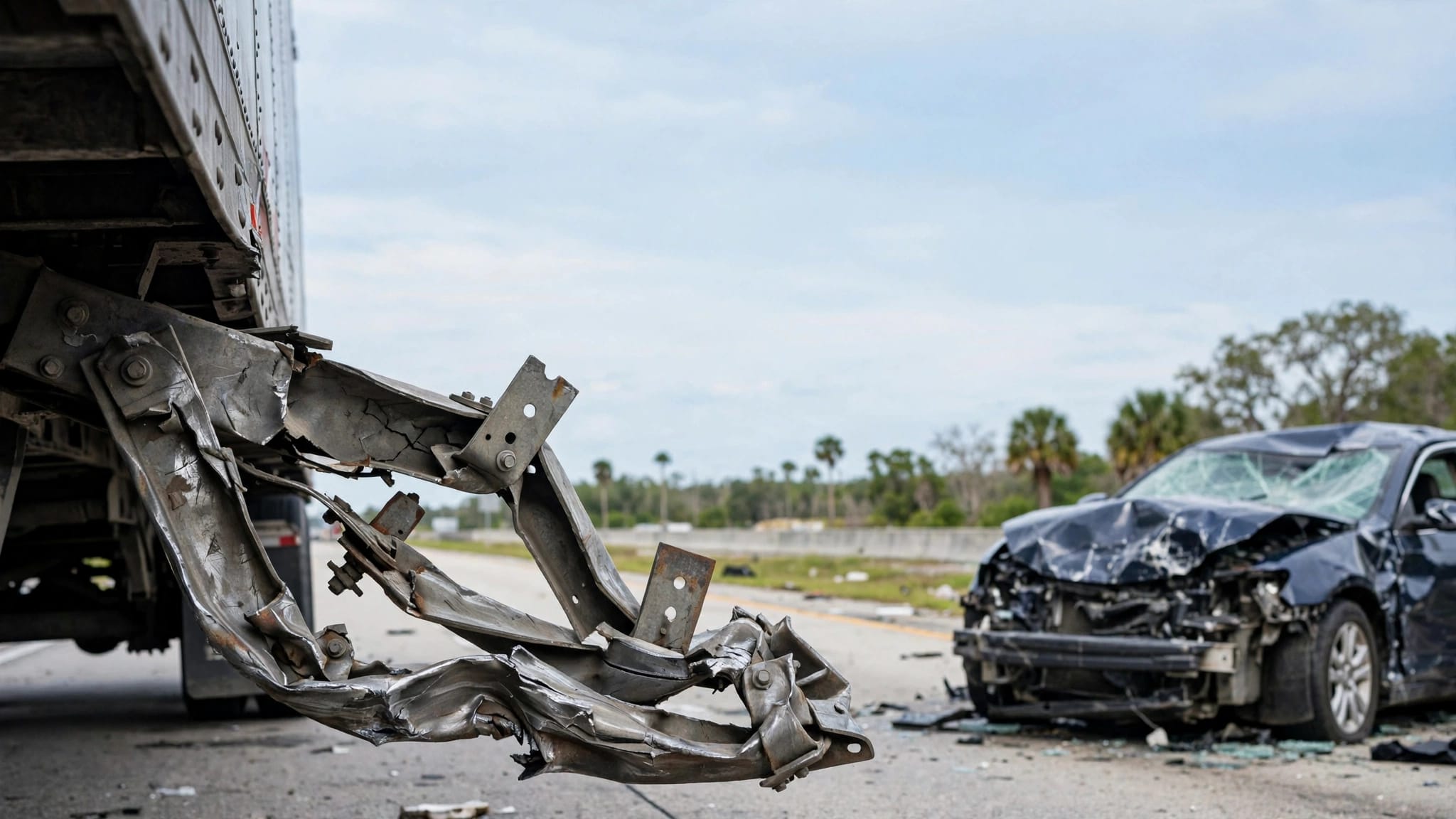
A trailer’s rear guard can become essential evidence after a car slides beneath a commercial truck. Florida truck underride crash claims often require proof of both how the collision happened and why the trailer caused severe injuries.
Your claim may depend on preserving the trailer, its damaged guard, and records held by the trucking company. Medical care comes first, but repairs and salvage can remove evidence before an investigation begins.
Start with the difference between evidence of the collision and evidence of failed protection.
Key Takeaways
- Preserve the trailer, guard attachments, damaged car, and original recordings before repairs or disposal change the evidence.
- Federal rear-guard requirements depend on the trailer’s weight, manufacture date, and vehicle classification.
- Guard damage must connect to the injuries claimed; damage alone doesn’t establish liability.
- Florida’s filing deadlines continue running during insurance negotiations, and shared fault can reduce or bar recovery.
Why Trailer Underride Claims Require Guard-Focused Evidence
Underride occurs when a smaller vehicle travels beneath a truck or trailer. The trailer can strike the windshield, roof, or passenger compartment above the car’s usual crash-protection structures.
Rear underride involves the trailer’s back end. Side underride involves its side, so rear-guard rules don’t resolve every underride case.
Identify the trailer and preserve its condition
The tractor and trailer may have different owners. Record both license plates, the carrier’s USDOT number, and the trailer’s identification information when safely available. These details help locate ownership, manufacturing, leasing, and maintenance records.
Photographs should show the entire trailer and close views of the guard, supports, bolts, welds, and attachment points. Also preserve detached pieces. A broken connection can tell investigators something different than a bent horizontal bar.
Separate the initial collision from injury severity
A driver may cause a collision through unsafe braking, an improper turn, or poor visibility. Meanwhile, a defective or poorly maintained guard may worsen the resulting injuries.
Those are separate questions. An investigation should establish the vehicles’ movements and determine whether guard performance affected passenger-compartment intrusion. This distinction matters when an insurer focuses only on which vehicle struck the other.
What Federal Rear-Impact-Guard Rules Require
The applicable regulation provides a starting point for evaluating the trailer. It doesn’t automatically establish that a particular guard caused an injury.
Which trailers fall under the rule
Under federal rear-impact-guard requirements, covered trailers and semitrailers manufactured on or after January 26, 1998, with a gross vehicle weight rating of at least 10,000 pounds must have rear impact guards.
Vehicle classifications and regulatory exceptions matter. Investigators need the actual trailer’s manufacturing information before selecting the governing standard.
FMVSS No. 223 addresses guard performance. FMVSS No. 224 addresses protection when the guard is installed. The applicable standards are those in effect when the trailer was manufactured.
Dimensions that deserve careful measurement
For covered trailer guards, the federal rule includes these physical requirements.
| Guard feature | Requirement |
|---|---|
| Horizontal member width | Extends within 4 inches of each side extremity without extending beyond it |
| Bottom edge | No more than 22 inches above the ground |
| Rear surface at 22 inches or higher | Within 12 inches of the trailer’s rear extremity |
| Vertical cross-sectional height | At least 3.94 inches |
Measurements should document the vehicle’s condition and the method used. Collision damage can change a guard’s height or position, so post-crash measurements alone may not establish its pre-crash condition.
What Guard Evidence Can and Cannot Establish
A useful guard investigation connects physical findings to the collision sequence. It should address competing explanations rather than treating every damaged component as proof of negligence.
Damage patterns can explain how protection failed
Investigators may examine fractured welds, torn mounting points, corrosion, loose fasteners, prior repairs, and deformation. Paint transfer and contact marks can help identify where the car first contacted the guard.
An accident reconstruction specialist or engineer can evaluate the impact angle, overlap, relative speed, and load path through the guard. The central question is whether the evidence supports a connection between guard performance and the injuries.
Photographs taken before towing may be especially useful because recovery equipment can alter damaged components.
Compliance and causation answer different questions
Regulatory compliance doesn’t resolve every negligence or product-defect question. Conversely, a violation doesn’t establish every element of an injury claim.
The claim still needs evidence connecting the condition to the harm. Medical imaging, passenger-compartment damage, and the impact sequence may help determine whether underride caused or worsened particular injuries.
The cause of the collision and the cause of severe injury can differ. A rear-impact investigation should address both.
Protect Evidence Before Repairs or Routine Overwriting
Once you’re safe, keep original photographs and recordings with their date information intact. Save complete dashcam files rather than social-media clips, which may lose quality or metadata.
Record the locations of both vehicles and identify who controls their release. Before repairs, dismantling, or disposal, an attorney can seek preservation and arrange appropriate inspections. Never crawl beneath a damaged trailer or enter an unsafe storage area to collect evidence.
A focused preservation request should identify the crash date, location, vehicles, and materials sought. Relevant records may include guard installation instructions, repair invoices, inspection reports, dispatch messages, dashcam footage, electronic logging device data, and available onboard data.
Driver-related evidence can also matter. Our guidance on truck driver qualification files explains how employment and qualification records fit into a broader investigation.
Preservation letters don’t automatically produce records or guarantee that everything remains available. Missing evidence also doesn’t automatically prove deliberate destruction. Preservation duties and possible remedies depend on notice, timing, control, and legal procedure.
Who May Be Responsible and What Compensation Covers
An underride case may involve more than the driver. However, each claim requires evidence of that party’s responsibility and a connection to the losses.
Investigate control over the trailer and guard
Potential defendants may include the motor carrier, trailer owner, maintenance contractor, guard manufacturer, or trailer manufacturer. Their roles depend on who operated, supplied, inspected, repaired, or designed the equipment.
Leasing documents and maintenance agreements can identify control. Repair records may show whether someone replaced a guard or altered its attachment system. Manufacturing records can distinguish an original component from a later replacement.
A company name painted on the trailer doesn’t establish every ownership or maintenance relationship.
Document injuries and financial losses
Recoverable losses may include medical expenses, lost earnings, supported future care needs, and other legally available damages. Keep treatment records, work restrictions, pay information, and receipts.
For a fatal crash, Florida’s wrongful-death law governs claims brought through the estate’s personal representative and the damages available to eligible survivors.
A settlement evaluation should account for the medical prognosis and available insurance. The severity of an underride crash alone doesn’t establish a settlement amount.
Florida Filing Periods and Comparative Fault
Truck investigations can take time, but evidence requests and insurance discussions don’t stop the lawsuit deadline.
The general filing period is two years
Many Florida negligence claims arising after March 24, 2023, have a two-year filing period. Florida Statutes section 95.11 also generally provides two years for wrongful-death actions, ordinarily measured from death.
The correct deadline depends on the claim, accrual date, defendants, and applicable exceptions. Older crashes, product-liability theories, and government defendants can require different analysis.
An open insurance file doesn’t preserve the right to sue. Neither do settlement talks or requests for additional medical records. Legal review should leave enough time to investigate and file when necessary.
Shared fault requires supporting evidence
Under Florida’s comparative-fault statute, assigned fault reduces damages proportionately in covered negligence actions. A person found more than 50% responsible for their own harm generally cannot recover. Exactly 50% doesn’t trigger that bar.
An insurer may allege speeding, distraction, inadequate following distance, or a late evasive maneuver. Those allegations need collision evidence. A rear impact doesn’t, by itself, answer every guard-related question.
Our explanation of Florida comparative negligence rules addresses how disputed fault can affect recovery. An adjuster’s proposed percentage isn’t a court finding.
Frequently Asked Questions
Can an underride claim succeed if I struck the trailer from behind?
A rear impact doesn’t automatically defeat every claim. The investigation must address your driving, the truck’s movements, visibility, and whether the guard contributed to your injuries.
Evidence may support different conclusions about collision responsibility and injury severity. However, comparative fault remains important, and a guard-related allegation still requires proof of a defect or negligent condition, causation, and damages. No outcome follows simply from labeling the crash an underride collision.
What should I bring to an attorney consultation?
Bring the crash report or report number, photographs, original video files, witness contacts, insurance correspondence, and available medical records. Include towing information and the locations of the car and trailer.
You don’t need a complete evidence file before seeking help. Early review is useful when vehicles face disposal or recordings may disappear. Also provide repair estimates, work restrictions, pay records, and any settlement offer or release you’ve received.
Protect the Guard Evidence and Your Claim
Florida truck underride crash claims depend on connecting the collision, trailer condition, and injuries through reliable evidence. Early preservation gives investigators a better opportunity to examine that connection before repairs or disposal change the vehicles.
We offer free consultations for Florida truck accident cases. Bring the records you have so our attorneys can assess the evidence, potential claims, and filing deadlines.